

Collagen Resides Inside Cells in Liquid Condensate-Like Form

A study by scientists at the Centre for Genomic Regulation (CRG) in Barcelona has found that collagen, the protein that builds skin, bones, tendons, and organs, exists inside cells as a liquid-like droplet rather than as the long, rigid rod-like structure we might find in textbooks.

The team used techniques including high-resolution live-cell imaging to generate what they say is the first direct observation of how the most abundant protein in the human body, which accounts for around a third of total protein mass, exists naturally inside living cells.

Collagen is built inside a cellular compartment called the endoplasmic reticulum (ER). The study specifically looked at a precursor form inside cells called procollagen 1 (PC1), which matures into type 1 collagen. Type 1 collagen is the most common type of collagen, consisting of around 90% of the body’s total collagen.

“Inside a cell, collagens are not rigid molecules as one had assumed,” said ICREA research professor Vivek Malhotra, PhD, senior author of the study at the CRG. They are, in fact, very pliable, taking a liquid condensate form much like oil in a drop of water.”

The liquid-like state may serve a protective function. Collagen’s job, once outside the cell, is to assemble into the rigid fibers that hold tissues together. The same process inside the cell would be catastrophic. “This is another way by which cells ensure that collagens probably never become fibrous inside the cell,” said Malhotra. “Because if it were to become fibrous, it would kill the cell.”

The new findings have implications for how the body exports its primary structural building block from production sites inside cells. The researchers suggest cells avoid using conventional receptors or vesicles, which is the route established by work carried out in the 1980s and 1990s and recognized with a Nobel prize in 2013.

Instead, they propose a “liquid extrusion” hypothesis, whereby collagen moves from its site of synthesis to the next compartment of the secretory pathway through capillary action. The new theory has important implications for wound healing, fibrosis, and cancer.

Malhotra and colleagues describe their study and results in a paper in the Journal of Cell Biology titled “Procollagen 1 assembles into phase-separated condensates in the endoplasmic reticulum.”

“Procollagen I (PC1) is assembled into a trimer within the lumen of the endoplasmic reticulum (ER),” the authors explained. Under a microscope, purified collagen looks like long, rigid rods of up to 400 nm in length, and this conformation is presumed to represent their assembled state in vivo, the team continued. “However, there is currently no direct experimental evidence demonstrating that PC1 adopts or is maintained in such a rigid, extended conformation within the ER lumen in vivo,” they wrote. Also, the vesicles that transport proteins out from their site of synthesis to the cell’s exterior are only 60 to 90 nanometers in diameter.

Since collagen’s structure was first described more than half a century ago, the field of cell biology has asked how such large molecules can be transported out of cells. The canonical picture of the protein describes collagen only after it has left cells and assembled into the fibers that hold tissues together. The newly reported findings suggest that inside the cell, collagen is not yet assembled into that rod structure.

Using high-resolution live-cell imaging of human hepatic stellate cells—the liver cells that produce collagen and drive scarring in liver fibrosis—the team showed that collagen inside the cell gathers into small droplets that merge, split, and exchange material with their surroundings. These are all signatures of a condensate, compartments of proteins that become so concentrated they disassociate from their surroundings, like droplets of oil in water.

Most of cell biology has focused on condensates in the nucleus and on stress granules in the cytosol, said first author Soumya Bhattacharyya, PhD, a postdoctoral researcher in Malhotra’s lab. “We’re just beginning to understand condensates inside the endoplasmic reticulum.”

The findings emerged from microscopy images taken by Bhattacharyya in May 2024. Bhattacharyya was using the liver cell system as a tool to study what happens when collagen production is increased in fibrotic cells. “I had no idea what it would lead to. But when we took the samples, what struck me were these bright spherical structures you can’t miss,” recalled Bhattacharyya.

The initial reaction in the laboratory to a finding that challenged cell biology dogma was sceptical. “I thought it must be an artefact,” said Malhotra. In the months that followed, the team had to settle whether the protein clumping they observed inside the endoplasmic reticulum was junk. Cells have an elaborate system for detecting badly folded proteins and either refolding them or marking them for destruction, centered on a chaperone called BiP.

If the collagen droplets were heaps of misfolded protein, the researchers would detect high levels of BiP. The droplets contained, instead, a mixture of helper proteins, including chaperones that specifically recognize properly folded collagen.
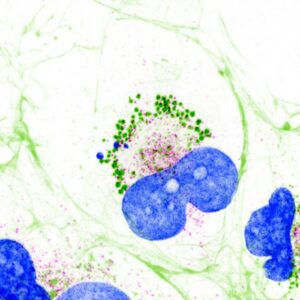
Human liver cells showing collagen droplets inside the cell (green clusters), held in place by TANGO1 (magenta), with extracellular collagen fibres visible as the surrounding network. Cell nuclei are stained blue. [Soumya Bhattacharyya / Centre for Genomic Regulation]
Human liver cells showing collagen droplets inside the cell (green clusters), held in place by TANGO1 (magenta), with extracellular collagen fibers visible as the surrounding network. Cell nuclei are stained blue. [Soumya Bhattacharyya/Centre for Genomic Regulation]

The study also clarifies the function of TANGO1, a protein discovered by the Malhotra lab roughly two decades ago and known to be required for collagen export. When the researchers depleted TANGO1, the collagen droplets still formed but were no longer positioned at the ER exit sites (ERES) where cargo leaves the compartment. Collagen secretion dropped accordingly. “PC1 condensates were still formed after TANGO1 knockdown, indicating that TANGO1 is not required for condensate formation per se,” the investigators stated. “However, TANGO1 depletion caused a marked reduction in the association of PC1 condensates with ERES …”

The discovery suggests TANGO1 acts as a mooring point that holds the droplet at the export site rather than as a conventional cargo receptor. The authors propose that collagen then leaves the cell by a physical process called wetting, in which the liquid droplet attaches to and flows through the exit site.

Malhotra offers two possible physical mechanisms for this transfer. “Imagine you have a rubber ball with a nozzle, filled with liquid. You squeeze it, you force the liquid to come out of this little orifice. Is that the mechanism? Or is the liquid rising by capillary forces, just like nutrients flow up against gravity in plants by capillary action?”

The proposed liquid extrusion mechanism remains a model, but the next experiments to obtain direct visualization of the export mechanism are already underway. The team also plans to develop a mouse model, in collaboration with external partners, to confirm the findings in living tissue. If the model is confirmed, the work has implications for several pathological conditions in which excess collagen secretion plays a central role, including liver, lung, and skin fibrosis, as well as for targeting the dense matrix that tumors use to shield themselves from chemotherapy and the immune system.

“One of the major problems in cancer is that the cells secrete so many collagens and other proteins out into the extracellular matrix that they hide in a shell made of these components and become chemo- and immuno-refractory, meaning they are not seen by the chemical therapeutics or by the immune system,” Malhotra said. “People are trying to find ways to break this tissue cement, and our study could help inform those strategies.”

The proposed collagen secretion model suggests that either degrading TANGO1 to prevent cargo from being captured at the exit site or dissolving the condensate itself to prevent the cargo from being properly organized in the first place could be new strategies worth exploring.

The post Collagen Resides Inside Cells in Liquid Condensate-Like Form appeared first on GEN – Genetic Engineering and Biotechnology News.

STAT+: FDA approves Sanofi diabetes drug for children with stage 3 diabetes

WASHINGTON — The Food and Drug Administration on Friday approved teplizumab, a type 1 diabetes drug developed by Sanofi, for children aged 8 and older with stage 3 diabetes. 

The drug was selected to go through a speedy review program launched last year by former FDA Commissioner Marty Makary, but the agency missed its goal date of April 21 to deliver a decision. 

STAT previously reported that Sanofi asked to pull its drug out of the program after former top drug regulator Tracy Beth Høeg disagreed with a staff decision to approve the drug. It’s rare for a center director, and particularly a political appointee like Høeg, to get involved in individual scientific reviews. 

Continue to STAT+ to read the full story…

WHO director-general is profoundly concerned after visit to Ebola outbreak area

The director-general of the World Health Organization is “really worried” about the Ebola outbreak in the Democratic Republic of the Congo and Uganda, already the third largest on record. 

In an exclusive interview with STAT, Tedros Adhanom Ghebreyesus described the conditions he saw after returning from his second visit to the affected area since the outbreak was declared on May 15, and designated a public health emergency of international concern on May 17. Already there have been at least 708 confirmed cases combined in the two countries, 141 of whom have died. 

Read the rest…

Long-Read DNA Test Could Replace 15 Existing Tests for Rare Diseases

Researchers in the Netherlands have developed a DNA test for rare diseases that can provide much more comprehensive results than standard diagnostics in a shorter amount of time. A study published today in the New England Journal of Medicine reports that this new approach could replace 15 other genetic tests with a single analysis while increasing the number of patients who successfully receive a diagnosis. 

Taken together, all rare diseases affect approximately 400 million people worldwide. Of the more than 7,000 rare diseases that have been identified so far, about 80% are caused by genetic mutations. Obtaining a diagnosis can be critical for people suspected of having a rare disease, offering them perspective for the future, better guidance and treatment, and less uncertainty. However, these patients often have to undergo multiple rounds of testing and wait years before receiving a definitive answer. 

The new test is based on long-read genome sequencing, a technology that can read significantly longer stretches of DNA before assembling them into a complete genome. While conventional genomic tests typically read fragments around 300 nucleotides long, long-read sequencing can analyze stretches of up to 20,000 nucleotides at a time. The longer reads make it easier to accurately assemble the full genome, providing a more complete picture of the patient’s genetic makeup. 

“Thanks to long reads, we obtain an even more complete view of DNA and can detect complex and hard-to-find abnormalities. We then link these to specific conditions,” says Alexander Hoischen, PhD, professor of genomic technologies at Radboud University Medical Center. “In this way, our knowledge grows and we can make more diagnoses.”

In addition, the test can detect epigenetic modifications in the genome that affect gene function without altering the underlying DNA sequence. Although these modifications can be responsible for some rare disorders, conventional testing methods are currently unable to detect them. 

“With current diagnostics, this requires additional specialized tests, but with long reads we capture these modifications as a bonus—two in one,” explains Christian Gilissen, PhD, professor of genome bioinformatics at Radboud University Medical Center.

Earlier this year, the technology was used as part of the National Undiagnosed Hackathon, where over 140 experts across the Netherlands came together to search for a diagnosis for 33 families. Long-read sequencing was used to map their DNA in detail, leading to five new confirmed diagnoses within two days as well as strong suspicion of a diagnosis for another eight families. 

As the number of rare disease diagnoses continues to rise, this new test could make the diagnostic process much faster and more efficient. Long-read sequencing could also help researchers identify and investigate the genetic drivers of rare conditions, many of which remain largely understudied. 

Based on these findings, Lisenka Vissers, PhD, professor of translational genomics at Radboud University Medical Center, calls for the technology to be adopted worldwide as the first choice diagnostic approach when testing patients suspected to have a rare genetic disorder. 

The post Long-Read DNA Test Could Replace 15 Existing Tests for Rare Diseases appeared first on Inside Precision Medicine.

Opinion: ‘I’m pretty much all in’: An interview with a woman starting medical residency at almost 73

Below is a lightly edited, AI-generated transcript of the “First Opinion Podcast” interview with Dawn Zuidgeest-Craft. Be sure to sign up for the weekly “First Opinion Podcast” on Apple Podcasts, Spotify, or wherever you get your podcasts. Get alerts about each new episode by signing up for the “First Opinion Podcast” newsletter. And don’t forget to sign up for the First Opinion newsletter, delivered every Sunday.

Torie Bosch: So I get a surprising number of ideas for First Opinion by watching TikTok. It’s for work, I swear. Recently, I came across a video of a woman proudly sharing the fact that her mother, age 72, had just completed medical school and matched into residency. I had to talk to the septuagenarian to find out more about going to medical school at an age when most people have already retired. And much to my delight, she agreed.

Read the rest…

<![CDATA[Alixorexton boosts wakefulness in type 1 narcolepsy, shows cognitive and fatigue gains, and hints at ADHD and neurodegenerative uses.]]>
<![CDATA[Let’s take a look at the next generation of pharmacotherapies for mood and anxiety disorders. ]]>
<![CDATA[Experts unpack why most psychiatric care relies on off‑label meds, how neuroscience guides safe polypharmacy, and what could reshape FDA approvals.]]>
<![CDATA[Once-nightly regular-release lithium cuts kidney risk, maintains bipolar control, improves adherence, and guides safer serum levels.]]>

Using a Virtual Reality CAVE–Based Mindfulness Intervention to Promote Mental Well-Being in Adolescents With Anxiety Symptoms: Pre-Post Mixed Methods Pilot Study

Background: Adolescent anxiety is a growing public health concern associated with significant social and emotional impairment. Mindfulness-based interventions (MBIs) have shown promise in reducing anxiety and improving well-being; however, engagement remains challenging. Virtual reality (VR)–based delivery may enhance immersion and attention, potentially addressing barriers of traditional mindfulness formats. Evidence on VR-based mindfulness interventions for adolescents, particularly in Hong Kong, remains limited. Objective: This study aimed to evaluate the feasibility and acceptability of a VR-MBI delivered via a CAVE, an enclosed VR environment with three projected walls displaying immersive natural scenes and ambient sounds, for adolescents with mild-to-moderate anxiety symptoms in Hong Kong. Secondary aims were to explore preliminary effects on psychological outcomes and physiological stress regulation and to identify facilitators and barriers to engagement. Methods: A mixed methods, single-group pre-post study was conducted with adolescents experiencing mild-to-moderate anxiety symptoms, recruited from secondary schools and youth service organizations in Hong Kong. Participants completed an 8-week group-based VR-MBI. Feasibility and acceptability were assessed using recruitment, attendance, retention, homework practice frequency, dropouts, and adverse events. Psychological outcomes were measured using the Depression Anxiety Stress Scale–21 and the Mindful Attention Awareness Scale. Heart rate variability indices, including the standard deviation of normal-to-normal intervals and root-mean-square of successive differences, were collected at baseline and postintervention using a wearable device. Focus group interviews explored participants’ experiences. Paired-sample tests and Wilcoxon signed rank tests examined pre-post changes, and qualitative data were analyzed using thematic analysis, with findings integrated through triangulation. Results: A total of 42 participants (mean age 14.88, SD 1.90 years; 20/42, 47.6% female; 22/42, 52.4% male) enrolled and completed both assessments. Attendance was high, with 73.8% (31/42) of participants attending at least 80% (8/10) sessions, and participants engaged in regular homework practice. No dropouts or adverse events were reported. No significant pre-post changes were observed in self-reported distress, anxiety, depression, stress, or trait mindfulness (all >.05). However, significant improvements were observed in both heart rate variability indices, standard deviation of normal-to-normal intervals (mean difference 17.6 ms, 95% CI −33.88 to −1.32; =.04; Cohen =0.38) and root-mean-square of successive differences (mean difference 20.20 ms, 95% CI −38.76 to −1.65; =.03; Cohen =0.39), which may suggest preliminary enhancements in physiological stress regulation. Qualitative findings suggested perceived benefits in emotional regulation, stress reduction, focus, and sleep, with the immersive environment and group-based format identified as key facilitators. Conclusions: The CAVE-based VR-MBI was feasible and acceptable for adolescents with mild-to-moderate anxiety symptoms in Hong Kong. Despite no significant changes in self-reported outcomes, physiological improvements and positive qualitative feedback suggest early benefits not captured by self-report measures. These findings support further investigation of using controlled designs and longer follow-up periods.