This tool could show how consciousness works

How does the physical matter in our brains translate into thoughts, sensations, and emotions? It’s hard to explore that question without neurosurgery. But in a recent paper, MIT philosopher Matthias Michel, Lincoln Lab researcher Daniel Freeman, and colleagues outline a strategy for doing so with an emerging tool called transcranial focused ultrasound.

This noninvasive technology reaches deeper into the brain, with greater resolution, than techniques such as EEG and MRI. It works by sending acoustic waves through the skull to focus on an area of a few millimeters, allowing specific brain structures to be stimulated so the effects can be studied.

The researchers lay out an experimental approach that would use the tool to help test two competing conceptions of consciousness. The “cognitivist” concept holds that brain activity generating conscious experience must involve higher-level processes such as reasoning or self-reflection, likely using the frontal cortex. The “non-­cognitivist” idea is that specific patterns of neural activity—more localized in subcortical structures or at the back of the cortex—give rise to subjective experiences directly.

“This is a tool that’s not just useful for medicine, or even basic science, but could also help address the hard problem of consciousness,” Freeman says. “It can probe where in the brain are the neural circuits that generate a sense of pain, a sense of vision, or even something as complex as human thought.” 

A natural protein may protect the GI tract from infection

Embedded in the body’s mucosal surfaces, proteins called lectins bind to sugars found on cell surfaces. A team led by MIT chemistry professor Laura Kiessling has found that one such protein, intelectin-2, both helps fortify the mucosal barrier and offers broad-spectrum protection against harmful bacteria found in the GI tract. 

Intelectin-2 binds to a sugar molecule called galactose that is found on bacterial membranes, the team found, trapping the bacteria and hindering their growth; the trapped microbes eventually disintegrate, suggesting that the protein is able to kill them by disrupting their cell membranes. It also helps strengthen the intestine’s protective lining by binding to the galactose in the mucins that make up mucus.

“What’s remarkable is that intelectin-2 operates in two complementary ways. It helps stabilize the mucus layer, and if that barrier is compromised, it can directly neutralize or restrain bacteria that begin to escape,” says Kiessling, who conducted the study with colleagues including Amanda Dugan, a former MIT postdoc and research scientist, and Deepsing Syangtan, PhD ’24.

Because intelectin-2 can neutralize or eliminate pathogens such as Staphylococcus aureus and Klebsiella pneumoniae, which are often difficult to treat with antibiotics, it could someday be adapted as an antimicrobial agent, the researchers say. Restoring desirable levels of intelectin-2 could also help people with disorders such as inflammatory bowel disease, who may have either too little of it (potentially weakening the mucus barrier) or too much (killing off beneficial gut bacteria).

“Harnessing human lectins as tools to combat antimicrobial resistance opens up a fundamentally new strategy that draws on our own innate immune defenses,” Kiessling says. “Taking advantage of proteins that the body already uses to protect itself against pathogens is compelling and a direction that we are pursuing.” 

The new word in home construction could be “plastics”

Single-use plastics are a persistent source of environmental pollution, and the need to house a growing global population puts increasing pressure on resources such as timber. MIT engineers have an idea that could make a dent in both problems at once.

In a recent study, a team led by mechanical engineering professor David Hardt, SM ’74, PhD ’79, and lecturer and research scientist AJ Perez ’13, MEng ’14, PhD ’23, laid out a plan for using recycled plastic to 3D-print construction-grade beams, trusses, and other structures that could one day offer lighter, more sustainable alternatives to traditional wood-based framing. Although some companies are working on using large-scale additive manufacturing to create walls, they’re mainly using concrete or clay, whose production typically has a large negative environmental impact. These engineers are among the first to explore printing structural framing elements—and to do so using recycled plastic.

The design they came up with is similar in shape to the traditional wooden trusses that support flooring, with beams that connect in a pattern resembling a ladder with diagonal rungs. To test it, they obtained pellets made of recycled PET polymers and glass fibers from an aerospace materials company and fed them into a room-size 3D printer as “ink.” When they printed four long trusses with this material and configured them into a conventional plywood-topped floor frame, the result had a load-bearing capacity of over 4,000 pounds, far exceeding key building standards set by the US Department of Housing and Urban Development.

The plastic-printed trusses weigh about 13 pounds each, light enough to transport without a flatbed truck. An industrial printer can crank one out in under 13 minutes. Crucially, the researchers are developing the process to work with “dirty” plastic that hasn’t been cleaned or preprocessed. In addition to floor trusses, they are working on printing other elements and combining them into a full frame for a modest-size house.

“We’ve estimated that the world needs about 1 billion new homes by 2050. If we try to make that many homes using wood, we would need to clear-cut the equivalent of the Amazon rainforest three times over,” says Perez. “The key here is: We recycle dirty plastic into building products for homes that are lighter, more durable, and sustainable.”

The researchers envision that one day, trash like used bottles and food containers could be sent directly into a shredder, turned into pellets, and fed into a large-scale additive manufacturing machine to become structural composite construction components. At the construction site, the elements could be quickly fitted into a lightweight yet sturdy home frame.

“The idea is to bring shipping containers close to where you know you’ll have a lot of plastic, like next to a football stadium,” Perez says. “Then you could use off-the-shelf shredding technology and feed that dirty shredded plastic into a large-scale additive manufacturing system, which could exist in micro-factories, just like bottling centers, around the world. You could print the parts for entire buildings that would be light enough to transport on a moped or pickup truck to where homes are most needed.” 

STAT+: Key GOP senators push back on Trump’s plan to cut NIH, reorganize HHS

WASHINGTON — Both Democratic and Republican senators who oversee federal spending seemed skeptical of proposed cuts to health research and public health in the White House’s budget, potentially teeing up a congressional package that ignores many of the administration’s most dramatic proposals for a second year. 

During a Senate appropriations health subcommittee hearing Tuesday, lawmakers questioned health secretary Robert F. Kennedy Jr. on how his department could tackle chronic disease, smoking cessation, and cancer research with a proposed 2027 fiscal budget that would cut the department by 12%. 

The request, which is broadly similar to what was proposed last year, includes deep cuts to the National Institutes of Health, the elimination of a health research agency, and the creation of a new agency devoted to chronic diseases called the Administration for a Healthy America.

Continue to STAT+ to read the full story…

Alzheimer’s Linked to Cancer Mutations in Brain Immune Cells

As the body ages, cells naturally accumulate dozens of genetic mutations each year. New research reported by researchers at Boston Children’s Hospital suggests that the brain’s resident immune cells, microglia, amass mutations in specific cancer-driving genes, yet they don’t manifest as cancer. Instead, these mutations may help drive Alzheimer’s disease.

The research team, led by Christopher Walsh, MD, PhD, chief of the Division of Genetics and Genomics at Boston Children’s and an investigator of the Howard Hughes Medical Institute, and collaborators Alice Eunjung Lee, PhD, and August Yue Huang, PhD, also in the Division of Genetics and Genomics—who are all professors at Harvard Medical School and associate members of the Broad Institute of MIT and Harvard—say their study findings may provide insights into new Alzheimer’s disease diagnostics and treatments.

“We find that to some extent, Alzheimer’s disease is a little like cancer—driven by the same mutations that drive blood cancers like lymphoma and leukemia,” said Walsh. “This is helpful because we have a lot of drugs to fight cancer and some of them might be useful therapeutically for Alzheimer’s disease.”

The researchers reported on their work in Cell, in a paper titled “Somatic cancer variants enriched in Alzheimer’s disease microglia-like cells drive inflammatory and proliferative states.”

Microglia function as the brain’s resident immune cells, acting as garbage collectors, eating debris and infected or dying cells. “The importance of microglia in Alzheimer’s disease (AD) pathogenesis has been demonstrated by large-scale genetic association studies, which have identified AD risk variants in a growing list of microglia-related genes,” the authors wrote. “Once abnormally reactive in AD, microglia can promote synaptic and neuronal loss while exacerbating tau proteinopathy.”

Unlike the rest of the immune system cells that circulate in the blood throughout the body, microglia don’t cross the blood brain barrier—or so experts thought. For their newly reported study the research team sequenced 149 cancer-driving genes from tissue samples in 190 brains donated from people with Alzheimer’s disease compared to 121 healthy brains. The Alzheimer’s samples had more single DNA letter changes than the healthy tissue with the most changes found repeatedly in the same five cancer driver genes, meaning the microglia were amassing mutations in specific genes. “Deep (>1,000×) panel sequencing of 311 brain samples revealed enrichment of somatic single-nucleotide variants (sSNVs) in cancer driver genes in AD brains, especially in genes associated with clonal hematopoiesis (CH),” the team stated.

The cancer gene mutations the researchers discovered in the microglia are commonly found in blood cancers. Because of this, the team tested blood samples from people with Alzheimer’s disease for these same mutations. The team didn’t expect the blood to have these mutations. However, Walsh’s team found the blood cells of the same Alzheimer’s patients carried the same cancer mutations too.

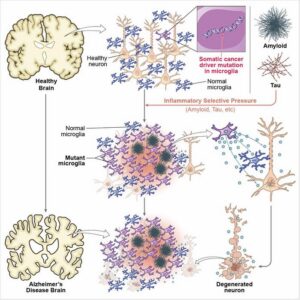
Microglia-like immune cells with cancer mutations (purple) emerge in the brain. Separately, clumps of proteins, like Tau or amyloid, accumulate in the brain, making the environment hostile. Those microglia cells with mutations get selected for survival and proliferation, creating an inflammatory environment that makes innocent bystander neurons die, contributing to Alzheimer’s disease. [Christopher Walsh and colleagues at Boston Children's Hospital]
Microglia-like immune cells with cancer mutations (purple) emerge in the brain. Separately, clumps of proteins, like tau or amyloid, accumulate in the brain, making the environment hostile. Those microglia cells with mutations get selected for survival and proliferation, creating an inflammatory environment that makes innocent bystander neurons die, contributing to Alzheimer’s disease. [Christopher Walsh and colleagues at Boston Children’s Hospital]

“These sSNVs were associated with clonal expansion and carried by both microglia-like brain macrophages (MLBMs) in multiple brain regions as well as paired blood, suggesting a likely hematopoietic origin,” the investigators stated. “It was actually a really unexpected finding that suggests a totally new mechanism for Alzheimer’s disease pathogenesis,” said Huang. “The findings mean that the blood’s immune cells with cancer mutations are likely getting into the brain and contributing to disease.”

The researchers theorize that the blood-brain barrier weakens, either by age or injury, allowing the blood’s immune cells to cross into the brain. These new arrivals then convert into microglia-like cells. Separately, clumps of proteins accumulate in the brain, triggering microglia to proliferate and respond. The cells most likely to dominate are those with a selective advantage, such as the microglia-like cells with the cancer mutations. However, these mutant microglia also make the environment more inflammatory and hostile than that of the healthy microglia, causing innocent bystander neurons to die off, which leads to Alzheimer’s disease. “These findings suggest that clonal somatic driver variants in MLBMs are enriched in AD, potentially promoting neuroinflammation and neurodegeneration,” the researchers noted. “Potential roles of somatic cancer driver variants in AD pathogenesis open up a whole new range of therapeutic avenues in AD, complementary to approaches emphasizing amyloid and tau.”

Lee added, “Because it’s hard to access brain tissue in a living patient, genetic screens using blood samples could be developed to test whether a person carries these mutations, and has an increased risk of developing Alzheimer’s disease.” Lee and Huang performed a follow-up study, now posted as a preprint on bioRxiv. Here, they demonstrated that cancer driver mutations observed in patient blood samples increased risk of Alzheimer’s disease independently of a well-established genetic risk factor, APOE4.

The post Alzheimer’s Linked to Cancer Mutations in Brain Immune Cells appeared first on GEN – Genetic Engineering and Biotechnology News.

AACR 2026: Lung Cancer Immunotherapy Response Predicted by Pathomics AI Model

SAN DIEGO – A new AI model applied to routine pathology slides accurately predicts outcomes and response to immunotherapy in patients with metastatic non-small cell lung cancer (NSCLC). The study was study presented at the American Association for Cancer Research (AACR) Annual Meeting. 

“Immunotherapy has transformed cancer treatment, but only a subset of patients benefit from it, and predicting who will respond remains challenging,” said Rukhmini Bandyopadhyay, PhD, a postdoctoral fellow at The University of Texas (UT) MD Anderson Cancer Center.  

“This study represents, to our knowledge, the first deep learning-based pathomics biomarker rigorously validated across international real-world cohorts and a Phase III randomized clinical trial, directly addressing one of the most urgent unmet needs in precision oncology: reliable patient selection and stratification for immunotherapy,” he continued. 

Pathomics applies computational and machine learning methods for high-throughput analysis of digital pathology images to extract large-scale data related to cell and tissue architecture linked to disease outcomes. 

Bandyopadhyay and colleagues developed a deep learning survival prediction model called Pathology-driven Immunotherapy Optimization (Path-IO), which can study patterns across tissue to identify patients most likely to benefit from immunotherapy. The model then combines imaging and clinical data to estimate whether a patient may have a higher or lower risk of poor outcomes from immunotherapy. 

The researchers tested the platform in a study that included 797 immune checkpoint inhibitor-treated NSCLC patients from UT MD Anderson, with external validation in 280 additional patients from Mayo Clinic, Gustave Roussy, and the Phase III Lung-MAP S1400I trial in which immunotherapy-naïve patients with lung squamous cell carcinoma, a subtype of NSCLC, were treated with immune checkpoint inhibitors. 

The model reliably stratified patients into higher and lower risk groups. In the UT MD Anderson cohort, patients in the high‑risk group had more than double the risk of death or disease progression compared with patients in the low‑risk group. 

Model performance was evaluated using the concordance index (C-index), which measures how well each biomarker distinguishes between patients with different outcomes. Notably, Path-IO consistently outperformed PD-L1, the U.S. Food and Drug Administration-validated standard-of-care biomarker for guiding immunotherapy use in NSCLC patients, across both discovery and test cohorts.  

PD-L1 alone showed limited prognostic performance, with C-indices of 0.58 for overall survival (OS) and 0.57 for progression-free survival (PFS) in the discovery cohort, declining to 0.50 and 0.51, respectively, in the test cohort. In contrast, Path-IO demonstrated stronger discriminative ability, achieving C-indices of 0.69 for OS and 0.65 for PFS in the discovery cohort and 0.63 for OS and 0.58 for PFS in the test cohort.  

Combining pathology-based predictions with radiomics and clinical data further improved the model’s performance, with the C-index increasing from 0.58 to 0.70 for PFS and from 0.63 to 0.75 for OS.  

Given that the approach was designed to be applied to routine pathology slides, the platform can be incorporated into existing clinical workflows without significant expense compared to other emerging data-based technologies. 

As the study is retrospective, further investigation is needed to go beyond the identification of patients who would benefit from immunotherapy and help predict what type of immunotherapy they can benefit from. Future directions include prospective validation and the integration of paired, more comprehensive molecular profiling to enhance predictive performance.

The post AACR 2026: Lung Cancer Immunotherapy Response Predicted by Pathomics AI Model appeared first on GEN – Genetic Engineering and Biotechnology News.

Cosmo Pharma Eyes 2027 NDA for Baldness Candidate After Positive Phase III 12-Month Data

Cosmo Pharmaceuticals says it plans to file for FDA approval of its androgenetic alopecia (AGA) candidate clascoterone 5% topical solution early next year, after the androgen receptor inhibitor generated 12-month Phase III data showing statistically significant continued hair growth as well as positive safety for chronic use.

Data from Cosmo’s Phase III program for clascoterone confirmed the drug’s long-term safety profile was comparable to vehicle, supporting suitability for chronic use in a lifelong condition. Clascoterone also showed a novel mechanism designed to target the underlying biology of hair loss and continued efficacy with ongoing use, Cosmo said.

A total of 1,465 patients were enrolled in the Phase III program, the largest for any topical treatment candidate for male AGA, according to Cosmo. The program consists of the SCALP 1 (NCT05910450) and SCALP 2 (NCT05914805) trials, which evaluated patients across 51 study centers in the United States and Europe.

Patients who remained on continuous clascoterone treatment for the full 12 months achieved a statistically significant 239% improvement in Target Area Hair Count (TAHC) compared with patients who received clascoterone for six months and were then switched to vehicle from month 7 to month 12, according to Cosmo.

That’s down slightly from the 252% improvement in TAHC shown for clascoterone versus “vehicle” or placebo in Cosmo’s six-month results, released in December. Cosmo Pharma CEO Giovanni Di Napoli told GEN that the 6- and 12-month results were not directly comparable due to differences in Part 1 and Part 2 of the Phase III placebo-controlled program and the corresponding patient groups being compared.

Part 1 is a double-blind study assessing if clascoterone was effective and safe compared to placebo when applied twice daily for up to six months. Part 2 is a single blind study that measured clascoterone’s long-term safety and efficacy versus placebo for an additional six months in patients who had responded to the study drug in Part 1. During Part 2, participants were re-randomized to receive either clascoterone 5% solution or vehicle solution.

SCALP 1 enrolled 702 patients in the United States, while SCALP 2 enrolled 763 patients in the Unites States as well as Germany and Poland.

Primary outcome measures

Change in vellus TAHC (hair of up to 30 micrometers in diameter) from baseline was the trials’ primary outcome measure, paired with a patient-reported outcome assessing participants’ perception of hair growth improvement.

Additional assessments of the trials included investigator-reviewed global scalp photography and secondary endpoints that included changes in non-vellus TAHC (thicker, pigmented hair >30-40 micrometers in diameter), and changes in subject’s assessment of satisfaction score.

Patients treated with clascoterone for 12 months reported a statistically significant +24.5% relative improvement in treatment satisfaction versus vehicle groups, according to Cosmo. The clascoterone users also reported positive ease of use and product acceptability at month 12—results that according to the company support positive real-world usability and long-term adherence potential for the drug.

Cosmo said it plans to submit its full Phase III dataset for publication in a leading peer-reviewed medical journal and present its findings at future major dermatology congresses.

‘Defining moment’

“These 12-month Phase III results mark a defining moment for clascoterone and for the treatment of male hair loss,” Di Napoli stated. “We are now seeing the combination that matters most: positive long-term safety, statistically significant continued hair growth through one year, and clear evidence that ongoing treatment drives sustained benefit.”

Investors responded to the positive 12-month data by sending Cosmo shares traded on the SIX Swiss Exchange rising 6% on the day of the announcement, from CHF95.50 ($122.69) to CHF101.40 ($130.27) on April 15. Since then shares have fluctuated in the high CHF 90 range, closing Monday at CHF 98.50 ($126.55).

Di Napoli said clascoterone has the potential to emerge as a major new therapeutic option and a highly valuable growth platform for Cosmo by tackling the most common cause of hair loss in men. Androgenetic alopecia, also called male pattern hair loss, affects approximately 40% of men worldwide—including 39% of males in the United States (65 million men).

“We are moving with urgency toward regulatory submissions and commercialization discussions,” Di Napoli added.

Cosmo’s results “likely now enable more advanced partnership discussions, in our view, with detailed presentation of results the next step to fully de-risk the asset,” Benjamin Jackson, equity analyst with Jefferies, wrote April 15 in a research note.

Jackson predicted clascoterone could generate $4 billion in peak-year worldwide sales.

“Our $4 billion WW potential peak sales require just 4% penetration of treated and 6% penetration of untreated men at peak, assuming a capable commercial partner is successfully found,” Jackson added.

Cosmo said it is preparing to submit not only an NDA for clascoterone in the U.S., but a marketing authorization application to the European Medicines Agency.

Clascoterone’s 1% formulation is already FDA-approved and marketed as Winlevi® for topical treatment of acne vulgaris in patients ages 12 and older.

The post Cosmo Pharma Eyes 2027 NDA for Baldness Candidate After Positive Phase III 12-Month Data appeared first on GEN – Genetic Engineering and Biotechnology News.


GABA-Based Target for Alzheimer’s Therapy Identified

Researchers at the University of Galway have found evidence that targeting inhibitory signaling in the brain may help address cognitive dysfunction in Alzheimer’s disease (AD), a finding that runs counter to current therapeutic approaches that focus on influencing excitatory pathways. The research, published in Neuropharmacology, identifies how modulation of gamma-aminobutyric acid (GABA) signaling can restore disrupted neural balance and improve memory-related function in AD disease models.

“Given the ever-increasing burden of Alzheimer’s disease, the urgent need for the identification of novel targets for the development of disease-modifying therapy is clear,” said senior author Andrea Kwakowsky, PhD, associate professor of pharmacology and lead researcher at the School of Medicine, University of Galway.

Alzheimer’s disease is characterized by progressive cognitive impairment and is associated with hallmark pathological features including β-amyloid (Aβ) plaques and neurofibrillary tangles. In addition to these, disruption of the brain’s excitatory/inhibitory (E/I) balance has gained traction as a central mechanism contributing to memory loss. Today, most approved therapies for AD target excitatory neurotransmitter systems such as cholinergic and glutamatergic pathways, but “the symptomatic relief provided by these therapies is only marginal, and the progression or underlying causes of the disease are not addressed,” the researchers noted.

For their work, the University of Galway team instead focused on the inhibitory side of this balance, specifically the role of gamma-aminobutyric acid (GABA), the brain’s main inhibitory neurotransmitter. GABA regulates neuronal activity and is essential for maintaining stable network function and memory processes. In AD, however, E/I balance becomes dysregulated with increased extracellular GABA—triggered in part by Aβ—leading to overactivation of certain GABA receptors, particularly α5-containing GABA type A receptors (α5-GABA ARs), which are abundant in the hippocampus. The result is a dampening of neuronal signaling and which impairs learning and memory.

“Our research is significant in that it demonstrates that if we block this GABA receptor activity in nerve cells we can reverse Alzheimer-like effects caused by amyloid beta and improve cognitive performance,” Kwakowsky said.

To test whether blocking a5-GGABA A could help restore E/I balance, the team investigated α5IA, an α5-GABA AR-selective inverse agonist. α5IA works by reducing the activity of α5-GABA ARs, which decreases excess tonic inhibition. The data showed that in experimental models of AD, the compound improved long-term potentiation (LTP), a mechanism of synaptic plasticity and memory, reduced abnormal inhibitory conductance, and restored spatial memory performance.

Mechanistically, α5IA appears to act by restoring physiological levels of inhibition in the hippocampus which is critical for memory formation. By reducing excessive tonic inhibition, it rebalances E/I signaling, which allows neuronal circuits to function more effectively. “The data presented here suggest that in both ex vivo and in vivo AD models, α5IA improves cognitive function by restoring CA1 tonic inhibition, thereby re-establishing E/I balance and ameliorating the abnormal hippocampal network activity induced by Aβ1-42,” the researchers wrote.

This new study is the latest to indicate that targeting inhibitory neurotransmission could be an effective treatment approach for AD. Earlier research has shown that α5-GABA AR modulation enhances memory and reduces inhibitory signaling in both animal models and humans. But most of these studies have not directly examined the effect of α5IA in chronic neurodegenerative disease models.

The researchers noted there are some limitations to their work, pointing out that while α5IA improved cognitive outcomes, it did not reverse neuronal loss in vivo, suggesting that its effects may be primarily functional rather than neuroprotective at later stages of AD. Also, variability in drug exposure and timing may influence outcomes. Finally long-term use of α5IA has also been associated with safety concerns at high doses, including renal toxicity, so further research is needed to determine toxicity and dosing regimens and limits.

Nonetheless, the implications of this research indicate there is potential to develop new AD therapies that directly target network dysfunction rather than focusing solely on amyloid accumulation or excitatory signaling. By restoring E/I balance, this approach shows the potential to improve cognitive function even when AD pathology has taken root. The findings could also benefit diagnostic methods, as biomarkers of inhibitory dysfunction or altered GABA signaling could help identify patients who would benefit an approach that rebalances E/I signaling.

The post GABA-Based Target for Alzheimer’s Therapy Identified appeared first on Inside Precision Medicine.

Sepsis Fast Diagnostics Could Save Lives and Billions in Costs

Fast diagnostics could improves patient outcomes and save billions in healthcare costs if used systematically to identify sepsis in hospitalized adults at risk due to bloodstream infections, according to an independent report.

The research encompassing all G7 countries revealed multiple benefits from earlier intervention for time-critical infections through the extensive application of fast identification and antimicrobial susceptibility testing (Fast ID/AST).

The Value of Fast Diagnostics in Time-critical Infections report by the independent Office of Health Economics showed how systematic use of fast diagnostics would lead to far fewer sepsis-related deaths and significantly decrease long-term post-sepsis complications, thereby improving patients’ quality of life.

The multi-country economic evaluation, commissioned and funded by bioMérieux, also showed major savings in healthcare costs each year, with the magnitude dependent on country size, incidence, and cost structures.

“While the magnitude varies by country, the direction is consistent: the model demonstrates that early diagnostics reduce the likelihood that high-risk patients progress to sepsis,” said Julien Textoris, PhD, vice president of EMEA medical affairs at bioMérieux.

“Preventing cases of sepsis could therefore reduce the risk of long-term complications after hospital discharge, including recurrent infections, cognitive decline, psychological effects, and organ-specific complications.”

Sepsis is a life-threatening reaction to an infection responsible for 21 million deaths worldwide each year. The initial hours of management are crucial, with targeted antibiotic treatment a key predictor of survival.

However, conventional methods for diagnosis takes at least a couple of days deliver results and nearly one in five bloodstream infection patients receive an inappropriate initial treatment.

In a model-based health economic analysis, Shaheer Hassan and co-workers at the OHE examined what would happen if fast ID/AST were systematically used early in the care pathway before clinical deterioration occurs.

The study encompassed Canada, France, Germany, Italy, Japan, the United Kingdom, and the U.S. and used expert-validated clinical inputs, country-specific cost data, and conservative assumptions.

Results revealed consistent cost savings regardless of the structure or financing of the healthcare system.

More than half of all savings—between 53% and 83%—would occur during the initial hospitalization, when the clinical and economic consequences of deterioration are most evident.

This is because early diagnostic information would prevent the chances of patients progressing into one of the most resource intensive stages of sepsis care.

The savings per patient ranged from €500 in Canada to €3,800 in Japan. This was primarily driven by fewer admissions to the intensive care unit, shorter hospital stays, and educed management of severe complications.

Annual national savings ranged from €26 million in Canada to €2.5 billion in the U.S. and reflected both cost savings in the acute phase and from reduced long-term complications.

“To realize these benefits, hospitals must address structural and workflow barriers so fast results translate into faster therapy, alongside broader system reforms to correct the persistent undervaluation of diagnostics,” the report maintained.

“Overcoming the underutilization and undervaluation of diagnostics will require coordinated system-level action, with the G7 countries included in this analysis well-positioned to lead.”


The post Sepsis Fast Diagnostics Could Save Lives and Billions in Costs appeared first on Inside Precision Medicine.

Navigating with Excellence: The Multi-Faceted Service Lines of Precision Logistics

Navigating with Excellence The Multi-Faceted Service Lines of Precision Logistics eBook coverThe global pharmaceutical industry operates within one of the most demanding and high-stakes environments of our modern world. Unlike traditional retail supply chains, pharmaceutical logistics is a discipline defined by extreme sensitivity, rigorous regulatory oversight, and an unwavering commitment to patient and product safety. It is the pinnacle of expertise on what happens insideand outside a shipment during its journey.

Marken UPS Healthcare Precision Logistics doesn’t simply move packages. We manage a complexecosystem of specialized service lines designed to maintain the integrity of priority shipping and lifesaving medications from the point of manufacture to the patient’s bedside. Understanding these services is essential for an appreciation of how modern medicine reaches the global population with its efficacy intact.

Specialty logistics distinguishes itself from general freight through a relentless commitment to technical precision and customized infrastructure. While standard shipping relies on high-volume throughout and routine packaging, specialty logistics demands a bespoke approach to every mile of the journey. This often involves the integration of advanced cold chain innovation to maintain biological integrity or the deployment of specialized technology for visibility of critical materials and equipment in transit.

Beyond the physical hardware, the sector is defined by a rigorous regulatory landscape where practitioners must navigate a complex web of international compliance, hazardous material protocols, and detailed chain-of-custody requirements. In this environment, good enough is never an option. Every variable, from the precise humidity levels of a storage facility to vibration dampening on a pallet shipper, is carefully monitored.

This level of granularity ensures that whether a shipment contains a life-saving pharmaceutical batch or a one-of-a-kind special piece of equipment, it arrives not just on time, but in its exact intended state. Consequently, precision logistics serve as the invisible backbone for industries where the cost of failure far exceeds the cost of transport, necessitating a fusion of engineering, legal expertise, and sophisticated data analytics to manage the inherent risks of moving the world’s most challenging cargo.

Transitioning from the theoretical complexities of the industry to the practical execution of a global supply chain requires an adaptable, expert-led approach. While the challenges of specialized logistics are diverse, ranging from strict thermal requirements to extreme environmental demands, Marken’s operational framework is built on seven distinct pillars of excellence.

Each of these service lines has been engineered to address a specific facet of the logistical puzzle, providing the specialized equipment, certified personnel, and rigorous oversight necessary to mitigate risk. By categorizing our capabilities into these dedicated sectors, we ensure every project receives a novel strategy rather than a one-sizefits- all solution.

These service lines represent more than just transportation or clinical trial categories. They are specialized disciplines derived from decades of work in logistics that allow us to maintain a high rate of success for the world’s most sensitive and high-value cargo. In this eBook, Marken experts share how these precision-driven services ensure the performance, reliability, and success of global supply chains.

The post Navigating with Excellence: The Multi-Faceted Service Lines of Precision Logistics appeared first on GEN – Genetic Engineering and Biotechnology News.