

The concept of multimorbidity, the co-occurrence of two or more long-term conditions, has become an important focus for research in the burden of ill-health associated with ageing. A burgeoning literature shows that the prevalence of multimorbidity is substantial, even though estimates vary according to definition and method of ascertainment.1 Not many studies have taken a longitudinal approach and evaluated the incidence of multimorbidity. In The Lancet Public Health, Eirion Slade and colleagues2 report on the incidence of multiple long-term conditions, also known as multimorbidity, in an electronic health records dataset for nearly the whole of England, UK.
[Editorial] An opportunity to confront multimorbidity
The notion of compression of morbidity was the guiding principle of public health a generation ago. If one could postpone the onset of chronic disease and disability to a later age, the total lifetime burden of illness could be reduced, compressing it into a shorter period at the end of life. The goal was to increase not only lifespans, but also healthspans. Public health systems are designed to enable individuals to live long, healthy lives, before experiencing a brief, sudden decline in their final months.
[Comment] The potential of online alcohol interventions for older adults
The adverse effects of high levels of alcohol consumption on cognitive function have been documented, including using Mendelian randomisation.1 Maintaining cognitive function is a priority for individuals as they age. However, the increasing size and health needs of the ageing population globally brings challenges for provision of preventive and therapeutic interventions.
[Comment] Achieving equity requires investment in vulnerable populations
It is well known that both mental health conditions (MHCs)1 and low income2 increase the risk for communicable and non-communicable diseases. However, previous studies have not comprehensively investigated potential interactions in the effects of mental disorders and income on physical health. In their Article, Linda Ejlskov and colleagues assessed the risks of a broad range of physical health conditions (PHCs) across income strata in people with and without MHCs.3 According to their results, MHCs and low income seem to operate as independent, additive risk factors, with some notable exceptions.
CleanAssure Launched as an ISO Class 5 Controlled Cleanroom for Sterile Single-Use Assemblies
Freudenberg Medical, a Kaiserslautern, Germany-based contract design manufacturing partner, launched CleanAssure, a new ISO Class 5 controlled cleanroom designed to deliver clean and sterile single-use assemblies for biopharmaceutical customers, according to the company.
Freudenberg Medical manufactures silicone and thermoplastic elastomer (TPE) tubing for bioprocessing and critical fluid transfer. The company specializes in seamless, overmolded single-use assemblies used in vaccine production, cell cultivation, fluid transfer, and fill-finish operations.
The controlled cleanroom enables customers to receive ready-to-use washed, dried, and gamma sterilized single-use assemblies with the highest product quality, sterility, and process consistency, noted Rudi Gall, vp, global pharma, Freudenberg Medical.
“CleanAssure allows us to support our customers beyond component manufacturing,” he said. “By integrating controlled cleaning and sterilization into our single-use assembly services, we help reduce contamination risk, streamline validation activities, and support a reliable supply for our customers. We can now support customers with their entire component value chain and allow them to focus on their core manufacturing capability.”
Freudenberg’s cleaning process uses ultrapure water and air, operating within ISO 5 conditions. The water is produced using a multi-stage filtration process, resulting in high-purity water specifically suitable for pharmaceutical applications.
Key biopharma industry challenges
Biopharmaceutical manufacturers increasingly rely on single-use systems but face ongoing challenges related to cleaning validation, contamination risk, and production downtime. Customer-managed cleaning processes are often time-intensive, costly, and require additional resources while directly impacting supply reliability, according to Gall.
The company explained that its controlled cleaning environment addresses these challenges by reducing cross-contamination risk through tightly controlled ISO Class 5 processing; alleviating customer cleaning validation burden by delivering assemblies washed and sterilized under cGMP, validated conditions; minimizing production downtime by removing cleaning as a process step; and supporting a consistent, reliable supply of high-quality single-use assemblies.
Freudenberg will be attending INTERPHEX New York, April 21–23, Booth 1673, to exhibit its new products and services.
The post CleanAssure Launched as an ISO Class 5 Controlled Cleanroom for Sterile Single-Use Assemblies appeared first on GEN – Genetic Engineering and Biotechnology News.
CRISPR Screens Map Human T‑Cell Genes That Promote or Block HIV Infection
How does HIV, armed with only nine genes, manage to hijack the immune system so effectively? For decades, researchers have known that the virus depends on human proteins to enter, replicate, and persist—yet the full roster of those host factors has remained elusive. One major reason: most HIV studies have relied on immortalized cell lines rather than the primary CD4+ T cells the virus actually infects in the body. As a result, scientists have lacked a comprehensive picture of how real human T cells respond when HIV attacks.
A new study from Gladstone Institutes and the University of California, San Francisco (UCSF), changes that. In the study, titled “Systematic Discovery of Pro- and Anti-HIV Host Factors in Primary Human CD4+ T Cells” and published in Cell, researchers report the first genome‑wide map of human genes that either promote or restrict HIV infection in primary human CD4+ T cells, offering a long‑sought blueprint of the host–virus interface.
“HIV has been a global crisis for over 40 years,” said Alex Marson, MD, PhD, director of the Gladstone‑UCSF Institute of Genomic Immunology and senior author of the study. “By studying human T cells, which are the primary target of the virus, we’ve finally mapped the genes—many of which were previously unknown—that influence whether or not they can be infected by HIV.”
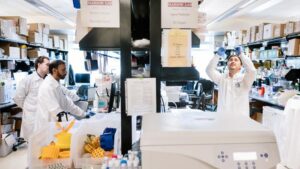
Achieving this required overcoming a fundamental technical barrier. “One challenge of using real human T cells for research is they’re very difficult to infect with HIV; out of a whole dish of cells, typically only one or two percent would get infected,” said first author Ujjwal Rathore, PhD. After years of optimization, the team pushed infection rates to roughly 70%, enabling genome‑scale CRISPR perturbations in primary cells for the first time.
With that platform in hand, the researchers performed orthogonal genome‑wide CRISPR activation (CRISPRa) and CRISPR knockout (CRISPRn) screens in CD4+ T cells, systematically testing nearly every human gene. Disrupting genes revealed those HIV depends on, while overactivating genes exposed natural antiviral defenses that HIV normally suppresses. “Over‑activating the genes gave us a wealth of information,” said co–first author Eli Dugan, a PhD candidate in Marson’s lab. “We discovered natural antiviral proteins that were previously invisible because the virus could effectively silence them.”
Across both screens, the team identified hundreds of host factors that shape HIV infection. Among the most striking were two previously unrecognized antiviral proteins: PI16 and PPID (Cyp40). “PI16 interacts with host factors involved in HIV fusion and inhibits viral entry, whereas PPID, a paralog of the proviral cyclophilin CypA, binds capsid and reduces nuclear import of the HIV core,” wrote the authors. Targeted mutagenesis, along with structural modeling and evolutionary analyses, pinpointed residues essential for PPID’s restriction activity, and engineered variants were up to tenfold more potent, according to Dugan.
To test whether these defenses could counter real‑world viral strains, the team collaborated with HIV pioneer Jay Levy, MD, who provided isolates from the early AIDS epidemic. Elevated levels of PI16 or PPID restricted even these aggressive HIV strains.
“This was the first genome‑wide effort to show how human genes affect HIV infection in cells taken directly from human blood samples,” said Nevan Krogan, PhD, director of the HIV Accessory and Regulatory Complexes (HARC) Center. “Our findings could eventually lead to new treatments that help the body’s immune system resist the virus.”
Beyond identifying antiviral factors, the study offers the potential for a powerful new platform for probing HIV latency—the persistent reservoir that evades antiretroviral therapy. “Now, we have the platform to ask the biggest questions in the field,” Rathore said, “and hopefully learn how to eliminate hidden HIV that current drugs can’t reach.”
The post CRISPR Screens Map Human T‑Cell Genes That Promote or Block HIV Infection appeared first on GEN – Genetic Engineering and Biotechnology News.
STAT+: At AACR, a provocative use of CAR-T, Merck’s new thing and cancer’s geography problem
You’re reading the web version of STAT’s popup newsletter, AACR in 30 seconds, your guide to what’s happening at the American Association of Cancer Researchers’ annual meeting. Sign up here.
We’re back with more data from the AACR meeting! Among the highlights today: a first look at a drug Merck acquired from China, a fascinating but potentially controversial use for CAR-T, and American oncology’s geography problem. Don’t forget: Tuesday night we will host a live event in San Diego, and we also have a virtual recap of the AACR conference on Thursday.
CAR-T shows deep response in smoldering myeloma
In an early phase trial, investigators at Dana-Farber Cancer Institute treated 20 high risk smoldering multiple myeloma patients with Carvykti, a BCMA directed CAR-T therapy. The idea was to use the immunotherapy on patients with the multiple myeloma precursor condition, hoping to prevent the active cancer in patients at high risk of progression.
STAT+: Former banker brought on to revitalize Pfizer’s strategy departs his post
Pfizer executive Andrew Baum, a former analyst at the investment bank Citi who joined the company in June 2024 to redirect its strategic approach, has left his role as an executive vice president and chief strategy and innovation officer, the company confirmed Monday. He will continue as an adviser to Pfizer CEO Albert Bourla until the end of the year.
Pfizer and sources familiar with the matter described the move as stemming from both a sense that Baum had accomplished what he set out to do and a streamlining of Pfizer’s operations.
“Pfizer regularly evaluates its operations to ensure it is best positioned to deliver on the company’s business in the near-term and beyond,” the company said in a statement. It said that organizational and leadership changes would “position Pfizer to move faster, make clearer decisions, and advance innovation across the enterprise.”
Synthetic Biology and Tissue Engineering Grow Liver Tissue In‑Body
Damage to the liver in patients developing end-stage liver disease has become too severe for the organ’s normally extraordinary regenerative capacity to repair or compensate for that damage. Once this point of no return has been reached the only option is an organ transplant. However, donor livers are in high demand and very limited supply.
Ambitious efforts are on the way that eventually could enable the engineering of entire implantable liver organs. However, the maximum size of laboratory-engineered liver constructs remains limited and cannot yet provide therapeutic benefits for patients. A research team at the Wyss Institute at Harvard University, Boston University, and MIT has now approached this important problem from a different angle.
“We asked if it would be possible to first implant a small-scale liver construct and then drive it to expand in the body following its engraftment,” said Christopher Chen, MD, PhD, a Wyss Institute core faculty member and the William Fairfield Warren Distinguished professor of biomedical engineering and director of the Biological Design Center at Boston University. “A sufficiently grown, functional ‘satellite liver’ could immediately relieve the metabolic burden in a damaged liver and help bridge the time until a transplant becomes available.”
Chen co-led the research together with associate faculty member Sangeeta Bhatia, MD, PhD, who is the John J. and Dorothy Wilson Professor of Health Sciences and Technology and of Electrical Engineering and Computer Science at the Koch Institute for Integrative Cancer Research at MIT, and a Howard Hughes Medical Institute investigator. Chen is also a leader of the Wyss Institute’s 3D Organ Engineering Initiative, and team lead of the recently awarded ARPA-H PRINT-supported ImPLANT project, which focuses on whole organ liver engineering at the Wyss and collaborating institutions.
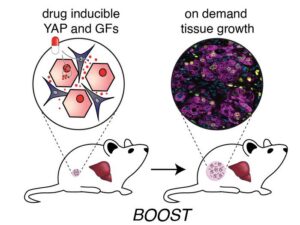
The project, spearheaded by Amy Stoddard, PhD, (MIT ’25), who developed the approach in her doctoral research and then as a postdoctoral fellow, integrates tissue engineering and synthetic biology tools in a genetic strategy the team has named “bioengineered on-demand outgrowth via synthetic biology triggering,” or BOOST. By specifically rewiring the gene expression of primary liver hepatocytes and supportive fibroblast cells, the scientists were able to effectively switch on a tissue growth program in small, engineered liver constructs after their implantation into mice.
“Using engineered liver tissue as a proof-of-concept application, we integrated synthetic biology and tissue engineering tools to build liver tissues that can be expanded on-demand after implantation in vivo,” the team reported in their published paper in Science Advances, which is titled “Synthetic control of implanted engineered liver tissue growth.” In the paper they concluded “In this study, we define the first steps toward an unconventional approach to cell therapy scale-up: engineering a small construct and then inducing it to grow in situ … “This strategy, which we have named BOOST, could provide several key advantages, including circumventing the need for large quantities of cellular raw materials and bypassing the formidable challenge of generating a rapidly perfusable construct that can survive the engraftment period.”
The authors wrote, “Organ transplant is currently the only curative treatment for patients with end-stage organ failure, yet this therapy is inaccessible to many due to the paucity of organs available for transplant.” And while significant progress has been made in the field of engineering tissue-based cell therapies that could represent alternatives, or bridges to transplant, they acknowledge, “… scaling of these constructs to sizes of therapeutic relevance remains a barrier to clinical translation.”
In order to address current challenges associated with fabrication, Chen and colleagues looked at the problem from different angle, asking whether it would be possible to first implant a small-scale construct and then trigger it to expand in situ, after its engraftment into the host.
To be able to induce growth of an implanted small liver constructs in situ within a recipient’s body the researchers first needed to identify the relevant cues that would allow them to do so. “A key first step toward this method of in situ scale-up would be the successful control of cellular growth within the engineered construct after engraftment,” they wrote. Since liver growth is known to be regulated by soluble growth factors (GFs), Stoddard screened a collection of candidate factors to identify those that, when added to cultured human primary hepatocyte cells (HEPs), had the strongest growth-inducing effects.
“We ended up with a set of four growth factors, HGF, TGFa, WNT2 and RSPO3, that potently induced sparsely scattered HEPs to grow in the culture dish,” said Stoddard. “But when we tested whether they could do the same in 3D liver tissues consisting of densely packed HEPs and fibroblasts, they turned out to be ineffective. This led us to hypothesize that there must be an additional mechanism at work in human HEPs that inhibits cell proliferation in high-density conditions.”
The team homed in on a protein, YAP, that senses mechanical signals, and which was known to move from cells’ cytosol to their nucleus in low-density conditions to help express genes involved in cell proliferation. However, in high-density conditions when cells are compressed, YAP is degraded in the cytosol, which prevents the activation of those target genes and restricts proliferation.
“Importantly, when we overexpressed a non-degradable version of YAP in HEPs, which also reaches the nucleus in high-density conditions to partake in gene regulation, we successfully overrode this density checkpoint in HEPs,” Stoddard said. “Interestingly, we found that HEPs needed to be stimulated with both YAP and GFs in order to grow in densely packed 3D liver tissues.”
Toward the goal of safely inducing and controlling HEP proliferation in a living organism, and eventually human patients, the researchers deployed synthetic biology tools to locally install control of these signaling pathways in HEPs and fibroblast cells within the engineered 3D liver tissues themselves. “We set out to engineer a synthetic biology toolkit capable of locally modulating growth factor and YAP signaling within engineered liver tissue, enabling on-demand control of proliferation even after implantation,” they noted.
The team engineered fibroblast cell lines that each secreted one of the four GFs, and HEPs that expressed the non-degradable YAP protein. And they made the expression of all proteins doxycycline (DOX)-inducible. They determined in time course experiments that a continuous seven-day treatment with DOX led 3D liver tissue composed of engineered cells to robustly expand in size and cell numbers in the culture dish. On DOX removal the HEPs reverted back to a non-proliferating state.
However, Stoddard noted, “… when we compared the gene expression of single cells in BOOST-engineered, DOX-induced 3D liver tissue to that of cells in non-engineered or BOOST-engineered, non-induced 3D liver tissue, we noticed that the expansion came with a trade-off: high proliferation rates went hand in hand with a less functional HEP state. While we believe this is a natural trade-off seen in a wide variety of biological settings, we hope to be able to address this in the future, recognizing that the liver also has native re-functionalization signals to harness.”
The litmus test for BOOST-engineered growth in 3D liver tissues was to see whether they would similarly expand following their implantation into living mice that were systemically treated with DOX for the same seven-day duration. Experiments showed that the implanted tissue exhibited a striking 500% increase in proliferation with a doubling of the engineered HEPs alone, and was vascularized to accommodate the metabolic demands of the expanded tissue. The tissue implants were also well tolerated by the mice, with no signs of fibrosis due to invading immune cells and fibroblast inflammation, or of tumor growth.
“These results were particularly exciting to us,” said Stoddard. “Prior to our work, injury to the host liver has always been required to trigger hepatocyte engraftment and proliferation. Here we were able to relieve this dependence, and trigger on-demand growth of implanted liver tissue in a completely healthy host.”
In the future, the team will explore the capacity of BOOSTed liver tissue to rescue the host in the setting of liver injury. “Our BOOST strategy lays the foundation for a future when solid organ cell therapies can be controlled non-surgically according to the needs of patients and their physicians,” Bhatia noted. “Beyond treating liver disease, the premise of BOOST could be applied to other engineered tissue therapeutics that are similarly constrained by challenges associated with tissue scale-up, such as engineered heart or pancreatic tissue to address serious diseases.”
In their paper the authors concluded, “… this work serves as an exciting proof-of-concept demonstration that scale-up of tissues via growth could be possible … Together, this work helps lay the foundations for a future of ‘smart’ tissue therapeutics that can be scaled to a patient’s needs and thereby offer treatment for numerous, previously incurable, diseases.”
The post Synthetic Biology and Tissue Engineering Grow Liver Tissue In‑Body appeared first on GEN – Genetic Engineering and Biotechnology News.
User Experience of Extended Reality Treatment for Visuospatial Neglect Among Patients and Informal Caregivers: Qualitative Interview Study
Background: Visuospatial neglect (VSN) is a cognitive disorder following a stroke, where individuals fail to perceive or respond to stimuli on the contralesional side of space. Visual scanning training (VST) is the recommended treatment in clinical guidelines. Objective: This qualitative study explored how patients (N=10) and informal caregivers (N=8) perceived the usability and potential implementation of 3 extended reality (XR)–based serious games to enhance VST—1 in virtual reality and 2 in augmented reality—as tools for VST. These technologies not only enhance patient engagement but also enable detailed data collection to monitor therapeutic progress. Methods: The themes and feedback were compared with themes and feedback from VSN therapists from a previous study: (1) suitability for VSN rehabilitation, (2) applicability, (3) motivation, (4) guidance, (5) versatility, and (6) detailed insights in game performance. Results: Highlights were that patients reported high engagement and enjoyment, with many expressing willingness to use the games in both clinical and home settings. Informal caregivers supported these findings and emphasized the motivational value of the games. Additionally, both groups noted the importance of accessible instructions and technical support. Conclusions: Although XR technology offers potential in neurorehabilitation, a uniform solution may not suit all users. This study showed the importance of including diverse end-user groups in development for usability, acceptance, and implementation. Successful integration of XR in rehabilitation requires customizable features, structured support, and attention to the differing roles of caregivers. Further research is needed to evaluate the clinical effectiveness and optimize patient-tailored applications of XR in VSN treatment.
<img src="https://jmir-production.s3.us-east-2.amazonaws.com/thumbs/879d75d42882fd56f40e5658aa6a60e8" />