

Google I/O showed how the path for AI-driven science is shifting

During Tuesday’s Google I/O keynote, Demis Hassabis, the CEO of Google DeepMind, proclaimed that we are currently “standing in the foothills of the singularity.” It was a striking statement—the singularity is the theoretical future moment when AI rapidly exceeds human intelligence and dramatically transforms the world. But what struck me as I listened in the audience was the context in which he said those words. 

He was on stage to close out the session with a segment on scientific AI, the centerpiece of which was a video detailing how the company’s weather prediction software provided an advance alert about Hurricane Melissa’s catastrophic landfall in Jamaica last year—and potentially saved lives. If that software, called WeatherNext, helped anyone escape the storm or better fortify their home, that’s an enormous and meaningful achievement. But it’s hardly evidence of an impending singularity.

The juxtaposition of Hassabis’ lofty rhetoric with the real-world results of WeatherNext highlighted the tension between two very different approaches to AI for science. The first focuses on AI tools, like WeatherNext, that are designed and trained to solve specific scientific problems. The second is agentic, LLM-based systems that could one day execute cutting-edge research projects without human involvement.

This second vision powers a great deal of AI enthusiasm right now, including recent excitement around recursive self-improvement, or the idea that AI systems could eventually become the primary drivers of AI advancement—a process that would get faster and faster as the AI systems grow smarter. And agentic systems are now making real research contributions, sometimes with limited human guidance.

Just this week, Pushmeet Kohli, Google Cloud’s chief scientist, published a piece in a special AI and science issue of the journal Daedalus, writing: “We are moving toward AI that doesn’t just facilitate science but begins to do science.” With autonomous AI scientists on the horizon, it’s harder to justify massive efforts to develop super-specialized tools—even one like AlphaFold, for which DeepMind scientists won a Nobel Prize, or a potentially life-saving system like WeatherNext. It also heralds a far stranger future for science, in which humans and AI systems collaborate as peers—or AI even makes scientific progress on its own.

To be clear, Google does not appear to be abandoning its work on specialized AI for science tools. AlphaGenome and AlphaEarth Foundations, which are trained for genetics and Earth science applications respectively, were released last summer, and the newest version of WeatherNext came out in November.

What’s more, such tools remain extremely popular among scientists. Last year, for instance, Google reported that protein structure predictions from AlphaFold have been used by over three million researchers worldwide. And Isomorphic Labs, a Google subsidiary that aims to use AlphaFold and related technologies to develop new drugs, just raised a $2 billion Series B funding round.

But there are concrete signs of realignment, in both enthusiasm and resources. Last month, the Los Angeles Times reported that Google fellow John Jumper, who won the Nobel for AlphaFold, is now working on AI coding, not on science-specific AI tools. It’s not surprising that Google is assigning its best minds to the coding problem, as the company has recently taken a reputational hit because its coding tools don’t currently stand up to those offered by Anthropic and OpenAI. But it may also signal a prioritization of agentic science on Google’s part, as coding abilities are key to the success of some of those systems. 

Across the industry, agentic researcher systems are showing real potential. This week, OpenAI announced that one of their models had disproved an important mathematics conjecture—perhaps the most meaningful contribution that generative AI has made to mathematics so far, according to some mathematicians.

Importantly, the model used by OpenAI is not specialized for solving mathematical problems, or even for research; according to the company, it’s a general-purpose reasoning model in the vein of GPT-5.5. If general agents can make independent contributions to mathematical research, they might soon be able to do the same in science (though the fact that ideas in science must be verified experimentally makes it a tougher domain for AI).

Google is certainly devoting a lot of attention toward an agent-driven scientific future. The big scientific announcement at I/O was the new Gemini for Science package, which unites several of the company’s LLM-based scientific systems under one brand.

This includes the hypothesis-generating AI Co-Scientist and algorithm-optimizing AlphaEvolve, which are still not publicly available—but as Google is now allowing any researcher to apply for access to Gemini for Science, they may soon see wider adoption in the scientific community. Scientists who were involved in early testing are enthusiastic about their potential: Gary Peltz, a Stanford geneticist, compared using the AI Co-Scientist to “consulting the oracle of Delphi” in a Nature Medicine article.

Gemini for Science isn’t incompatible with specialized tools; to the contrary, agentic systems can be designed to call on such tools when they might be useful. And no agentic system can predict the structure that a protein will fold into without AlphaFold’s help (at least not yet). But the company seems to be shifting its public image—and at least some resources and personnel, such as Jumper—away from specifically developing those kinds of tools. Though it has only been five years since AlphaFold solved the protein-folding problem, both the technology and the discourse have quickly moved beyond that once-revolutionary achievement.

Google has been careful to position this new set of scientific agents as an accelerant for human scientists, rather than a replacement for them—the choice of the name AI Co-Scientist as opposed to AI Scientist, for instance, appears quite deliberate. Hassabis uses that same human-centric framing when he talks about changes in the landscape of scientific AI. “For the next decade or so, we should think about AI as this amazing tool to help scientists,” Hassabis said in an interview published in the Daedalus issue. “Beyond that timeframe, it is hard to say with any certainty, but perhaps these systems will become more like collaborators.”

But no one can be an effective scientific collaborator without also being a skilled scientist in their own right. And if Hassabis is anywhere near the mark when he talks about the “foothills of the singularity,” then AI scientists could eventually exceed the capabilities of their human counterparts.

In a discussion with the journalist Mike Allen at I/O, Hassabis spoke of how he was initially inspired to pursue AI when he observed how progress in physics had stagnated since the 1970s; he wondered whether the human mind had reached its limits in that domain, and if AI could help to overcome that barrier. Superhuman agentic scientists would certainly fit that bill. We might not ever get anywhere near there, but Google seems to be aiming itself toward that summit.
Precancerous Pancreatic Lesions May Not Always Lead to Cancer

Pancreatic cancer is an often deadly disease that, even if successfully treated, has a relative survival rate of about 13%, according to the NIH. When detected and treated early, that survival rate increases substantially. Developing strategies to diagnose cancer early or identify precancerous tissues is vital to success and increased survival.

A common precursor to pancreatic cancer is the presence of lesions called pancreatic intraepithelial neoplasia (PanIN). Researchers from the University of Michigan and the University of Maryland have been studying these precursor lesions and previously identified metabolic biomarkers involved with the development of PanIN to cancer. In their new study, published in Cancer Discovery, they expand their work into the PanIN microenvironments—the cells and tissues directly surrounding the lesions—to understand the cellular changes in an effort to find markers to use in diagnostics.

To examine the microenvironments, the team utilized single-cell RNA sequencing and spatial transcriptomics, isolating single cells and mapping their gene expression.

“These lesions are like needles in a haystack,” said co-senior author Timothy Frankel, MD, professor of surgical oncology and co-director of the Rogel and Blondy Center for Pancreatic Cancer at the University of Michigan. “The prior way of looking at this was to look at the entire haystack. You get a lot of information about hay and very little information about the needle.” He explained that using these precise techniques to examine cells individually is both more efficient and allows the researchers “to just focus in on the needle so we can look at multiple needles using the same amount of computing power and resources.”

The researchers used whole donated human pancreases to map the progression from PanIN to cancer, both for the precancerous and cancerous cells themselves, and the microenvironments surrounding them.

The pancreatic cancer microenvironment contains a highly diverse group of interactive cells, including fibroblasts and immune cells. The researchers found that while the epithelial tissue gene expression changes on a continuum from PanIN to cancer, the cells in the microenvironment are much more dynamic.

“Progression to cancer is accompanied by profound geographical reorganization of myeloid cells and lymphocytes and the formation of a cancer-specific fibroblast population characterized by high levels of Smooth Muscle Actin, LRRC15, and the WNT signaling component LEF1,” they wrote.

“It turns out, the microenvironment of these precursor lesions is the same as the microenvironment of the normal pancreas,” explained co-senior study author Marina Pasca di Magliano, PhD, professor of surgical immunology and co-director of the Rogel and Blondy Center for Pancreatic Cancer at the University of Michigan.

“The lesions have not convinced any of the cells around them to change. That’s not what we were expecting. We were expecting the two components, the cells and the microenvironment, to evolve in lockstep. They did not.”

These unexpected results indicate that there are other factors or stressors impacting the microenvironment. This is also in line with prior data showing that while pancreatic cancer is preempted by PanIN, not all, and in fact most, PanIN occurrences do not lead to a cancer diagnosis.

“It is incredible to see how we can uncover the fundamental cellular mechanisms of disease etiology by blending new computational methods and cutting-edge spatial transcriptomics technologies,” said co-corresponding author Elana J. Fertig, PhD, director of the Institute for Genome Sciences at the University of Maryland School of Medicine and associate director of quantitative sciences at the University of Maryland Marlene and Stewart Greenebaum Comprehensive Cancer Center. “Through careful study design, we can use the spatial information to start delving into the unknown dynamics of pancreatic tumor evolution.”

Moving forward, more research is needed to identify those stressors that may impact the microenvironment surrounding PanINs, which would allow the lesions to turn into cancers. Understanding those switches may open the door for developing earlier diagnostics or therapies to help prevent cancer development in the first place.

The post Precancerous Pancreatic Lesions May Not Always Lead to Cancer appeared first on Inside Precision Medicine.

AI Designs Miniprotein Switches for GPCR Targeting

Many scientists first encountered G protein–coupled receptors (GPCRs) as a looping sketch across the cell membrane in an early biology textbook. That simple diagram belied the complexity of a receptor family now known to govern vision, smell, hormone sensing, and the actions of countless medicines. Yet despite their centrality, designing molecules that can precisely switch GPCRs on or off has remained one of drug discovery’s most persistent challenges.

A new study led by the UW Medicine Institute for Protein Design and Skape Bio demonstrates that AI‑driven de novo protein design can finally meet that challenge. The work, published recently in Nature, shows that computationally designed miniproteins—compact proteins under 100 amino acids—can be engineered to either activate or block GPCRs with high affinity, potency, and selectivity. The paper is titled “De novo design of miniproteins targeting G protein-coupled receptors.”

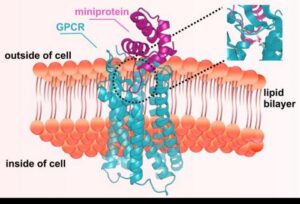
The research team developed a suite of design strategies to create miniproteins capable of slipping into the deep, flexible pockets that govern GPCR signaling. These pockets shift shape depending on whether the receptor is active or inactive, making them difficult to target with conventional biologics. By designing molecules that recognize specific receptor states, the team generated agonists for receptors involved in itch and pain, and antagonists for receptors implicated in cancer, metabolic disease such as diabetes and obesity, and migraine.

GPCR microprotein
A tiny protein (pink) designed on a computer fits into a deep pocket (inset) of a cell surface receptor called a GPCR (blue), allowing scientists to switch cell signaling on or off. [Edin Muratspahić/UW Medicine Institute for Protein Design]

“Protein design takes our understanding of how proteins fold and reverses it—asking if we can envision, with the aid of AI computing, a new protein that sticks to a target in a purpose-built way,” said senior author David Baker, PhD, director of the Institute for Protein Design, professor of biochemistry at the University of Washington School of Medicine, and a Howard Hughes Medical Institute Investigator. “This paper showcases how we can do this repeatedly for different GPCRs in ways that capitalize on their dynamic motion to either activate or inactivate them.”

Cryo‑EM structures of five designed miniproteins closely matched their computational models, underscoring the accuracy of the design pipeline. In one mouse study, a designed chemokine‑receptor antagonist mobilized hematopoietic stem and progenitor cells at levels comparable to a clinically used drug—but with fewer side effects, according to the authors.

For first author Edin Muratspahić, PhD, the moment of validation came when the designed molecules did more than bind. “Seeing computationally designed miniproteins not only bind but actually control GPCR signaling in living cells was a defining moment for me,” he said.

A second major advance reported in the study is a high‑throughput “receptor diversion” screening system that evaluates tens of thousands of designed proteins directly in living human cells. Traditional GPCR screens often require purifying or stabilizing receptors—steps that can distort their natural signaling behavior. By keeping receptors in their native membrane environment, the new system accelerates discovery while preserving biological relevance.

According to corresponding author Christoffer Norn, PhD, co‑founder of Skape Bio, the study lays out a roadmap for all‑computational design of GPCR ligands.

The methods described in the paper are already being adapted at Skape Bio to explore GPCR targets involved in metabolic, inflammatory, and neurologic pathways—areas where conventional discovery efforts have often struggled.

The post AI Designs Miniprotein Switches for GPCR Targeting appeared first on GEN – Genetic Engineering and Biotechnology News.

STAT+: Closely watched experimental Parkinson’s drug fails key clinical trial

Biogen and Denali Therapeutics said Thursday that their experimental therapy for Parkinson’s disease failed to slow the degenerative brain disorder in a randomized trial, dealing a substantial blow to a scientific approach that stoked excitement among advocates and academics. 

In the study, 648 adults with Parkinson’s were randomized to receive either a placebo or a pill targeting a protein called LRRK2. In 2004, researchers discovered that mutations in the LRRK2 gene can cause a rare, inherited form of Parkinson’s. And in 2018, another group of scientists showed that blocking the protein might actually benefit all patients with the disease. 

Thursday’s results are a significant setback to the latter idea. 

Continue to STAT+ to read the full story…

MyLungHealth, a Patient-Facing Education Tool for Lung Cancer Screening: Qualitative User-Centered Design Study

Background: Lung cancer remains the leading cause of cancer-related mortality worldwide, with low-dose computed tomography screening demonstrating an approximately 20% reduction in mortality among high-risk individuals. Despite this benefit, screening prevalence remains suboptimal, with often less than 20% of eligible individuals reported to be up to date on screening. Shared decision-making is essential for effective lung cancer screening (LCS) implementation, with decision aids shown to enhance patient knowledge and engagement. Objective: The aim of this study is to identify patient preferences, concerns, and design considerations through qualitative evaluation of MyLungHealth, a personalized patient-facing educational tool for LCS integrated with electronic health records, and to describe how these findings informed iterative design modifications. Methods: We employed qualitative research methods through focus groups (n=34) and individual interviews (n=18) with individuals who met screening eligibility criteria. Participants were recruited from the University of Utah Health and New York University Langone Health between May and December 2023. Feedback was analyzed using Braun and Clarke’s thematic analysis principles. Results: Six themes were organized into three overarching domains. Domain A included interpretation and impact of personalized risk information: theme 1, difficulties interpreting risk information, and theme 2, varied impacts of risk information on motivation. Domain B included autonomy, privacy, and user interface preferences: theme 3, desire for autonomy and control over personal health data, and theme 4, preference for straightforward language and multiple information formats. Domain C included integration with clinical workflows and patient portal systems: theme 5, expectations for integration with health care provider workflows, and theme 6, mixed experiences with personal health record systems. These insights led to key design modifications, including simplified risk presentation, multimodal content delivery options (video and text), and implementation of electronic health record alerts for clinicians. Conclusions: The user-centered design process for MyLungHealth revealed important considerations for developing effective patient education tools for LCS. The findings highlighted the need for simplified risk presentation, personalized information delivery, and integration with clinical workflows. These findings underscore the importance of balancing comprehensive risk communication with user accessibility. Trial Registration: ClinicalTrials.gov NCT06338592; https://clinicaltrials.gov/study/NCT06338592 International Registered Report Identifier (IRRID): RR2-10.1136/bmjopen-2024-087056
<img src="https://jmir-production.s3.us-east-2.amazonaws.com/thumbs/912e33dcbc9d4e0ade062267a8435697" />