

<![CDATA[New analysis shows COMP360 psilocybin sessions for PTSD stay mostly silent, with nondirective support boosting safety and autonomy.]]>
<![CDATA[ASCP updates spotlight ketamine safety guardrails, at‑home agitation therapy, psilocybin phase 3 momentum, and biomarker-driven precision psychiatry.]]>
<![CDATA[COMP360 psilocybin shows rapid, durable gains in treatment‑resistant depression, as psychedelics continue to grow.]]>
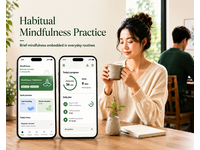
A Self-Guided Mobile Mindfulness Intervention Embedded in Daily Routines for Adults With Mild to Moderate Psychological Distress: Randomized Controlled Trial
Background: Mobile mindfulness interventions have shown promise for reducing anxiety and depressive symptoms, but sustaining engagement remains a persistent challenge. Many digital programs still rely on formal practice that requires dedicated time, which may be difficult to integrate into daily life. Objective: This randomized controlled trial evaluated Habitual Mindfulness Practice (HMP), a self-guided mobile mindfulness intervention that embeds brief practices into recurring daily routines, among adults with mild to moderate psychological distress. Outcomes were compared with those of Traditional Mindfulness (TM), Mindfulness-Based Psychoeducation (MBP), and a waitlist control (WL). Methods: Adults aged 18 to 65 years with mild to moderate symptoms of anxiety or depression were randomly assigned in a 1:1:1:1 ratio to HMP, TM, MBP, or WL (N=686). All procedures were conducted online, and the intervention was fully self-guided, with outcomes assessed using self-report measures. The intervention lasted 21 days, with assessments conducted at baseline, postintervention, and 3-month follow-up. Primary outcomes were depressive and anxiety symptoms. Secondary outcomes included mindfulness, cognitive emotion regulation, affective balance, and interpersonal difficulties. Postintervention group differences were examined, controlling for baseline scores, and longitudinal trajectories were evaluated across the active intervention conditions. Results: At postintervention, significant group effects were observed for depressive symptoms (=28.67, <.001, ηp²=0.11) and anxiety symptoms (=30.11, <.001, ηp²=0.12). Both HMP and TM showed lower depressive and anxiety symptom scores than MBP and WL. TM showed lower postintervention anxiety than HMP (=.04), whereas depressive symptoms did not differ significantly between HMP and TM (=.63). The mindfulness practice conditions also showed more favorable postintervention outcomes for mindfulness, affective balance, interpersonal difficulties, and emotion regulation. Improvements in depressive and anxiety symptoms were generally maintained at follow-up among the active intervention conditions, although maintenance of secondary outcomes varied across measures. Postintervention outcome data were available for 55.2% (379/686) of randomized participants, and follow-up outcome data were available for 24.1% (124/515) of participants in the active intervention conditions. HMP and TM did not differ significantly in practice duration, engagement, or satisfaction. Conclusions: A routine-embedded, self-guided mobile mindfulness intervention may be a feasible approach for reducing mild to moderate psychological distress. HMP produced benefits broadly comparable to those of traditional app-delivered mindfulness, but it did not confer advantages in engagement or short-term efficacy. Trial Registration: Chinese Clinical Trial Registry ChiCTR2400093771; https://tinyurl.com/3d6tky8v
STAT+: Swing Therapeutics acquired by medical VR platform XR Health
Swing Therapeutics, developer of a Food and Drug Administration-cleared digital treatment for fibromyalgia, has been acquired by medical virtual reality company XR Health.
Swing is XR Health’s sixth acquisition in the last two years and finds the VR developer taking a new business direction as it aims to be a go-to source of digital treatments for disease. The terms of the deal were not disclosed because, as XR Health CEO Eran Orr explained, “it won’t be the last” acquisition for the company.
XR Health, Orr claimed, has dozens of different apps on its platform currently and delivered a million user sessions in 2025. Offerings include a range of meditation and cognitive behavioral therapy-based VR experiences targeted at mental health issues, pain, hot flashes, and more. XR Health’s large packages of VR treatments are registered with the FDA but not cleared.
Working Mechanisms and Effectiveness of IV Ketamine-assisted Psychotherapy on Depression in TRD Clients
Conditions: Treatment Resistant Depression
Sponsors: Senz; Radboud University Medical Center
Recruiting
Sponsors: Senz; Radboud University Medical Center
Recruiting
Clinical Trial of MDMA-Assisted Therapy for Military Service Members With Posttraumatic Stress Disorder
Conditions: PTSD; Post Traumatic Stress Disorder PTSD; Post Traumatic Stress Disorder
Interventions: Drug: TREATMENT ARM: Full dose; Drug: CONTROL ARM: Active-controlled
Sponsors: U.S. Army Medical Research and Development Command; Resilient Pharmaceuticals; Walter Reed National Military Medical Center; Congressionally Directed Medical Research Programs
Not yet recruiting
Interventions: Drug: TREATMENT ARM: Full dose; Drug: CONTROL ARM: Active-controlled
Sponsors: U.S. Army Medical Research and Development Command; Resilient Pharmaceuticals; Walter Reed National Military Medical Center; Congressionally Directed Medical Research Programs
Not yet recruiting
Digital Mindfulness-Based Therapy for Obsessive-Compulsive Disorder
Conditions: Obsessive-Compulsive Disorder
Interventions: Behavioral: Digital Mindfulness-Based Therapy; Drug: Routine Pharmacological Treatment
Sponsors: Central South University; Second Xiangya Hospital of Central South University
Not yet recruiting
Interventions: Behavioral: Digital Mindfulness-Based Therapy; Drug: Routine Pharmacological Treatment
Sponsors: Central South University; Second Xiangya Hospital of Central South University
Not yet recruiting
Effect of Psilocybin and Structured Integrated Reframing Therapy on Gut-Brain Axis Biomarkers and Depression in Major Depressive Disorder
Conditions: Major Depressive Disorder; Post-Traumatic Stress Disorder (PTSD)
Interventions: Drug: Psilocybin; Behavioral: Structured Integrated Reframing Therapy (SIRT); Drug: Selective Serotonin Reuptake Inhibitor (SSRI)
Sponsors: Khyber Medical University Peshawar; Hayatabad Medical Complex; KMU Institute of Health Science, Islamabad
Recruiting
Interventions: Drug: Psilocybin; Behavioral: Structured Integrated Reframing Therapy (SIRT); Drug: Selective Serotonin Reuptake Inhibitor (SSRI)
Sponsors: Khyber Medical University Peshawar; Hayatabad Medical Complex; KMU Institute of Health Science, Islamabad
Recruiting
Rehabilitation, Education, and SElf-management for Adolescents After Mild Traumatic Brain Injury
Conditions: Brain Concussion; Mild Traumatic Brain Injury; Concussion
Interventions: Behavioral: Mindfulness-based intervention; Behavioral: Health Education
Sponsors: Molly Cairncross
Not yet recruiting
Interventions: Behavioral: Mindfulness-based intervention; Behavioral: Health Education
Sponsors: Molly Cairncross
Not yet recruiting