Kelonia Therapeutics became the newest biotech takeout target this week. The privately held company, which is developing cell therapies for cancer and autoimmune diseases, will be acquired by Eli Lilly.
The acquisition is a boon for the small startup, which has subsisted on $60 million over the last five years and previously struggled to stay afloat. (Check out an earlier slide deck and memo on the company here.) Kelonia came within a week of running out of cash three times. Now it’s being bought for $3.2 billion with potential milestone payments that could double that payout.
On this week’s edition of its biotech podcast, “The Readout Loud,” STAT spoke with Bryan Roberts, a partner at VC firm Venrock, which incubated the biotech, to discuss how this small company managed to land a big deal.
Utah’s high-profile experiment with using an artificial intelligence system to renew prescriptions without physician oversight is facing its first major challenge as doctors in the state push back.
Utah’s Office of Artificial Intelligence Policy in January announced an agreement with AI doctor startup Doctronic to launch a chatbot that can conduct a clinical evaluation of a patient and autonomously renew prescriptions for nearly 200 drugs. In a letter published Friday, the Utah Medical Licensing Board said it only learned about the agreement after it had been launched and asked the state to halt the program.
“Proceeding with this agreement without consulting the Medical Board potentially places Utah citizens at risk and remains a major concern of the board,” they wrote. “It is the strong recommendation of the Utah Medical Licensing Board that this program be immediately suspended pending further discussion.”
This is today’s edition of The Download, our weekday newsletter that provides a daily dose of what’s going on in the world of technology.
We’re in a new era of AI-driven scams
When ChatGPT was released in late 2022, it showed how easily generative AI could create human-like text. This quickly caught the eye of cybercriminals, who began using LLMs to compose malicious emails. Since then, they’ve adopted AI for everything from turbocharged phishing and hyperrealistic deepfakes to automated vulnerability scans.
Many organizations are now struggling to cope with the sheer volume of cyberattacks. AI is making them faster, cheaper, and easier to carry out, a problem set to worsen as more cybercriminals adopt these tools—and their capabilities improve. Read the full story on how AI is reshaping cybercrime.
Subscribers can watch an exclusive roundtable unveiling the technologies and trends on the list, with analysis from MIT Technology Review’s AI reporter Grace Huckins and executive editors Amy Nordrum and Niall Firth.
Healthcare AI is here. We don’t know if it actually helps patients.
Doctors are using AI to help them with notetaking. AI-based tools are trawling through patient records, flagging people who may require certain support or treatments. They are also used to interpret medical exam results and X-rays.
A growing number of studies suggest that many of these tools can deliver accurate results. But there’s a bigger question here: Does using them actually translate into better health outcomes for patients? We don’t yet have a good answer—here’s why.
—Jessica Hamzelou
The story is from The Checkup, our weekly newsletter that gives you the latest from the worlds of health and biotech. Sign up to receive it in your inbox every Thursday.
The must-reads
I’ve combed the internet to find you today’s most fun/important/scary/fascinating stories about technology.
1 DeepSeek has unveiled its long-awaited new AI model The Chinese company has just launched preview versions of DeepSeek-V4. (CNN) +It says V4 is the most powerful open-source platform. (Bloomberg $) + And rivals top closed-source models from OpenAI and DeepMind. (SCMP) + The model is adapted for Huawei chip technology. (Reuters $)
2 More countries are curbing children’s social media access Norway is set to enforce the latest ban. (Reuters $) + The Philippines could follow soon. (Bloomberg $) + Americans are pushing to get AI out of schools. (The New Yorker)
3 The US has accused China of mass AI theft as tensions rise A White House memo claims Chinese firms are exploiting American models. (BBC) + Beijing calls the accusations “slander.” (Ars Technica)
4 OpenAI set itself apart from Anthropic by widely releasing its new model It’s releasing GPT-5.5 to all ChatGPT users, despite cybersecurity concerns. (NYT $) + OpenAI says the new model is better at coding and more efficient. (The Verge)
5 Meta is cutting 10% of jobs to offset AI spending Roughly 8,000 layoffs are set to be announced on May 20. (QZ) + Anti-AI protests are growing. (MIT Technology Review)
6 Palantir is facing a backlash from employees Thanks to its work with ICE and the Trump administration. (Wired $) + Surveillance tech is reshaping the fight for privacy. (MIT Technology Review)
7 The era of free access to advanced AI is coming to an end AI labs are under mounting pressure to start turning profits. (The Verge)
8 Elon Musk’s feud with Sam Altman is heading to court The case has already revealed several unflattering secrets. (WP $)
9 A new movement is encouraging people to ditch their smartphones for a month “Month Offline” is like a Dry January for smartphones. (The Atlantic)
10 Spotify has revealed its most-streamed music of the last 20 years Featuring Taylor Swift, Bad Bunny, and The Weeknd. (Gizmodo)
Quote of the day
“We want a childhood where children get to be children. Play, friendships, and everyday life must not be taken over by algorithms and screens.”
—Norwegian Prime Minister Jonas Gahr Store announces age restrictions for social media.
One More Thing
NASA/JPL-CALTECH VIA WIKIMEDIA COMMONS; CRAFT NASA/JPL-CALTECH/SWRI/MSSS; IMAGE PROCESSING: KEVIN M. GILL
The search for extraterrestrial life is targeting Jupiter’s icy moon Europa
As astronomers have discovered more about Europa over the past few decades, Jupiter’s fourth-largest moon has excited planetary scientists interested in the geophysics of alien worlds.
All that water and energy—and hints of elements essential for building organic molecules —point to an extraordinary possibility. In the depths of its ocean, or perhaps crowded in subsurface lakes or below icy surface vents, Jupiter’s big, bright moon could host life.
Japanese pharmaceutical companies are engaging CDMOs earlier in the development cycle, as increasing complexity in peptide programs places greater strain on in-house capabilities, according to officials at Neuland Laboratories, which is attending CPHI Japan this week. The company says it has seen a notable shift in demand over the past 12–24 months, with more early-stage programs seeking external support.
This trend is being driven in part by growing activity from venture-backed biotech companies and spinouts emerging from large pharmaceutical R&D organizations, reports a Neuland spokesperson, who adds that as these programs advance into clinical development, demand for specialized CDMO capabilities is increasing.
Neuland has observed a rise in peptide-related engagements from Japanese companies, particularly at the preclinical and early clinical stages, where technical requirements are more demanding, notes Sharadsrikar Kotturi, PhD, CSO at Hyderabad, India-based Neuland Labs.
Peptide development presents several challenges compared with traditional small molecules, explains Kotturi. Analytical complexity remains a key issue, with structural characteristics making characterization, impurity detection, and purity assessment more difficult, he continues. Scaleup is also constrained by the availability and quality of protected amino acids, which can affect manufacturing timelines, cost, and overall success rates.
Regulatory expectations further add to the burden, points out Kotturi. Demonstrating purity, consistency, and process control to authorities such as Japan’s Pharmaceuticals and Medical Devices Agency requires extensive data, while shifting requirements introduce additional hurdles during development and approval. Simultaneously, pricing and regulatory pressures in Japan are increasing the operational load on drug developers, he states. Frequent drug price revisions are pushing companies to improve cost efficiency, reinforcing the case for outsourcing.
“The bottleneck isn’t discovery anymore. It’s execution,” says Kotturi. “In peptides, programs are running into challenges around analytical complexity, scaleup, and the availability of key raw materials such as protected amino acids.”
Or that it is being used, increasingly, in hospitals. Doctors are using AI to help them with notetaking. AI-based tools are trawling through patient records, flagging people who may require certain support or treatments. They are also used to interpret medical exam results and X-rays.
A growing number of studies suggest that many of these tools can deliver accurate results. But there’s a bigger question here: Does using them actually translate into better health outcomes for patients?
We don’t yet have a good answer.
That’s what Jenna Wiens, a computer scientist at the University of Michigan, and Anna Goldenberg of the University of Toronto, argue in a paper published in the journal Nature Medicine this week.
Wiens tells me she has spent years investigating how AI might benefit health care. For the first decade of her career she tried to pitch the technology to clinicians. Over the last few years, she says, it’s as though “a switch flipped.” Health-care providers not only appear much more interested in the promise of these technologies, they have also begun rapidly deploying them.
The problem is that many providers aren’t rigorously assessing how well they actually work.
Take “ambient AI” tools, for example. Also known as AI scribes, they “listen” to conversations between doctors and patients, then transcribe and summarize them. Multiple tools are available, and they are already being widely adopted by health-care providers.
A few months ago, a staffer at a major New York medical center who develops AI tools for doctors told me that, anecdotally, medics are “overjoyed” by the technology—it allows them to focus all their attention on their patients during appointments, and it saves them from a lot of time-consuming paperwork. Early studies support these anecdotes and suggest that the tools can reduce clinician burnout.
That’s all well and good. But what about patient health outcomes? “[Researchers] have evaluated provider or clinician and patient satisfaction, but not really how these tools are affecting clinical decision-making,” says Wiens. “We just don’t know.”
The same holds true for other AI-based technologies used in health-care settings. Some are used to predict patients’ health trajectories, others to recommend treatments. They are designed to make health care more effective and efficient.
But even a tool that is “accurate” won’t necessarily improve health outcomes. AI might speed up the interpretation of a chest X-ray, for example. But how much will a doctor rely on its analysis? How will that tool affect the way a doctor interacts with patients or recommends treatment? And ultimately: What will this mean for those patients?
The answers to those questions might vary between hospitals or departments and could depend on clinical workflows, says Wiens. They might also differ between doctors at various stages of their careers.
Take the AI scribes, as another example. Some research on AI use in education suggests that such tools can impact the way people cognitively process information. Could they affect the way a doctor processes a patient’s information? Will the tools affect the way medical students think about patient data in a way that impacts care? These questions need to be explored, says Wiens. “We like things that save us time, but we have to think about the unintended consequences of this,” she says.
In a study published in January 2025, Paige Nong at the University of Minnesota and her colleagues found that around 65% of US hospitals used AI-assisted predictive tools. Only two-thirds of those hospitals evaluated their accuracy. Even fewer assessed them for bias.
The number of hospitals using these tools has probably increased since then, says Wiens. Those hospitals, or entities other than the companies developing the tools, need to evaluate how much they help in specific settings. There’s a possibility that they could leave patients worse off, although it’s more likely that AI tools just aren’t as beneficial as health-care providers might assume they are, says Wiens.
“I do believe in the potential of AI to really improve clinical care,” says Wiens, who stresses that she doesn’t want to stop the adoption of AI tools in health care. She just wants more information about how they are affecting people. “I have to believe that in the future it’s not all AI or no AI,” she says. “It’s somewhere in between.”
This article first appeared in The Checkup, MIT Technology Review’s weekly biotech newsletter. To receive it in your inbox every Thursday, and read articles like this first, sign up here.
How did a biotech company that almost ran out of money three times get acquired for over $3 billion? Will the M&A streak continue? And why are drugmakers working with a telehealth company called Prescribery?
We discuss all that and more on this week’s episode of “The Readout LOUD,” STAT’s weekly biotech podcast. Venture capitalist Bryan Roberts joins us to discuss his firm’s investment in Kelonia Therapeutics, the CAR-T biotech that Eli Lilly just said it would buy for $3.25 billion.
Lentiviral vectors are gaining momentum not just as ex vivo tools but as potential in vivo therapeutic platforms. But with that shift comes a number of manufacturing challenges, including higher doses, tighter control of impurities, greater batch consistency, and scalable processes to meet both clinical and commercial needs.
In this GEN Podcast, two experts from SK pharmteco, a global CMO, address these challenges and lay out some best practices that guide the manufacture of lentiviral vectors with the requisite purity, robustness, and economic feasibility required for widespread clinical adoption..
Podcast Guests:
Tatiana Nanda, PhD CTO, Cell and Gene Therapy SK pharmteco
Mardhani Aparajithan Director of Manufacturing, Science and Technology SK pharmteco
Affecting an estimated 100,000 people globally, cystic fibrosis (CF) cases stem from mutations in the cystic fibrosis transmembrane conductance regulator (CFTR) protein. In the past several decades, scientists have successfully engineered various small-molecule therapies that lessen the severity of the disease. However there are still treatment challenges. Now, data from a new study in a cell model demonstrates that a gene therapy can successfully repair an “untreatable” mutation associated with a particularly severe form of the disease. Details of the potential therapy are published in a new Science Translational Medicine paper titled “Functional correction of the untreatable CFTR 1717-IG>A mutation through mRNA- and sgRNA-optimized base editing.”
Many current therapies benefit patients with the most common disease-associated mutation, F508del. However they often have little effect on patients who harbor other types of mutations. For example, some patients have a mutation named 1717-1G>A, which is relatively common but doesn’t have any approved therapies due to being a splicing mutation that results in little to no protein production. In fact, “about 10% of people with CF do not qualify for any of the available CFTR modulator therapies, particularly those people with severe splicing mutations that result in frameshifts and the formation of premature termination codons.”
The 1717-1G>A mutation is the target of the therapy described in the paper, which was written by scientists from the University of Trento and their collaborators elsewhere. Specifically, the team developed an “adenine base editing strategy to efficiently correct the 1717-1G>A mutation,” they wrote in Science Translational Medicine. “By harnessing the SpRY- ABE9 system, which we delivered as optimized RNAs for both the base editor and single guide RNA (sgRNA), we achieved functional correction in patient-derived models.”
Furthermore, the scientists note that they opted to use base editing rather than strategies like base editing because it has the advantage of “typically higher nucleotide modification efficiencies and a streamlined system requiring only the editor and an sgRNA” and because it has been used in other CF studies.
Using their ABE9 base editor and modified CRISPR-Cas9 tool, the scientists report successfully editing up to 30% of target DNA in human embryonic kidney cell lines and patient-derived airway epithelial cells with minimal off-target effects. It also corrected the mutation in intestinal organoids derived from CF patients as evidenced by restored CFTR activity.
Additional studies are needed, especially in animals, to fully assess the effectiveness of potential therapy but early results are promising. Overall, the approach achieved an editing efficiency of 13%. Prior studies showed that 10% efficiency may be enough for functional recovery. The results suggest that the therapy could benefit the subset of patients whose disease is caused by 1717-1G>A.
The results of a study by researchers at the International Centre for Genetic Engineering and Biotechnology (ICGEB) suggest that the heart’s constant beating may actively suppress tumor growth in cardiac tissues. The collective findings from the team’s research in mouse models and in engineered heart tissues (EHT) suggests that this is because cellular pathways in these tissues alter gene regulation in cancer cells to keep them from proliferating.
Headed by Giulio Ciucci, PhD, and Serena Zacchigna, MD, PhD, at the ICGEB Cardiovascular Biology Laboratory, the scientists say the findings shed light on the role of mechanical forces in protecting the heart from cancer and may pave the way to new cancer therapies based on mechanical stimulation. First author Ciucci, together with senior author Zacchigna and colleagues reported on their findings in Science, in a paper titled “Mechanical load inhibits cancer growth in mouse and human hearts.” In their report the authors concluded “Collectively, the data presented in this work provide evidence that mechanical load in the heart inhibits cancer cell proliferation, likely explaining the low incidence of cardiac tumors.”
Heart cancer is very rare in mammals, but as the authors noted, “The mechanisms that protect the heart remain elusive.” The adult human heart in addition has a limited capacity for self-renewal, with cardiomyocytes regenerating at roughly 1% per year. “This suggests that the same mechanisms that halt the proliferation of cardiac cells could also inhibit the growth of cancer cells in the adult heart,” the authors continued. One proposed explanation for this loss of cardiomyocyte proliferative capacity lies in the intense mechanical demands placed on heart tissues, which must continuously pump blood against significant resistance. “We hypothesized that it could similarly hamper the proliferation of cancer cells in the heart,” the investigators reported.
Using a genetically engineered mouse model, Ciucci et al. first showed that the heart is remarkably resistant to cancer-causing mutations, even when potent oncogenic changes were introduced. To understand why, the authors developed a transplantation model in which the heart’s mechanical workload could be reduced. By grafting a donor heart into the neck of a compatible mouse, they created a “mechanically unloaded” organ, one that remained perfused with blood but did not bear physiological strain. “To assess the contribution of mechanical load to the low incidence and growth of cancer in the heart, we used a model of in vivo cardiac unloading by heterotopically transplanting a donor heart into the neck of a recipient syngeneic mouse,” they explained.
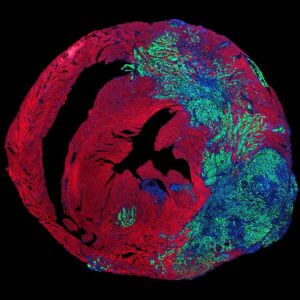
Image of lung cancer cells (in green) growing in a heart, in which cardiomyocytes are stained in red. Nuclei are stained in blue. [Ciucci et al., Science 2026]
After injecting human cancer cells directly into the heart muscle, they compared tumor behavior in the unloaded transplanted heart versus the animal’s native, mechanically active heart. Across their experiments, Ciucci et al. found that mechanical load consistently suppressed the growth of various cancer types, while unloading the heart promoted tumor cell proliferation within cardiac tissue.
According to the study findings, mechanical forces within the tissue reshape the cancer cell genome’s regulatory landscape, influencing whether cells can proliferate. Central to this process is Nesprin-2, a protein that transmits mechanical signals from the cell surface to the nucleus. “Nesprin-2, a protein known to mediate mechanotransduction from the cytoplasm to the nucleus, emerged as a key molecule sensing mechanical forces operating in beating hearts and translating them into reduced cell proliferation,” the scientists reported.
Nesprin-2, a component of the LINC complex, senses the mechanical microenvironment of the heart and functionally alters chromatin structure and histone methylation, reducing gene activity linked to tumor cell proliferation. When Nesprin-2 was silenced in cancer cells, those cells regained the ability to grow in the mechanically active environment of the heart, forming tumors. “Silencing of Nesprin-2 in lung cancer cells prior to their implantation in the heart in vivo restored the capacity of the cells to proliferate in the presence of physiological mechanical load, resulting in the formation of large tumors,” the authors stated.
The team noted that their collective results shed light on the role of mechanical forces in protecting the heart from cancer and may pave the way to new approaches to cancer therapy. “This offers fundamental insights into the biology of cell proliferation within the myocardium, and additionally, the mechanical stimuli that operate in a beating heart could be exploited for the development of a mechanical therapy for cancer.”
SAN DIEGO – At the American Association for Cancer Research (AACR) Annual Meeting 2026, the conversation around AI-driven cancer research has moved decisively past theory. Now the focus is on what’s being deployed and how to gain researchers’ and clinicians’ trust.
Fay Lin, PhD, senior editor, technology at GEN, and Jonathan D. Grinstein, PhD, North American editor at Inside Precision Medicine, discuss how AI is increasingly embedded across cancer research areas, from organoid models to pathology. Yet challenges such as data integration, longitudinal patient tracking, and clinician confidence continue to hinder its impact on patient outcomes.
Watch the full discussion below for a clearer view of the trends, tensions, and inflection points in AI shaping the future of cancer research: