

Monitoring Mammalian and Microbial Bioprocesses in Real Time

At the 2026 BiOS conference in San Francisco, researchers presented a biosensing platform aimed at improving how living cells and tissues are monitored during drug bioprocessing. Known as TissueSense, the system provides continuous, real-time insight into cellular behavior without disrupting the biological environment.

In biopharmaceutical manufacturing, maintaining consistent cell health and productivity is essential. Yet many monitoring approaches still rely on intermittent sampling or endpoint measurements, offering only partial visibility into dynamic biological processes. TissueSense addresses this limitation by enabling continuous, in situ observation—capturing changes as they unfold.

The platform combines resonator-based photonic sensing with phase contrast microscopy, allowing simultaneous detection of biochemical activity and structural changes in cells. This dual approach provides a more complete picture of how cells respond to process conditions, such as nutrient shifts or environmental stress, which directly impact production outcomes.

A defining feature of the system is its label-free operation. Conventional biosensing methods often require fluorescent markers or reagents that might alter cell behavior or limit long-term monitoring. By removing these constraints, TissueSense supports extended observation of living systems in conditions closer to their natural state, an advantage for prolonged bioprocesses.

Data from the platform are analyzed using machine learning to simultaneously quantify up to 18 biomarkers, linking molecular outputs—such as secreted proteins—to tissue structure and function. This multiplexed capability is particularly relevant in drug manufacturing, where small variations in cellular activity can influence yield, quality, and reproducibility.

While TissueSense focuses on mammalian tissue models, parallel advances in microbial systems highlight a broader shift toward continuous, high-resolution monitoring across bioprocessing platforms. In yeast-based systems, for example, researchers have developed microbead-based cultivation methods that enable high-throughput, label-free screening of millions of individual mutants in extremely small volumes. These approaches can enrich desirable traits, such as resistance to metabolic inhibitors, by thousands-fold, supporting strain optimization for industrial bioproduction.

Similarly, in bacterial bioreactors, automated flow cytometry techniques now allow real-time tracking of population dynamics and physiological states. By combining DNA staining with indicators of active replication, these systems provide continuous insight into growth rates and cell cycle behavior, helping optimize feed strategies and overall process performance.

Together, these developments point toward a more integrated future for bioprocess monitoring—one that spans mammalian, yeast, and bacterial systems. Continuous, non-destructive sensing technologies are enabling researchers and manufacturers to move beyond static measurements toward dynamic control of biological production.

The post Monitoring Mammalian and Microbial Bioprocesses in Real Time appeared first on GEN – Genetic Engineering and Biotechnology News.

Overcoming the VLP Purification Bottleneck

Virus-like particles (VLPs) are a popular platform for biomanufacturers because of their good biosafety profile, immunogenicity, and ease of engineering, although downstream purification remains bottlenecked.

“Successful purification of VLPs cannot rely on any single unit operation, but instead requires integrated, product-specific process design guided by the critical quality attributes of the target particle,” Jingchao Zhang, PhD, Chengdu University of Technology, and Chen Chen, Tianjin University, point out in a recent review. The complex processes needed to generate VLPs result in multiple routes to success, and they are each vulnerable to environmental and process-induced stress, they note.

One option to mitigate such stress is buffer optimization. When developing buffers, they advise evaluating pH, ionic strength, ion species, excipients “such as nonionic surfactants,” and stabilizers that “improve thermal and freeze-thaw robustness.” Start by identifying conditions that most often cause the target molecule to fail, they advise. “This stress-informed characterization is particularly valuable because the stability of VLPs cannot usually be inferred from a single condition alone and may depend on both particle type and solution context,” they write.

Another option is “gentle chromatography.” By that, Zhang and Chen mean macroporous (100 nm or greater pore sizes) chromatography media that support process scaleup by improving binding capacity, increasing mass transfer rates and recovery, and are gentler on VLPs than the narrow (less than 30 nm) agarose media that often are used. Emerging options include non-woven structures and medium-to-large pore hydrogel microspheres, both of which have achieved success, respectively, with adeno-associated viruses and exosomes. “Overall, the chromatographic strategy for VLP purification should be framed as a balance between separation performance and particle preservation,” they conclude.

Process analytical technology is also increasingly valuable as technologies emerge to enable real-time monitoring, analysis, and control, they add.

Managing product heterogeneity is another challenge, as VLP downstream purification must address process- and product-related impurities. Typically, this is a multi-step endeavor “including clarification, ultrafiltration/diafiltration, chromatography, and, where appropriate, disassembly/reassembly-based purification,” Zhang and Chen report.

So far, there haven’t been many viral clearance studies for VLPs, they say. Part of the challenge is the many different expression systems used, such as E. coli, Chinese hamster ovary cells, and insect baculovirus expression vector systems.

In comparing the major downstream viral clearance strategies mentioned in the literature, Zhang and Chen report:

  • Solvent/Detergent (TritonX-100) treatment has some environmental concerns and mainly inactivates enveloped viruses.
  • Anion-exchange chromatography shows robust viral clearance only if the isoelectric points of the virus and VLPs differ.
  • Ion-exchange chromatography is constrained in high-salt or complex sample matrices.
  • Cation-exchange chromatography is highly effective in specific conditions.
  • Virus filtration is gentle and clears enveloped and non-enveloped viruses, but large VLPs may be larger than the filter pore size.

Looking forward, Zhang and Chen predict near-term VLP purification advances will include: responsive materials and media that enable precise control; AI and machine learning that predicts structure-performance relationships to accelerate materials screening; greater process intelligence; continuous processing; increased use of quality-by-design principles; parallel development in regulatory science; and clearer regulatory standards.

The post Overcoming the VLP Purification Bottleneck appeared first on GEN – Genetic Engineering and Biotechnology News.

Antigen‑Stabilized Nanobody Probes Enable On‑Demand, Multicolor Protein Imaging

Fluorescent probes have reshaped how biologists study living systems, making it possible to watch viruses invade cells, follow the cell’s internal waste‑disposal machinery, and track the signaling events that fuel tumor growth. Yet even with decades of innovation, a fundamental limitation has persisted: most fluorescent nanobody probes glow whether or not they are bound to their targets. That constant background haze can blur the very molecular details researchers are trying to resolve.

A new imaging platform developed by scientists at Albert Einstein College of Medicine and the Salk Institute for Biological Studies aims to eliminate that problem entirely. The technology, described in Nature Methods in a paper titled “Synthetic multicolor antigen-stabilizable nanobody platform for intersectional labelling and functional imaging,” uses engineered fluorescent nanobodies that become brightly fluorescent only when they bind their intended protein targets. These “on‑demand” probes, known as VIS‑Fbs (visible-spectrum target-stabilizable fluorescent nanobodies), illuminate proteins inside living cells and animals with far greater clarity than conventional tools.

“The key advantage of our approach is that the signal appears only where the target protein is present,” said Vladislav Verkhusha, PhD, co‑corresponding author and professor of genetics at Einstein. “That eliminates the background glow that has long limited the precision of intracellular imaging.” His collaborator, Axel Nimmerjahn, PhD, professor and the Françoise Gilot‑Salk Chair at Salk, added, “This work establishes a versatile platform for imaging proteins with high specificity and minimal background. It opens new opportunities to study how molecular and cellular processes unfold in real time across diverse biological systems.”

Nanobodies have become increasingly valuable for live‑cell imaging because they can be engineered to bind specific proteins with high affinity. But their ongoing fluorescence has remained a stubborn obstacle. The VIS‑Fb design solves this by making the probes unstable when unbound; they rapidly degrade unless they encounter their target. Binding stabilizes the nanobody and triggers bright fluorescence, reducing background noise by as much as 100‑fold. The team also created VIS‑Fbs that span nearly the entire visible spectrum, from blue to far red, enabling simultaneous tracking of multiple proteins or cellular processes within the same cell.

The researchers developed a modular engineering platform, instead of a single probe, capable of generating VIS‑Fbs for a wide range of targets and experimental needs. They integrated more than 20 fluorescent proteins and biosensors into multiple nanobody scaffolds, creating a flexible system that supports multicolor imaging, light‑switchable variants for precise temporal control, and functional readouts of ions and metabolites. This allows the probes not only to show where proteins are but also to show what those proteins are doing in real time. According to first author Natalia Barykina, PhD, “The VIS‑Fb approach allows us to identify and track specific cell populations in living organisms based on the proteins they express, rather than just their location.”

In mice, VIS‑Fbs allowed for high‑contrast imaging of neuronal and astrocyte activity during behavior. In zebrafish embryos, the probes captured rapid developmental changes and responses to drugs that modulate signaling pathways. “Our results show that this imaging platform offers a much clearer and more precise view of how proteins behave inside living systems,” Verkhusha said. “It opens the door to studying complex biological processes, such as cell signaling, development, and disease progression, in new ways.”

The post Antigen‑Stabilized Nanobody Probes Enable On‑Demand, Multicolor Protein Imaging appeared first on GEN – Genetic Engineering and Biotechnology News.

Alzheimer’s Linked to Cancer Mutations in Brain Immune Cells

As the body ages, cells naturally accumulate dozens of genetic mutations each year. New research reported by researchers at Boston Children’s Hospital suggests that the brain’s resident immune cells, microglia, amass mutations in specific cancer-driving genes, yet they don’t manifest as cancer. Instead, these mutations may help drive Alzheimer’s disease.

The research team, led by Christopher Walsh, MD, PhD, chief of the Division of Genetics and Genomics at Boston Children’s and an investigator of the Howard Hughes Medical Institute, and collaborators Alice Eunjung Lee, PhD, and August Yue Huang, PhD, also in the Division of Genetics and Genomics—who are all professors at Harvard Medical School and associate members of the Broad Institute of MIT and Harvard—say their study findings may provide insights into new Alzheimer’s disease diagnostics and treatments.

“We find that to some extent, Alzheimer’s disease is a little like cancer—driven by the same mutations that drive blood cancers like lymphoma and leukemia,” said Walsh. “This is helpful because we have a lot of drugs to fight cancer and some of them might be useful therapeutically for Alzheimer’s disease.”

The researchers reported on their work in Cell, in a paper titled “Somatic cancer variants enriched in Alzheimer’s disease microglia-like cells drive inflammatory and proliferative states.”

Microglia function as the brain’s resident immune cells, acting as garbage collectors, eating debris and infected or dying cells. “The importance of microglia in Alzheimer’s disease (AD) pathogenesis has been demonstrated by large-scale genetic association studies, which have identified AD risk variants in a growing list of microglia-related genes,” the authors wrote. “Once abnormally reactive in AD, microglia can promote synaptic and neuronal loss while exacerbating tau proteinopathy.”

Unlike the rest of the immune system cells that circulate in the blood throughout the body, microglia don’t cross the blood brain barrier—or so experts thought. For their newly reported study the research team sequenced 149 cancer-driving genes from tissue samples in 190 brains donated from people with Alzheimer’s disease compared to 121 healthy brains. The Alzheimer’s samples had more single DNA letter changes than the healthy tissue with the most changes found repeatedly in the same five cancer driver genes, meaning the microglia were amassing mutations in specific genes. “Deep (>1,000×) panel sequencing of 311 brain samples revealed enrichment of somatic single-nucleotide variants (sSNVs) in cancer driver genes in AD brains, especially in genes associated with clonal hematopoiesis (CH),” the team stated.

The cancer gene mutations the researchers discovered in the microglia are commonly found in blood cancers. Because of this, the team tested blood samples from people with Alzheimer’s disease for these same mutations. The team didn’t expect the blood to have these mutations. However, Walsh’s team found the blood cells of the same Alzheimer’s patients carried the same cancer mutations too.

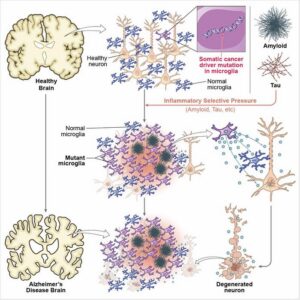
Microglia-like immune cells with cancer mutations (purple) emerge in the brain. Separately, clumps of proteins, like Tau or amyloid, accumulate in the brain, making the environment hostile. Those microglia cells with mutations get selected for survival and proliferation, creating an inflammatory environment that makes innocent bystander neurons die, contributing to Alzheimer’s disease. [Christopher Walsh and colleagues at Boston Children's Hospital]
Microglia-like immune cells with cancer mutations (purple) emerge in the brain. Separately, clumps of proteins, like tau or amyloid, accumulate in the brain, making the environment hostile. Those microglia cells with mutations get selected for survival and proliferation, creating an inflammatory environment that makes innocent bystander neurons die, contributing to Alzheimer’s disease. [Christopher Walsh and colleagues at Boston Children’s Hospital]

“These sSNVs were associated with clonal expansion and carried by both microglia-like brain macrophages (MLBMs) in multiple brain regions as well as paired blood, suggesting a likely hematopoietic origin,” the investigators stated. “It was actually a really unexpected finding that suggests a totally new mechanism for Alzheimer’s disease pathogenesis,” said Huang. “The findings mean that the blood’s immune cells with cancer mutations are likely getting into the brain and contributing to disease.”

The researchers theorize that the blood-brain barrier weakens, either by age or injury, allowing the blood’s immune cells to cross into the brain. These new arrivals then convert into microglia-like cells. Separately, clumps of proteins accumulate in the brain, triggering microglia to proliferate and respond. The cells most likely to dominate are those with a selective advantage, such as the microglia-like cells with the cancer mutations. However, these mutant microglia also make the environment more inflammatory and hostile than that of the healthy microglia, causing innocent bystander neurons to die off, which leads to Alzheimer’s disease. “These findings suggest that clonal somatic driver variants in MLBMs are enriched in AD, potentially promoting neuroinflammation and neurodegeneration,” the researchers noted. “Potential roles of somatic cancer driver variants in AD pathogenesis open up a whole new range of therapeutic avenues in AD, complementary to approaches emphasizing amyloid and tau.”

Lee added, “Because it’s hard to access brain tissue in a living patient, genetic screens using blood samples could be developed to test whether a person carries these mutations, and has an increased risk of developing Alzheimer’s disease.” Lee and Huang performed a follow-up study, now posted as a preprint on bioRxiv. Here, they demonstrated that cancer driver mutations observed in patient blood samples increased risk of Alzheimer’s disease independently of a well-established genetic risk factor, APOE4.

The post Alzheimer’s Linked to Cancer Mutations in Brain Immune Cells appeared first on GEN – Genetic Engineering and Biotechnology News.

Navigating with Excellence: The Multi-Faceted Service Lines of Precision Logistics

Navigating with Excellence The Multi-Faceted Service Lines of Precision Logistics eBook coverThe global pharmaceutical industry operates within one of the most demanding and high-stakes environments of our modern world. Unlike traditional retail supply chains, pharmaceutical logistics is a discipline defined by extreme sensitivity, rigorous regulatory oversight, and an unwavering commitment to patient and product safety. It is the pinnacle of expertise on what happens insideand outside a shipment during its journey.

Marken UPS Healthcare Precision Logistics doesn’t simply move packages. We manage a complexecosystem of specialized service lines designed to maintain the integrity of priority shipping and lifesaving medications from the point of manufacture to the patient’s bedside. Understanding these services is essential for an appreciation of how modern medicine reaches the global population with its efficacy intact.

Specialty logistics distinguishes itself from general freight through a relentless commitment to technical precision and customized infrastructure. While standard shipping relies on high-volume throughout and routine packaging, specialty logistics demands a bespoke approach to every mile of the journey. This often involves the integration of advanced cold chain innovation to maintain biological integrity or the deployment of specialized technology for visibility of critical materials and equipment in transit.

Beyond the physical hardware, the sector is defined by a rigorous regulatory landscape where practitioners must navigate a complex web of international compliance, hazardous material protocols, and detailed chain-of-custody requirements. In this environment, good enough is never an option. Every variable, from the precise humidity levels of a storage facility to vibration dampening on a pallet shipper, is carefully monitored.

This level of granularity ensures that whether a shipment contains a life-saving pharmaceutical batch or a one-of-a-kind special piece of equipment, it arrives not just on time, but in its exact intended state. Consequently, precision logistics serve as the invisible backbone for industries where the cost of failure far exceeds the cost of transport, necessitating a fusion of engineering, legal expertise, and sophisticated data analytics to manage the inherent risks of moving the world’s most challenging cargo.

Transitioning from the theoretical complexities of the industry to the practical execution of a global supply chain requires an adaptable, expert-led approach. While the challenges of specialized logistics are diverse, ranging from strict thermal requirements to extreme environmental demands, Marken’s operational framework is built on seven distinct pillars of excellence.

Each of these service lines has been engineered to address a specific facet of the logistical puzzle, providing the specialized equipment, certified personnel, and rigorous oversight necessary to mitigate risk. By categorizing our capabilities into these dedicated sectors, we ensure every project receives a novel strategy rather than a one-sizefits- all solution.

These service lines represent more than just transportation or clinical trial categories. They are specialized disciplines derived from decades of work in logistics that allow us to maintain a high rate of success for the world’s most sensitive and high-value cargo. In this eBook, Marken experts share how these precision-driven services ensure the performance, reliability, and success of global supply chains.

The post Navigating with Excellence: The Multi-Faceted Service Lines of Precision Logistics appeared first on GEN – Genetic Engineering and Biotechnology News.

The Download: turning down human noise, and LA’s stunning subway upgrade

This is today’s edition of The Download, our weekday newsletter that provides a daily dose of what’s going on in the world of technology.

The noise we make is hurting animals. Can we learn to shut up?

As human society has expanded, animals have started struggling to hear one another. For many birds, the noise has grown so loud that they’ve begun to sing with faster trills. Now, their mating calls aren’t as effective. 

The growing hubbub can also increase bird-on-bird conflict, and entire species that can’t handle urban clamor simply leave town for good. But there are technological solutions to the noises hurting animals—and they could help humans, too.

Read the full story.

—Clive Thompson

Los Angeles is finally going underground

In May, a new subway segment will connect downtown Los Angeles to the Pacific Ocean. What today can be an hours-long drive through a busy, museum-­packed stretch of the city will be, if all goes well, a 25-minute train ride.

The existence of subway stops in this part of town—known as Miracle Mile—is a technological triumph over geography and geology. Find out why.

—Adam Rogers

Both of these stories are from the next issue of our print magazine, which is all about nature. Subscribe now to read it when it lands tomorrow.

The must-reads

I’ve combed the internet to find you today’s most fun/important/scary/fascinating stories about technology.

1 Apple’s Tim Cook is stepping down as CEO
Hardware chief John Ternus will take over from him in September. (CNN)
+ Ternus’ defining challenge may be fixing Apple’s AI strategy. (CNBC)
+ How does Cook compare with Apple’s other CEOs through the years? (NYT $)

2 Anthropic’s new Amazon deal escalates the compute war with OpenAI
Anthropic will spend more than $100 billion on Amazon compute.(Axios $)
+ OpenAI touted its compute advantage over Anthropic two weeks ago. (Bloomberg $)
+ Here’s why the AI compute explosion has only just begun. (MIT Technology Review)

3 Silicon Valley is trying to get into the news business
The latest addition is Andreessen Horowitz’s MTS. (The Information $)
+ OpenAI recently bought a business talk show. (NPR)
+ They join Elon Musk’s X and a new Peter Thiel-backed startup. (Axios)

4 The banking industry is scrambling to get access to Anthropic’s Mythos
As regulators review the risks to financial services. (Reuters $)+ Germany’s central bank has called for wider access to Mythos. (Bloomberg $)

5 War memes are turning conflict into content
Fueled by recommendation systems designed to keep you hooked. (Wired $)
+ AI is turning the Iran conflict into theater. (MIT Technology Review)

6 AI is boosting worker productivity, but not their paychecks
Employees aren’t financially benefiting from their extra efficiency. (Quartz)
+ New data sheds light on the current state of AI. (MIT Technology Review)

7 Amazon’s ambition to rival Starlink has hit a setback
After a Blue Origin rocket was grounded. (FT $)

8 Jeff Bezos’s AI lab has neared a $38 billion valuation
In an imminent $10 billion fundraising deal from investors. (FT $)
+ The startup focuses on AI for engineering ‌and ⁠manufacturing. (Reuters $)

9 Scientific AI agents have got their own social network
Where they share, debate, and discuss research papers. (Nature)

10 A Mars rover has discovered new “origin-of-life” molecules
They suggest Mars wasn’t always a lifeless red desert. (Gizmodo)

Quote of the day

“He’s been a transformational Apple CEO that’s always had a steady hand at the wheel. I think that will be his legacy. He had massive shoes to step into, and he was the ​right person for the job. That’s the ​way he’ll be remembered.”

One More Thing

""

MIKE MCQUADE


The race to save our online lives from a digital dark age

There is more stuff being created now than at any time in history, but our data is more fragile than ever. One day in the future, YouTube’s videos may permanently disappear. Facebook—and your uncle’s holiday posts—will vanish. 

For many archivists, alarm bells are ringing. Across the world, they’re scraping up defunct websites, saving at-risk data collections, and developing data storage technologies that could last thousands of years. 

Their work raises complex questions. What is important to us? How do we decide what to keep—and what do we let go? Read our story on the thorny problems of digital preservation.


—Niall Firth

We can still have nice things

A place for comfort, fun and distraction to brighten up your day. (Got any ideas? Drop me a line.)

+ Apple’s forgotten co-founder recently shared his story of the company’s early days.
+ Witness a rare underwater volcanic eruption in the Solomon Islands.
+ Learn what makes Shakespeare’s writing so effective in this masterful analysis.
+ An Artemis II astronaut shared a stunning iPhone video showing Earth disappear behind the Moon at 8x zoom.

AACR 2026: A Video Update from San Diego

The American Association for Cancer Research (AACR) meeting is off and running in San Diego. Julianna LeMieux, PhD, Deputy Editor in Chief at GEN, and Damian Doherty, Editor in Chief at Inside Precision Medicine, are on the ground—in the talks, expo hall, and press room, covering as much of the news as they can. Here, they take a moment to chat about the first few days at the meeting.

The post AACR 2026: A Video Update from San Diego appeared first on GEN – Genetic Engineering and Biotechnology News.