

Stockport NHS Foundation Trust’s pathology department has gone live with a laboratory information system to enhance test results processing.
Awakening from the Trance
This blog was originally posted by the TLC Foundation for BFRBs
Trichotillomania touches on all levels of human experience, from the neurological to the spiritual. It represents the interactions of brain chemistry, but also habituated physiological responses, sensory processing, behavior patterns, characteristic emotional states, perceptual styles and beliefs, and the sense of interconnectedness with others and the experience of faith. It is more than just a behavior, although it is most apparent when it manifests itself in that way.
Trichotillomania can be treated at all of these levels through different treatment approaches: medication, relaxation and response prevention, behavior modification, hypnotherapy, psychotherapy, cognitive therapy and visualization, group therapy and spiritual practices. The most effective approach will depend on the specific needs and circumstances of each individual at specific times, as well as on the compatibility of the personalities of the treatment provider and patient/participant.
In this article I will present my own view of treatment with a particular focus on how to understand and address the aspect of trance.
“Trance” is not a clinical term, but it is one which most pullers seem to recognize immediately as a significant part of the hair pulling experience: particularly when reading or watching TV. However, I believe that any time one is pulling, one has entered a trance state and that trance states occur with great frequency even at other times. To look at how to make use of this concept I will first describe what I think treatment needs to address.
Trichotillomania as a symptom: My approach is to look at what the behavior of pulling means to a particular person, and what it means about them. I view pulling as a symptom which indicates something about what is going on in that person’s life and can be best understood if we look at the context in which it occurs – both over time (how did it evolve), and ecologically (how does it fit into the network of the person’s relationships, commitments, self-perceptions, experiences of their own body and emotional states, etc.).
Symptoms are an indication of the existence of some other process. Just as a fever may reflect a viral infection, a repetitive behavior reflects an underlying mental activity. The symptom develops in response to the activity and one of its functions is to achieve some control over the consequences of that mental activity. I believe that trichotillomania indicates an attempted solution to a psychological challenge (or opportunity) one is facing in one’s life. However, it is an ineffective solution for two reasons. Firstly, it doesn’t alter the situation which has become challenging, and so the underlying causes remain unchanged. Secondly, by drawing attention onto itself it obscures those underlying causes. It distracts attention from them.
But the behavior, none the less, does have some purpose and utility. It relieves the anxiety of becoming too aware that there are challenges and opportunities which one feels unprepared to confront.
The role of emotions:
The mechanism which could be drawing one’s attention to these challenges and opportunities is the experience of emotional reaction. Emotions serve to amplify our perceptions of situations by making the good seem better and the bad seem worse. In that way, they lead us to focus on what is important to us so that we will take action. Being able to notice and interpret our emotions is something we learn as we grow up. Emotions represent a kind of language for helping us make meaningful choices as we engage with life.
But if these emotions were felt to be too overwhelming – if what they indicated felt too bad to be tolerated because we did not learn how to resolve the situations they drew attention to – then we eliminated them from our emotional vocabulary and we restricted our awareness of them. Now, when those situations reoccur, rather than notice our feelings of hopelessness and helplessness, we may turn to other mechanisms, more basic ones rooted in physical sensations, to occupy ourselves and restore some sense of order to the world.
So, in this model, the behavior of hair pulling is not an indicator of psychological inadequacy, but rather a lack of awareness. It reflects a split between awareness/thoughts and sensations/feelings. It is the result of an unknown mental process, something one has not been able to assimilate into one’s conscious thought, for which no words or language have been developed.
If this could be understood then I believe there would be less justification for feelings of shame connected with Trichotillomania, because Trichotillomania represents an underlying process outside of personal awareness, and thus is not something voluntarily chosen. (It would also answer the following disturbing statement frequently made to hair pullers: “You could stop if you really wanted to.”)
I have so far described how emotional activity and unconscious thoughts affect us in ways which we do not recognize. Despite this lack of recognition, we still need to adjust to them and regulate or organize ourselves. A good example of this is the way in which a fussy baby, if not picked up or fed when it wants to be, learns to get its thumb into its mouth and suck on it. It is finding a way to organize its reactions to its world by retreating into an attitude of self-sufficiency. In this way it solves the problems of the conflict it experiences between the emotions it feels and the lack of a way to take effective action about them in the outside world. It restores order by returning to a sensation-based activity which it has control over. It has learned to retreat into a trance.
The similarities between this example and the experience of hair pulling are striking. So how is Trichotillomania like a trance, exactly?
Trance:
The (Oxford) dictionary defines “trance” in these ways: a suspension of consciousness; a state of mental abstraction from external things; absorption, exaltation, rapture, ecstasy. Going into a trance is turning away from the world, suspending engagement with it, and entering a twilight zone of self-enchantment. The experience is one of being in between states: neither in one’s own mind, nor aware of one’s body. One has turned away, both from the rest of the world and from the rest of oneself.
It is a state in which one doesn’t think about what one feels, and doesn’t act on what one feels. One has turned away from the parts of the self which are concerned with action and purposefulness. In the trance state, a part of the personality takes over which doesn’t care about anything (except the act of pulling) and ignores the existence of time or consequences to one’s actions. It is the opposite of the perfectionist attitude so common to many hair pullers. Becoming entranced in the act of reading, for example, one detaches from the here and now, and allows this part of the personality to “come out”: while the cat’s away, the mouse plays. It is a secure, dependable, magical place in which one can avoid dealing with the stimulation of one’s spontaneous emotional responses to life.
If we look again at the role of emotions as amplifiers of perceptions, we see that what is happening in this state is that one is neither thinking about, nor acting on, what the emotions could be indicating. And as they indicate what is important so that action can be taken, the trance state eliminates the possibility of taking the action required.
How does this detaching process become chronic?
I believe it is the result of repeated experiences of failing to take effective action on what one’s emotions tell one is important. This failure can have many causes, but the result is that these important situations become perceived as challenging and threatening because they are felt as over stimulating. To protect oneself from discomfort, one disassociates from the situation. The part of oneself which perceives or feels what is going on is split off from consciousness. What remains conscious is the part which doesn’t feel and which preserves a sense of order and calm. Gradually, a gap develops between this external presentation of the self – as coherent, caring, positive – and an inner state of feeling confused, frustrated, and overwhelmed.
A false self develops, a self which appears to be more in control than is actually felt, and which one tries to believe in. The fear of having this façade penetrated adds greatly to the level of stress felt by hair pullers. Because this false self cannot be dropped when one’s gut reactions tell one to, one becomes trapped in a vicious circle that leaves one over stimulated (including the times when one merely seems to be bored), detaching from one’s body, and trying to regain control. A strong need is felt to reconnect to the body and feel grounded.
Trichotillomania as a return to the body:
The route to feeling in one’s body again is through becoming hyperaware and hypersensitive to sensation. This is a more basic and elementary experience of oneself: one cannot think or feel what is happening, so one uses a physical behavior to establish a link between unconscious inner experience and being in the real, physical world. This provides a solution to the twilight state of feeling detached. The sensation-focused behavior provides a substitute sense of being connected, and its ritualistic aspect creates a sense of soothing order rather than chaos.
So, looked at in this way, the act of pulling a hair actually represents the second stage of entering into a trance. The trance is triggered by the habitual reaction of disassociating rather than facing a situation which one perceives as overwhelming. But while an attitude of order and calm is being adopted (a state of “mental abstraction”), the experience of being detached from the feelings in the body becomes disorienting and the urgent need is felt to focus on the sensation of touching, playing with, and pulling hair. This provides the experience of concreteness and connectedness which allows the trance to continue.
Awakening:
What is needed is a process for regaining consciousness and turning back to engaging with life. How does one wake up? How can one build a sort of observational platform from which to watch the process of entering into a trance; one which can be separate from the process itself? I would suggest that rather than start with the ultimate goal of avoiding trance states altogether (which may be unreachable), a more pragmatic approach would be to learn how to wake up once one starts.
When we drive long distances on freeways and our attention wanders, we sometimes find ourselves drifting over into the next lane. If there were raised lane markers on the road, they would then alert us by causing a noise and a vibration as the car drove over them. That is the kind of alarm system we are looking for. It doesn’t prevent our minds from wandering, but it brings us back to the here-and-now experience before we get into trouble.
Such a system does exist: it is the sensation of a hair being pulled out. Once one hair is pulled, the opportunity exists to break the trance. That hair can be a signal to come back to the here and now rather than getting into the trouble of starting a pulling binge. (The goal of stopping at one hair pulled would also very likely include the benefit of making it much easier to commit to a realistic process of bringing the behavior within tolerable limits.)
How can one learn to stop at just one? Setting such a goal becomes much more possible if one understands one’s reasons for avoiding the goal until now. I have discussed in this article how Trichotillomania is a process which provides an attempted solution to an underlying tension. There is an inevitable anxiety about relinquishing a familiar, dependable behavior. A part of oneself therefore resists changing it and depends on the benefits it brings. This part has no intention of allowing any changes to occur unless one is prepared for the emotional experiences that follow, and it protects one from them.
A way to understand this resistance to change would be to think of the patterns of our behavior as a balanced mobile hanging from the ceiling. All its parts are interconnected and form a stable pattern. If we remove one of the parts, all of the others start to swing wildly until they settle into a new, substantially different formation. The intermediate stage of unbalanced, indeterminate movement could be likened to the feeling of overstimulation from one’s emotions when the ritualistic trance is denied.
To prepare for this change, an expanded awareness of emotional experience and what it teaches is indispensable. The remainder of this article offers some suggestions for work that can be done alone to expand this ability. This task is made much easier and more effective, however, when it is done in the context of a healing dialogue: either in individual or group therapy, or in a support group. This option deserves serious consideration because the act of communicating to another person helps bring one’s inner experiences into focus. Additionally, when there is the trust that the other person is willing not only to listen but to actively attempt to grasp what the speaker means from the speaker’s own point of view, the feeling of validation and recognition received makes awareness of the emotional states more bearable.
Reading the signals:
Part of the personal preparation which can be done is to establish intent to learn from what is found when one tries to read the signals. This would require a willingness to recognize that there are good reasons for what one feels rather than prejudging emotions as wrong, inappropriate, or proof of all the “bad” things one has come to believe about oneself. It also requires a willingness to feel discomfort, hurt, and vulnerability so that there can be a return to wholeness and the sense of being fully alive.
1. The most direct step is simply to ask yourself questions such as: What am I feeling? What is on my mind? Is something bothering me? What do I want right now? Is there something I should be doing? Special attention should be paid to the first answer that comes to mind, even if it very quickly disappears or seems insignificant. You should have an open mind and be prepared to be surprised. Before asking yourself these questions, stop the activity you are doing, if possible. If answers do not emerge the following techniques can be tried.
2. Let your body speak. Allow yourself to become aware of where you feel tension or discomfort. Imagine that that part of you has a voice and can answer the questions in Step One. Try asking follow-up questions to learn more.
3. Try exaggerating the physical state that you are in. That is, whatever movement your body is making or would like to make, take it to an extreme as if you were a very melodramatic actor or dancer who had no inhibitions. Again, think about how your body is expressing answers to the questions in Step One.
4. Visualize yourself as a child of about five and ask the questions of her or him. The answers should seem to be in the language of a 5-year-old. It might help to hold an object such as a cushion or stuffed animal to you as you try to make contact with yourself in this way. It also might help to combine this with some exaggeration of body expression. Additional questions you might ask could be: What do you need from me? Is somebody upsetting you? (See Reference 1.)
5. Write a question to the child, then switch your pen to your other hand and write the answer with that hand. You should write very quickly and with no attempt to make the writing more legible. Then switch your pen back to your original hand for a further question. Continue the dialogue, and the switching of hands, until no further clarification is necessary. The purpose of this technique is to facilitate the spontaneous flow of ideas. (See Reference 2.)
6. Write out the questions as complete sentences to be completed and complete the same question five times as quickly as possible. The questions would be rewritten as follows: Right now, I want….; or: I am upset because…. Allow any response to come forward. Often, a few unrevealing responses will be followed by one unexpected and more valuable one. (See Reference 3.)
7. Hold the hair which has just been pulled out and ask yourself: What did this hair give itself up for? A significant reason for the failure to stop hair pulling is the frequent presence of trance states, which enable one to deny the consequences of the behavior. Additionally, the experience of trance encourages one to focus on physical sensations such as the feeling of a hair being pulled, so as to achieve a greater sense of being connected to reality.
I have described how one enters a trance when certain situations trigger a habituated expectation of becoming overwhelmed. In self-defense one suspends consciousness of the challenge and retreats into a state of emotional detachment. The alternative to the trance, then, is to identify and assimilate the emotional cues about the situation so that appropriate action can be taken. The sensation of the first hair being pulled can serve as an alarm to awaken one from the trance and begin this process of self-evaluation and a return to an alert engagement with life.
Reference 1: Margaret Paul. Inner Bonding. San Francisco: Harper Collins, 1990.Reference 2: Lucia Cappachione. The Power of Your Other Hand. North Hollywood, CA: Newcastle Publishing, 1988.Reference 3: Nathaniel Branden. How to Raise Your Self-Esteem. New York: Bantam, 1987.
The post Awakening from the Trance appeared first on International OCD Foundation.
STAT+: Alnylam to partner with Inceptive Nucleics for AI foundation models for RNAi therapeutics
Jakob Uszkoreit went from inventing the “T” in ChatGPT to putting the “AI” in Alnylam’s RNAi therapeutics.
After over a dozen years at Google, where he’d co-authored the seminal “Attention is all you need” paper that laid the foundations for artificial intelligence models like GPT, Uszkoreit in 2021 left a job at Google Brain to start Inceptive Nucleics. The company is building “AI foundation models of life” — models that will hopefully learn so much about how biology operates that they will be reusable across many different tasks without having to be trained specifically to do them.
On Wednesday, Alnylam and Inceptive announced a new, three-year strategic collaboration worth up to $2 billion, with $30 million up front in cash and equity in the startup. The additional payments will be predicated on the co-discovered drugs achieving preclinical, regulatory, and commercial sales milestones. In 2025, Alnylam’s total revenues were $3.7 billion.
Experienced Physicians Still Beat AI at Skin Cancer Diagnosis
Artificial intelligence could help support less-experienced clinicians in identifying skin cancer but it still performs more poorly compared with expert dermatologists, research suggests.
The findings, in JAMA Dermatology, suggest that the oft-reported superiority of AI in diagnosing skin cancer may need closer inspection in situations that are more similar to daily clinical practice.
First-generation convolutional neural network (CNN) systems did not maintain their reported advantages when confronted with a broad spectrum of cases, including rare and atypical presentations.
Foundation models were more promising, reproducing a substantial portion of clinical expertise and approaching the diagnostic accuracy of well-trained clinicians while surpassing that of novices.
Nonetheless, these models still fell short of the best experts who had at least a decade of experience.
“This shows that human expertise at the highest level remains indispensable and that experience continues to be the most powerful tool for performance,” reported Luc Thomas, PhD, from Hôpital Lyon Sud in France, and co-workers.
They suggested: “AI tools may be most valuable as decision-support systems for less experienced clinicians, effectively functioning as a virtual mentor.”
The prevailing narrative suggests that AI has matched or surpassed human expertise in medical diagnosis, particularly in the imaging-based specialties.
Yet a substantial gap remains between promising results under controlled experimental conditions and meaningful clinical implementation, which requires integrating factors such as patient demographics, medical history, physical findings, and contextual information.
To get a better comparison in realistic clinical settings, Thomas and team compared the diagnostic performance of 652 physicians with varying dermatological expertise with three AI algorithms: a first-generation CNN model and the PanDerm uni- and multimodal foundation models.
The dataset comprised dermatological images—including clinical and dermoscopic images with associated metadata—from 1117 cases that represented everyday clinical scenarios.
Results showed that expert dermatologists with at least a 10 years’ experience achieved the highest multiclass accuracy, at a mean of 74.2%, outperforming all AI models on this primary endpoint.
The lowest accuracy was for CNN, at 56.7%, while unexpectedly the modern unimodal foundation model outperformed the multimodal version, at a corresponding 72.2% versus 66.3%.
All human readers outperformed the CNN, with the former collectively having an accuracy of 65.9%. However, the unimodal model was better than that of readers with less than a year of experience and those with less than three years of experience, who had accuracies of 59.1% and 68.2%, respectively.
Among the malignant lesions missed by both foundation models, there appeared to be a preponderance of acral localizations.
“The future likely lies in collaboration between humans and machines to optimize diagnostic performance,” the researchers concluded.
“For novice practitioners, AI could serve as a safety net and educational tool. For experts, it could provide an efficient triage modality and a systematic second reading, particularly useful for reducing errors caused by fatigue or inattention.”
The post Experienced Physicians Still Beat AI at Skin Cancer Diagnosis appeared first on Inside Precision Medicine.
Almost 33,000 Bedfordshire patients had data stolen in cyber attack
Almost 33,000 Bedfordshire Hospitals NHS Foundation Trust patients had personal data stolen in the cyber attack on Synnovis in June 2024.
Developing a Virtual Reality-assisted Intervention for Emotion Regulation Difficulties in Psychosis
Conditions: Psychosis; SCHIZOPHRENIA 1 (Disorder); Schizophrenia and Related Disorders
Interventions: Other: MANOEUVRE therapy
Sponsors: King’s College London; South London and Maudsley NHS Foundation Trust
Not yet recruiting
Interventions: Other: MANOEUVRE therapy
Sponsors: King’s College London; South London and Maudsley NHS Foundation Trust
Not yet recruiting
Tics and OCD: Why Treatments Differ and Ways to Support Your Kids
by Dr. Christine Conelea and Dr. Adrienne Manbeck
Tics, compulsions, and obsessions are part of many people’s everyday lives. As clinicians and researchers at the University of Minnesota Tic and Compulsivity Lab (MnTiC), we see people living with different, unique combinations of these symptoms that can feel interconnected. There are some broad differences between tics, obsessions, and compulsions, but it’s important to note that they do overlap and that a person can have all of these things at the same time. Still, disentangling symptoms in order to provide effective treatment can sometimes be challenging.
Tics and compulsions are similar in that they both involve movements that are repetitive and difficult for the person to control. Research has shown that overlapping genetic, neurological, and psychological factors contribute to both experiences. Because of this, researchers and clinicians consider both tics and compulsions to be on the “obsessive-compulsive spectrum.” However, there are important differences in treatment and in how loved ones can provide support.
Behaviors
Tics are sudden, repetitive, involuntary movements or sounds that are usually very brief. Common tics include rapid or hard eye blinking, facial scrunching, throat clearing or sniffing. In our studies, we have found that people with tics have an average of 8 tics per minute.
Many individuals with tics experience an urge right before they tic. This urge can feel like tension, an itch or pressure that typically goes away after the tic occurs. Tics tend to wax and wane over time. Compulsions are often more rule bound or rigid and are driven by a thought. Common compulsions include checking, counting, washing and reordering. They tend to be longer, smooth movements or sequences of movements. They’re linked to very specific situations, triggers, or thoughts to prevent something bad from happening or to relieve anxiety.
Why Treatments Differ
Although tic disorders and OCD sometimes look similar on the surface (repetitive movements can occur in both), they are different disorders. Subjectively speaking, tics can feel like a “body itch” while compulsions might feel like a “brain itch.” Though they may be very connected for some people, what works for one won’t necessarily work for the other.
In general, we often take a less interventionist approach to tic disorders because tics may not be inherently harmful. On the other hand, because compulsions work to reinforce obsessive thoughts and provide escape from non-harmful but unpleasant feelings, we often intervene with OCD as soon as possible. As clinicians working with children and teens, we want to help kids learn to be brave, learn that they can tolerate distress associated with anxiety, and learn that OCD doesn’t get to make their decisions for them.
Watchful Waiting
In general, OCD will not get better on its own. If a parent notices symptoms associated with distress or impairment, taking action of some kind is often the best approach. If tics aren’t causing problems for a child, it might be best to monitor. If tics become painful, start to bother your child, or in some other way cause harm, that might be the time to pursue treatment. The American Academy of Neurology refers to this as “watchful waiting” and sees it as an appropriate treatment, in some cases, for tics.
Tips for Providing Support
People with tic disorders face high stigma and discrimination compared to the general population. Tics are often hyper-visible and poorly understood. For OCD, stigma is more likely to emerge from public messaging rather than hypervisibility. The general public talks about OCD in a highly stereotyped way that misses a lot of people’s actual experiences with OCD and can trivialize symptoms.
For both OCD and tic disorders, parents can help support their child by collaboratively developing a reward structure for hard work in therapy.
For tic disorders, research has shown that situational factors have an important role in influencing tics, including what a person is doing, who is around them, and how they are feeling. Most people can identify situational factors that make their tics better or worse. Some factors frequently associated with tic exacerbation are fatigue, social events, and starting school in the fall. Stress, frustration, or anxiety-provoking events can make it harder for the brain to inhibit tics. Events frequently reported to coincide with tic reductions include social interactions with familiar people, situations in which the individual is a passive participant or deeply focused on a task, and leisure activities.
Because tics are so reactive to situational factors, one of the best ways to provide support is to create tic-neutral environments. This means eliminating intended or unintended consequences related to the tics, such as minimizing reactions to tics or changes to activities because of tics. We frame this as, “focusing on the person instead of the tics.” Tic neutrality can also help children feel better about tics since they can’t control them.
For OCD, minimizing parent accommodation, parents helping kids avoid anxiety-provoking things, can be helpful. Parents can help their kids by reducing accomodation and encouraging their children to be brave and face their fears in manageable, developmentally-appropriate ways.
About the Authors:

Christine Conelea, PhD is an Associate Professor in the Department of Psychiatry & Behavioral Sciences at the University of Minnesota, a licensed clinical psychologist, and the director of the MnTiC Lab. Dr. Conelea’s research interests include Tourette Syndrome/tic disorders, obsessive-compulsive disorder (OCD), and anxiety disorders. She is particularly interested in understanding how the brain, environment, and psychosocial factors interact to impact symptoms and treatment outcomes.

Adrienne Manbeck, PhD, is a postdoctoral fellow in the MnTiC Lab. Dr. Manbeck earned her doctorate in clinical psychology at the University of Minnesota and completed her pre-doctoral internship at Allegheny General Hospital in Pittsburgh, PA. Dr. Manbeck’s research aims to better understand the development, maintenance, and treatment of OCD and anxiety disorders across the lifespan, with a particular emphasis on the impact of societal stressors on these disorders, including the ways in which societal stressors impact symptom severity, access to high-quality treatment, and impact of treatment on symptoms.
More Reading:
Micali, N., Heyman, I., Perez, M., Hilton, K., Nakatani, E., Turner, C., & Mataix-Cols, D. (2010). Long-term outcomes of obsessive–compulsive disorder: Follow-up of 142 children and adolescents. British Journal of Psychiatry, 197(2), 128–134.
Conelea, C.A., Woods, D.W., Zinner, S.H. et al. The Impact of Tourette Syndrome in Adults: Results from the Tourette Syndrome Impact Survey. Community Ment Health J 49, 110–120 (2013).
Tourette Association of America Tourette Awareness Month resources
MnTiC Lab
Check out our research
Stay in touch! Subscribe to our newsletter
The post Tics and OCD: Why Treatments Differ and Ways to Support Your Kids appeared first on International OCD Foundation.
Platform shift in mental health support among undergraduates: from campus counselors to GenAI-based consultation
China is advancing the implementation of the “AI+” initiative and exploring the promotion of AI technology in scenarios such as health management and assisted diagnosis. Against this backdrop, universities are accelerating the adoption of GenAI virtual counseling tools to address the growing psychological issues among undergraduates, including depression, anxiety, and academic stress. However, research on why students are shifting from traditional in-person psychological consultations to GenAI consultations remains limited. Therefore, this study focuses on the student population, collecting data through online questionnaires and employing the PLS-SEM method to systematically analyze the key factors and underlying mechanisms influencing students’ willingness to transition from campus psychologists to GenAI virtual doctors. The findings reveal that privacy concerns, social anxiety, and stigma surrounding mental illness significantly enhance students’ inclination toward AI consultations. The comfort level of interacting with AI and the accessibility of AI services play mediating roles. Additionally, perceived AI information quality significantly moderates the pathways through which privacy concerns, social anxiety, and stigma influence the willingness to switch. This study provides a theoretical foundation and practical reference for universities to develop intelligent psychological support systems that align with students’ actual needs.
Bio-IT World Keynote Highlights Collaborative Intelligence in AI-Driven Drug Discovery
BOSTON—A critical part of the conversation around the use of artificial intelligence (AI) in drug discovery focuses on the development of the foundation models that underpin AI-based applications and workflows. There are also discussions about federated learning and how it provides a secure path to accessing critical training data for AI models. These two themes underpinned the keynote panel that kicked off the second day of Bio-IT World Conference 2026, which took place last month in Boston.
Through presentations and a group discussion, the six-person panel painted a picture of the different types of foundation models and federated learning approaches, as well as ways to optimize AI’s performance for specific projects. Importantly, they discussed the AI Structural Biology (AISB) initiative, which provides a platform for pooling proprietary protein-ligand structure data to train OpenFold3, an AI model designed to precisely predict molecular interactions. In fact, several members of the panel were either directly or indirectly involved in the OpenFold consortium.
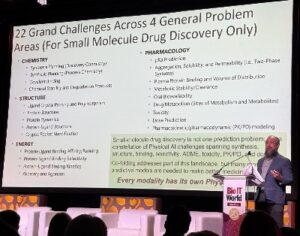
That group included Woody Sherman, PhD, founder and chief innovation officer at PsiThera, who serves as chair of the OpenFold executive committee. Sherman reiterated the benefits of open-source platforms and how they are making inroads into the drug discovery space.
“We’re going to need these open platforms that we can all build on,” he said. “We can’t all be building our own foundation models from scratch. It just doesn’t make sense as an ecosystem. It is important to have these open platforms so that we can interact precompetitively, build the best foundation models, and then “we can get into federated learning.”
From AlphaFold to OpenFold
The non-profit OpenFold Consortium consists of scientists from over 40 technology companies, startups, pharma companies, and academic institutions. It builds on a lot of the progress made in the 2010s in terms of predicting protein structures from sequences, “a foundational problem in biochemistry.” That progress was quantified at least in part by efforts like the Critical Assessment of Structure Prediction (CAS) competitions, said Mohammed AlQuraishi, PhD, an assistant professor of systems biology at Columbia University, during his presentation.

assistant professor, systems biology,
Columbia University [Uduak Thomas]
AlphaFold and later iterations of the platform “compressed decades of progress in about four years,” he said. Besides reliably predicting protein structures, AlphaFold provided “calibrated predictions” that gave biologists a sense of the accuracy of its predictions. But there were limitations.
“It did not really have an understanding of anything other than just protein structure,” meaning it missed things like ions that were also part of the structure, he said. It also struggled to handle things like protein complexes, ligands, and cofactors. Another challenge was that although the computational models could predict targets that were closer to the training dataset used, their ability to make viable predictions dropped the further away the targets were from the training dataset. Additionally, “these models have limited ability to capture conformational changes,” AlQuraishi noted. “This becomes a major bottleneck in being able to reliably model allosteric modulators or cryptic pockets or similar types of systems.” Besides the technical limitations, there were also licensing limitations to consider.
AlQuraishi positioned OpenFold as an open source, high-performance, and reproducible alternative to AlphaFold that serves as a common platform for innovation for the community. “Partly it’s a code base, essentially a set of tools that allow [scientists] to build these types of models and extend them and apply them,” AlQuraishi explained. “It’s also an academic-industry consortium that provides a steerable mechanism for industry to support science that is open source and that’s broadly useful, but it’s also in tune with the needs of industry.”
Federated learning and foundation models
The next set of presentations made the argument for using federated learning to leverage proprietary biopharma datasets to train AI models. The presentation from Jonathan Gilbert, PhD, senior director, ecosystem growth and contributor partnerships at Eli Lilly, offered an example of how the pharma company has used federated learning to improve model predictions in different contexts.
“It’s not surprising that companies are very sensitive to the proprietary data that they’ve spent incredible investments generating,” he said. With federated learning, models are trained in the environment where the data is housed, making it possible to “improve model performance while maintaining the privacy of the individual training sets.”
Eli Lilly launched the TuneLab platform in 2025, through which it provides access to its own AI and machine learning models to biotech companies at no cost—although those that choose to use the models are expected to contribute datasets to help improve them. “These are the same models that we use every day,” he said. “These models have been trained on decades of internal data sets. That’s maybe over a billion dollars in data that have been brought into models by Lilly.”
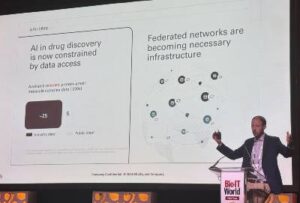
Gilbert noted that since its launch, the appetite for TuneLab has been quite strong. At the time of the presentation, there were more than 75 partners in TuneLab, and it was being used in dozens of countries across three continents. Furthermore, during the meeting, Eli Lilly and Collaborative Drug Discovery (CDD), a provider of data management solutions for pharma and biotech, announced an agreement to integrate TuneLab into both the core and AI modules within the CDD Vault platform.
For now, TuneLab is focused on models for small molecules and antibody development, but there are plans to release additional models in the near future. Lilly is also working on additional partnerships similar to the one with Collaborative Drug Discovery. “This is an active work in progress and [we are] thinking [about] how we can scale this,” Gilbert said. And how can “[we] build a community to improve those models such that we can create medicines faster for more people.”
The presentation from José-Tomás Prieto, PhD, director of AI programs at Apheris, built on Gilbert’s presentation but focused on the complexities of implementing industrial federated learning setups. The key takeaway from his talk was that successfully implementing federated learning at an industrial scale is not a plug-and-play capability but rather a process that requires engineering rigor, data preparation without centralization, and enterprise-level deployment strategies. His company, Apheris, has experience with this process as they provide solutions that power federated networks for drug discovery.
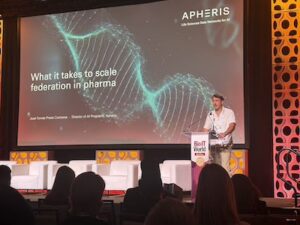
One of the networks that they support is the AI Structural Biology Network, a collaboration that brings together several of the top 20 biopharma companies. Its intent is to allow AI models designed to predict the 3D structure of molecule complexes to be trained on proprietary protein structure data. The common denominator for these and other networks that Apheris supports is that the models are trained on proprietary data in a secure way, so the data never leaves the environments of any of the nodes in the network.
“It’s obvious that there’s a lot of public data, but the public data skews toward well-characterized targets,” Prieto said. “The industry data complements that view, with more diverse data and sometimes higher quality data. And if there is something to learn about the AI world today is that you cannot necessarily model your way out of a data problem, and you can’t buy this data either.” Federated learning provides a solution to that problem. “It’s quite remarkable that a couple of years ago … it was mostly IT people making the decision of whether to use federated learning products,” he noted. “Today, we have business leaders trying to get ahold of this technology and leverage the power.”
Prieto also discussed some important considerations for building federated networks. To provide a sense of the complexity involved, “each one of these companies have their own network constraints, their own firewall rules, their own compute window that they have to negotiate with the cloud providers to make sure that the compute comes online at the right time.”
It is also important to consider “that data preparation without centralization is a new paradigm,” he continued. “Each company has [their] own ways of organizing the data or harmonizing your data,” as well as their own standards, but at the same time you have to have comparable training setups so that the foundation models can actually learn from this.” Furthermore, “your federated learning partner has to be able to work with your processes, has to be able to understand how to streamline the reviews, the security [and] the privacy requirements” among other things before projects can move forward.
A key point that both Prieto and Arman Zaribafiyan, PhD, head of strategic alliances, AI simulation at SandboxAQ, emphasized was that while federated models provide broad generalizations, fine-tuning them on specific, project-level data is crucial for translating model performance into practical impact for drug programs.
SandboxAQ has worked with the OpenFold consortium on its models and co-folding models, among other projects. “We are really living in exciting times when it comes to ML-accelerated drug discovery,” Zaribafiyan said. “There’s really an explosion of new models we see every day. And what we see at Sandbox with our partners in large pharma and biotech companies is that it’s getting a little bit overwhelming and harder to put these models into good use.” Furthermore, “a lot of these models are amazing in achieving great results on benchmarks, and it’s fascinating for publishing papers, but they fail to generalize to real drug discovery use cases.”
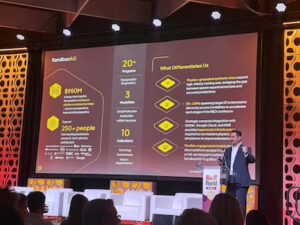
Commenting on some of the lessons SandboxAQ has learned through its partnerships, Zaribafiyan noted that “fine-tuning could help a lot to bridge this gap.” SandboxAQ and others have published data showing that “even a small fine-tuning effort can dramatically change the predictive accuracy of these models.” Over the next few years, he believes these are going to become the norm: “We’re going to see more and more of these federated platforms we use for both pooling data but also for fine-tuning these models on project-specific data.”
Zaribafiyan closed his presentation with an announcement of a new platform from SandboxAq that connects quantitative models for drug discovery to large language models, allowing scientists to launch and run simulations and workflows using plain English, much like prompts written for ChatGPT. “No code required,” he said.
Foundational models at work in crop science and drug development
Christina Taylor, PhD, senior science fellow and computational molecular design lead at Bayer, focused on how her company has leveraged foundational models and AI to drive decisions in crop science and pharma.
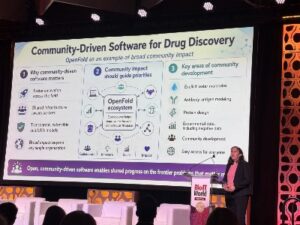
“I think that this community-driven software has really allowed faster innovation in the field overall,” and “sharing some of these foundational architectures allows everyone to be able to drive biomolecular AI work,” and “ has driven some of the very quick advancements we’ve seen in the field over the past few years.” Community projects like this also save time and are more sustainable since “everybody doesn’t need to be training their own foundational models.”
To date, these models have helped Taylor and her team better solve crystal structures. “One of the big problems with solving crystal structures is actually determining the phase, and by doing protein, we’re able to actually solve these structures faster and more efficiently,” she said. “Another thing is taking these foundational models and fine-tuning them … we’re using that quite regularly to improve our development of biomolecular pharmaceuticals as well as some of our crop science traits.” Other applications that Taylor and her team have used the models for include studying protein-protein interaction as well as for modeling enzyme catalysis.
The post Bio-IT World Keynote Highlights Collaborative Intelligence in AI-Driven Drug Discovery appeared first on GEN – Genetic Engineering and Biotechnology News.
How small businesses can leverage AI
This article is from Making AI Work, MIT Technology Review’s limited-run newsletter examining how to apply LLMs across industries. To receive it in your inbox,sign up here.
From accounting to design to market research and product development, there’s a staggering breadth of skills needed to run a business. A large company can hire experts to handle these tasks, but small businesses don’t always have this luxury.
That’s where AI comes in. Today’s AI models do a decent job at these tasks. The trick for small businesses is to understand where AI is good enough and where it’s not.
One place where a “good enough” AI can already be quite valuable to small business owners is in providing secretarial skills and handling basic administrative matters. Let’s take a look at how one private tutor is using it to improve his recordkeeping and free up his time.
Case study
Sam Finnegan-Dehn works in fundraising for a charity, but he moonlights as a math and philosophy tutor for university students from his home in London. Through this part-time business, he can leverage his degrees in philosophy and share his love of the subject with clients.
But meeting with students is only a fraction of the work it takes to be a good tutor. He also plans lessons and finds fresh reading materials, creates assignments, sends invoices, and keeps up with new research—all on top of his regular job. Given these demands, Finnegan-Dehn doesn’t have as much time as he’d like to grow his tutoring roster.
So he’s turned to AI for some help in managing the day-to-day aspects of his business. He says AI has taken on a secretarial role across all of his digital notebooks, where he jots down reminders about his clients’ progress and new readings to keep himself up-to-date. He describes using AI as kind of like having a second memory that helps him connect ideas he’s written down in various places.
While he has experimented with different tools like Claude and ChatGPT, he’s now landed on Notion AI because it integrates better with his tutoring notes, which live across his notebook tabs in the Notion app. Finnegan-Dehn doesn’t use AI to create teaching materials, but he does let Notion AI record meetings with his clients (after getting their consent), and then uses its automated summaries to refine his teaching strategy. For example, if he notices from the AI’s summary that it seems like a certain technique was not helping a student, he may change how he approaches the subject next time.
Beyond this, Notion AI also helps him with goal-setting, drafting lesson notes, invoicing, and generating and syncing social media posts. For goal-setting, for example, Finnegan-Dehn says he understands his long-term goals for his business but not always the concrete steps to build to them. He uses AI to help fill in these gaps. He starts by writing down a “North Star” goal—say, to have a certain number of clients by the end of the year. Next, he asks his AI to generate the steps that he needs to take to get there, given the profile he has built up in the app. Then, he can reflect on the results and choose which tasks to tackle first.
The tool
Notion has been a big player in note-taking software for many years. Its AI add-on, released in late 2023, now has tools that enable it to interact with many other online productivity platforms. There’s an email client, calendar integrations, and a newly released agent. And while this level of access has raised privacy concerns, it can also make for a pretty powerful virtual assistant.
Many of the tasks targeted by Notion AI are less creative and more rote: syncing information across documents or searching through old scribbles, for example. This makes the tool especially appealing to small business owners, who have limited bandwidth, particularly for menial work.
Other companies are developing tools targeted at specific industries. For example, Grandma’s Quilt Shop in Yuma, Arizona, uses Rain, which has a software suite tailored to craft companies, to generate inventory descriptions and pricing for its stock of fabric designs. The owners claim this AI tool cuts the time it takes to list items by 60 to 80%.
There are drawbacks, though, as Finnegan-Dehn described some of Notion AI’s idiosyncrasies as “clunky” at times. And the AI add-on for Notion costs $20 per month. As with all new tools, small business owners should carefully assess how the potential gains and headaches measure up against the cost of just doing the job themselves.
User tips
Consider these points when thinking about whether AI might be able to help you run a business, or make any part of your work life just a little bit easier.
- Look before you leap. Since LLMs feed on the data you input to answer your queries or complete tasks, you want to give them information in a way that’s convenient for you and for the model. For many of these notebook AI services, this means, for example, using their platform for notetaking so you don’t have to input or upload notes later. Because of this, it’s a good idea to weigh your options carefully before committing to an AI-powered ecosystem.
- Work to your strengths. Think about what skills you lack in-house, and see if AI can either help with training or take these tasks on for you. Just be aware: AI hallucinates and makes mistakes, so think about where accuracy is needed and keep humans in charge there.
- AI isn’t always the best tool. It’s okay to use something off the shelf when that’s the better choice. It’s going to be safer, for example, to use existing payment processing platforms like Shopify or Square than to vibe-code one using AI.
- Consider using local models for any sensitive information. Our reporting has covered the risks that online AI models have in leaking sensitive data, and there have been many reports about how AI companies collect your data when you ask their chatbots questions. Even if your business doesn’t handle personal information, there can still be some things you’d prefer not to share publicly. In these cases, using an open-source model that makes inferences on your prompts locally can be a great option, instead of ChatGPT or Claude or other proprietary models. Thankfully, some LLMs can now be run off of laptops and small desktops. Here’s how to set one up and start using it.
Sign up for Making AI Work, MIT Technology Review’s limited-run newsletter examining how to apply LLMs across healthcare, climate tech, education, and more.