

SET Domain Containing 1A (SETD1A) is a histone H3K4 methyltransferase implicated in neurodevelopmental disorders. Pathogenic variants in this gene are associated with schizophrenia, intellectual disability, and epilepsy. Here, whole-exome sequencing and Sanger sequencing were performed on a 4-year-old Chinese girl with early-onset epilepsy and her unaffected parents. A novel de novo heterozygous variant in SETD1A (NM_014712.3: c.1067C > T/p.Ser356Phe) was identified in a patient presenting with focal-to-bilateral tonic–clonic seizures, beginning at 3 months of age. Neuroimaging revealed a normal brain MRI, and comprehensive neuropsychological assessment indicated preserved cognitive function. The variant was absent in 200 local controls and classified as likely pathogenic per ACMG criteria. This study may expand the mutation and phenotypic spectrum of SETD1A-related disorders, establishing the relationship between SETD1A variants and isolated early-onset epilepsy without accompanying severe neurodevelopmental deficits, highlighting the value of genetic testing in infants with unexplained epilepsy.
The Quest for Large-Scale DNA
Although genome editing was not a new concept, as zinc finger and TALEN platforms were already in use, the discovery of CRISPR-Cas9 shifted genome-editing research and clinical translation into high gear. But just like other platforms, this new kid on the block was not applicable to every editing situation for every genetic disease.
A longstanding desire in the field is a one-and-done, mutation-agnostic cure for genetic diseases that result from numerous mutations in a gene or from large-scale chromosomal structural variations, including deletions, duplications, inversions, and translocations. Gene therapies for these genetic indications require large-scale DNA manipulation, presenting different technical and regulatory challenges than correcting single-nucleotide point mutations.
Scientists donned their Indiana Jones hats to search for this holy grail of genome editing. Promising approaches under exploration included bridge recombinases, large serine recombinases, and CRISPR-associated transposases (CASTs), as well as immune-evasive DNA cargoes like circular single-stranded DNA (cssDNA), which may address the innate toxicity of double-stranded DNA (dsDNA) payloads.
Still, delivery can remain a conundrum for large payloads. For the most part, current delivery mechanisms are size-limited in terms of payloads, as are the workarounds using mRNA formats and leveraging reverse transcriptase.
The thirst is there, and the quest will continue. New genome-editing tools applicable to large DNA cargoes and delivery mechanisms will be refined, putting potential cures in sight for some deplorable diseases.
Bridge recombinases
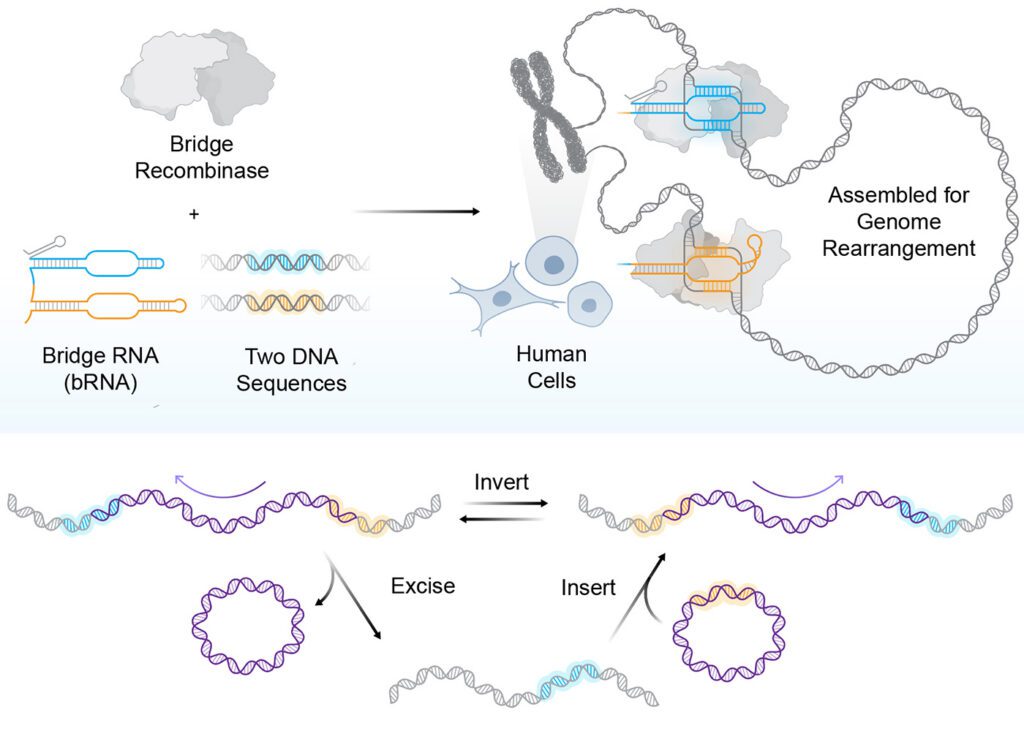
A new class of programmable genome-editing tools, bridge recombinases are the first RNA-guided DNA recombinases providing a distinct mechanism for manipulating DNA.1,2
The system has two key components: the recombinase enzyme, which catalyzes the DNA rearrangement, and a bridge RNA guide with two independently programmable loops. The target-binding loop controls genomic locus targeting, and the donor-binding loop specifies the donor payload.
Reprogramming the bridge RNA to change the configuration and orientation of the target and donor sites allows the system to be redirected to perform excision of a desired sequence from the genome or inversion of a DNA segment in place. The modularity means a single two-component system can perform all three fundamental DNA rearrangements—insertion, excision, and inversion—through a single unified mechanism.
“The most immediate advantage is the scale of DNA that bridge recombinases can manipulate,” said Patrick Hsu, PhD, co-founder and core investigator of the Arc Institute and assistant professor of pathology at Stanford University. “A technology that can operate at the scale of whole-gene replacement or correct structural variants opens up a new class of genetic interventions.” Multi-kilobase insertions, inversions up to 0.93 Mb, and excisions up to 0.13 Mb have all been demonstrated in human cells.3
Bridge recombination also does not rely on dsDNA breaks. The recombinase catalyzes strand exchange directly through a covalent intermediate, making the outcome deterministic in a way that nuclease-dependent approaches are not. This indicates that the system may have advantages in post-mitotic cells for therapeutic applications. About a quarter of the size of Cas9, the system can be encoded in delivery vectors with limited capacity.
“The technology is still in development. While our current efficiency and specificity numbers (20% insertion efficiency with 82% on-target) represent a meaningful proof-of-concept in human cells, improving both metrics will be necessary for safe and effective therapeutic applications,” said Hsu. The diversity of bridge-recombinase systems found in nature continues to be explored.
Large serine recombinases
“For simpler cases where we want to insert a DNA payload into a fixed safe harbor site, we are working on large serine recombinases (LSRs),” said Hsu. While these enzymes lack the RNA programmability of bridge recombinases, they offer very high efficiency and specificity of insertion and are effectively unidirectional, leading to very stable insertions of large DNA cargoes into the human genome.
A 2025 Nature Biotechnology paper described an LSR enzyme engineered to enable site-specific insertions of multi-kilobase DNA payloads with 53% efficiency and 97% genome-wide specificity. Importantly, it was demonstrated that LSRs work well in non-dividing cells, including primary human T cells.4
Stylus Medicine, a company Hsu co-founded, intends to advance LSRs for in vivo genetic therapies. “I am excited to see the new therapies that will emerge from combining recombinase technology with machine learning-assisted protein engineering and advances in DNA and effector delivery for challenging disease contexts,” said Hsu.
CRISPR-associated transposases
CASTs are naturally occurring bacterial systems that utilize nuclease-deficient CRISPR machinery to integrate DNA at genomic locations specified by guide RNAs (gRNA). “While CRISPR is often used to cut DNA, CASTs instead use CRISPR systems to guide site-specific DNA transposition,” said Isaac Witte, PhD, department of chemistry and chemical biology at Harvard University.
In 2019, two research groups—one at Columbia University led by Sam Sternberg, PhD, and the other at the Broad Institute of MIT and Harvard, headed by Feng Zhang, PhD—found that CASTs use CRISPR systems to target DNA transposition by a transposase complex. Further work demonstrated that CASTs were very efficient bacterial genome editors.
CASTs can mobilize multi-kilobase-scale DNA cargoes, and their naturally evolved transposition mechanism avoids forming dsDNA breaks in the genome. The problem was that the wild-type systems exhibited extremely low (often ≤0.1% of treated cells) or undetected integration activity in human cells.
Collaborating with the Sternberg lab, the lab of David Liu, PhD, from the Broad Institute of MIT and Harvard, used PACE (phage-assisted continuous evolution), a directed evolution platform developed by the Liu lab, to enhance the efficiency of CAST transposition.
In PACE, bacteriophages, which infect host bacteria, encode evolving genes in place of an essential gene for phage replication. This essential gene is instead encoded by host bacteria. “In PACE, you link the desired activity of the evolving biomolecule to the expression of this essential gene. In this case, we linked targeted DNA integration to the replication of phages encoding evolving CAST protein components,” said Witte.
A series of modifications ensured efficient enhancement of activity, resulting in the generation of an evolved variant of the CAST transposase protein TnsB that mediated over 200-fold improved integration activity in human cells. The TnsB protein contained ten individual mutations scattered throughout the predicted structure, which contributed to improved activity.
The evolved TnsB was combined with other PACE-evolved and rationally engineered CAST components to yield evoCAST, a system optimized for human-cell integration activity, published in Science.5
The evoCAST DNA integration does not require formation of dsDNA breaks in the genome, resulting in undetected levels of insertion and deletion mutations (indels) commonly found in traditional methods of gene insertion like nuclease-stimulated, homology-directed repair (HDR). In addition, evoCAST can be easily reprogrammed to genomic sites of interest by changing the gRNA sequence, and it supports a variety of DNA payload sizes, ranging from less than 1 kb to at least 15 kb.
A potential limitation, however, is that evoCAST is molecularly complex, containing seven distinct protein subunits, making the total coding size (~8.5kb) relatively large compared to around 5 kb for Cas9.
Big-picture limitations center on delivery, according to Witte, such as mitigating the cytotoxicity of foreign dsDNA in most therapeutically relevant cell types. Additionally, reducing the size and the number of distinct components required for integration activity may facilitate evoCAST applications in vivo. Next steps include harnessing the naturally existing diversity of CAST systems to develop a more diverse repertoire of CASTs for genome editing in human cells.
Circular single stranded DNA
Full Circle Therapeutics’ genome writing technology centers on an immune evasive DNA modality, a mini-cssDNA, called C4DNA—circular, clean, concealed, and customizable up to 20 kb.
“The holy grail of gene editing is kilobase DNA integration. While most studies focus on new editing enzyme discovery, we address the challenge from the donor side. To integrate gene-size DNA in a specific locus, the choices of donor cargo templates are ds, ss, circular, or linear DNA. Workarounds using RNA formats and leveraging reverse transcriptase are still size-limited,” said Howard Wu, PhD, co-founder and CSO at Full Circles Therapeutics.
The company has commercialized over 350 research-grade cssDNA for primary sequences and is developing processes for GMP-grade products for clinical applications. According to Wu, initially, the company’s founder, Richard Shan, intended to supply linear cssDNA as a DNA commodity for researchers in the gene-integration field. The starting material was cssDNA that was cleaved into linear strands. A serendipitous benchmark experiment using cssDNA as a control demonstrated surprisingly better integration performance than its linear counterpart.6 The unexpected results led to a foundational patent describing the use of cssDNA for targeted genomic integration.
After benchmarking the different DNA formats, cssDNA appeared superior and compatible with various CRISPR-Cas systems, along with other meganuclease editing systems such as TALEN. Next, they evaluated the hypothesis that immunogenicity due to dsDNA could be eliminated if mobile genetic elements like transposase systems and LSRs could use cssDNA.
Collaborating with a team at Harvard Medical School led by Benjamin Kleinstiver, PhD, they demonstrated that naked unmodified cssDNA, combined with piggyback transposases or LSRs, enables kilobase writing, albeit inefficiently. One way to improve integration efficiency was to design an oligo that could fuse to the cssDNA with hydrogen bonding to form a partial duplex. A 30- to 60-mer partial duplex showed good integration efficiency when compared to dsDNA, while remaining immune silent.
In another approach, the team modified the nuclear editor and installed a peptide sequence identified from a bacterial genome with a strong binding affinity with cssDNA. In this case, the modified Cas9 became an engineered molecular chaperone to recruit the DNA molecule and form a complex, effectively loading and delivering the genome engineering complex into the nucleus and direct to the targeted genome.7
Continued collaboration with Kleinstiver’s lab aimed to improve integration efficiency. The approach, in this case, used a partial duplex cssDNA that reconstituted a recombinase recognition sequence. The scientists termed this integration through nucleus-synthesized template addition of large lengths (INSTALL). INSTALL is compatible with diverse genome engineering nucleases and RNA-guided recombinases for high-fidelity kilobase-scale human genome writing.8
“We welcome partners,” said Wu. “It is prime time to talk about DNA medicines.”
References
- Hiraizumi, M, Perry NT, Durrant, MG, et al. Structural mechanism of bridge RNA-guided recombination. Nature2024; 630:994-1002. doi:10.1038/s41586-024-07570-2
- Durrant, MG, Perry NT, Pai JJ, et al. Bridge RNAs direct programmable recombination of target and donor DNA. Nature2025:630:984-993. doi:10.1038/s41586-024-07552-4
- Perry NT, Bartie LJ, Katrekar D, et al. Megabase-scale human genome rearrangement with programmable bridge recombinases. Science. 2026 Mar 12;391(6790):eadz0276. doi:10.1126/science.adz0276
- Fanton, A, Bartie, LJ, Martins JQ, et al. Site-specific DNA insertion into the human genome with engineered recombinases. Nat Biotechnol. 2025 Nov 6. doi:10.1038/s41587-025-02895-3
- Witte IP, Lampe GR, Eitzinger S, et al. Programmable gene insertion in human cells with a laboratory-evolved CRISPR-assoc iated transposase. Science. 2025 May 15;388(6748). doi:1126/science.adt5199
- Xie K, Starzyk J, Majumdar I, et al. Efficient non-viral immune cell engineering using circular single-stranded DNA-mediated genomic integration. Nat Biotechnol. 2025 Nov;43(11):1821-1832. doi:10.1038/s41587-024-02504-9
- Nam H, Xie K, Majumdar I, et al. Engineering tripartite gene editing machinery for highly efficient non-viral targeted genome integration. Nat Commun. 2025; 16:4569. doi:1038/s41467-025-59790-3
- Tou CJ, Xie K, Ferreira da Silva J, et al. Immune evasive DNA donors and recombinases license kilobase-scale writing. Nature. 2026 Mar 11. doi:10.1038/s41586-026-10241-z
The post The Quest for Large-Scale DNA appeared first on GEN – Genetic Engineering and Biotechnology News.
Alzheimer’s Targets Spotted in Circulatory System
Several genes relating to plasma proteins—particularly those involved in the immune system—have been linked for the first time with Alzheimer’s disease.
The proteome-wide association study (PWAS) strengthens the link between dementia and the immune system.
It also highlights potential therapeutic targets outside the traditional confines of the central nervous system (CNS) brain and spinal cord.
Genes relating to both the innate and adaptive immune system were linked with the neurodegenerative disease in the Science Translational Medicine study.
“The present PWAS, which modeled circulating protein abundance, identified potential candidate genes, many of which are expressed broadly or predominantly outside the CNS,” reported Keenan Walker, PhD, from the National Institute on Aging in Baltimore.
“These genes exhibited a higher enrichment for adaptive immunity compared with GWAS [genome-wide association study] candidates, implying distinct mechanistic pathways operating outside the CNS.”
Data on the plasma proteome and protein quantitative trait loci (pQTLs)—genetic variants that control the expression of proteins—are increasingly becoming available.
These offer the opportunity to identify disease-related genes through their effect on protein levels. Proteins are highly relevant to diseases and the development of therapeutic targets, given their role as effectors of cellular biology.
Walker and team compared genetic and proteomic changes associated with Alzheimer’s disease by studying GWAS results from tens of thousands of cases of Alzheimer’s disease, related dementias and control individuals.
They then compared this information with genetic models of 1348 circulating proteins derived from European Americans and 1385 circulating proteins from African Americans.
Plasma cis-pQTL data identified genes associated with the neurodegenerative disease through the cis regulation of plasma protein abundance. It also highlighted several plasma proteins with potential links with dementia.
The research revealed 18 genes with potentially causal relationships with the risk of Alzheimer’s disease among people with European ancestry, six of which had not been previously identified through GWAS.
Leukocyte immunoglobulin-like receptor (LILR)B1 and signal regulatory protein alpha (SIRPA), two immunoregulatory proteins not previously implicated in GWAS, showed the strongest mechanistic link to Alzheimer’s disease in the European Americans.
“We demonstrated that a subset of the plasma proteins encoded by PWAS candidate genes may function as biomarkers, given their association with dementia risk over 8- and 20-year follow-up periods, as early as middle adulthood,” the researchers reported.
“These same plasma proteins were associated with biomarkers of [Alzheimer’s disease] pathology and a broad set of cerebrospinal fluid (CSF) proteins enriched for immune and metabolic processes relevant to [Alzheimer’s disease].
“The present PWAS, which modeled circulating protein abundance, identified potential candidate genes, many of which are expressed broadly or predominantly outside the CNS.
“These genes exhibited a higher enrichment for adaptive immunity compared with GWAS candidates, implying distinct mechanistic pathways operating outside the CNS.”
The post Alzheimer’s Targets Spotted in Circulatory System appeared first on Inside Precision Medicine.
Mammographic AI Adds Predictive Power to Breast Cancer Risk Models
A study by Kaiser Permanente researchers has shown that integrating mammographic AI with polygenic risk scores and clinical risk models can improve breast cancer risk stratification, guiding both personalized breast cancer screening and chemoprevention.
The study, published in the Journal of the National Cancer Institute, is one of the largest and most diverse to evaluate the ability of the three approaches to predict breast cancer risk.
“Our goal is to improve our ability to assess a woman’s breast cancer risk so we can personalize breast cancer screening recommendations,” said lead author Vignesh Arasu, MD, PhD, a radiologist and research scientist at the Kaiser Permanente Division of Research. “Our study shows that each of the approaches identifies a distinct group of women, and that when all three risk tests are used, we increase our ability to differentiate high-risk and low-risk women and provide more personalized screening recommendations.”
The study included 82,957 women (75% non-Hispanic White, 9% Asian, 7% Latina, and 4% Black) who enrolled in the Kaiser Permanente Research Bank between 2003 to 2020. All the women had a recent negative mammogram, and none had previously been diagnosed with breast cancer or had a genetic mutation known to increase breast cancer risk.
The researchers calculated each woman’s breast cancer risk using three different approaches: The Mirai mammography AI risk score, which looks for risk-related imaging biomarkers; the Breast Cancer Surveillance Consortium version 3 clinical risk score, which considers factors such as age, race or ethnicity, family history of breast cancer, breast density, and body mass index; and the 313-SNP polygenic risk score (PRS) that assesses risk based on the presence or absence of 313 breast cancer-associated single nucleotide polymorphisms.
During 10 years of follow-up, 2471 (3%) women were diagnosed with invasive breast cancer or ductal carcinoma in situ.
Arasu and team report that the C-index for breast cancer prediction when all three risk scores were combined was 0.70.
“This means that if you take any women who actually will get breast cancer in the future and pass her information to a risk model, that model will say she has a higher risk about 70% of the time relative to women who won’t get cancer,” Arasu explained.
The C-index for the combined model was significantly higher than that for individual models with only the clinical risk score (0.62), which is used by most clinical practices, the PRS (0.61), or the Mirai score (0.66).
The C-index for the triple model was also significantly higher than that for a model that combined the clinical and the polygenic risk scores (0.66).
The increase in the C-index of 0.04 “represents a moderate but meaningful improvement in discrimination when incorporating all three risk domains compared with the clinical plus polygenic model alone,” Arasu told Inside Precision Medicine.
He added: “The C-index reflects overall model performance across all possible risk thresholds and is commonly used as an initial, global assessment when integrating new predictors, such as AI-derived measures, to gauge their added value. However, future work will focus on defining clinically actionable risk thresholds to better characterize how these improvements translate into real-world tradeoffs between benefit and harm.”
Importantly, the improvements in risk prediction were consistent over time and across four common self-reported racial/ethnic subgroups of Asian, Black, Latina, and White women, which the authors say indicates that incorporating mammographic AI and ancestry-adjusted PRS into clinical risk prediction models may benefit all women.
The study also found that among the women at highest risk for developing breast cancer, the clinical risk score alone identified 19% of the women who went on to develop breast cancer over a 10-year period while the combined model identified 26% of these women.
Although all three model types are becoming increasingly accessible and part of care, Arasu cautioned that “more research is needed to see the benefit of using all three scores before a program that uses all three should be implemented.”
He added: “We already are planning the next research step, which will be to study the combined model in the on-going national WISDOM clinical trial in the next 1-2 years. The WISDOM trial already uses a PRS and clinical risk score to assess risk. Now, we will be adding mammographic AI.”
“By identifying more accurately which women are truly at high-risk, we hope to find more breast cancers as early as possible, when they are most easily treatable,” said Arasu. “For women who are very high risk, there is also the potential to discuss, in addition to annual mammography, risk reduction with a medication, such as tamoxifen.”
The post Mammographic AI Adds Predictive Power to Breast Cancer Risk Models appeared first on Inside Precision Medicine.
Highly Sensitive ctDNA Test Improves Detection of Residual Pancreatic Cancer
A highly sensitive blood test that detects traces of tumor DNA in patients with localized pancreatic cancer identified substantially more patients with residual disease than conventional liquid biopsy testing, according to a prospective study published in Clinical Cancer Research. The findings suggest that more sensitive detection of circulating tumor DNA (ctDNA) could improve risk stratification after chemotherapy and surgery and help identify patients who remain at high risk for recurrence despite reassuring imaging results.
Researchers at Northwestern Medicine evaluated digital droplet polymerase chain reaction (ddPCR), a liquid biopsy approach that detects specific KRAS mutations, against standard next-generation sequencing (NGS), which surveys hundreds of cancer-associated genes but with lower sensitivity. Because KRAS mutations drive more than 90% of pancreatic cancers, the investigators hypothesized that focusing on this single, biologically important target would allow detection of extremely low levels of circulating tumor DNA that broader sequencing approaches often miss.
“We’re able to detect very high sensitivity in the blood for pancreas cancer,” said senior author Akhil Chawla, MD, clinical associate professor of surgery at Northwestern University Feinberg School of Medicine and a complex surgical oncologist at Northwestern Medicine. “We’re looking for extremely low levels of the DNA in the plasma.”
The prospective study followed 106 patients with localized pancreatic cancer from diagnosis through chemotherapy and surgical resection. Blood samples were collected before treatment, after chemotherapy, and following surgery to determine whether changes in KRAS ctDNA reflected treatment response and predicted patient outcomes.
At diagnosis, ddPCR detected tumor-derived KRAS DNA in 65% of patients, compared with just 17% using conventional NGS. The differences became even more striking after treatment. Following chemotherapy, ddPCR detected ctDNA in 60% of patients, while NGS detected it in only 5%. After surgery, ddPCR remained positive in 56% of patients compared with 9% using standard sequencing.
“What this publication is going to show is that yes, we can detect it with both, but we are missing a significant number of patients with standard sequencing,” Chawla said.
According to the study, patients whose disease was detected only by ddPCR represented a previously hidden intermediate-risk group. These patients had a median overall survival of 27 months after diagnosis, compared with 41 months among patients who tested negative by both assays. The findings suggest that standard liquid biopsy testing may underestimate the presence of minimal residual disease in many patients who appear to have responded well to therapy.
“We’re missing up to 60% of patients,” Chawla said. “Even at the time of diagnosis, and after treatment—particularly where we think it looks like on a CT scan after a patient’s undergone chemotherapy and had their surgical resection—everything looks great, and even the blood test that looks at ctDNA looks great. In sixty percent of patients we were still able to detect low levels.”
He adds, “Our goal is to get rid of that disease forever. Unfortunately, even with the work that we’ve done, we’ve shown that 60% to 70% of patients have recurrence of that disease after chemotherapy and surgery.”
The study also demonstrated that ctDNA dynamics over the course of treatment carried important prognostic information. Rather than relying solely on whether ctDNA was present or absent, investigators found that changes in ctDNA levels reflected treatment response.
“We’ve been able to see it even with chemotherapy and surgery,” Chawla said. “Patients that have that significant decline in the marker—not just the presence or absence, but even if they go from a high level to a medium to low level—those patients actually are benefiting from that treatment.”
Conversely, patients whose ctDNA levels remained stable or increased during treatment experienced substantially worse outcomes.
Unlike broad NGS panels, which search for hundreds of genetic alterations simultaneously, ddPCR focuses on a limited number of mutations with far greater analytical sensitivity. Chawla emphasized that the innovation was not a new laboratory technology but rather a new application of an established one.
“DDPCR can detect a single mutation with 1,000 times more sensitivity,” he said. “When we do that deep dive in pancreas cancer, what we’re really trying to do is identify whether this biomarker can, number one, be detectable in a high percentage of patients; number two, is it prognostic… and number three, can it really tell us how well a treatment is working?”
Because the assay targets the same KRAS mutations that are the focus of emerging targeted therapies, Chawla believes the approach could become increasingly valuable as those therapies enter clinical practice.
“I think there’s a lot of value in this test, particularly as we enter the age of KRAS-targeted treatments,” he said. “Our biomarker actually targets the exact same gene.”
Currently, surveillance after surgery relies primarily on CT imaging performed every few months, leaving clinicians with limited tools for detecting microscopic residual disease before recurrence becomes radiographically apparent.
“What the standard of care today is, is we just get CT scans every three months to give us an idea of when this comes back—we’re just kind of sitting on our hands and waiting,” Chawla said. “This blood test gives us an opportunity to be more active in that surveillance, potentially be more adaptive in our treatment.”
The post Highly Sensitive ctDNA Test Improves Detection of Residual Pancreatic Cancer appeared first on Inside Precision Medicine.
The Download: AI “coworkers” and stratospheric internet
This is today’s edition of The Download, our weekday newsletter that provides a daily dose of what’s going on in the world of technology.
AI agents are not your “coworkers”
Imagine coming in to work to learn that a new underling will report to you. The worker is not a person but an AI tool—one that your company nonetheless calls Alex, an “employee” with a title and defined responsibilities. How well do you think you would work with Alex?
If you’re anything like the managers studied by Boston University professor Emma Wiles, treating that AI as a “coworker” would lead you to do a worse job. They caught 18% fewer errors when the work was attributed to an agentic “AI employee” rather than a chatbot.
This is an alarming glimpse of the future Silicon Valley is hurling us toward. Microsoft, OpenAI, Anthropic, and Google have all released tools for managing teams of AI agents, many of which are advertised as digital colleagues. Find out why that’s a losing proposition for workers.
—James O’Donnell
This story is from The Algorithm, our weekly AI newsletter. Sign up to receive it in your inbox every Monday.
This flying solar-powered platform could deliver better internet from the air
As soon as August, a giant silver bullet will cut its way through the dry air of the southwestern US and cross the Pacific to reach the coast of Japan.
Once there, the roughly 200-foot-long craft, built by the New Mexico–based company Sceye, will park some 18 kilometers above the ocean’s surface in the stratosphere, then use a custom-built antenna to supplement a 5G network, in a test that includes beaming data straight to devices.
Sceye (pronounced “sky”) is one of several firms building these high-altitude platform stations, or HAPS. Find out why they plan to connect us from the stratosphere.
—Rachel Courtland
This story is from the latest edition of our magazine, which is all about engineering. Subscribe now to get a copy, plus all our other issues and a range of subscriber-only content.
Longevity’s next frontier: “reprogramming” your body
Billions of dollars are flooding into efforts to reverse aging as scientists explore ways to return cells to a younger state. But how far off are these experimental treatments? Will they really work? At a virtual Roundtables event today, MIT Technology Review will examine the science behind the hype.
Science editor Mary Beth Griggs and senior biotechnology reporter Jessica Hamzelou will explore longevity’s latest frontier in a subscriber-only discussion.
Register here to join the session at 11:30 AM ET / 8:30 AM PT / 16:30 GMT.
The must-reads
I’ve combed the internet to find you today’s most fun/important/scary/fascinating stories about technology.
1 The US House has passed new youth online safety legislation
+ It would set baseline federal standards for kids’ online safety. (Politico $)
+ States would be allowed to adopt more aggressive protections. (Reuters $)
+ But critics say it lets tech companies avoid accountability. (Axios)
+ And tech groups warn it threatens privacy and free expression. (NBC)
+ The Senate is expected to push for tougher rules. (The Hill)
2 Ford is rehiring human engineers after AI failed to match quality checks
It said the AI lacked the training and expertise of technicians. (Bloomberg $)
+ The new hires will train younger staff and reprogram AI tools. (BBC)
+ Many firms that replaced workers with AI are now rehiring humans. (Forbes)
+ The AI jobs hysteria needs a reality check. (MIT Technology Review)
3 Senator Mark Warren is set to introduce a bill to regulate AI agents
It would set rules for agent permissions and verification. (The Information $)
+ Voters of both parties want tighter AI regulation. (NBC News)
+ But politicians are bitterly divided on the rules. (MIT Technology Review)
4 Rocket Lab is buying Iridium for $8 billion to take on SpaceX
It wants to integrate the satellite network with its launch services. (The Verge)
+ Which could create a fleet that can compete with SpaceX. (WSJ $)
5 Hackers have exposed secrets about Apple’s upcoming iPhone 18
The data was stolen from Tata Electronics, Apple’s Indian supplier. (Reuters $)
+ The breach also exposed Tesla secrets. (TechCrunch)
6 Chatbots are replacing therapists despite lacking scientific evidence
Experts question their safety and therapeutic quality. (WSJ $)
+ Chatbots may make us lose control of our brains. (MIT Technology Review)
7 Newborn DNA sequencing is edging closer to routine healthcare
Trials are expanding despite privacy and ethical concerns. (Economist $)
+ The push for perfect babies is an ethical mess. (MIT Technology Review)
8 Astronomers are using AI to find new galaxies
New tools are reviving decades of space telescope data. (FT $)
9 Remote-controlled cockroach swarms can now breathe underwater
The cyborg insects could one day explore Mars. (New Scientist $)
10 Drone shows are creating new forms of worship
Churches are depicting biblical stories with thousands of UAVs. (Wired $))
Quote of the day
“This is taking us back to the 1950s, and that is not progress.”
—Edwin Lyman, director of nuclear power safety at the Union of Concerned Scientists, tells NPR that slashing regulations undoes decades of safety lessons from the industry.
One More Thing

Design thinking was supposed to fix the world. Where did it go wrong?
When Kyle Cornforth walked into IDEO’s San Francisco offices for a meeting about reimagining school lunches, she was impressed. “It was Post-its everywhere, prototypes everywhere,” she recalls. “What I really liked was that they offered a framework for collaboration and creation.”
Cornforth was new to IDEO’s way of working: a six-step methodology for innovation called design thinking. But when she looked at the ideas themselves, she had questions: “I was like, ‘You didn’t talk to anyone who works in a school, did you?’ They were not contextualized in the problem at all.”
Design thinking broadened the idea of “design,” elevating designers to take on big, knotty problems through a structured process. But critics argue it has produced unrealistic ideas and, by centering designers, reinforced existing inequities.
Read the full story on the rise and fall of design thinking.
—Rebecca Ackermann
We can still have nice things
A place for comfort, fun, and distraction to brighten up your day. (Got any ideas? Drop me a line.)
+ A London tube station has solved its persistent flooding issue by reintroducing beavers.
+ The Beastie Boys song “Sabotage” has been stunningly recreated in this stop-motion video.
+ Classical antiquity is lovingly preserved in this collection of over 8,000 late Latin and Greek letters from the Roman world.
+ This homemade jet-powered fishing boat is a reminder that great engineering and good judgment don’t always travel together.
Top image credit: Photo Illustration by Sarah Rogers/MITTR | Photos Getty
Please send homemade jet-powered fishing boats to hi@technologyreview.com.
You can follow me on LinkedIn. Thanks for reading!
—Thomas
Delivering the benefits of genomic data reanalysis for diagnosis equitably and at scale
Nature Medicine, Published online: 29 June 2026; doi:10.1038/s41591-026-04516-1
We developed a tool, Talos, for automated reanalysis of genomic data from patients with a rare disease and show that frequent reanalysis can be delivered at scale and low cost. Talos is open source, thereby enabling broad adoption by the clinical and research communities.
Association of MAP2 gene polymorphisms and altered expression with schizophrenia risk in a Chinese Han population
BackgroundSchizophrenia (SCZ) is a highly heritable primary psychotic disorder. The microtubule-associated protein 2 (MAP2) gene is essential for dendritic integrity and synaptic plasticity, positioning it as a key candidate for bridging genetic risk and neuropathology. Nevertheless, the role of common genetic variations within MAP2 in SCZ susceptibility remains to be elucidated.MethodsWe conducted a candidate gene association study of MAP2 in a Han Chinese cohort comprising 418 SCZ patients and 418 matched healthy controls. Targeted sequencing was used to genotype single nucleotide polymorphisms (SNPs). MAP2 mRNA levels were quantified by RT-qPCR and correlated with genotypes and clinical symptoms. Bioinformatic tools (such as GTEx, BrainSeq, 3DSNP, HaploReg, RegulomeDB and SNP2TFBS database) were employed for functional annotation of risk loci.ResultsWe identified multiple MAP2 SNPs associated with SCZ risk in a Han Chinese cohort. Specifically, the AA genotype of rs288057 and the GG genotype of rs288087 were significantly associated with increased disease risk (OR = 2.393 and 2.258, respectively). Expression analysis revealed a marked reduction in peripheral MAP2 mRNA levels in patients compared to controls. This downregulation was genotype-dependent: the risk AA at rs288057 and GG at rs288087 were correlated with lower mRNA levels, a finding supported by its significant eQTL effect in the GTEx and BrainSeq database. In silico annotation suggested rs288087 resides within a putative enhancer region, while rs288057 may affect a promoter-proximal regulatory site. Clinically, MAP2 expression showed a significant positive correlation with the severity of negative symptoms (SANS score). Furthermore, ROC analysis indicated that MAP2 expression levels distinguished patients from controls with an AUC of 0.728.ConclusionThis study identifies MAP2 as a schizophrenia risk gene, wherein non-coding variants likely reduce its expression via distinct regulatory mechanisms, linking this downregulation to core negative symptoms. These findings highlight MAP2’s pathophysiological and translational relevance.
Retargeted serine integrases for one-step, precise integration of large DNA sequences in human cells
Nature Biotechnology, Published online: 29 June 2026; doi:10.1038/s41587-026-03186-1
Serine integrases are retargeted to streamline genomic integrations of DNA.
<![CDATA[Expert shares ADHD medication sequencing tips and practical insomnia strategies, from stimulants to melatonin, for kids and adults.]]>