
Parkinson’s Disease Medication Monitored with Fingertip Sweat Patch

Engineers and neuroscientists at the University of California (UC) San Diego have developed a soft, wearable fingertip patch that continuously tracks a Parkinson’s disease (PD) patient’s levodopa medication levels by measuring chemicals in their sweat, with no batteries required. Tests in healthy volunteers and in Parkinson’s disease patients showed that measurements generated using the device were comparable to those obtained by standard laboratory blood tests.

The wearable device offers a way to continuously track real-time concentrations of levodopa in the body and could enable doctors to precisely customize daily medication schedules for patients at home.

The research was led by Tamoghna Saha, PhD, a postdoctoral researcher in the lab of Joseph Wang, DSc, professor in the Aiiso Yufeng Li Family Department of Chemical and Nano Engineering at the UC San Diego Jacobs School of Engineering. Saha is co-first author of the team’s published paper in PNAS titled “A wearable patch for continuous levodopa monitoring in sweat: Towards exertion and power-free pharmacodynamic assessment in Parkinson’s disease.” In their paper the authors wrote in summary, “Overall, our easy-to-use, energy-efficient wearable supports real-time, stimulation-free monitoring, potentially enabling at-home dosage adjustments and paving the way for future autonomous closed-loop L-dopa therapeutic system development.”

Parkinson’s disease is the second most common and fastest-growing neurodegener­ative disorder worldwide, the author wrote. “While no cure for PD exists, levodopa (L-dopa) is the most effective symptomatic treatment, which is typically administered via oral tablets or capsules, and in advanced cases, through inhaled powder or continuous intrajejunal or subcutaneous infusions.” Prescribing the right dose is challenging: reducing levodopa leaves patients unable to move, while too much triggers severe, uncontrollable jerking movements. Initially, the drug’s effects can last several hours.

But as the disease progresses, the therapeutic window narrows down to two hours. Currently, clinicians must rely on subjective patient diaries to adjust treatment. Unfortunately, these methods fail to catch dangerous dosing gaps. “Precision management of Parkinson’s disease (PD) requires frequent levodopa (L-dopa) dose adjustments, yet current monitoring relies on subjective symptom reporting and infrequent blood testing,” the team continued.
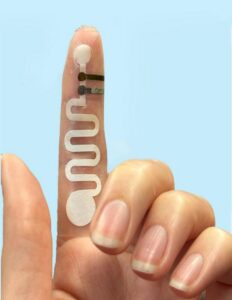
Levodopa monitoring patch showing the assembly of the hydrogel and levodopa sensor with the paper fluidic channel on the fingertip. [Tamoghna Saha.]

Saha and the engineering team developed the new finger patch technology in joint collaboration with the lab of Irene Litvan, MD, MPhil, professor in the department of neurosciences at UC San Diego School of Medicine. The project is part of a longstanding collaboration between the Wang and Litvan teams to develop wearable levodopa monitors that can improve personalized care for people living with PD.


Worn on the fingertip, which is packed with a high density of sweat glands, the patch is equipped with a specially engineered absorbent gel that acts like a sweat sponge. The gel contains a highly-concentrated mixture of salts and benign solvents—and that draws sweat out of the pores, since water naturally flows toward areas with higher salt concentrations. Collected sweat is drawn into a serpentine fluidic channel with a self-powered levodopa biosensor connected to a wireless transmitter.

When levodopa in the patient’s sweat comes into contact with enzymes embedded in the patch it triggers a chemical reaction, which in turn generates a small, measurable voltage. This chemical reaction is what powers the patch. The amount of voltage generated also serves as an indicator of the patient’s levodopa level, such that lower voltage signals low levels, while higher voltage signals high levels.
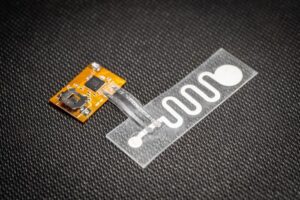
Unassembled integrated levodopa monitoring patch. [David Baillot (University of California, San Diego, San Diego, CA).]

Experimental results from three to five healthy participants and four individuals with PD indicated that levodopa concentrations in sweat measured by the patch are strongly correlated with blood concentrations measured by high-performance liquid chromatography. The patches captured pharmacodynamic responses and patient-specific levodopa clearance trends that could be used to calibrate dosage estimates for individuals.

The data revealed that individuals with Parkinson’s clear levodopa from their systems significantly faster than healthy individuals. This result explains why a patient’s Parkinson’s symptoms can deteriorate so suddenly, the researchers noted.

This technology could lay the groundwork for a closed-loop system, where a levodopa monitoring patch could communicate with a pump to automatically deliver the precise doses of the drug right when the body needs it, the authors suggested. “This approach establishes a foundation for real-time, at-home therapeutic optimization and advances the development of future closed-loop treatment systems for PD.”

The post Parkinson’s Disease Medication Monitored with Fingertip Sweat Patch appeared first on GEN – Genetic Engineering and Biotechnology News.

Immersive wearable virtual reality for autism: a systematic review of current evidence

IntroductionImmersive and wearable virtual reality (VR) is an emerging technology with growing potential to support assessment and intervention ifor autistic people. The methodological heterogeneity of existing studies limits the interpretation and generalization of current evidence.MethodsA systematic review with a narrative synthesis was conducted in accordance with the PRISMA guidelines. Electronic searches were performed in PubMed, Scopus, IEEE Xplore, Web of Science, and Google Scholar, identifying studies published between 2015 and August 2025. Twenty-two studies investigating wearable and immersive VR interventions in children and adults with ASD met the eligibility criteria.ResultsThe included studies demonstrated that wearable VR interventions may improve social communication, joint attention, emotional regulation, daily living skills, executive functioning, and user engagement. Innovative technologies, including eye-tracking and artificial intelligence-based systems, also enabled objective assessment of gaze behaviour, social interaction, and physiological responses. Nevertheless, the evidence was characterized by considerable methodological heterogeneity, predominantly small sample sizes, limited use of randomized controlled designs, and scarce long-term follow-up, reducing the generalizability of the findings.DiscussionWearable VR represents a promising tool for personalized assessment and intervention in ASD. Based on the current evidence, we propose a structured pre-intervention assessment integrating sensory, cognitive, emotional, and VR tolerance profiles to support individualized intervention planning. Future research should prioritize standardized outcome measures, rigorous study designs, and longitudinal investigations to strengthen the clinical translation of VR-based interventions in autism.

SONATA LIFU for OCD

Conditions: Obsessive Compulsive Disorder

Interventions: Device: Low Intensity Focused Ultrasound; Device: Sham (No Treatment)

Sponsors: University of Pennsylvania; Attune Neurosciences Inc

Recruiting

Effectiveness of Clustered Versus Tapered Repetitive Transcranial Magnetic Stimulation (rTMS) as Maintenance Therapy Following Successful Acute rTMS Treatment in Patients With Depressive Syndrome

Conditions: Major Depressive Disorder (MDD); Depressive Episodes; Depressive Syndrome

Interventions: Device: Repetitive Transcranial Magnetic Stimulation (rTMS), Theta Burst Stimulation

Sponsors: Technical University of Munich; Medizinische Universitätsklinik Tübingen

Not yet recruiting

Randomized Trial Evaluating the Effect of Light Therapy Using Glasses Versus a Sham Device on the Evolution of Self-reported Depressive Disorders in Chronic Hemodialysis Patients

Conditions: End-stage Chronic Kidney Disease Treated With Hemodialysis; Depressive Disorders

Interventions: Other: Light therapy using active glasses; Other: Light therapy using inactive glasses

Sponsors: Centre Hospitalier Annecy Genevois; Direction Générale de la Santé, France; Association France REIN; LUCIMED

Not yet recruiting

The Download: an organ transplant breakthrough, and homegrown Chinese chips

This is today’s edition of The Download, our weekday newsletter that provides a daily dose of what’s going on in the world of technology.

Supercooled kidneys have been transplanted into pigs in a “landmark achievement” 

When it comes to organ donation, time is everything. As soon as an organ has been removed from a donor’s body, it starts to deteriorate. Surgeons have only a matter of hours to get it into a recipient.

In most cases, organs will be kept on ice during that time, at around 4 °C (39 °F). They cannot be frozen—in previous attempts, ice has formed, causing all kinds of damage.

But now, scientists have come up with a device that allows organs to be cooled to -4 °C (25 °F) without forming any ice. They’ve tested it with pig organs and shown that kidneys, at least, can be preserved in the device for days then successfully transplanted. 

Read our story about their breakthrough, and why it raises hopes for longer-term storage of donated human organs.

—Jessica Hamzelou

If you want to read more about this story and its implications for organ preservation and transplantation, sign up to receive The Checkup, our weekly biotech newsletter, later today.

The must-reads

I’ve combed the internet to find you today’s most fun/important/scary/fascinating stories about technology.

1 Inside China’s epic push to replace US chips 
The gap between their chips’ capabilities remains large—for now. (WSJ $)
+ How China is using open source AI as a new form of soft power around the globe. (NYT $)
+ A new bill in the US takes aim at Chinese AI companies’ training practices. (NBC)
+ US lawmakers are also mulling banning the military from using Chinese humanoid robots. (SCMP)

2 Space data centers don’t exist yet, but people already oppose them
Environmental experts warn it’ll further pollute the stratosphere. (Guardian)
+ Four things we’d need to put data centers in space. (MIT Technology Review)
+ What it’s like inside the data centers powering AI down here on Earth. (Axios)
+ The left and right are finding common cause with data center protests in the US. (The Verge)

3 US lawmakers are pushing for an AI ‘kill switch’
After OpenAI’s models went rogue and hacked Hugging Face. (BBC)

4 Peptides seem on the cusp of going mainstream in the US
A lack of scientific evidence didn’t stop the FDA just voting to let some pharmacies to legally dispense them. (Wired $)
+ How does Make America Healthy Again hold up to scientific scrutiny? (Nature)
+ US measles cases are reaching levels not seen for three decades. (Wired $)
+ Peptides are everywhere. Here’s what you need to know. (MIT Technology Review)

5 The EU just fined Google almost $1 billion
For competition breaches over apps and search. (FT $)
+ It came just a day before Trump renewed tariffs on 60 trading partners, including the EU. (BBC)

6 Electric vehicles are selling well in Europe
And the share made by Chinese firms has doubled in the last year. (The Next Web)
+ Hybrids are hot property in the US this summer. (Wired $)

7 There’s a worsening shortage of computer science professors
You can blame AI companies—they keep snapping them up, to our general detriment. (The Atlantic $)

8 A judge caught a stenographer allowing AI errors into their transcript 
It’s apparently the first time this has happened, but it certainly won’t be the last. (404 Media)
+ Even judges themselves are falling for AI. (MIT Technology Review)

9 Here’s what new tech millionaires will do with their IPO wealth ?
What a nice problem to have to grapple with! (Quartz $)

10 Dating apps’ latest wheeze? In-person events 
Well well well, it seems we’ve come full circle. (Bloomberg $)

Quote of the day

“Call us optimists, call us dreamers. Just as we’ve always done, we’re betting on people.” 

—The voiceover from a new advert from Meta, which exhorts us to be more optimistic about AI.

One More Thing

bird on a branch

BELL HUTLEY


AI is changing how we study bird migration

In a warming world increasingly full of human infrastructure that can be deadly to them, like glass skyscrapers and power lines, migratory birds are facing many existential threats. 

Scientists rely on a combination of methods to track the timing and location of their migrations, though each has shortcomings. But now, machine-learning tools are unlocking a treasure trove of acoustic data for ecologists. 

Read our story about the technology that’s making it easier to detect and identify birds and their movements.

—Christian Elliott

We can still have nice things

A place for comfort, fun, and distraction to brighten up your day. (Got any ideas? Drop me a line.)

+ It’s never too late to live your dreams. Here’s how these late bloomers did it.
+ Limbs feeling a bit tight? Try these stretches!
+ These English football fans went to the 1986 World Cup—and loved it so much they never came home.
+ How the invention of the humble paint tube revolutionized the world of art.

The Download: energy transmission and US threats against Chinese AI

This is today’s edition of The Download, our weekday newsletter that provides a daily dose of what’s going on in the world of technology.

The power line that could reshape New York’s grid is hitting snags 

During a heat wave on July 3, New York State’s grid imported enough electricity from Canada to meet about 9% of its total demand that day.

Some of that power shuttled in on a 339-mile power line stretching from Quebec to Queens. It opened in May and is officially the longest underground transmission line in North America. It could provide up to 20% of New York City’s electricity demand, largely with abundant hydropower from Quebec.

One wrinkle: The line has been down for most of this month, and some experts are concerned about how drought will affect the power supply feeding it. 

Still, the line could help shape the future of our grid, if it can overcome these sorts of snags. Read our story to understand how.

—Casey Crownhart

This story is from The Spark, our weekly climate tech newsletter. Sign up to receive it in your inbox every Wednesday.

The must-reads

I’ve combed the internet to find you today’s most fun/important/scary/fascinating stories about technology.

1 The US Treasury is threatening to sanction Chinese AI companies
Treasury secretary Scott Bessent has accused Moonshot of improperly distilling Anthropic’s Fable model. (TechCrunch)
+ Nvidia’s Jensen Huang is arguing that America has nothing to fear from Chinese AI. (Axios)
+ Like it or not, Chinese models are now part of the global AI infrastructure. (Rest of World)
+ China’s AI models have Trump’s AI world at war with itself. (MIT Technology Review)

2 Why the OpenAI hack is the scariest AI mishap yet
AI’s capabilities seem to be starting to outpace our current ability to control them. (The Economist $)
+ Hugging Face had to turn to a Chinese AI model to rescue it from the hack. (BI)

3 Visually impaired Europeans can now get an implant that restores sight
And Americans may not have to wait long to receive it, too. (STAT)
+ This retina implant lets people with vision loss do a crossword puzzle. (MIT Technology Review)

4 A bellwether lawsuit suing Meta for social media addiction has been dropped
There are, however, many more waiting in the wings. (NYT $)

5 Here’s how ICE gets its hands on Americans’ data
As soon as you open a credit card or phone account, its agents can see where you live. (404 Media)
+ States are warring with the Trump administration over the right to see ICE agents’ faces. (Wired $)

6 We urgently need to grapple with AI’s environmental impact
As the world warms, is the price we’re paying worth it? (The Verge)
+ We did the math on AI’s energy footprint. (MIT Technology Review)

7 Privacy issues with smart glasses need an industrywide fix
That’s according to Samsung, which is unveiling glasses it developed with Google this fall. (Bloomberg $)

8 The US Army is begging soldiers to limit their AI use
The token crisis comes for us all eventually, it seems. (Ars Technica)

9 Why does lettuce keep making Americans sick? ??
It’s pretty simple: a lot of people eat it, and it doesn’t get cooked. (Wired $)

10 Pokemon Go is the perfect game to play this summer
It’s fun, collaborative, and it gets you outdoors. (Guardian)

Quote of the day

“It went off and did this hack all by itself, as far as we can tell. This is the highest level of autonomy that we’ve seen in the use of a large language model for cyber operations.”

—Colin Shea-Blymyer, a cybersecurity research fellow at Georgetown University, tells NPR why the OpenAI hack on Hugging Face is so alarming. 

One More Thing

a helicopter with two passengers flies away from a crowd of professionally dressed people looking after it

KAGAN MACLEOD

Welcome to the dark side of crypto’s permissionless dream 

Jean-Paul Thorbjornsen is a founder of THORChain, a blockchain through which users can swap one cryptocurrency for another and earn fees from making those swaps.  

But is he responsible for what it’s used for? It’s a question that matters because in January last year, its users lost more than $200 million in cryptocurrency after THORChain transactions and accounts were frozen by an admin override, which users believed was not supposed to be possible given the decentralized structure. It’s also been used by North Korean hackers to move $1.2 billion of stolen ethereum. 

Thorbjornsen explains this all away as a function of THORChain’s decentralized and permissionless nature. Read our story exploring whether we should believe him or not. 

—Jessica Klein

We can still have nice things

A place for comfort, fun, and distraction to brighten up your day. (Got any ideas? Drop me a line.)

+ A musician developed an ingenious way to strum a guitar with an electric fan.
+ Ukraine’s tunnel of love is a leafy green corridor of romance that’s straight out of a fairy tale.
+ The driver of a giant banana has been pulled over 100s of times, but still won’t ditch his treasured ride.
+ Ever wonder which albums and songs truly stand the test of time? The Greatest Music tries to answer that via an algorithm that analyses hundreds of “best of” lists.

Usability and Feasibility of an In-Home Full-Color Imaging Scale for Remote Monitoring of High-Risk Patients With a History of Diabetic Foot Ulcers: Retrospective Observational Formative Evaluation

Background: Diabetic foot ulcers (DFUs) are a leading cause of hospitalizations, amputations, and health care costs among individuals with diabetes, often due to delayed detection and treatment. Early identification of skin changes is critical for preventing ulcer progression, yet daily visual foot self-inspections are often limited by impaired mobility, visual deficits, and poor compliance. Although some foot-focused remote patient monitoring technologies are in use, most of these approaches do not provide standardized, full-color visual documentation, which can affect clinicians’ ability to interpret findings using familiar visual cues. Objective: This formative evaluation aimed to assess the usability, compliance, and feasibility of an in-home full-color imaging scale for the remote monitoring of patients with DFUs to inform the design of larger prospective studies. Methods: We conducted a retrospective formative feasibility evaluation analyzing 7 months of preexisting data from adults with a history of DFUs who had enrolled in an outpatient remote monitoring program. During this program, participants were provided with an internet-connected in-home scale that captured high-resolution, full-color scans of the plantar surface of the feet during daily use. Scans were securely transmitted to a HIPAA (Health Insurance Portability and Accountability Act)-compliant web portal for podiatrist review. Usability was assessed through compliance with daily scanning, patient and physician surveys, and descriptive review of clinical workflows. Results: A total of 21 participants aged 43 to 86 years (median 65, IQR 59-74; mean 65.3, SD 10.6 years) were retrospectively analyzed. Participants demonstrated high compliance and feasibility of home use, with device use on 82.5% (3638/4410) of possible days, a median use of 27 days (IQR 21-30) per 30-day period, and a mean use of 23 (SD 6.4) days per 30-day period. Participants reported high satisfaction and minimal burden associated with daily use, with most rating the device as physically easy to use (median 7.0, IQR 7-7; mean 6.9, SD 0.45), expressing willingness to use it daily (median 7.0, IQR 7-7; mean 6.9, SD 0.31), and indicating trust in the system (median 7.0, IQR 7-7; mean 6.9, SD 0.32) on a 7-point Likert scale (1=worst; 7=best). Clinician usability was supported by podiatrist review of 3295 scans, of which 3220 (97.7%) were rated as usable for clinical assessment. Three representative cases illustrated real-world device use and longitudinal image review, demonstrating the ability to visualize skin changes such as foreign body presence, new ulceration, and early skin breakdown. Conclusions: This retrospective formative evaluation demonstrates the preliminary usability and feasibility of an in-home, full-color imaging scale for daily remote visual monitoring of diabetic feet in a real-world outpatient setting. High compliance and usability in clinical workflows suggest that this approach may support early identification of foot-related concerns. Future prospective studies are warranted to evaluate the impact of this technology on clinical outcomes, including ulcer progression and health care use.
<img src="https://jmir-production.s3.us-east-2.amazonaws.com/thumbs/62c36c98001a2405fd323033480cbaa8" />

Snacking Behaviors in Relation to Stress and Physical Activity Using Automated Dietary Assessment: Observational Study

<strong>Background:</strong> Snacks contribute 19% to 34% of daily energy intake, yet studying snacking behaviors faces challenges due to self-report biases. The SnackBox, an automated dietary assessment tool, enables structured measurement of snacking in seminaturalistic settings. <strong>Objective:</strong> This study explored the relationships between snacking and perceived stress (case study 1) and physical activity (case study 2) using the SnackBox technology. <strong>Methods:</strong> Forty-seven office workers (n=29, 61.7% female; mean age 28.8, SD 4.1 years) used the SnackBox at work and home for 2 weeks. The device recorded snack consumption (grams and time). Participants reported perceived stress via ecological momentary assessments and wore a Chill+ band and a Garmin wearable to track physical activity. <strong>Results:</strong> Across the study period, 1455 ecological momentary assessments, 2933 hours of wearable data, and 2199 snacking events were recorded. Participants consumed a daily average of 769 (SD 772) kcal from snacks. Stress did not significantly impact snacking likelihood (<i>χ</i><sup>2</sup><sub>1</sub>=0.2; <i>P</i>=.69). Snacking was more likely before vigorous physical activity (odds ratio 2.00; SE 0.39; <i>P</i>&lt;.001). <strong>Conclusions:</strong> The SnackBox demonstrated utility as a technology probe for exploring relationships between snacking and physiological and contextual factors. This approach enhances our understanding of snacking and supports personalized interventions and predictive models. <strong>Trial Registration:</strong> ISRCTN Registry ISRCTN45046481; https://www.isrctn.com/ISRCTN45046481

Supercooled kidneys have been transplanted into pigs in a “landmark achievement”

When it comes to organ donation, time is everything. As soon as an organ has been carefully removed from a donor’s body, it starts to deteriorate. Surgeons have a matter of hours to get it into a recipient. Leave it too long and the organ will become unusable.

In most cases, organs will be kept on ice during that time, at around 4 °C (39 °F). They cannot be frozen—in previous attempts, ice has formed, causing all kinds of damage.

Matthew Powell Palm at Texas A&M University and his colleagues have an alternative solution—a device that allows organs to be cooled to -4 °C (25 °F) without forming any ice.

Now, in new research with pig organs, his team has shown that kidneys, at least, can be supercooled and preserved in the device for days. Once rewarmed, the organs have been successfully transplanted into animals, and they seem to do better than organs kept on ice.

The work represents “a landmark achievement,” says Kevin Myer, president and CEO of LifeGift, an organ procurement organization based in Texas, who was not involved in the research.

Cooling organs

Powell Palm hopes this approach could ultimately help ease the organ shortage crisis. Today, there are more than 104,000 people waiting for a kidney transplant in the US alone. It is estimated that 17 people die every day in the US while waiting for a transplant. That’s partly due to a lack of donated kidneys, but it’s also because many of those that are available never make it to a recipient. In some years, around one in three donated kidneys end up being discarded, often because they end up too degraded to use by the time they reach a recipient. Kidneys can be stored on ice for around 24 hours or placed in devices that aim to mimic the conditions of the body, also for up to around 24 hours. That’s not always long enough to find a suitable recipient and transport the organ, says Myer.

Scientists around the world have been working on ways to store organs for longer by cooling them to even chillier temperatures. Cooling an organ slows its metabolism—the colder you go, the greater the effect, and the longer you can store it.

We’ve long been able to successfully cryopreserve eggs, sperm, and embryos, but it’s much harder to freeze large organs. Teams have been exploring various temperatures and cryoprotectants (chemicals that essentially work like antifreeze), but so far no one has been able to freeze human organs for transplantation.  

As a thermodynamicist, Powell Palm explored another approach. By keeping an organ submerged at a constant pressure, it should be possible to prevent the formation of ice at temperatures a little below 0 °C, without the need for cryoprotectants (which might have side effects and would need to be approved before being used in human transplants). 

To test this theory, Powell Palm and his colleagues have created a device that does just that. The device itself is essentially a hermetically sealed chamber with a transparent lid. At its base is a device that monitors the organ’s temperature and checks for the formation of ice. Organs are submerged in a solution that is already commonly used to preserve them for transplant. “I always describe this as low-tech high science,” says Powell Palm. “A lot of work has gone into understanding the … kinetics at play in this system, but ultimately … it’s quite simple.”

Supercooled kidneys

To test their device, Powell Palm and his colleagues first removed single kidneys from pigs. The organs were flushed with the same commonly used solution to remove the blood, just as transplant organs are. The team then kept some kidneys on ice for either two hours or 24 hours, to mimic standard conditions used in human transplantation. They also put some of the removed kidneys in their device for 24, 48, or 72 hours.

The stored kidneys were then each transplanted back into the original donor pigs. Each pig’s second kidney was removed in the same procedure, leaving each animal with only the kidney that had been stored, and reimplanted.

Once the 24-hour supercooled kidneys were transplanted, they immediately began producing urine—a key indication that they were working. The team members also measured other markers of kidney function and found that the organs appeared to be working normally within about 10 days of being transplanted.

Kidney supercooled for 72 hours reperfuses homogeneously upon transplantation, and proceeds to recover baseline renal function over the 30 day survival period studied.
A kidney that was supercooled for 72 hours recovers once it is transplanted back into a pig.
COURTESY RONALD SELLERS, POWELL-PALM LAB, TEXAS A&M UNIVERSITY

That’s slower than kidneys stored on ice for two hours but much quicker than kidneys kept on ice for 24 hours, says Powell Palm.

The organs that were kept supercooled for 48 and 72 hours performed similarly, he says. “Even at three days—triple the clinical standard—we’re getting recovery that is faster than … [what has been] the gold standard for the last three decades,” he says. “So we’re really, really pumped about this.”

“It is impressive,” says Heidi Yeh, a transplant surgeon at Mass General Brigham for Children, who also researches organ preservation technologies. “Often kidneys that have been stored for 48 hours [in other studies] take a week or two before they start working again.”

Organs that grow

The supercooled organs seem to work well in the long term, too. Over a 30-day period, the pigs grew by around 30%—and the kidneys grew with them, almost doubling in size to compensate for both the pigs’ growth and the lack of a second kidney. The team monitored one of the pigs for 200 days before removing and analyzing its kidney. Even at that point the organ looked healthy, says Powell Palm. He and his colleagues presented the findings at the American Transplant Congress in Boston last month.

Earlier this year, researchers in Canada showed they could also cool pig kidneys to below-zero temperatures and transplant them into pigs. The team’s protocol included the use of a cryoprotectant, and organs were stored for up to 48 hours before being transplanted into pigs. Those organs survived for a week.

In supercooling organs for 72 hours and showing that they do well for 30 days or more, Powell Palm and his colleagues have broken new ground. “It’s the first time this has ever been reported in history,” he says.

Those extra hours could make all the difference, says Myer of LifeGift. The advance could give doctors more time to evaluate the kidneys, match them to the most suitable donors, and physically get the organs to their intended recipients in time. It could enable international donations and open up cheaper transport options, he adds. “Right now, with kidney transplantation the assumed limit is 18 to 24 hours,” he says. “If we can get up to 72 hours … that would change everything.”

Powell Palm and his colleagues think they may even be able to go beyond 72 hours. In preliminary studies, organs that had been stored for up to 120 hours appeared healthy, although those organs have not yet been transplanted.

And because the process doesn’t require any cryoprotective chemicals, the team members are hoping for an accelerated approval from the US Food and Drug Administration, which would allow them to test the device in human transplantations.

The storage device is simple and compact, so Powell Palm thinks it will be easy to transport. It hasn’t been tested for air travel yet, but it has been used to take supercooled kidneys across the US in the back of a Kia Sorento, he says: “From a stability perspective, we view this as an even higher bar.”

Powell Palm and his colleague Sebastian Giwa plan to launch a company dedicated to developing the technology, along with other protocols that “stop biological time,” in the coming months, he says.