Ultrasmall fluorescent core‑shell silica nanoparticles—best known for their roles in medical imaging applications—are now showing surprising therapeutic muscle. Originally engineered as inert carriers for imaging agents, these particles, called Cornell Prime dots (C’ dots), have steadily expanded their résumé. In a new preclinical study, researchers at Weill Cornell Medicine report that these engineered silica nanoparticles can directly kill prostate tumor cells while reawakening antitumor immunity, offering a potential new edge in a disease where immunotherapy has historically struggled.
Prostate cancer remains one of the most immunologically “cold” solid tumors, with myeloid‑driven immune suppression, metabolic bottlenecks, and stromal remodeling that blunt the effects of checkpoint blockade. The new work suggests that C’ dots—when targeted to prostate‑specific membrane antigen (PSMA)—can break through these layers of resistance by triggering ferroptosis, remodeling the tumor microenvironment, and priming tumors for combination immunotherapy.
“We’re very encouraged by these results; a treatment that directly induces tumor‑cell death while transforming the immune microenvironment, as this does, would represent a new clinical paradigm,” said senior author Michelle Bradbury, MD, PhD, the endowed professor of imaging research in radiology and director of the Molecular Imaging Innovations Institute at Weill Cornell Medicine and a neuroradiologist at NewYork-Presbyterian/Weill Cornell Medical Center.
The study, published in Cancer Research and titled “Reprogramming of TLR–Ferroptosis Signaling and Immunometabolic Pathways Overcomes Myeloid Suppression to Improve Checkpoint Blockade in Prostate Cancer,”shows that the silica particles accumulate in prostate tumors and push cancer cells toward ferroptosis, a form of iron‑dependent cell death driven by runaway lipid peroxidation. Although the particles were originally designed for imaging, the team found that they often pick up positively charged iron ions in the bloodstream and shuttle them into tumor cells—effectively turning the particles into catalytic seeds for oxidative collapse.
At the same time, the nanoparticles reshape the immune landscape. T cells, macrophages, and other immune populations shift from inert or suppressive states into robust antitumor activity, converting cold tumors into hot ones. “One of the most intriguing aspects of this work is the convergence of direct tumor cell killing with broad immune remodeling,” said co‑author Jedd Wolchok, MD, PhD, the Meyer director of the Sandra and Edward Meyer Cancer Center, professor of medicine at Weill Cornell Medicine, director of the Parker Institute for Cancer Immunotherapy at Weill Cornell Medicine Meyer Cancer Center, and an oncologist at NewYork-Presbyterian/Weill Cornell Medical Center.
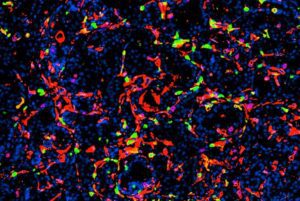
Multiplex immunofluorescence image of a prostate tumor 10 days after treatment with prostate-targeted C’ dots and immunotherapy, showing extensive infiltration of immune cells throughout the tumor. Different colors represent distinct immune cell populations, including anti-tumor T cells, helper T cells, regulatory T cells, and macrophages. The image illustrates the coordinated immune response triggered within the tumor following treatment. [Bradbury Lab]
The therapeutic impact was most striking in survival experiments. C’ dots alone modestly extended survival in aggressive mouse models, as did checkpoint blockade alone. But the combination produced complete or near‑complete remissions in 40% of mice. Adding CSF‑1R blockade increased complete remissions to 50%.
The researchers’ next steps include continuing to explore these ultrasmall core-shell silica particles, setting the stage for the platform’s translational potential.
“By creating conditions that support a more effective antitumor immune response, these particles may help unlock the full potential of immunotherapy in prostate cancer, where durable responses have historically been difficult to achieve,” added Wolchok.
Research led by the University of Exeter on a large group of people from the UK Biobank shows that carriers of certain genetic mutations are more likely to have an adverse reaction to oral corticosteroid medications.
The researchers found that a variant in the CYP3A4 gene raised osteoporosis risk and a variant in the CTLA4 gene increased the risk for multiple adverse outcomes including stroke and cataracts.
People with these variants were also more likely to have a higher cumulative exposure to corticosteroids over time, suggesting that genetic differences may blunt the clinical benefit of standard steroid doses, so they end up needing more treatment over time and therefore being at even higher risk of adverse events.
“We were also able to show a clear relationship between the dose of steroid and side effects,” said Deniz Turkmen, PhD, a postdoctoral researcher at the University of Exeter, who presented the work at the European Society of Human Genetics conference in Gothenberg this week. “This precise analysis shows the increased risk associated with long-term treatment.”
Oral corticosteroids are an effective and very common medication used to target excessive inflammation. They are widely used to treat conditions such as asthma, rheumatoid arthritis, lupus, and other autoimmune diseases, as well as severe allergies and some acute respiratory infections.
In the U.S., millions of people take oral steroid tablets each year, and roughly one in 100 adults is on them at any given time. However, even short courses can increase the risk of health problems like infections, fractures and blood clots, and long‑term use is linked to osteoporosis, diabetes, weight gain and cataracts, among other adverse effects.
Around one in 10 people are estimated to have side effects to these medications, but it has been difficult to predict who will respond poorly, which triggered Turkmen and colleagues to look into the genetics of how these drugs are metabolized.
In this study, the team evaluated information from almost 38,000 participants from the UK Biobank. These individuals had primary‑care prescriptions for oral corticosteroids for inflammatory and autoimmune conditions.
For each person, Turkmen and colleagues calculated cumulative steroid dose up to the point they had an adverse event or a follow‑up appointment. They also modelled dose–response relationships with outcomes such as osteoporosis, stroke and cataracts. In total, 21 candidate pharmacogenetic variants were assessed.
Median cumulative exposure to corticosteroid in the study was around 1.5 g. Increasing this dose from 1.5 g to 4.0 g was associated with an approximate 50% higher risk of osteoporosis. Variants in the genes CYP3A4 and CTLA4 were associated with higher cumulative dose and increased risk of adverse outcomes, but only in steroid‑treated individuals, consistent with pharmacogenetic effects on steroid metabolism and immune regulation.
Adding polygenic scores to the evaluation including multiple variants for osteoporosis‑related traits significantly improved prediction of steroid‑related osteoporosis beyond age and sex, with particular improvements seen in individuals under the age of 40 at first prescription.
A genome wide association study identified an area on the genome (HLA‑DQA1) where the allele linked to lower cumulative oral corticosteroid dose was not associated with adverse outcomes, hinting at biology that reduces steroid need without obvious toxicity signals.
“It was reassuring that the genetic findings involving CYP3A4 and CTLA4 aligned with their roles in steroid metabolism and immune regulation, but the improvement in prediction of osteoporosis when we incorporated polygenic risk scores data was remarkable, especially in younger patients,” said Turkmen.
“We hope that, in time, greater availability of genetic data at population level will mean that it will be possible to integrate genomics into everyday healthcare and hence into prescribing decisions. That will be a major step on the road to the provision of personalized medicine for all.”
A research team at the Stanford Medicine-based Wu Tsai Neurosciences Institute has developed a blood-based method that can determine the biological age of more than 40 different cell types throughout the body, providing a new way to assess disease risk and longevity years before symptoms emerge. The method, published in Nature Medicine, combines plasma proteomics with machine learning to develop estimates of the biological age of cell types including neuronal, immune, glial, endocrine, epithelial and musculoskeletal systems.
“With this indicator, we can assess the age of an organ today and predict the odds of your getting a disease associated with that organ 10 years later,” said senior author Tony Wyss-Coray, PhD, professor of neurology and neurological sciences and director of the Knight Initiative for Brain Resilience at the Wu Tsai Neurosciences Institute.
Developing this new cellular aging estimate was driven by the understanding that aging is the largest driver of a range of chronic diseases.
“Over 50% of the global disease burden can be attributed to aging,” the researchers wrote noting that while aging increases the risk of neurodegenerative disease, cancer and other chronic illnesses, “aging itself remains poorly understood, and quantifying its biology is therefore an important priority for improving prevention and treatment.”
This new model builds on the lab’s previous work in which the team developed a blood test capable of estimating the biological age of 11 organs and organ systems: the brain, muscle, heart, lung, arteries, liver, kidneys, pancreas, immune system, intestine and fat. In that study, published last July, the investigators analyzed blood samples from 44,498 participants in the UK Biobank and measured nearly 3,000 proteins circulating in the bloodstream. By identifying proteins associated with specific organs and comparing individual protein signatures with age-adjusted population averages, the researchers created algorithms that assigned biological ages to each organ.
Those organ-specific aging profiles revealed that organs age at different rates within the same person. Approximately one-third of participants had at least one organ classified as “extremely aged” or “extremely youthful,” while one in four had multiple organs falling into those categories. The biological age of a person’s organs was strongly associated with future disease risk. For instance, people with an aged heart were more likely to develop atrial fibrillation or heart failure, while aged lungs predicted a greater risk of chronic obstructive pulmonary disease. An aged brain was linked to a substantially higher risk of Alzheimer’s disease.
“The brain is the gatekeeper of longevity,” said Wyss-Coray. “If you’ve got an old brain, you have an increased likelihood of mortality. If you’ve got a young brain, you’re probably going to live longer.”
Participants with extremely aged brains experienced a 182% increase in mortality risk over roughly 15 years of follow-up in the study, while those with extremely youthful brains had a 40% reduction in mortality risk.
This new research goes beyond organ-level measurements to evaluate aging at a cellular level. For this research, the team analyzed more than 7,000 plasma proteins from 60,542 people across three independent cohorts. Using protein signatures mapped to their likely cellular origins, they constructed machine-learning models capable of estimating the biological age of more than 40 cell types.
The findings showed substantial variation in cellular aging patterns. Between 20% and 25% of people showed accelerated aging in a single cell type, while 1% to 3% showed accelerated aging in 10 or more cell types. These cellular aging signatures were associated with disease status and predicted disease development and mortality over a 15-year follow-up period.
One important finding centered on the risk of developing Alzheimer’s disease. The data showed that people carrying two copies of the APOE4 genetic variant, a major risk factor for Alzheimer’s disease, tended to have older astrocytes in the brain. Extreme astrocyte aging tripled the risk of developing Alzheimer’s disease among APOE4 homozygotes, whereas youthful astrocytes appeared to reduce that risk. “Youthful astrocytes seem to powerfully attenuate the detrimental effects of APOE4,” the researchers wrote.
The researchers also found strong links between cellular aging and amyotrophic lateral sclerosis (ALS). Individuals with extremely aged skeletal muscle cells had a 12.7-fold higher risk of developing ALS than those with youthful muscle-cell profiles. According to the researchers, this elevated risk could be detected more than three years before a clinical diagnosis.
Other findings suggest potential applications in cancer prevention and metabolic disease monitoring. The researchers reported that extreme aging of respiratory epithelial cells identified smokers at higher risk of lung cancer, while aging of myeloid immune cells was associated with elevated risk of developing type 2 diabetes.
“Our findings suggest that specific cellular vulnerabilities and cumulative aging burden influence survival,” the researchers wrote. Skeletal muscle-cell aging showed the strongest association with mortality, followed by neurons, fibroblasts, alveolar type 2 lung cells and myeloid lineage immune cells.
The investigators believe these new findings could begin to shift medicine toward earlier intervention. “This is, ideally, the future of medicine,” Wyss-Coray said. “Today, you go to the doctor because something aches, and they take a look to see what’s broken. We’re trying to shift from sick care to health care and intervene before people get organ-specific disease.”
WASHINGTON — The Food and Drug Administration said Monday that it will allow Colorado to import certain prescription drugs from Canada in an effort to bring prices down for residents, making it the second U.S. state to be granted such authorization.
For more than a quarter of a century, Americans have sought drugs from Canada for relief from the ever-rising costs of medicines, sometimes taking widely publicized bus trips across the border. It wasn’t until 2020, though, that the first Trump administration officially endorsed the practice, when it published a regulation allowing states and Indian tribes to propose import plans. The Biden administration affirmed this rule with an executive order in 2021. And Florida became the first state to earn FDA approval in 2024.
But state importation programs have proved extremely difficult to carry out, even with bipartisan support. Florida has yet to actually import any drugs from Canada, in part due to pushback from the Canadian pharmaceutical industry and fears the program will affect Canada’s drug supply. In May, the FDA extended its approval by six months to give the state more time to get its program up and running.
Kristen Dahlgren never expected to leave her successful 25-year career as a correspondent for NBC News, let alone become part of the fabric advancing cancer medicines. The transition was not driven by professional restlessness but by something far more personal: Dahlgren was diagnosed with stage II breast cancer in 2019.
Kristen Dahlgren Chief External Affairs Officer Parker Institute for Cancer Immunotherapy (PICI)
“I thought I was a lifer at NBC,” Dahlgren told Inside Precision Medicine on leaving NBC News in 2024 to advocate for accelerating the development of cancer vaccines. “I loved my job. But a cancer diagnosis changes you.” That diagnosis would eventually lead her to found the Cancer Vaccine Coalition (CVC).
Her story, however, is only half of a larger narrative. The other half belongs to Parker Institute for Cancer Immunotherapy (PICI) chief executive officer Karen Knudsen, PhD, an oncology leader and healthcare executive whose career has been defined by a single, persistent challenge: how to turn scientific discovery into real-world patient impact.
With the advent of new scientific discoveries, more investment, and increasing public and private support, cancer vaccines are entering a new phase of development, which includes this integration. The goal of these vaccines is to teach the immune system to identify and attack tumors.
Together, Dahlgren and Knudsen aim to accelerate the development and delivery of cancer vaccines, one of the most promising frontiers in cancer research. Their partnership reflects a broader shift in oncology, one that is less about isolated breakthroughs and more about building systems that can deliver those breakthroughs to patients faster.
Two paths, one problem
Before joining PICI, Knudsen had navigated the upper echelons of academic medicine and healthcare leadership. As an oncology healthcare executive for Jefferson Health, Knudsen ran one of the largest health systems in the country. She also led one of the major cancer centers in the United States, a National Cancer Institute (NCI)-designated cancer center, in a role that placed her at the intersection of science and care delivery.
Karen Knudsen, PhD CEO, Parker Institute for Cancer Immunotherapy (PICI)
The experience exposed Knudsen to a stark reality: the greatest challenge in cancer care is not always discovery—it can be cancer care delivery. “I love science, and we are funding more of it,” Knudsen told Inside Precision Medicine. “However, I don’t think that we have a science problem in the U.S. There’s a ton of science. What we have is a translation problem.” Dahlgren arrived at the same conclusion by asking researchers what was preventing them from moving forward and finding that they often felt like they were operating in silos.
What neither woman accepted was the idea that this gap was inevitable. A systemic gap exists between research and patient care, and it is not subtle. Knudsen saw it daily in the clinic. “If you’ve ever run an oncology unit, the first thing you do … is walk the infusion center. The sense of urgency gets much higher.”
Even without new scientific breakthroughs, the system has room for improvement. “Current data indicate that we could reduce cancer mortality by 20% if everyone in the U.S. with a cancer diagnosis received guideline-concordant care,” Knudsen said. “Forget even new discoveries.”
As a patient, Dahlgren encountered a different version of the same problem: she wasn’t informed of cancer vaccines or any related clinical trials. “I did a lot of medical reporting at NBC and had just been treated at one of the top hospitals, but nobody ever mentioned [cancer vaccines] as a possibility,” said Dahlgren. “There just weren’t the clinical trials available to me. I think there is a lack of awareness.”
Dahlgren continued, “The CVC started with a conversation with some doctors who were working on cancer vaccines because, frankly, I didn’t really believe that they were real or that far along because I hadn’t heard anything about it. I think that was part of the problem. There just isn’t a large public awareness of some of the research that’s going on. Even some oncologists are unable to keep up with all the cutting-edge developments.”
Between those two perspectives lies a critical insight: innovation alone is not enough. It must be accessible, scalable, and visible. That insight is at the core of PICI’s model, originally conceived by entrepreneur Sean Parker, co-founder of Napster and the first president of Facebook. With a $250-million grant from The Parker Foundation, PICI is an attempt to redesign the entire cancer immunotherapy pipeline, from discovery to commercialization.
Unlike traditional funding bodies, PICI does not simply award grants but rather establishes research sites across the country, of which there are currently seven. “The agreements allow our investigators, irrespective of geography, to freely share data and materials, so they truly are functioning [as] one institute, multiple geographies,” said Knudsen. “The whole concept here is to advance those studies from preclinical to clinical, obtaining a clinical signal so that other investors and biopharma follow suit toward the goal of near-term patient benefit.”
Cancer vaccines, now!
When Knudsen met Dahlgren at a Milken Institute event, the alignment was immediate. Dahlgren, for her part, had already recognized that PICI was building something she could not replicate alone. “They were already doing everything I wanted to do: building a system where the ecosystem could thrive and where these discoveries could reach patients.”
That meeting led PICI to strategically integrate the CVC to accelerate the development of next-generation cancer vaccines, including personalized neoantigen therapies. “Cancer vaccines have been around, but we really are at this tipping point,” Dahlgren said, who is now at a new role within the PICI as chief external affairs officer, placing vaccines at the top of PICI’s strategic priorities. Knudsen said, “As part of the scientific priorities, vaccines rise right to the top. Cancer vaccines offer a genuine opportunity to revolutionize cancer therapies.”
Several forces have converged to create this moment: advances in genomics, improved understanding of immune biology, and new platforms for vaccine delivery. “We understand the immune system better,” Dahlgren said. “This is the time to fully support this technology and get it through trials, approved, and to patients.” Dahlgren points to emerging data from clinical studies on vaccines across multiple cancer types, she said, “You hear about the work in pancreatic cancer or glioblastoma … patients who have achieved unexpected success.”
For Knudsen, the cancer vaccines won’t just be abundant and accessible; they’ll be personalized. Early clinical results, while small, are compelling, especially for hard-to-treat solid cancers (BOX 1). Knudsen highlighted a 2025 Nature study on kidney cancer led by Catherine Wu, MD, and Toni K. Choueiri, MD. “There were zero recurrences,” said Knudsen, “and everybody in that study got the vaccine. It’s a small study with single-digit patients; I believe there were nine patients. The science is getting there.”
The implications are profound, but so are the challenges. “But then who’s going to take it to the next step in a larger clinical trial?” Knudsen asked. “Biopharma wants the clinical signal.”
That gap between early success and large-scale validation is precisely where PICI aims to operate.
Patients are ready
Part of the problem is financial. The traditional venture ecosystem is not always aligned with early-stage scientific risk. “The venture world is currently locked up due to a lack of IPOs. … They do not have dry powder available to invest capital in opportunities,” Knudsen said.
PICI’s model attempts to bypass that constraint. “We ourselves are a major investor,” Knudsen said. “We’ve put about $400 million into 17 portfolio companies. … Or we just start new companies.” Revenue generated from successful commercialization is reinvested into new research, creating a self-sustaining cycle. “That’s how the nonprofit model works.”
If there is uncertainty in the system, it does not come from patients. “We’re getting reach-outs from patients … ‘What do I need to start to think about so that I can get enrolled in a trial to prevent recurrence?’” Knudsen said. “Who wouldn’t want that?” Dahlgren echoed the urgency from personal experience. “My current course of treatment is to ‘call us when you get a headache,’ and that’s a horrible way to live.”
Cancer vaccines offer a different paradigm, one that emphasizes long-term immune protection. “Imagine if you could get a vaccine … that boosts your T-cell response. … It’s just a matter of taking care of it for the rest of your life.”
Despite growing momentum, cancer vaccines remain misunderstood. “There’s definitely a misunderstanding with the term ‘vaccine,’” Dahlgren said. Knudsen is less concerned about semantics, asserting, “I don’t know if we have a name problem. I don’t think there’s anyone who is going to say, ‘I don’t want to take a vaccine’ when facing cancer.”
Where education does matter, however, is prevention. Knudsen points to the Gardasil vaccine as a case study. “When you reframe that appropriately, as a cancer vaccine … you say actually, we have cancer vaccines that will prevent cancer.” In places like Puerto Rico, Knudsen notes that high uptake of HPV vaccination has already demonstrated what is possible. “They’ll be the first place in the U.S. where cervical cancer will no longer be a thing.”
A shared urgency
While vaccines are a major focus, they are part of a broader transformation in cancer therapy. “Immunotherapy is the same as cancer therapy,” Knudsen said. “Name a cancer modality that does not have a root in the immune system.” This shift indicates a deeper understanding of cancer as an immune-mediated disease, paving the way for more personalized treatments.
What ultimately unites Dahlgren and Knudsen is not just a belief in science but a shared sense of urgency. Dahlgren frames it in deeply personal terms. “There’s no evidence of disease—I’m in remission, and I still think about it every day,” said Dahlgren.
With CVC working lockstep with PICI, Dahlgren and Knudsen are working together to remove those barriers by building a system that does not just generate knowledge but delivers it. For Dahlgren, joining PICI is not a departure from her mission but an amplification of it. “I’ve always looked for the quickest path to these better treatments, and there’s just no doubt that under this new structure that we’ll be able to have a lot more impact.” For Knudsen, it is the continuation of a career spent bridging science and care. “It’s the businessperson in me always looking for how we go faster and farther and make it so that patients benefit more quickly.”
Dahlgren and Knudsen are betting on a future where cancer vaccines and the systems that support them transform not just how cancer is treated but how innovation itself happens. If they’re right, the question will be how quickly these breakthroughs can reach those who need them most.
BOX 1. The Rise of Personalized Cancer Vaccine
Personalized cancer vaccines are rapidly emerging as one of the most promising frontiers in oncology. Unlike traditional therapies, these vaccines are designed for each individual patient, using the unique mutations in their tumor to train the immune system to recognize and destroy cancer cells. Powered by advances in mRNA technology and genomic sequencing, this approach has shifted from theory to real clinical momentum in just a few years.
Early trial results are beginning to validate the strategy. In pancreatic cancer, one of the most difficult diseases to treat, a personalized mRNA vaccine developed by teams led by Vinod P. Balachandran, MD, and Benjamin D. Greenbaum, PhD, at Memorial Sloan Kettering Cancer Center triggered strong, lasting immune responses and extended survival in early-stage studies. In melanoma, combining a personalized vaccine with Keytruda reduced the risk of recurrence or death by 44% to 50%, advancing the approach into large Phase III trials.
Trials in lung, breast, and other tumors show that these vaccines are safe, feasible, and capable of generating strong T-cell responses. Increasingly, they are used in combination with checkpoint inhibitors, acting as a primer that enhances broader immune attack.
The pipeline is growing quickly. Dozens of personalized mRNA and DNA vaccines are now in development, with many expected to reach late-stage trials before 2030. Preventive versions, aimed at stopping cancer before it develops, are also beginning to enter human testing.
Investment is accelerating alongside the science. Pharmaceutical companies, biotech firms, and governments are committing billions to personalized vaccine platforms. In the United Kingdom, a partnership between the National Health Service and BioNTech aims to treat up to 10,000 patients with individualized vaccines by 2030.
Challenges remain, including small trial sizes, complex manufacturing, and the need for large-scale validation. Still, the trajectory is clear. Personalized cancer vaccines are moving steadily toward mainstream clinical use.
Recent Covid vaccination appears to have broad cardioprotective effects, according to a new study, which found reduced risk of events like heart attacks and stroke, hospitalization, and death in people who had received the vaccine.
The study, published in JAMA Internal Medicine on Monday along with several other Covid-related papers, followed more than 1 million veterans who received flu vaccinations at Veterans Affairs health care facilities in 2024; about a third of them also received a Covid vaccine.
Want to stay on top of the science and politics driving biotech today? Sign up to get our biotech newsletter in your inbox.
A worsening shortage of Bicillin, Pfizer’s injectable form of penicillin, left an Arizona woman unable to receive timely treatment for syphilis during pregnancy.
Also, the FDA approved Sanofi’s diabetes drug Tzield after an unusually contentious review process, and the Trump administration has proposed closing a Medicare negotiation loophole.
A randomized crossover study shows that gait-phase-synchronized adaptive deep brain stimulation is feasible and safe, and reduces falls compared to continuous stimulation in Parkinson’s disease.
The biological age of individual cell types can be evaluated using plasma proteomics, revealing diverse aging profiles across more than 40 cell types and links between the accelerated aging of specific cell types and disease.