

Google I/O showed how the path for AI-driven science is shifting

During Tuesday’s Google I/O keynote, Demis Hassabis, the CEO of Google DeepMind, proclaimed that we are currently “standing in the foothills of the singularity.” It was a striking statement—the singularity is the theoretical future moment when AI rapidly exceeds human intelligence and dramatically transforms the world. But what struck me as I listened in the audience was the context in which he said those words. 

He was on stage to close out the session with a segment on scientific AI, the centerpiece of which was a video detailing how the company’s weather prediction software provided an advance alert about Hurricane Melissa’s catastrophic landfall in Jamaica last year—and potentially saved lives. If that software, called WeatherNext, helped anyone escape the storm or better fortify their home, that’s an enormous and meaningful achievement. But it’s hardly evidence of an impending singularity.

The juxtaposition of Hassabis’ lofty rhetoric with the real-world results of WeatherNext highlighted the tension between two very different approaches to AI for science. The first focuses on AI tools, like WeatherNext, that are designed and trained to solve specific scientific problems. The second is agentic, LLM-based systems that could one day execute cutting-edge research projects without human involvement.

This second vision powers a great deal of AI enthusiasm right now, including recent excitement around recursive self-improvement, or the idea that AI systems could eventually become the primary drivers of AI advancement—a process that would get faster and faster as the AI systems grow smarter. And agentic systems are now making real research contributions, sometimes with limited human guidance.

Just this week, Pushmeet Kohli, Google Cloud’s chief scientist, published a piece in a special AI and science issue of the journal Daedalus, writing: “We are moving toward AI that doesn’t just facilitate science but begins to do science.” With autonomous AI scientists on the horizon, it’s harder to justify massive efforts to develop super-specialized tools—even one like AlphaFold, for which DeepMind scientists won a Nobel Prize, or a potentially life-saving system like WeatherNext. It also heralds a far stranger future for science, in which humans and AI systems collaborate as peers—or AI even makes scientific progress on its own.

To be clear, Google does not appear to be abandoning its work on specialized AI for science tools. AlphaGenome and AlphaEarth Foundations, which are trained for genetics and Earth science applications respectively, were released last summer, and the newest version of WeatherNext came out in November.

What’s more, such tools remain extremely popular among scientists. Last year, for instance, Google reported that protein structure predictions from AlphaFold have been used by over three million researchers worldwide. And Isomorphic Labs, a Google subsidiary that aims to use AlphaFold and related technologies to develop new drugs, just raised a $2 billion Series B funding round.

But there are concrete signs of realignment, in both enthusiasm and resources. Last month, the Los Angeles Times reported that Google fellow John Jumper, who won the Nobel for AlphaFold, is now working on AI coding, not on science-specific AI tools. It’s not surprising that Google is assigning its best minds to the coding problem, as the company has recently taken a reputational hit because its coding tools don’t currently stand up to those offered by Anthropic and OpenAI. But it may also signal a prioritization of agentic science on Google’s part, as coding abilities are key to the success of some of those systems. 

Across the industry, agentic researcher systems are showing real potential. This week, OpenAI announced that one of their models had disproved an important mathematics conjecture—perhaps the most meaningful contribution that generative AI has made to mathematics so far, according to some mathematicians.

Importantly, the model used by OpenAI is not specialized for solving mathematical problems, or even for research; according to the company, it’s a general-purpose reasoning model in the vein of GPT-5.5. If general agents can make independent contributions to mathematical research, they might soon be able to do the same in science (though the fact that ideas in science must be verified experimentally makes it a tougher domain for AI).

Google is certainly devoting a lot of attention toward an agent-driven scientific future. The big scientific announcement at I/O was the new Gemini for Science package, which unites several of the company’s LLM-based scientific systems under one brand.

This includes the hypothesis-generating AI Co-Scientist and algorithm-optimizing AlphaEvolve, which are still not publicly available—but as Google is now allowing any researcher to apply for access to Gemini for Science, they may soon see wider adoption in the scientific community. Scientists who were involved in early testing are enthusiastic about their potential: Gary Peltz, a Stanford geneticist, compared using the AI Co-Scientist to “consulting the oracle of Delphi” in a Nature Medicine article.

Gemini for Science isn’t incompatible with specialized tools; to the contrary, agentic systems can be designed to call on such tools when they might be useful. And no agentic system can predict the structure that a protein will fold into without AlphaFold’s help (at least not yet). But the company seems to be shifting its public image—and at least some resources and personnel, such as Jumper—away from specifically developing those kinds of tools. Though it has only been five years since AlphaFold solved the protein-folding problem, both the technology and the discourse have quickly moved beyond that once-revolutionary achievement.

Google has been careful to position this new set of scientific agents as an accelerant for human scientists, rather than a replacement for them—the choice of the name AI Co-Scientist as opposed to AI Scientist, for instance, appears quite deliberate. Hassabis uses that same human-centric framing when he talks about changes in the landscape of scientific AI. “For the next decade or so, we should think about AI as this amazing tool to help scientists,” Hassabis said in an interview published in the Daedalus issue. “Beyond that timeframe, it is hard to say with any certainty, but perhaps these systems will become more like collaborators.”

But no one can be an effective scientific collaborator without also being a skilled scientist in their own right. And if Hassabis is anywhere near the mark when he talks about the “foothills of the singularity,” then AI scientists could eventually exceed the capabilities of their human counterparts.

In a discussion with the journalist Mike Allen at I/O, Hassabis spoke of how he was initially inspired to pursue AI when he observed how progress in physics had stagnated since the 1970s; he wondered whether the human mind had reached its limits in that domain, and if AI could help to overcome that barrier. Superhuman agentic scientists would certainly fit that bill. We might not ever get anywhere near there, but Google seems to be aiming itself toward that summit.
The Enhanced Games fit right in with the rest of 2026’s longevity vibes

This Sunday, a group of 42 athletes will gather in Las Vegas to compete in a somewhat unusual sporting competition. Participants in the inaugural Enhanced Games are being encouraged to take performance-enhancing drugs. The goal is to “push the boundaries of human performance.”

The games’ organizers have said that competitors will only be taking substances that have been approved by the US Food and Drug Administration, and that they are all being medically monitored and supervised. But they have also said they expect to see world records broken—and are offering substantial prizes to athletes who succeed in doing so.

As you might expect, the event is generating a mix of curiosity, excitement, and condemnation from various quarters. To me, it feels like very much a reflection of where we are today—an era of peptide-crazed looksmaxxing in which consumers are being encouraged to get thinner than ever, optimize for longevity, and have their “best baby.” It’s 2026, and if you’re not enhancing, what are you even doing?

So, these games. They’ll feature competitions in four categories: swimming, track and field, weightlifting, and strongman (which also involves lifting weights). Many of the competitors already hold national and world records, and some are Olympic medalists. They’ve been paid a salary and will compete for prizes from a $25 million pot. The money has been a major draw for at least some of the athletes.

Another draw is the opportunity to openly experiment with drugs that might boost their performance. In the world of elite sport, every microsecond and every millimeter counts. Athletes—most of whom arguably have genetics on their side already—follow meticulous diet, training, and recovery protocols and wear specially designed gear that allows them to reach for those performance bests.

But within most sporting communities, there are limits. The World Anti-Doping Agency—an international outfit that fights the use of drugs in sports—maintains a lengthy list of “non-approved substances” that are banned in international sporting events. It features many anabolic steroids (which can build muscle), hormones (such as those that stimulate testosterone production or increase the ability of blood to carry oxygen), growth factors (which can stimulate muscle growth and repair, among other things), and more.

Some of these substances have been FDA approved to treat health disorders. And that means they can be used by participants in the Enhanced Games, according to the organization’s rules.

I’ll briefly point out the obvious here—just because a drug has been approved by the FDA doesn’t mean it’s totally safe for everyone and anyone. The risks associated with use of anabolic steroids, for example, include high blood pressure, acne, depression, and liver tumors. Growth hormone use can cause weak muscles, affect vision, and even lead to diabetes.

“Technological doping,” or using improved equipment to gain advantage, has also been supported by the games’ organizers. Last year, participating swimmer Kristian Gkolomeev was reported to have broken a record in a 50-meter freestyle time trial while wearing a polyurethane “super” swimsuit. Such suits have been banned for use in the Olympics since a slew of record-breaking performances in 2008 and 2009. Back then, the swimming governing body ruled that they gave athletes an unfair advantage. But hey, this is the Enhanced Games, where the word “unfair” seems to have a completely different meaning.

Can we expect more records to be broken on Sunday? Maybe. In addition to prize money for winning an event, any athlete who manages to beat a record stands to win up to $1 million, the sum also awarded to Gkolomeev last year following his time trial. But those performances won’t be recognized by official sporting bodies.

Plenty of concerns have been raised about these games. Some argue that they are unsafe and promote risky drug use. Others see them as a “clown show,” and a slap in the face to “clean” athletes who train hard without the use of prohibited drugs. World Athletics president Sebastian Coe has said that anyone who takes part is “moronic,” and World Aquatics, which oversees international competitions in water sports, has banned Enhanced Games participants from its events and activities.

But. The games—and the participating athletes—will still get a huge amount of attention. As a result, so will performance-enhancing drugs. Enhanced, the company behind the games, also runs an online store. There, you can buy a $52 T-shirt emblazoned with the message “I am Enhanced.”

There is also a range of prescription drugs on offer, including peptides “to support recovery, vitality, and longevity.” One of these is a growth hormone that the FDA approved in 1997 for the treatment of children with “growth failure.” The compounded version offered on the Enhanced website, which is not FDA approved, is marketed for longevity, supporting deep sleep and “overall wellness and vitality.” (“Marketed” is the key word here. The drug has, again, not been approved for that purpose.)

It all fits very well with the zeitgeist. Sure, we don’t yet have any drugs that are designed to extend human lifespan. But the search for anti-aging drugs is getting more attention—and funding—than ever. People, particularly women, are seemingly not allowed to visibly age anymore—we have filters and facelifts for that now. The idea that “death is wrong” is gaining acceptance.

And self-experimentation is rife. “Biohacking” was shortlisted for Collins Dictionary’s Word of the Year in 2025. Peptides are everywhere, despite all the unknowns surrounding their safety and effectiveness. So are longevity clinics, despite the fact that most are selling unproven treatments. US states like Montana are making it easier for people to get hold of unapproved “therapies.”

Companies are even offering would-be parents the option to choose the potential future children expected to live longest. Yep—you can supposedly optimize your embryos now, too.

In this climate, the Enhanced Games don’t feel so radical. They feel entirely fitting for our era of questionable optimization despite the risks —an era when, apparently, being human is no longer enough.

Precancerous Pancreatic Lesions May Not Always Lead to Cancer

Pancreatic cancer is an often deadly disease that, even if successfully treated, has a relative survival rate of about 13%, according to the NIH. When detected and treated early, that survival rate increases substantially. Developing strategies to diagnose cancer early or identify precancerous tissues is vital to success and increased survival.

A common precursor to pancreatic cancer is the presence of lesions called pancreatic intraepithelial neoplasia (PanIN). Researchers from the University of Michigan and the University of Maryland have been studying these precursor lesions and previously identified metabolic biomarkers involved with the development of PanIN to cancer. In their new study, published in Cancer Discovery, they expand their work into the PanIN microenvironments—the cells and tissues directly surrounding the lesions—to understand the cellular changes in an effort to find markers to use in diagnostics.

To examine the microenvironments, the team utilized single-cell RNA sequencing and spatial transcriptomics, isolating single cells and mapping their gene expression.

“These lesions are like needles in a haystack,” said co-senior author Timothy Frankel, MD, professor of surgical oncology and co-director of the Rogel and Blondy Center for Pancreatic Cancer at the University of Michigan. “The prior way of looking at this was to look at the entire haystack. You get a lot of information about hay and very little information about the needle.” He explained that using these precise techniques to examine cells individually is both more efficient and allows the researchers “to just focus in on the needle so we can look at multiple needles using the same amount of computing power and resources.”

The researchers used whole donated human pancreases to map the progression from PanIN to cancer, both for the precancerous and cancerous cells themselves, and the microenvironments surrounding them.

The pancreatic cancer microenvironment contains a highly diverse group of interactive cells, including fibroblasts and immune cells. The researchers found that while the epithelial tissue gene expression changes on a continuum from PanIN to cancer, the cells in the microenvironment are much more dynamic.

“Progression to cancer is accompanied by profound geographical reorganization of myeloid cells and lymphocytes and the formation of a cancer-specific fibroblast population characterized by high levels of Smooth Muscle Actin, LRRC15, and the WNT signaling component LEF1,” they wrote.

“It turns out, the microenvironment of these precursor lesions is the same as the microenvironment of the normal pancreas,” explained co-senior study author Marina Pasca di Magliano, PhD, professor of surgical immunology and co-director of the Rogel and Blondy Center for Pancreatic Cancer at the University of Michigan.

“The lesions have not convinced any of the cells around them to change. That’s not what we were expecting. We were expecting the two components, the cells and the microenvironment, to evolve in lockstep. They did not.”

These unexpected results indicate that there are other factors or stressors impacting the microenvironment. This is also in line with prior data showing that while pancreatic cancer is preempted by PanIN, not all, and in fact most, PanIN occurrences do not lead to a cancer diagnosis.

“It is incredible to see how we can uncover the fundamental cellular mechanisms of disease etiology by blending new computational methods and cutting-edge spatial transcriptomics technologies,” said co-corresponding author Elana J. Fertig, PhD, director of the Institute for Genome Sciences at the University of Maryland School of Medicine and associate director of quantitative sciences at the University of Maryland Marlene and Stewart Greenebaum Comprehensive Cancer Center. “Through careful study design, we can use the spatial information to start delving into the unknown dynamics of pancreatic tumor evolution.”

Moving forward, more research is needed to identify those stressors that may impact the microenvironment surrounding PanINs, which would allow the lesions to turn into cancers. Understanding those switches may open the door for developing earlier diagnostics or therapies to help prevent cancer development in the first place.

The post Precancerous Pancreatic Lesions May Not Always Lead to Cancer appeared first on Inside Precision Medicine.

AI Designs Miniprotein Switches for GPCR Targeting

Many scientists first encountered G protein–coupled receptors (GPCRs) as a looping sketch across the cell membrane in an early biology textbook. That simple diagram belied the complexity of a receptor family now known to govern vision, smell, hormone sensing, and the actions of countless medicines. Yet despite their centrality, designing molecules that can precisely switch GPCRs on or off has remained one of drug discovery’s most persistent challenges.

A new study led by the UW Medicine Institute for Protein Design and Skape Bio demonstrates that AI‑driven de novo protein design can finally meet that challenge. The work, published recently in Nature, shows that computationally designed miniproteins—compact proteins under 100 amino acids—can be engineered to either activate or block GPCRs with high affinity, potency, and selectivity. The paper is titled “De novo design of miniproteins targeting G protein-coupled receptors.”

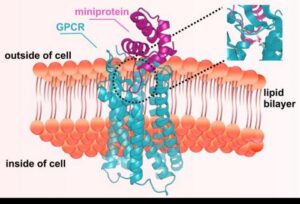
The research team developed a suite of design strategies to create miniproteins capable of slipping into the deep, flexible pockets that govern GPCR signaling. These pockets shift shape depending on whether the receptor is active or inactive, making them difficult to target with conventional biologics. By designing molecules that recognize specific receptor states, the team generated agonists for receptors involved in itch and pain, and antagonists for receptors implicated in cancer, metabolic disease such as diabetes and obesity, and migraine.

GPCR microprotein
A tiny protein (pink) designed on a computer fits into a deep pocket (inset) of a cell surface receptor called a GPCR (blue), allowing scientists to switch cell signaling on or off. [Edin Muratspahić/UW Medicine Institute for Protein Design]

“Protein design takes our understanding of how proteins fold and reverses it—asking if we can envision, with the aid of AI computing, a new protein that sticks to a target in a purpose-built way,” said senior author David Baker, PhD, director of the Institute for Protein Design, professor of biochemistry at the University of Washington School of Medicine, and a Howard Hughes Medical Institute Investigator. “This paper showcases how we can do this repeatedly for different GPCRs in ways that capitalize on their dynamic motion to either activate or inactivate them.”

Cryo‑EM structures of five designed miniproteins closely matched their computational models, underscoring the accuracy of the design pipeline. In one mouse study, a designed chemokine‑receptor antagonist mobilized hematopoietic stem and progenitor cells at levels comparable to a clinically used drug—but with fewer side effects, according to the authors.

For first author Edin Muratspahić, PhD, the moment of validation came when the designed molecules did more than bind. “Seeing computationally designed miniproteins not only bind but actually control GPCR signaling in living cells was a defining moment for me,” he said.

A second major advance reported in the study is a high‑throughput “receptor diversion” screening system that evaluates tens of thousands of designed proteins directly in living human cells. Traditional GPCR screens often require purifying or stabilizing receptors—steps that can distort their natural signaling behavior. By keeping receptors in their native membrane environment, the new system accelerates discovery while preserving biological relevance.

According to corresponding author Christoffer Norn, PhD, co‑founder of Skape Bio, the study lays out a roadmap for all‑computational design of GPCR ligands.

The methods described in the paper are already being adapted at Skape Bio to explore GPCR targets involved in metabolic, inflammatory, and neurologic pathways—areas where conventional discovery efforts have often struggled.

The post AI Designs Miniprotein Switches for GPCR Targeting appeared first on GEN – Genetic Engineering and Biotechnology News.

<![CDATA[Explore how integrated psychotherapy—CBTp, family support, and humane alliance—reduces relapse and restores meaning beyond medication in schizophrenia.]]>

Melatonin for Kids: Is It Safe?

If you’ve spent any time talking to other parents about sleep, you’ve probably heard about melatonin. One person swears by it. Someone else warns against it. And if your child is struggling to fall asleep, it can be hard to know what to believe.

Melatonin is widely available, often marketed as a “natural” sleep aid, and increasingly used to help kids of all ages. But it may not be the right solution. The key is knowing when it makes sense, when it doesn’t, and how to make it work best as part of a bigger sleep plan.

What is melatonin?

Melatonin is a hormone the body produces naturally to regulate sleep. As it gets dark, the brain releases melatonin to signal that it’s time to wind down. Light exposure at night — especially blue light from screens — can disrupt the body’s natural rhythm so you don’t feel sleepy even when it’s bedtime.

“Melatonin supplements can help facilitate that circadian rhythm, that 24-hour sleep cycle,” says Rohn Nahmias, DO, a child and adolescent psychiatrist at the Child Mind Institute. Because it’s sold over the counter, melatonin seems to be harmless. In practice, clinicians are much more cautious. While they tend to consider it relatively low risk, with few side effects, they still don’t view it as something to take casually or indefinitely.

That’s because there are real gaps in what we know about melatonin — especially when kids take it regularly over long periods. “The longest study was about four years, and they did not find any issues,” says Judith Owens, MD, MPH, a pediatric sleep expert and professor of neurology at Harvard Medical School. “But the data are very limited in subject numbers and long-term follow-up.”

So, the question parents often ask — is melatonin safe for kids? — doesn’t have a simple yes or no answer. The more useful question may be whether melatonin is right for your kid and what guidelines should you follow if you’re going to give it to them.  

That’s why it’s especially important to consult your child’s pediatrician or tell them if you’ve already started your child on melatonin. “Because melatonin is over the counter, families often forget to mention it,” says Dr. Nahmias. But doctors need to know about supplements, especially if a child is on other medications or has additional health concerns.

Melatonin can be helpful in the right situations, but using it without looking deeper can be “kind of slapping a Band-Aid onto a problem,” Dr. Nahmias says. In his practice, he always wants to rule out anxiety, mood concerns, or a medical issue that may be impacting sleep (such as snoring, breathing problems, or pain) before introducing something new like melatonin.

When melatonin can help

Melatonin is most useful when the issue is falling asleep, not staying asleep. For example, if your child has persistent trouble falling asleep — not just occasional bedtime resistance — and you have already tried using behavioral strategies.

The immediate-release melatonin sold in the United States is primarily helpful for sleep onset. (A prolonged-release form approved in the UK and EU may help with staying asleep, but it’s not available here.) Melatonin can also help with circadian rhythm issues like delayed sleep-wake phase disorder, when a child or teen’s natural sleep and wake times are much later than their schedule allows. “That is the other real indication for melatonin,” Dr. Owens says.

How to use melatonin thoughtfully

If melatonin does make sense for your child, experts agree: Start low and go slow. Dr. Nahmias recommends beginning with 1 to 2 milligrams for kids four and up and increasing the dose only if needed — up to 3 milligrams for kids ages 6–10. Many children respond well to low amounts. More than 5 milligrams, he says, isn’t much more effective and is more likely to cause side effects like grogginess or irritability. Dr. Owens emphasizes a similarly cautious approach: Use the lowest effective dose, monitor whether it’s actually helping, and reassess regularly rather than letting it quietly become an open-ended routine.

Dr. Nahmias recommends using melatonin in “clusters” — short, purposeful stretches of nightly use to help realign the circadian rhythm — and then pulling back to use as needed. A cluster might make sense for a few weeks after travel, during a tough transition, or while the family works on behavioral changes.

If a child needs melatonin every night for months, that’s a signal to dig deeper. “That tells me that there’s something likely going on underneath that’s not being addressed,” Dr. Nahmias says.

Side effects and safety

Melatonin is generally well tolerated, but knowing the possible side effects can help you catch problems early. The most common is grogginess the next morning. Others include irritability, headaches, dizziness, stomach upset, and — in toddlers and younger children — increased bedwetting. Some children may also experience vivid dreams or nightmares, though these tend to be mild.

Check in with your child’s pediatrician if side effects appear, your child needs melatonin frequently or for more than a short period, the dose keeps creeping up, sleep problems get worse, or if you notice signs of anxiety, depression, or ADHD that might be driving their sleep struggles.

One important safety note: melatonin gummies look like candy, and Dr. Owens describes an “astronomical increase” in calls to poison control centers and emergency room visits related to melatonin in children, largely due to accidental ingestion. Store melatonin — especially gummies — like any other medication: out of reach, ideally in a locked cabinet. Never present them to children as a treat.

A bigger concern: what’s actually in the bottle

Melatonin isn’t tightly regulated in the United States, which means the dose on the label may not match what’s actually in the product. Studies have found that 22 out of 25 over-the-counter melatonin gummies were labeled inaccurately, with some containing far more melatonin than advertised.

Dr. Owens describes the variability as “huge” and says she was genuinely shocked by the findings. When shopping, look for products with a USP Verified mark. USP (United States Pharmacopeia) is an independent nonprofit that tests supplements to confirm the product contains what the label says, in the correct amount, and without harmful contaminants.

Melatonin for kids with ADHD or autism

There’s solid evidence that melatonin can benefit children with neurodevelopmental conditions, particularly autism and ADHD, who are more likely to have disrupted sleep-wake cycles. “There is a pretty robust literature supporting efficacy, without a lot of side effects,” Dr. Owens says about children on the autism spectrum.

But Dr. Nahmias encourages parents of kids with autism or ADHD to take a closer look at bedtime routines before turning to melatonin. “Both of those populations of kids do best when there is structure put into their day,” he says. He recommends having a posted list of the sleep routine that a child needs to accomplish as a helpful visual reminder that will start to become second nature as it is built into their evening.

If getting to sleep is still an issue, trying melatonin makes sense. But for kids with autism and ADHD, it may take more time to see an effect. “It can be helpful to give it a bit longer to re-right the sleep cycle,” Dr. Nahmias says. “Trying it for two to three months may be more beneficial than just a few weeks.”

 Many neurodivergent kids may also need to stay on melatonin longer than neurotypical children. “This makes it absolutely imperative that administration of melatonin for these children is under the supervision of a health professional who can monitor efficacy and side effects, and recommend periodic ‘off-drug holidays,’” Dr. Owens says. The goal is to get sleep back on track and consistent for some time. Once that goal is achieved, Dr. Nahmias adds, “it is important that there be attempts to take breaks from the medication or try lower doses.”

When melatonin is not likely to help

Melatonin is often used in situations where it’s unlikely to make much difference. That’s not a criticism of parents — sleep deprivation is exhausting, and it’s natural to reach for something that seems gentle and accessible. But if the real issue is an inconsistent routine, untreated anxiety, or an unidentified medical problem, melatonin may only be a temporary solution. The real problem will persist and need diagnosis and treatment.

For younger children — kids under five, especially — sleep problems are almost always better addressed with changes in habits and routines rather than supplements. For kids under two, “there’s no reason to use melatonin… and really, honestly, under five, for the most part,” Dr. Owens says. At those ages, behavioral approaches almost always work better.

What to try before using melatonin

Small, consistent changes in sleep habits can make a real difference — and unlike a supplement, these strategies can help children build skills that support sleep for years to come. Dr. Nahmias focuses on what’s often called sleep hygiene: a consistent bedtime and wake time, a predictable wind-down routine, and a sleep environment that actually supports rest, like keeping the bedroom dark, cool, and quiet. “The bed is meant for one thing and one thing only, and that is for sleep,” he says, emphasizing no TV or cellphones before bed. Even small amounts of light can interfere with the body’s natural melatonin production.

He also suggests addressing anxiety, rumination, or bedtime fears directly. “Behavioral interventions, time and time again, have really been shown to be very effective,” Dr. Owens says. For younger children, that might mean learning to fall asleep without a parent in the room. For older kids and teens, it often means setting limits around devices and making sure the schedule they’re keeping is actually realistic.

Making a melatonin plan

Melatonin is a tool that works best with a plan behind it. Before starting, write down what problem you’re actually trying to solve. Is your child unable to fall asleep before 11pm? Waking during the night? Scared to sleep alone? Anxious about school?

A simple sleep log can make your conversation with your child’s doctor much more useful. For a week or two, track bedtime, approximate time asleep, any night wakings, morning wake time, screen use, and whether melatonin was used and, if so, at what dose. Dr. Owens calls sleep diaries “invaluable” because they reveal patterns that are nearly impossible to see when everyone’s tired and running on memory. That information helps you and your child’s doctor decide whether melatonin is worth trying, whether it’s working, and when it might be time to stop — keeping the focus not just on getting through tonight, but on helping your child build the sleep habits they’ll carry with them for years.

Frequently Asked Questions

Is melatonin safe for kids?

Melatonin is generally considered low risk and can be helpful for some children who have trouble falling asleep, especially when used short term and under a doctor’s guidance. But experts caution that there are still gaps in research about long-term use in kids, so it shouldn’t be treated as harmless or used casually without looking at underlying issues.

Can you OD on melatonin?

Accidental overuse can happen, especially because melatonin gummies may look like candy to young children. In recent years, there has been a major increase in poison control and ER visits related to accidental ingestion, so melatonin should always be stored like any medication — out of reach and ideally locked away.

Is melatonin bad for kids?

Melatonin is not inherently “bad” for kids, but it’s not the right solution for every sleep problem. If poor sleep is caused by anxiety, inconsistent routines, or a medical issue, melatonin may only mask the problem.

How much melatonin is safe for kids?

Experts recommend starting with the lowest effective dose. Some clinicians suggest starting with 1–2 milligrams for children ages four and up, and generally not exceeding 3 milligrams for kids ages 6–10 unless advised by a doctor.

The post Melatonin for Kids: Is It Safe? appeared first on Child Mind Institute.

Next-Generation Cardiac AI System Outperforms Existing Models

A next-generation artificial intelligence system can analyze complex heart scans better than existing models without the need for laboriously, manually labeled training data.

The system, outlined in Nature Communications, sets the scene for multimodal learning approaches to be further integrated into medical imaging, with the potential to improve diagnoses and patient outcomes.

The vision-language self-supervised learning framework for cardiac magnetic resonance (CMR) imaging uses contrastive language image pretraining (CLIP) and treats scans as videos of the beating heart.

The novel CMR-CLIP system outperformed existing models by 35% and was better at identifying common pathologies such as myocardial fibrosis and left ventricular hypertrophy.

It also beat other models at common computational tasks such as the retrieval of CMR studies or radiology reports and downstream disease classification tasks.

“Systems like CMR-CLIP have the potential to support clinicians through automated screening, and interpretation support, particularly in settings where expert readers are limited,” explained researcher David Chen, PhD, of Cleveland Clinic.

“Such reader assistant tools are critical to improving patient access to this powerful diagnostic technology.”

Cardiac magnetic resonance imaging is the definitive way to diagnose several cardiac diseases including valvular pathologies, cardiomyopathies, pericardial and aortic diseases.

However, interpreting and documenting each exam takes a great deal of time due to the amount of information collected in each CMR exam—often more than 40 minutes per study.

Vision-language models trained using self-supervised learning are therefore crucial to reduce dependency on large volumes of labeled data.

However, conventional self-supervised approaches that rely on precise image-text pairing are not always feasible for CMR, given that it is able to visualize cardiac anatomy, physiology, and microstructure in a single exam.

Unlike either generalists and other biomedical domain-specific models, which are trained using individual images or limited views, CMR-CLIP incorporates a wide variety of standard cardiac views and image types that represent of morphology, function, and myocardial viability.

The vision language model connects images and associated reports, treating the various views of the heart and image types as a sequence of images in video format.

The model was trained on over a million images from over 10,000 unique studies at a single institution and performed well on evaluation in both on internal and external datasets.

The researchers said it achieved “remarkable performance” at real-world clinical tasks, reaching accuracies of 88.5% for non-ischemic cardiomyopathy, 88.0% for ischemic cardiomyopathy, 96.2% for cardiac amyloidosis, and 98.6% for hypertrophic cardiomyopathy.

“This work demonstrates that domain-specific foundation models can significantly outperform general-purpose AI systems in specialized clinical applications,” said researcher Ding Zhao, PhD, Carnegie Mellon University.

“By designing models that reflect the structure and complexity of cardiac MRI data, rather than adapting generic image models, we can unlock new levels of performance and clinical utility.”

The post Next-Generation Cardiac AI System Outperforms Existing Models appeared first on Inside Precision Medicine.

Open-Source Algorithm Advances Precision Menstrual Health Beyond Fertility

Scientists at SRI International have developed an algorithm that analyzes menstrual cycle data to uncover hidden connections to overall health and aging, moving beyond the fertility focus of most previous research. In a study published in Science Advances, the tool revealed how aging influences key changes during the menstrual cycle and identified markers of individual variability that could be leveraged for the development of personalized approaches to menstrual health. 

“Across the reproductive life stage, a woman living in the United States would have, on average, 450 menstrual cycles, out of which [approximately] 3.2 cycles result in pregnancy. Yet, most of the focus on menstrual health—including research, medical training, customers apps, and patents—are centered solely on the reproductive aspect, and fail to leverage these 99% non-conceptive menstrual cycles as health indicators,” writes Marie Gombert-Labedens, PhD, postdoctoral researcher at SRI International and lead author of the study. 

The menstrual cycle is a complex process that is tightly connected to an individual’s health, influencing many physiological processes including metabolic and immune functions. Gombert-Labedens and colleagues believe that tracking the rhythms of the menstrual cycle can be a valuable yet underexplored diagnostic tool—similar to how cardiac rhythms are routinely monitored to diagnose a wide range of cardiovascular conditions or how circadian rhythms can indicate metabolic disorders. 

However, more work needs to be done in menstrual health research to identify the most relevant metrics, their relationship with health conditions, and the extent to which individual variations may require a personalized approach. To aid the research community in this endeavor, the team developed the WAVES algorithm, which stands for ‘women’s health assessment through variability in endocrine-related signals.’

Using the WAVES algorithm, the researchers analyzed data from 5,674 menstrual cycles from 753 participants between 18 and 42 years old, including daily temperature measurements, vaginal secretions, age, reproductive history and sexual activity. Results showed that aging was associated with measurable changes in the menstrual cycle, including higher average temperatures, shorter cycles, and a decrease in regularity across multiple metrics. 

Gombert-Labedens and colleagues also looked at individual variability across all metrics, as menstrual cycles are known to vary widely from person to person both in terms of length and regularity. “Although the menstrual cycle is typically described as 28 days long, research based on large datasets indicate that this is more the exception than the rule, as only 12.4% of individuals present 28-day cycles,” she stated. 

Their analysis revealed that each participant showed individual patterns concerning mean body temperature across cycles, minimum and maximum temperature measurements, and the duration of both the full cycle and its phases. “These findings suggest that, across cycles from the same individual, each person has their own temperature baseline measurement around which the menstrual fluctuations are organized and are highly stable,” noted Gombert-Labedens. 

As an open-source platform, the WAVES algorithm is now available to researchers worldwide studying menstrual cycle patterns, helping them parse through large amounts of data to identify relevant biomarkers associated with health, disease, and treatment response. 

“The menstrual cycle is a rich yet underused source of physiological information,” Gombert-Labedens concludes. “This work suggests that the WAVES algorithm can be used for advancing digital biomarker discovery, and highlights the relevance of a personalized approach in the development of next-generation tools for women’s health.” 

The post Open-Source Algorithm Advances Precision Menstrual Health Beyond Fertility appeared first on Inside Precision Medicine.

Functional brain alterations associated with acupuncture for chronic pain: a scoping review of fMRI studies

BackgroundChronic pain (CP) is a public health challenge recognized as involving large-scale functional brain dysregulation. Acupuncture is widely used as a non-pharmacological intervention for CP, yet its central mechanisms remain incompletely understood. fMRI provides an approach for investigating acupuncture-related brain alterations in CP.MethodsEight databases were searched from inception to March 27, 2025 for fMRI studies investigating acupuncture’s central effects in CP. Eligible studies included randomized controlled trials and observational studies involving migraine, knee osteoarthritis, fibromyalgia, sciatica, chronic shoulder pain, chronic neck pain, cervical spondylosis, chronic low back pain, and lumbar disk herniation. Data on characteristics, acupuncture protocols, neuroimaging findings, and outcomes were extracted and narratively synthesized. Reporting quality of acupuncture interventions was assessed using STRICTA, risk of bias of randomized controlled trials using RoB 2, and methodological quality of observational studies using the Newcastle–Ottawa Scale.ResultsA total of 64 studies were included. CP was characterized by widespread functional brain abnormalities, mainly involving the default mode network, sensorimotor network, and pain- and emotion-related regions such as the anterior cingulate cortex, precuneus, insula, and thalamus. Across longitudinal and controlled analyses, acupuncture-related brain changes were most consistently reflected in altered functional connectivity, local neural synchrony, and regional spontaneous activity. Functional connectivity findings suggested a potentially ACC-centered circuit pattern, whereas regional homogeneity findings revealed bidirectional modulation across multiple brain regions. Comparative evidence further indicated that VA, SA, and EEA may engage partially overlapping but distinct neural processes. Reporting of core acupuncture protocol components was generally adequate, whereas methodological quality remained heterogeneous.ConclusionCurrent fMRI evidence suggests that CP involves large-scale network-level functional imbalance and that acupuncture may be associated with modulation of key abnormal nodes and circuits related to pain perception, sensory processing, and emotional regulation. The available evidence supports a cautious interpretation that acupuncture-related brain effects may predominantly reflect a state-dependent recalibration of dysregulated brain networks. Future studies should prioritize large-sample, multicenter, longitudinal, and multimodal designs, together with rigorous control settings and more rigorous, externally validated machine learning-based prediction studies, to better distinguish differential central effects across intervention conditions and advance mechanism-informed personalized acupuncture in CP management.