Exchange Marketplace Launched to Help Stalled Cell and Gene Therapies

A type of exchange marketplace for cell and gene therapies has launched to try and reinvigorate and relaunch candidate therapies that are no longer being developed due to financial constraints, despite having good science behind them.

CGTxchange, an online platform enhanced by artificial intelligence, is the brainchild of the American Society of Gene and Cell Therapy (ASGCT) and the Orphan Therapeutics Accelerator. The latter was set up in 2024 as a patient‑centered, non‑profit biotech accelerator that acquires “shelved” clinical‑stage therapies for ultra‑rare diseases and completes their development and commercialization so patients can actually access them.

The new platform was launched at the ASGCT conference in Boston and is designed to help stalled assets to find a new home. This is designed to address funding pull‑backs, program terminations, and company exits, which are forcing hundreds of cell and gene therapy programs to be discontinued or indefinitely paused despite having good scientific promise.

CGTxchange will link up companies who want to develop their assets with funders and partners who are looking for new development opportunities in cell and gene therapy.

“The cell and gene therapy field has built an extraordinary base of clinical evidence, and yet too many of those programs sit on the shelf for reasons that have nothing to do with the science,” said Terry Flotte, MD, dean of University of Massachusetts Chan Medical School and president of the ASGCT, in a press statement.

“CGTxchange gives our community a structured way to bring those programs back into view, and to connect them with the partners and funders who can help reactivate them.”

The platform is built so that people who own assets they want to develop can securely upload information about them into a database that is then searchable by possible interested parties such as investors, nonprofits, biotechs, and academic groups. They will have to pay a fee for this service, but the press statement says, “up to 10 of the initial listings will be eligible for discounted onboarding.”

When a match is achieved then the asset owner and the interested party will come to some sort of agreement on further financing. This could include traditional or alternative development and financing models, including nonprofit and hybrid structures.

The platform can theoretically be used by people from around the world, but users must apply and be approved rather than simply signing up. According to the platform’s terms and conditions on its website, “access is restricted to authorized representatives of biotechnology companies, academic institutions, nonprofits, and accredited investors.”

The post Exchange Marketplace Launched to Help Stalled Cell and Gene Therapies appeared first on Inside Precision Medicine.


<![CDATA[Psychiatry faces surging stress-driven illness as psychedelics, lifestyle medicine, and biomarkers reshape precision diagnosis and care.]]>

Single Psilocybin Dose Relieves Depression for Over Three Months

Researchers in Sweden report that a single dose of psilocybin, a psychedelic compound found in mushrooms, can provide rapid relief from depressive symptoms. Results from a small-scale Phase II trial, published today in JAMA Network Open, show that patients experienced an improvement as soon as two days after treatment, with effects persisting for longer than three months. 

”Our results suggest that psilocybin can provide rapid, clinically meaningful improvement in depression and may serve as an alternative to standard treatment when fast symptom reduction is important,” says Hampus Yngwe, MD, consultant psychiatrist and PhD student at the department of clinical neuroscience of the Karolinska Institutet in Stockholm. 

Major depressive disorder is commonly treated with selective serotonin reuptake inhibitors (SSRIs), but most patients do not respond to this treatment or become resistant. In addition, their effects can typically take several weeks to be noticeable, and side effects are common. 

Previous research had shown that a single dose of psilocybin can have antidepressant effects in people with treatment-resistant depression or anxiety disorders in patients with advanced cancer. The current study looked instead at the effects of this compound on “common” forms of major depressive disorder. 

The study recruited a total of 35 people with moderate to severe recurrent depression, between 20 and 65 years of age. They were randomly assigned to receive either a single 25mg dose of psilocybin or niacin, an active placebo that causes a noticeable physical reaction. All patients received psychotherapeutic support before, during, and after treatment.  

Participants were evaluated using the Montgomery–Åsberg depression rating scale (MADRS) to assess treatment effects at multiple time points after dosing. After a week, the group who received psilocybin saw an average MADRS score reduction of 9.7 points, compared to 2.4 points in the placebo group, and these effects persisted after two weeks and six weeks. At this point, 53% of participants who received psilocybin were in remission, compared to 6% in the placebo group. 

A self-reported version of the MADRS revealed that patients saw antidepressant effects as early as day two after dosing, and continued to experience these positive effects for over three months. 

A year after treatment, all patients who received psilocybin treatment remained in remission. However, many of the patients who received the placebo had also recovered at that point, showing no major statistical difference between both groups. 

“The long-term effects are uncertain,” says Yngwe. “Repeated treatments may be needed to prevent relapse. This needs to be investigated in larger studies.”

Because the effects of psilocybin are strong and easily recognizable, many participants were able to tell whether they had received the treatment or the placebo. This is a common challenge scientists face when studying psychedelic treatments that can make it difficult for patients and researchers alike to separate the effects of the treatment from their expectations. “We want to understand how factors such as treatment expectations and lack of blinding affect the results, as previous studies may have exaggerated the treatment effects,” notes Yngwe.

Next, the researchers will analyze data from PET scans, blood, and cerebrospinal fluid samples collected from all patients before and after dosing. This will help them understand the physiological changes induced by psilocybin, and how these influence its observed antidepressant effects. 

”Research suggests that the interaction between parts of the brain is impaired in depression and that this may be linked to changes in the connections between nerve cells, known as synapses,” says Yngwe. “In preclinical studies, psychedelics have been shown to stimulate synaptic growth. We therefore want to investigate whether psilocybin alters synaptic density in the brain.”

The post Single Psilocybin Dose Relieves Depression for Over Three Months appeared first on Inside Precision Medicine.
STAT+: Takeda will pay $13.6 million to settle allegations it paid kickbacks to doctors

Takeda Pharmaceuticals agreed to pay $13.6 million to settle allegations that it paid kickbacks to doctors to prescribe an antidepressant and, consequently, violated federal law by causing Medicaid to pay false claims, the U.S. Department of Justice said in announcing the settlement.

From January 2014 to October 2020, the company allegedly offered speaking fees and paid for meals at “high-end” restaurants to persuade physicians to prescribe Trintellix. Moreover, certain doctors who attended multiple programs on the same topic and received meals and drinks did not gain any educational benefit from attending the programs.

“This settlement demonstrates the continued commitment of my office to ensure that patients’ best interests remain paramount,” Eric Grant, the U.S. attorney for the Eastern District of California, said in a statement. “Prescribing decisions should not be influenced by drug companies’ payments or side perks made available to physicians.”

Continue to STAT+ to read the full story…

ASGCT 2026: Rare Instance of AAV Integration into Human Genome Linked to Brain Tumor

Rebecca Ahrens-Niklas
Rebecca Ahrens-Niklas, MD, PhD

BOSTON — A team at Children’s Hospital of Philadelphia (CHOP) led by Rebecca Ahrens-Niklas, MD, PhD, and Lindsey George, MD, has described a case of a brain tumor linked to a rare integration of adeno-associated virus (AAV).

George presented the work at the American Society of Gene and Cell Therapy (ASGCT) conference in a plenary talk selected as the “presidential abstract” by ASGCT president, Terry Flotte, MD. The study, “Neuroepithelial tumor with AAV integration after intracisternal magna vector delivery,” was published in the New England Journal of Medicine.

Lindsey George
Lindsey George, MD

Over the past 25 years, some 6,000 patients have been treated with some form of AAV gene therapy. In all that time, George said, there have been no established long-term safety concerns, although genome integration events have been reported in mouse and dog studies. But the case documented by George and colleagues at CHOP suggests that the gene therapy field may need to pay more attention to this potential occurrence.


The story began with a 5-year-old boy with an inherited lysosomal disorder, severe MPS1 deficiency (Hurler subtype). The patient received enzyme replacement therapy at six weeks of age, followed by a cord blood stem cell transplant at age four months.

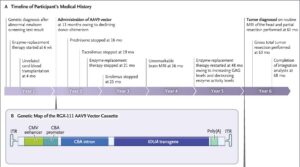
Investigators chose to perform gene therapy when the patient was 13 months old to deliver the iduronidase (IDUA) gene. The vector chosen was an AAV9 serotype, using a cytomegalovirus enhancer and a chicken beta-actin promoter driving the gene. The virus was administered into the boy’s cisterna magna in the base of the skull.

When the boy was five years old, a routine neurological scan revealed a large intraventricular mass that had not been observed two years earlier. Analysis of the tumor revealed it was a PLAG1-driven neuroepithelial tumor—indeed, PLAG1 expression was almost 300 times higher than in other central nervous system tumors studied at CHOP. (PLAG1 is usually only expressed during embryogenesis.)

Surgery to remove the tumor was successful. Eight months after surgery, there are no signs of tumor growth. The boy is also showing advanced neurocognitive function.


Tumor typing

George described RNA sequencing of the tumor, which revealed the fusion of a fragment of the AAV9 vector cassette to exon 5 of the PLAG1 gene on chromosome 8. The resulting transcript is predicted to encode a PLAG1 derivative containing five zinc-finger DNA-binding domains and a C-terminal transcriptional activation domain, which was previously reported to function as a transcriptional activator.

Adeno-associated virus
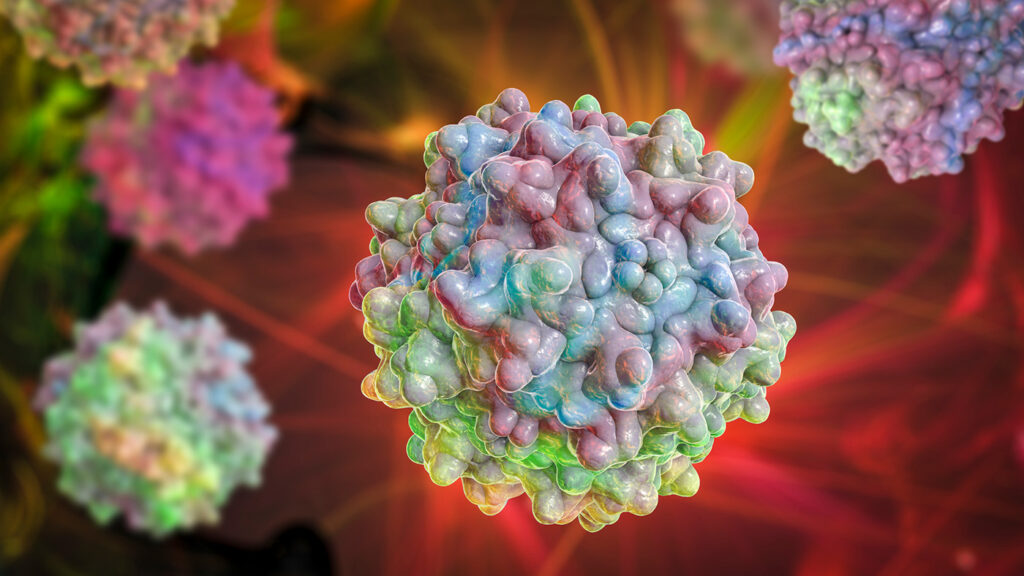
Credit: Dr_Microbe / iStock / Getty Images Plus

Curiously, the chimeric junction also included a segment of human chromosome 10, which George suspects originated during the vector manufacturing process. The integration event was present in about 40% of the total reads, suggesting integration into one of the two PLAG1 alleles.

George concluded her talk by noting that while the clinical outcome in this patient is so far encouraging, this is evidence that AAV integration can be associated with oncogenesis. The study underscores the need to monitor the most heavily transduced tissues after AAV gene therapy.

While the gene therapy community should be cautious in extrapolating this single case report across all AAV gene therapy programs, George said the study supports the use of the lowest feasible vector dose as well as tissue-specific promoters.

A) Timeline of the patient’s medical history; B) Diagram of AAV gene therapy cassette. [The New England Journal of Medicine ©2026]

George noted that detection of the integrated AAV vector DNA was challenging, in part because of rearrangements of vector DNA. The use of several complementary techniques—long-read DNA sequencing, targeted PCR amplification, and RNA sequencing—was required to confirm the integration.

George and coworkers closed their paper, noting that, “Our findings support the hypothesis that rare AAV integration can contribute to human oncogenesis, which emphasizes the need to optimize gene delivery methods and monitor transduced tissues after treatment.”

The post ASGCT 2026: Rare Instance of AAV Integration into Human Genome Linked to Brain Tumor appeared first on GEN – Genetic Engineering and Biotechnology News.

STAT+: Top U.S. officials pressured Germany to pay more for prescription drugs

WASHINGTON — Over a recent breakfast, U.S. officials had a message for the German ambassador: pay more for pharmaceuticals.

The meeting, between U.S. Trade Representative Jamieson Greer, chief health department adviser Chris Klomp, and German Ambassador Jens Hanefeld, was part of a larger push from the Trump administration to get other countries to pay more for medications as the U.S. pays less, according to a person familiar with the meeting.

The U.S. officials discussed the possible use of tariffs under Section 301 — which grants the government authority to combat trade practices considered “unfair.” The move would be similar to the tactic of threatening new tariffs to get other countries to pay more for drugs. The ambassador agreed to review the matter with officials in Germany, but no deal was made, the person said. 

Continue to STAT+ to read the full story…