

Illuminating the Drug Development Path with Cell-Based Reporter Assays

Sponsored content brought to you by

BPS Bioscience logo

Selecting and advancing drug candidates through discovery and development is a long, resource-intensive process. Demonstrating efficacy, mechanism of action (MOA), and product quality requires robust functional data.

In early discovery, researchers use high-throughput screening (HTS) to identify active compounds in a biologically relevant context. During lead characterization and validation, these assays generate reproducible, quantitative data to confirm activity and support candidate selection. In later stages, cell based assays are commonly used as potency assays to ensure reliability, consistency, and lot-to-lot comparability of biologics, supporting regulatory compliance.

BPS Bioscience maintains upstream licensing agreements for its cell lines, enabling clients to operate within established regulatory frameworks. This approach mitigates downstream risks associated with third-party restrictions and supports a smoother transition from research to clinical and commercial use.

Scientific rationale for using cell-based assays in biologics development

Unlike biochemical assays, cell-based assays capture key parameters such as membrane permeability, receptor engagement, and downstream signaling in intact cells, providing a more accurate representation of biological activity. Genetically engineered cell lines include overexpression and knockout models used to validate therapeutic targets and assess compound activity. Inducible reporter assays are particularly valuable for studying signaling pathways. Luciferase reporters, placed under the control of pathway-specific response elements, enable sensitive, quantitative, and reproducible measurement of pathway activation.

Reporter systems are broadly applicable across diverse cell types and signaling pathways, supporting HTS as well as more complex applications such as research in metabolism/obesity and immunotherapy, chimeric antigen receptor and T-cell receptor functional evaluation, antibody-dependent cellular cytotoxicity assays, and other co-culture models. Many biologics, including cytokine-targeting antibodies, peptides, and mimetics, are defined by their effects on specific signaling pathways. For example, GLP-1 receptor agonists activate cAMP-dependent signaling cascades, while anti-TL1A antibodies inhibit TL1A-mediated immune signaling. Accurately measuring these pathway-specific responses is essential for candidate selection and mechanistic validation.
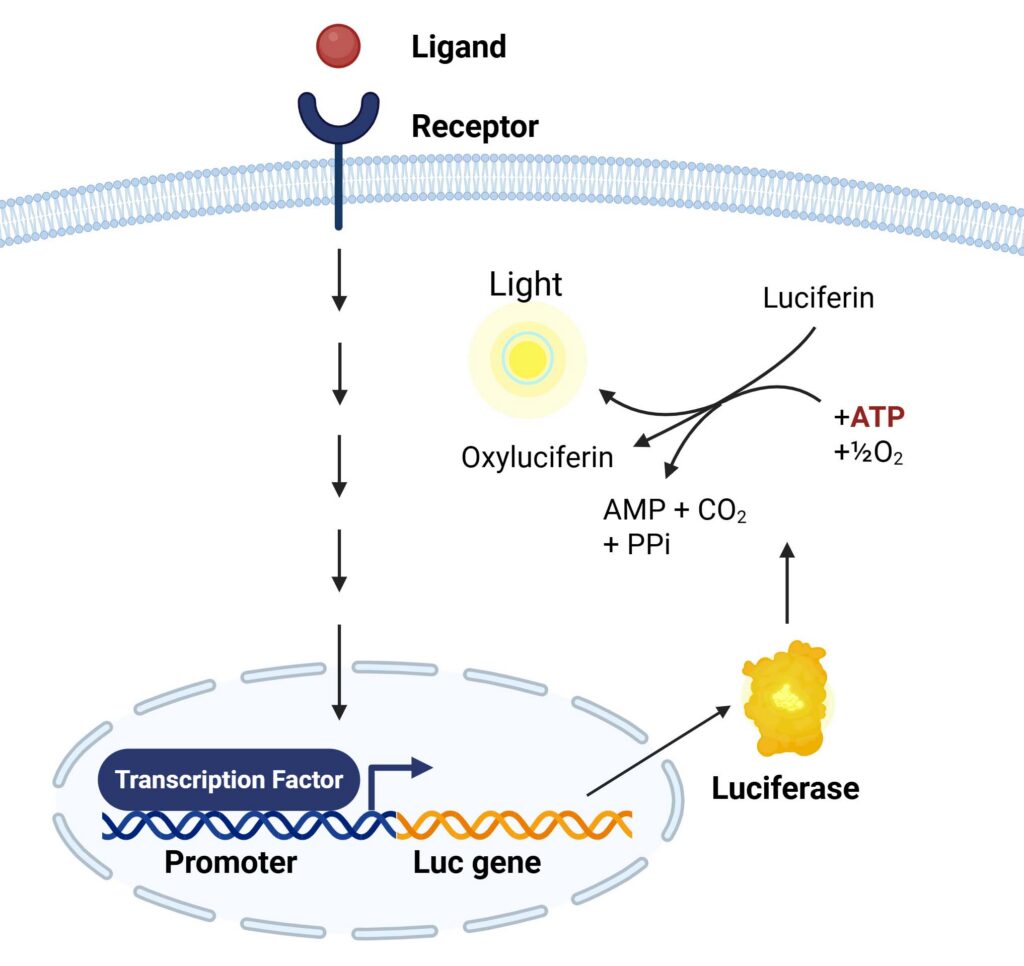
Activation of receptor signaling upon ligand binding triggers luciferase expression. The potency of a candidate drug can be assessed by simply measuring luciferase activity. [This illustration was created using BioRender.com]

Applications

Reporter cell lines enable a wide range of applications:

  1. Discovery and screening

    • Identify agonists or antagonists of specific signaling pathways

    • Screen compound libraries for selective modulators

  2. Mechanistic studies

    • Characterize MOA

    • Analyze pathway function and regulation

  3. Functional assays

    • Perform co-culture cytotoxicity assays to evaluate immune effector function

    • Support immunotherapy development and cell-based therapeutic evaluation

BPS Bioscience reporter cell portfolio

BPS Bioscience offers a comprehensive portfolio of pathway-specific reporter cell lines designed to support biologics development across multiple therapeutic areas. Reporter cell lines include IL-2, IL-6, and IL-15-responsive reporter cells, GLP-1-responsive models for metabolic research, and TL1A-responsive Jurkat cells.

Luciferase-based reporter systems provide rapid, sensitive, and quantitative detection of cellular responses, enabling efficient compound screening, pathway analysis, and target validation. Supporting reagents, including optimized culture media and the One-Step™ Luciferase Assay System, further streamline experimental workflows and improve reproducibility.

Advantages of luciferase reporter cell systems

  • Quantitative readouts enable precise measurement of pathway activity
  • High sensitivity allows detection of subtle biological effects
  • Low background and high signal-to-noise ratio ensure robust data
  • Compatibility with high-throughput formats supports large-scale screening

Advantages of BPS Bioscience reporter cell lines

  • Optimized protocols and media simplify assay implementation
  • Human cell backgrounds improve physiological relevance (with select alternative models available)
  • Cost-effective workflows with minimal reagent requirements
  • Extensive validation, with data often benchmarked against clinically relevant compounds
  • Clonal cell lines ensure consistency and reduce variability over time

Together, cell based reporter assays and their supporting tools enable efficient, pathway

relevant evaluation of biologics from discovery through late stage development.

 

BPS Bioscience QRcode


Learn more bpsbioscience.com.


The post Illuminating the Drug Development Path with Cell-Based Reporter Assays appeared first on GEN – Genetic Engineering and Biotechnology News.

Flumazenil for Benzodiazepine Reversal in Electroconvulsive Therapy

Conditions: Depression – Major Depressive Disorder; Bipolar Disorder (BD); Functional Magnetic Resonance Imaging (fMRI); Cognition; Autobiographical Memory; Electroconvulsive Therapy; ECT; Treatment Outcome; Inpatients

Interventions: Drug: Flumazenil; Procedure: Electroconvulsive therapy (ECT)

Sponsors: Anders Jørgensen

Recruiting

Group-based ACT for Psychological Distress of Young People

Conditions: Depression – Major Depressive Disorder; Depression Anxiety Disorder; Anxiety; Anxiety Depression

Interventions: Other: Group-based Acceptance and Commitment Therapy; Other: TAU

Sponsors: Sorlandet Hospital HF; University of Oslo; Helse Sor-Ost; Karolinska Institutet; Australian Catholic University

Recruiting
<![CDATA[Phase 2 data suggest luvesilocin quickly eases postpartum depression with durable remission and minimal breast‑milk transfer, supporting larger trials.]]>

Sleep-related problems among patients with rheumatoid arthritis in the World Health Organization Eastern Mediterranean region: a systematic review and meta-analysis

BackgroundSleep-related problems are common among patients with rheumatoid arthritis (RA) and contribute substantially to disease burden and reduced quality of life. Evidence from the World Health Organization Eastern Mediterranean Region (WHO EMRO) remains fragmented, with variability in reported prevalence, sleep constructs assessed, and associated risk factors. This study aimed to systematically review and meta-analyze the prevalence and correlates of sleep-related problems among adults with RA in WHO EMRO countries.MethodsA systematic search of PubMed, Scopus, Web of Science, Embase, CINAHL, and Google Scholar was conducted to identify observational studies reporting sleep-related outcomes among adults (≥18 years) with RA in WHO EMRO countries from inception to 27 July 2025. Study screening, data extraction, and quality appraisal using Joanna Briggs Institute (JBI) checklists were conducted primarily by a single author, with methodological oversight and consultation from senior collaborators. Eligible studies reported prevalence or sufficient data to calculate prevalence of specific sleep-related constructs, including subjective sleep quality, insomnia symptoms, daytime sleepiness, or obstructive sleep apnea. Random-effects meta-analysis (DerSimonian-Laird) was used to pool prevalence estimates and odds ratios (ORs) for associated risk factors. Heterogeneity was assessed using the I² statistic and Cochran’s Q test. Subgroup analyses were conducted by sleep construct, assessment method, and country. Publication bias was evaluated using funnel plots, Egger’s test, and Begg’s test, with cautious interpretation due to the small number of studies.ResultsTen studies met inclusion criteria for qualitative synthesis, and six studies (n = 2,315 participants) were included in the quantitative meta-analysis. The pooled prevalence of sleep-related problems was 60.9% (95% CI: 56.5%–65.2%), with substantial heterogeneity (I² = 88%, p < 0.001), reflecting differences in sleep constructs and assessment methods. Subgroup analyses yielded pooled prevalence estimates of 58% for insomnia symptoms, 65% for obstructive sleep apnea-related measures, and 61% for poor subjective sleep quality (PSQI above cut-off), with no statistically significant differences between subgroups. Among associated factors, depression showed the strongest association with sleep-related problems (OR = 2.65; 95% CI: 1.87–3.75), followed by pain (OR = 2.18; 95% CI: 1.68–2.84), fatigue (OR = 1.91; 95% CI: 1.45–2.52), female gender (OR = 1.67; 95% CI: 1.25–2.23), and older age (OR = 1.42; 95% CI: 1.12–1.80). Heterogeneity for risk factor analyses ranged from low to moderate. Publication bias assessments did not indicate statistically significant small-study effects but were underpowered.ConclusionSleep-related problems—assessed using heterogeneous subjective and objective measures—are highly prevalent among patients with RA in WHO EMRO countries with available data. Given substantial clinical and methodological heterogeneity and the limited number of contributing countries, findings should be interpreted as reflecting overall sleep-related burden rather than the prevalence of a single clinical disorder. Routine screening, multidisciplinary management, and culturally adapted interventions are recommended. Future large-scale, longitudinal studies using standardized diagnostic criteria across a broader range of WHO EMRO countries are needed to strengthen the evidence base.Systematic review registrationhttps://www.crd.york.ac.uk/PROSPERO/view/CRD420251109906, identifier CRD420251109906.

Pilot Feasibility Study With Doulas

Conditions: Post Partum; Maternal Depression; Maternal Depression and Parent Practices, Postpartum

Interventions: Behavioral: YouMatter

Sponsors: Duke University

Not yet recruiting

Detecting Alzheimer’s Early by Brain Scan or Blood

While Alzheimer’s disease accounts for about 60-70% of dementia diagnoses, the timing of these diagnoses occur late in disease progression. Identifying early signs of Alzheimer’s may allow individuals time to address potential risk factors in their lives.

“Alzheimer’s disease pathology begins years before symptoms emerge,” said Kristine Yaffe, MD, vice chair in the UCSF Department of Psychiatry and Behavioral Sciences. Yaffe and her team have spent years researching modifiable risk factors that may play a role in dementia development, including physical and cognitive activity, depression, smoking, and cardiovascular health.

A current trajectory of research into Alzheimer’s disease is focusing on ways to detect the disease early, before major symptoms manifest. Two new studies published in The Lancet present different methods for detecting Alzheimer’s disease that converge in their early detection ability.

Alzheimer’s disease is characterized by increased amounts of tau and amyloid-β plaques. Growing research indicates the importance of tau pathology and amyloid-β  accumulation at initiating changes to the brain associated with Alzheimer’s disease.

“Tau is the biology most closely tied to symptoms and future decline,” said Tharick Pascoal, MD, PhD, associate professor of psychiatry and neurology at the University of Pittsburgh and a behavioral neurologist at University of Pittsburgh School of Medicine. “If we can detect tau earlier and stage it more precisely, we can make better decisions about who is truly on an Alzheimer’s trajectory, which matters for clinical trials now and could shape clinical decision-making as new therapies emerge.”

Researchers at the University of Pittsburgh led by Guilherme Povala, PhD, and Bruna Bellaver, PhD, have focused their work on brain scan imaging to detect tau both more effectively, and earlier.

The team’s recently published work compared the ability of two tracers used in non-invasive PET scans to visualize Alzheimer’s-associated tangles of tau protein. To do this, participants underwent paired tau PET scans, the first using a standard tau tracer, Flortaucipir, or a new tracer, MK6240. Within 45 days of the PET scan, participants also received an amyloid-β PET scan and detailed cognitive assessments. Of the 775 initial participants, 682 completed all of the study components.

“Because participants received both tracer scans within a short window, we’re looking at the same moment in the disease course, so differences we see reflect the tracers, not changes over time,” explained co-lead author, Guilherme Povala, PhD, postdoctoral associate at the University of Pittsburgh, about the experimental design.

Analysis showed that imaging with the MK6240 tracer detected more tau than tracing with Flortaucipir. In participants with cognitive impairment and positive amyloid-β results, MK6240 identified move than twice as many tau-positive cases, 15% compared with six percent, which was an additional 23 patients per 100. Tracing with MK6240 also identified increased tau, 28% vs. 16% with Flortaucipir, in patients with mild cognitive impairment and dementia, resulting in 15 or 21 additional cases per 100 participants scanned.

“People typically seek evaluation because they have memory concerns or other symptoms,” pointed out co-lead author, Bruna Bellaver, PhD, research assistant professor of psychiatry at the University of Pittsburgh. “Tau PET is one tool that can help clinicians stage disease biology and make more informed decisions.”

Across the country in California, researchers from University of California, San Francisco, have drawn on their experience with blood biomarkers in an effort to develop a method for detecting Alzheimer’s before major symptoms develop.

The west coast study included 1,350 participants (out of an initial 2248) who were retained in the U.S. Coronary Artery Risk Development in Young Adults (CARDIA) study. Participant blood plasma was tested from samples that were collected at project year 35 (2020-2022) and five years prior. Plasma biomarkers for amyloid-β (Aβ42 and Aβ40) and tau (p-tau217) were measured and used to calculate p-tau217-to-Aβ42 and Aβ42-to-Aβ40 ratios and then those were compared to the cognitive assessment scores that were measured at the same time period. Any participants missing materials were excluded from the initial cohort. During analysis, participants were also classified by Alzheimer’s disease neuropathy status of negative, intermediate and positive based on amyloid PET-validated cutpoints for each marker.

Results from the initial analysis showed that participants with high biomarkers also had both lower processing speeds and lower executive function in the first time point. After five years, the group that initially had high levels of biomarkers now had a 2.5 to 4 times increased risk of rapid decline in verbal memory, and three to four times the risk for rapid decline in processing speed. Together, these data suggest a connection between the observed cognitive decline and increase in biomarkers.

While brain scans, and spinal fluid tests are often used and widely available, blood tests are less invasive and relatively inexpensive, potentially enabling more patients access to diagnostics along with early detection prior to symptom development. While there is potential for measuring blood biomarkers for clinical use, senior author, Yaffe, prescribes cautious optimism. “There’s a possibility of false positives and [these markers] can only be used for Alzheimer’s, not other dementias, meaning about 60% to 70% of all dementia cases,” she said. “But for some people who discover they have the biomarkers, testing could open a window to embark on interventions that may postpone Alzheimer’s onset.” More work is still needed to clarify the utility of both early detection methods in the clinic.

Overall, both studies show significant progress in developing strategies to identify dementia, and specifically Alzheimer’s disease, earlier. Earlier diagnosis may lead to earlier intervention and potentially more positive outcomes for patients. As Yaffee concluded, “Detecting the disease early means patients can target modifiable risk factors and maybe seek other care.”

The post Detecting Alzheimer’s Early by Brain Scan or Blood appeared first on Inside Precision Medicine.

<![CDATA[Phase 3 data show COMP360 psilocybin rapidly lifts treatment-resistant depression, with durable MADRS gains and stronger effects from two sessions.]]>