MIT Technology Review Explains: Let our writers untangle the complex, messy world of technology to help you understand what’s coming next. You can read more from the series here.
Eight passengers aboard a Dutch-flagged cruise ship have contracted a type of hantavirus, a rare virus transmitted by rats. Three of them have died. As the ship prepares to dock in the Canary Islands, plans are being finalized to let the remaining passengers and crew disembark safely.
The virus in question appears to have a high fatality rate. Read on for answers to the big questions surrounding the outbreak—and to hear why health experts don’t expect a rerun of the covid-19 pandemic.
What is hantavirus?
Hantaviruses are a group of viruses that typically infect rodents but can be transmitted to humans through exposure to the animals or their droppings, urine, or saliva. The viruses don’t seem to cause illness in rodents, but they can make people very unwell. The symptoms can depend on the type of hantavirus a person has been exposed to. Varieties found in the Americas can cause hantavirus cardiopulmonary syndrome, which affects the lungs and heart and has a fatality rate of up to 50%.
That condition made headlines last year when it caused the death of pianist Betsy Arakawa, the wife of actor Gene Hackman.
How many cases have there been so far?
On April 6, a man aboard the MV Hondius developed respiratory symptoms. He became very unwell and died just five days later. His wife, who left the ship at the island of Saint Helena, also developed symptoms. Her health deteriorated during a flight to Johannesburg, South Africa, and she died the following day, on April 26. South Africa’s National Institute of Communicable Diseases tested samples taken from the woman and confirmed that she had hantavirus.
A third person aboard the ship, who developed symptoms on April 28, died on May 2. Four other passengers who became ill were evacuated—one to South Africa and three to the Netherlands.
An eighth person had disembarked in Saint Helena and reported similar symptoms once he was in Zurich, Switzerland. A team at Geneva University Hospitals confirmed that he had become ill from the Andes virus—a form of hantavirus that can be spread between people.
Could this be the start of the next pandemic?
Health experts don’t believe so. They stress that the situation is nothing like the one the coronavirus that causes covid-19 presented in 2020. For a start, the Andes virus is not a mysterious new virus—scientists already have an understanding of it, and Argentina is sharing diagnostic kits it has already developed.
The virus also doesn’t spread in the same way. Officials at the World Health Organization emphasized that the spread of hantavirus requires close contact—the kind a person might have with a partner, household member, or medical caregiver.
The cruise ship outbreak represents “a specific confined setting where people are interacting in a prolonged close contact,” Abdirahman Mahamud, the alert and response director for the WHO’s health emergency program, said at a press event on Thursday. “With the experience our member states have, and the actions they have taken, we believe that this will not lead to a subsequent chain of transmission.”
What about the rest of the people onboard the ship?
All the remaining passengers have been asked to stay in their cabins, which the WHO says are being disinfected. Doctors and health professionals from the WHO and the European Center for Disease Prevention and Control have boarded the ship and are assessing everyone on board.
So far, no one else on board has developed symptoms, Maria Van Kerkhove, WHO acting director for epidemic and pandemic management, said at the press event. That’s “a good sign,” she said, but she added that the Andes virus has a long incubation period (around six weeks). Passengers are being advised to wear a medical mask when they leave their rooms.
At the same event, WHO director general Tedros Adhanom Ghebreyesus said he was in regular contact with the ship’s captain, who was reporting that “morale had increased significantly” since the ship started its journey to the Canary Islands.
What do we know about the Andes virus?
The Andes virus is the only hantavirus that is known to be transmitted between people. That transmission seems to rely on prolonged, intimate contact.
There was an Andes virus outbreak in Argentina around eight years ago. Between November 2018 and February 2019, there were 34 confirmed cases of infection, and 11 deaths. That outbreak was triggered when a person with symptoms attended a social gathering, said Tedros. “We are in a similar situation right now,” he said. “A cluster in a confined space with close contact.”
The fact that the 2018 outbreak was limited to 34 cases should be somewhat reassuring, he implied. “We believe this will be a limited outbreak if the public health measures are implemented and solidarity is shown across all countries,” he said.
How is hantavirus treated?
Unfortunately, we don’t have any specific antiviral treatments or vaccines for hantavirus. The WHO recommends early intensive care for people who develop symptoms. “This can save lives,” Anaïs Legand, WHO technical lead on viral hemorrhagic fevers, said on Thursday.
How did people get infected in the first place?
We don’t yet have an answer to that. But we do know that the couple who died had traveled through Argentina, Chile, and Uruguay on a birdwatching trip before they boarded the ship. That trip included visits to areas where species of rats that carry the Andes virus are known to live. The WHO is working with authorities in Argentina to try to retrace the couple’s movements on that trip.
Has the virus spread beyond the ship?
We don’t yet know for sure. The WHO is receiving reports of “potential suspect cases,” Van Kerkhove said at the Thursday briefing. Some of them have links to the ship or its passengers. Each “alert” will be followed up by health authorities in the relevant country, she said.
Has the US withdrawal from WHO affected anything?
Five US states have said they are monitoring US nationals who have disembarked from the ship. WHO officials are stressing that they are still sharing technical information with the US Centers for Disease Control and Prevention. “Things are … as they used to be,” Tedros said. “WHO’s mission is to help the world to be safe … and we want the American people to be safe as well.”
But it’s worth noting that cuts made by the Trump administration aren’t exactly putting the US in a good position for events like these. Last year, all full-time employees in the CDC’s Vessel Sanitation Program—which helps prevent and control illness outbreaks on cruise ships—were laid off. Further cuts to the CDC have left public health experts worried about how ill prepared the US is to deal with future disease outbreaks.
What will happen next?
Any suspected cases will be monitored by health authorities. Passengers are due to disembark in Tenerife in the Canary Islands on Sunday, May 10, and the WHO has said it will work with the Spanish government to ensure that the risk to residents remains low and that the passengers are treated with dignity and respect.
In the meantime, scientists are working to fully sequence the genome of the virus from patient samples. They want to find out if it is different from the viruses involved in the previous cases. “So far, we haven’t seen anything unusual,” said Van Kerkhove.
A research team led by scientists at the Princess Máxima Center for Pediatric Oncology, the University of Michigan Medical School, EMBL European Bioinformatics Institute, and the Institute for Systems Biology, has uncovered more than 1,700 new proteins that could have implications for human diseases, including cancer.
Mostly very small, these proteins have been discovered in what’s known as the “dark proteome,” which covers gene products from previously overlooked sections of DNA. These proteins have unusual properties, motivating scientists to coin a new concept, peptideins, to help understand their potentially unique biology. Research co-lead Sebastiaan van Heesch, PhD, a group leader at the Princess Máxima Center, commented, “We know that the current overview of recognized proteins doesn’t capture the full picture. With this study, we show that thousands of overlooked genetic sequences contribute to the dark proteome by producing a new class of protein-like molecules, microproteins, that had been missed before now. But for most of them, we don’t yet know what they do.”
Research co-lead and co-corresponding author Robert Moritz, PhD, professor and head of proteomics at the Institute for Systems Biology, further noted, “Biology has long relied on a relatively small cast of well-characterized proteins to explain the regulatory logic of the cell, but peptideins suggest that beneath that familiar layer lies an entire untapped layer of molecular actors whose functional roles in gene regulation, signaling, and cytopersistence, many we are only beginning to imagine. Given their smaller size and the diversity of cellular contexts in which they appear, I believe peptideins may prove to be among the most versatile and consequential regulatory molecules we have yet encountered in human biology. This is not the end of a search—it is the opening of a vast and fertile new territory for the entire scientific community to explore and exploit, and I look forward to seeing what the broader scientific community uncovers as these molecules, and many more that are yet to be confirmed, are brought into the light.”
Research co-lead John Prensner, MD, pediatric neurooncologist at the University of Michigan Medical School, together with Van Heesch and Moritz, are co-senior and co-corresponding authors of the researchers’ published paper in Nature titled “Expanding the human proteome with microproteins and peptideins.” The team is sharing its discoveries with scientists worldwide in an open-source format to stimulate further research.
Van Heesch added, “With growing interest in industry and academia, peptideins are at the center of multiple drug development initiatives. Similarly, we see them increasingly turning up as important players in diseases, including childhood cancers. We hope to inspire a new wave of research into peptideins and to unlock new insights and drug targets across human biology, particularly for the development of cellular immunotherapies and cancer vaccines.”
The study is the work of the TransCODE Consortium, an international collaboration of more than 60 researchers at over 30 institutions worldwide, co-led by the Princess Máxima Center for Pediatric Oncology in the Netherlands, the University of Michigan Medical School, the EMBL European Bioinformatics Institute in Hinxton, and the Institute for Systems Biology in Seattle.
Genes in DNA provide the recipe for cells to produce peptides. Historically, peptides have been called proteins if they are long enough and have existing evidence for a biological role, such as the appearance of the same protein across species in evolution. “Protein-coding genes are the bedrock of biomedical investigations, including the overwhelming majority of drug development programs,” the authors wrote. A large, curated international database of proteins contains some 19,500 entities.
But increasingly, scientists believe the traditional definition of a protein needs to be broadened. “Whether the human genome encodes substantially more than the approximately 19,500 canonical protein-coding genes has sparked a spirited debate in recent years,” the scientist continued. “Therefore, any wholesale addition of protein-coding genes creates ripple effects across human bioscience.”
Through their newly reported study the team looked at more than 7,200 previously understudied sections of the DNA called non-canonical open reading frames (ncORFs). They found that some 25% of these sections—more than 1,700—generated detectable protein-like molecules. These proteins, smaller than traditional proteins, are referred to as “microproteins.”
Generating their results involved looking at 3.7 billion individual bits of raw data that may support known and previously unknown proteins—drawing upon 95,520 experiments. “We show that about 25% of a set of 7,264 ncORFs gives rise to detectable peptides in a large-scale analysis of 95,520 proteomics experiments,” they wrote. The process took around 20,000 hours for computers to complete, working non-stop. They found 1,785 microproteins, a number that at first glance would increase the protein databases by nearly 10%.
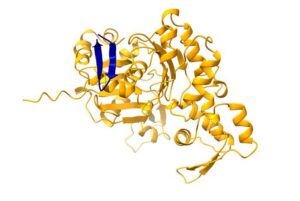
Predicted binding between a non-canonical open reading frame (blue) and traditional protein (yellow). [Leron Kok/Princess Máxima Center for Pediatric Oncology]
Moritz further explained, “By deploying our battle-hardened Trans Proteomic Pipeline across nearly 100,000 mass spectrometry experiments encompassing 3.7 billion spectra—derived from the world’s collective publicly available mass spectrometry data, with the results housed within PeptideAtlas at ISB for the scientific community to view and share—we were able to confirm, with high confidence, the existence of more than 1,700 of these newly identified peptideins that would otherwise have largely remained invisible to science.”
But most of these 1,785 microproteins didn’t resemble the other 19,500 traditional proteins. For example, they were very small: 65% were fewer than 50 amino acids in length, compared to less than 1% of the 19,500 previously catalogued. Looking more closely at the microproteins the investigators saw that only a few—perhaps a dozen—resembled the traditional proteins. The team then spent more than a year trying to make sense out of the remaining bulk.
Working with protein experts from across the globe in the TransCODE consortium, the scientists coined a new biological concept, which they coined peptidein. For decades, the research community has had a binary view of the relationship between human DNA and human proteins. A given piece of DNA either does or does not produce a protein. In their new study, the scientists propose a third choice, which is that DNA could make a protein, a peptidein, or neither.
The team defined a peptidein as existing in cells as a protein-like molecule, meaning that it is made of amino acids, as are proteins. But the role of a peptidein is ambiguous. Perhaps it has a function in normal human biology, or perhaps not; this is the key distinction with traditional proteins, where all are believed to have a function in normal human biology even if the details of that function are not fully known yet. “To advance these ncORFs in biological inquiry, we invoke the emerging umbrella term of peptidein, which we define as an ORF with experimentally confirmed RNA translation and protein synthesis, but for which the data are currently insufficient to claim conventional protein-coding gene status,” the investigators stated in their report.
Importantly, this definition of peptidein leaves the door open for it to become a ‘protein’ in the future—that is, if scientists gather more evidence on it. To start exploring this idea, the team searched for peptideins without which cells cannot survive. These so-called pan-essential peptideins can be important candidate drug targets in cancer and other diseases.
Using large-scale CRISPR gene editing, the scientists found six peptideins that looked promising. For example, one of these was a peptidein produced from OLMALINC, a genetic sequence previously thought not to produce proteins. When the researchers switched this gene off, 85% of more than 485 cancer cell lines showed impaired survival. The researchers confirmed that this effect comes from the peptidein itself, not the RNA molecule it sits on, and found that it plays a role in cell division and DNA damage response. “Our work here highlights c10riboseqorf92 (in the OLMALINC transcript),” they commented. “… while we do not yet have sufficient evidence that this ncORF encodes a bona fide protein, its CRISPR-based phenotypes in the context of cancer cells are intriguing.”
Many of the newly detected peptideins are presented on cell surfaces for recognition by the immune system, making them potential targets for cancer immunotherapy. A number of such molecules presented to the immune system are already under development as drug targets, and there is growing interest from both academia and industry in exploiting this new class of cancer antigens. Peptideins could also shed light on genetic diseases that conventional gene analysis has been unable to explain, simply because genetic diagnostics were unaware that these molecules were encoded by the human genome.
Members of the consortium had previously uncovered an essential role for a microprotein, ASNSD1-uORF, in children with a high-risk form of the brain cancer, medulloblastoma. Scientists at the Princess Máxima Center are now carrying out further research to determine its role in additional pediatric cancers with the activated MYC oncogene, such as neuroblastoma.
van Heesch commented, “It felt really special to discuss and decide what to do with this new class of molecules, as we had gathered enough early evidence to suspect that they might be widespread across cell types and tissues. By classifying these molecules of unknown functionality as peptideins, we’ve given them a formal place in reference databases so the wider community can study them.”
In their paper the researchers concluded, “The extent of the undiscovered proteome is one of the central questions in human biomedicine. This work reflects the multi-consortium collaboration between the TransCODE Consortium, the HUPO-HPP/PeptideAtlas project, the HIPP immunopeptidomics project and the GENCODE gene annotation group to coalesce a generalizable approach towards understanding which ncORFs can be understood as encoding proteins … Through our efforts, we bring microproteins and alternative protein molecules into reference gene annotation by defining them as either a protein-coding gene or a peptidein, a new concept referring to confirmed protein molecules of indeterminate consequence.”
Prensner added, “We’re just beginning to see what this ‘dark proteome’ has to offer. It’s like the trailer to a movie. We see the outline of a game-changing view of human biology. We’re incredibly excited that the coming years will open new doors to help solve and treat human diseases such as cancer.”
Moritz further stated, “Our collaborative work represents a culmination of decades of investment from federal funding agencies in building the computational and data infrastructure needed to interrogate the proteome at truly unprecedented scale at the Institute for Systems Biology … What excites me most is not simply that these molecules exist, but what their existence implies.”
The researchers are making we make all ncORFs, peptides and spectra publicly available through PeptideAtlas.
The San Francisco–based startup Goodfire just released a new tool, called Silico, that lets researchers and engineers peer inside an AI model and adjust its parameters—the settings that determine a model’s behavior—during training. This could give model makers more fine-grained control over how this technology is built than was once thought possible.
Goodfire claims Silico is the first off-the-shelf tool of its kind that can help developers debug all stages of the development process, from building a data set to training a model.
The company says its mission is to make building AI models less like alchemy and more like a science. Sure, LLMs like ChatGPT and Gemini can do amazing things. But nobody knows exactly how or why they work, and that can make it hard to fix their flaws or block unwanted behaviors.
“We saw this widening gap between how well models were understood and just how widely they were being deployed,” Goodfire’s CEO, Eric Ho, tells MIT Technology Review in an exclusive chat ahead of Silico’s release. “I think the dominant feeling in every single major frontier lab today is that you just need more scale, more compute, more data, and then you get AGI [artificial general intelligence] and nothing else matters. And we’re saying no, there’s a better way.”
Goodfire is one of a small handful of companies, including industry leaders Anthropic, OpenAI, and Google DeepMind, pioneering a technique known as mechanistic interpretability, which aims to understand what goes on inside an AI model when it carries out a task by mapping its neurons and the pathways between them. (MIT Technology Review picked mechanistic interpretability as one of its 10 Breakthrough Technologies of 2026.)
Goodfire wants to use this approach not only to audit models—that is, studying those that have already been trained—but to help design them in the first place.
“We want to remove the trial and error and turn training models into precision engineering,” says Ho. “And that means exposing the knobs and dials so that you can actually use them during the training process.”
Goodfire has already used its techniques and tools to tweak the behaviors of LLMs—for example, reducing the number of hallucinations they produce. With Silico, the company is now packaging up many of those in-house techniques and shipping them as a product.
The tool uses agents to automate much of the complex work. “Agents are now strong enough to do a lot of the interpretability work that we were doing using humans,” says Ho. “That was kind of the gap that needed to be bridged before this was actually a viable platform that customers could use themselves.”
Leonard Bereska, a researcher at the University of Amsterdam who has worked on mechanistic interpretability, thinks Silico looks like a useful tool. But he pushes back on Goodfire’s loftier aspirations. “In reality, they are adding precision to the alchemy,” he says. “Calling it engineering makes it sound more principled than it is.”
Mapping models
Silico lets you zoom in on specific parts of a trained model, such as individual neurons or groups of neurons, and run experiments to see what those neurons do. (Assuming you have access to the model’s inner workings. Most people won’t be able to use Silico to poke around inside ChatGPT or Gemini, but you can use it to look at the parameters inside many open-source models.) You can then check what inputs make different neurons fire, and trace pathways upstream and downstream of a neuron to see how other neurons affect it and how it affects other neurons in turn.
For example, Goodfire found one neuron inside the open-source model Qwen 3 that was associated with the so-called trolley problem. Activating this neuron changed the model’s responses, making it frame its outputs as explicit moral dilemmas. “When this neuron’s active, all sorts of weird things happen,” says Ho.
Pinpointing the source of odd behavior like this is now pretty standard practice. But Goodfire wants to make it easier to adjust that behavior. Using Silico, developers can now adjust the parameters connected to individual neurons to boost or suppress certain behaviors.
In another example, Goodfire researchers asked a model whether a company should disclose that its AI behaves deceptively in 0.3% of cases, affecting 200 million users. The model said no, citing the negative business impact of such a disclosure.
By looking inside the model, the researchers found that boosting neurons that were found to be associated with transparency and disclosure flipped the answer from no to yes nine out of 10 times. “The model already had the ethical reasoning circuitry, but it was being outweighed by the commercial risk assessment,” says Ho.
Tweaking the values of a model in this way is just one approach. Silico can also help steer the training process by filtering out certain training data to avoid setting unwanted values for certain parameters in the first place.
For example, many models will tell you that 9.11 is greater than 9.9. Looking inside a model to see what’s going on might reveal that it is being influenced by neurons associated with the Bible, in which verse 9.9 comes before 9.11, or by code repositories where consecutive updates are numbered 9.9, 9.10, 9.11 and so on. Using this information, the model can be retrained to make it avoid its “Bible” neurons when doing math.
By releasing Silico, Goodfire wants to put techniques previously available to a few top labs into the hands of smaller firms and research teams that want to build their own model or adapt an open-source one. The tool will be available for a fee determined on a case-by-case basis according to customers’ requirements (Goodfire declined to give specific pricing details).
“If we can make training models a lot more like building software, there’s no reason why there can’t be many more companies designing models that fit their needs,” says Ho.
Bereska agrees that tools like Silico could help firms build more trustworthy models. These techniques could be essential for safety-critical applications in health care and finance, he says.
“Frontier labs already have internal interpretability teams,” he adds. “Silico arms the next tier of companies, where the value is not having to hire interpretability researchers.”
Background: Due to the high burden on health care, home-based rehabilitation (HBR) has gained increasing interest. A new HBR program for stroke survivors, containing a gaming app with upper-limb exercises, monitoring system, and virtual coach was being developed. Objective: This study aimed to assess the user requirements of an HBR tool including a gaming app, monitoring system, and virtual coach, and to examine potential differences between end users and countries. Methods: Thirteen stroke survivors, 12 caregivers, and 15 health care professionals from centers in the Netherlands, Italy, and Spain, participated in focus groups or interviews. Each center used the same interview guide with open questions about each component. An inductive thematic analysis was conducted separately at each center, and results were combined during a physical meeting. Results: User requirements were categorized into three main themes: (1) customization: aligning with individual preferences and capabilities; (2) motivational elements: these included reminders, a variety of levels and games, and ease of use; and (3) feedback elements: maintaining interactions with therapists. These themes apply to both home-based exercises as well as daily-life activities during HBR. There were minor differences between end users or centers. Conclusions: All end users across the participating countries emphasized the importance of integrating gamified exercises, monitoring, and virtual coaching into an HBR system. The user requirements for such a system can be categorized into three key areas: customization, motivational elements, and feedback elements.
<img src="https://jmir-production.s3.us-east-2.amazonaws.com/thumbs/23f37680a120d72e0eb0271c9ca90305" />
Background: Suicide helplines increasingly employ chat services to aid those in urgent need, but the wording and structure of text-driven exchanges may affect their effectiveness. Objective: Given the association of cognitive distortions with depression and anxiety, this study investigated their prevalence in the language of individuals seeking help from the Dutch 113 suicide helpline. Methods: We observed the prevalence of cognitive distortions for both help seekers and counselors in a large volume of chat sessions (N=71,148) of the Dutch 113 suicide chat helpline using natural language processing. The results were compared to 2 large collections of online text data from Dutch social media and web content. Results: We found that nearly all types of cognitive distortions are more prevalent in the language of help seekers compared to the control group of helpline counselors. Distortions of the personalizing, emotional reasoning, and mental filtering types were, respectively, 20.22, 7.87, and 4.53 times more prevalent among help seekers, revealing a distinct pattern of thought and language among individuals affected by suicidality. Conclusions: Our results raise the prospect of improving the effectiveness of online therapeutic interventions that target cognitive distortions through lexical analysis that detects the cognitive and lexical markers of suicidality.
<img src="https://jmir-production.s3.us-east-2.amazonaws.com/thumbs/00f57a522b7e20d230db8854f4090023" />
The mood at the recent 2026 AD/PD International Conference on Alzheimer’s and Parkinson’s Diseases and Related Neurological Disorders in Copenhagen was notably different from the mood that has hung over much of neurodegeneration research for the past decade.
There was still plenty of caution, and plenty of unanswered questions, and certainly no shortage of technical nuance. But there was also something more concrete than hope: a growing sense that the field now has enough tools, biological insight, and clinical momentum to start probing more deeply and stratifying pathologies of neurodegenerative diseases in patients, at varying stages of progression.
That shift was visible across the meeting. It was there in conversations about co-pathologies, the increasingly central role of inflammation and the rapid maturation of blood-based biomarkers. It also featured in the way industry and academia alike talked about therapy: not as a search for a single silver bullet, but as a move toward combination treatment strategies more familiar from the fields of oncology, cardiology, and other complex chronic diseases.
Henrik Zetterberg, PhD, Gothenburg University
Henrik Zetterberg, PhD, Gothenburg University, University College London, and a guest professor at University of Wisconsin-Madison, one of the field’s most influential biomarker researchers, put the central theme plainly: “I think disease heterogeneity will be the mantra in the coming years, to dissect the molecular underpinnings of this heterogeneity.”
Heterogeneity moves from caveat to core concept
Zetterberg described how biomarker-enabled phenotyping is exposing just how different patient trajectories can be once amyloid begins to accumulate. Some people decline quickly. Others remain resilient for a decade or longer. Some cases that appear clinically similar may in fact be driven by very different molecular constellations.
Geoff Kerchner, MD, PhD, vice president, global head of neurodegeneration at Roche
Geoff Kerchner, MD, PhD, vice president, global head of neurodegeneration at Roche, made a similar point from the therapeutic side. In Alzheimer’s disease, he said, some features remain strikingly consistent across patients.
But once one moves beyond core pathology, “the rate at which that happens varies from person to person,” and that variance is shaped in part by co-pathologies, including alpha-synuclein, TDP-43, and vascular disease.
Steve Williams, MD, PhD, chief scientific officer at Alamar Biosciences, pushed the same logic further, arguing that mixed biology is not the exception but the rule. “Everyone with neurodegeneration is carrying around some combination of other pathologies,” he said. “It’s almost inevitable because it’s a feature of aging.”
Steve Williams, MD, PhD, chief scientific officer at Alamar Biosciences
That view has major consequences. It means the field is increasingly moving away from asking whether a patient is amyloid-positive or tau-positive in a binary sense and toward asking what additional pathological burden may be present, what that burden means for progression, and how it should influence treatment choice.
Betty M. Tijms, PhD, head of science Alzheimer Center Amsterdam
Betty M. Tijms, PhD, head of science Alzheimer Center Amsterdam at Amsterdam UMC, offered a useful example from discovery research. In her work integrating CSF proteomics and lipidomics, she described signals that shift depending on tau status and amyloid background. At one point, she noted that these patterns “will inform which type of patients may require their own, personalized therapies.” It captures the direction of travel: from broad molecular mapping to biologically meaningful subtyping.
Inflammation is no longer a side story
Andréa Lessa Benedet, PhD, University of Gothenburg
Andréa Lessa Benedet, PhD, University of Gothenburg, discussed findings showing that people with faster progression in tau-related pathology had “higher expression of many inflammatory markers in plasma and in CSF.” That observation alone is not enough to settle the longstanding question of whether inflammation is driving disease, responding to it, or doing both. But it adds to a growing body of work suggesting that immune biology is closely tied to the pace of progression.
What made Benedet’s description especially interesting was that the signal was not identical across biofluids. The proteins elevated in CSF were not the same as those elevated in plasma. Yet when her group mapped those proteins to cell types and pathways, the two compartments converged on similar biology. In other words, the field may not always be looking for one-to-one molecular matches between brain-adjacent and peripheral compartments. It may instead be learning to recognize pathway-level concordance.
Benedet pointed to evidence suggesting that amyloid pathology together with inflammation may influence how tau spreads through the brain. That “bit of both” view—driver and response, cause and consequence—may be unsatisfying if one wants a simple mechanism. It may also be closer to biological reality.
The therapeutic implication is obvious. If inflammatory processes help define faster-progressing biology, then they are not merely descriptive. They become candidates for stratification and, eventually, intervention.
Blood-based biomarkers as research infrastructure
Jacob Vogel, PhD, Lund University and SciLifeLab
Few topics drew more sustained attention in Copenhagen than blood-based biomarkers. Kerchner called blood-based biomarkers one of the biggest themes of the meeting saying they could “really democratize the diagnosis of Alzheimer’s disease.”
Democratization here is about health equity—geography, trial access, earlier identification, and the possibility of shifting neurodegeneration research beyond the relatively narrow populations that have historically been easiest to recruit and deeply phenotype. That broader perspective surfaced in a session on sex differences in neurodegeneration, where Jacob Vogel, PhD, assistant professor at Lund University and SciLifeLab, presented findings suggesting that brain cells responding to Alzheimer’s pathology have different expression patterns in men and women. Seen that way, the field needs tools that are sophisticated enough to capture the true biological complexity of disease across different patients.
However, one excellent blood-based biomarker, such as brain-derived p-tau217, does not solve the co-pathology problem. As Niranjan Bose, PhD, managing director at Gates Ventures put it, there is a growing “need to do better when it comes to co-pathologies so we can stratify participants better.” A strong single analyte may be enough to identify one core process very well; it is not enough to capture the layered biology of aging brains. That is why the discussion is shifting from singleplex to multiplex, from favorite markers to models.
Zetterberg spoke about the new NULISA Neuro 220 panel from Alamar Biosciences, as a research tool that can help the field probe lysosomal and synaptic biology, alpha-synuclein-related processes, and other pathways relevant to co-pathology. He also highlighted the importance of brain-derived tau readouts, arguing that they may reduce confounding from peripheral tau expression and make blood results easier to interpret in diseases where peripheral neuropathy or other non-CNS biology could muddy the picture.
Zetterberg said, “Those broader panels will be the engines for discovery.” In other words, the value of broad biomarker panels is not that every protein measured will someday be run routinely in a clinical lab. It is that broad panels can reveal reproducible patterns, identify hub biology, and narrow the search toward robust clinical assays.
Combination treatment is becoming the default future
The conference’s other major shift was therapeutically focused. Even where amyloid remained central, the discussion increasingly assumed that amyloid-directed therapy alone will not be the endpoint.
Michael Irizarry, MD, senior vice president and deputy chief clinical officer at Eisai US
Michael Irizarry, MD, senior vice president and deputy chief clinical officer at Eisai US, put it bluntly: “Alzheimer’s is being used as the example of precision medicine.” That is a striking statement, because for years Alzheimer’s was more often framed as the place where precision medicine had failed to arrive. What changed is that biomarkers, imaging, and fluid measures have advanced enough to stage disease more accurately and begin matching interventions to biology and timing.
Irizarry also described an emerging combination logic already being tested clinically. “The hope is that by targeting multiple processes we can get a greater treatment effect,” he said, referring to efforts to combine anti-amyloid therapy with a tau-directed antibody strategy. The reasoning is straightforward: if amyloid clearance slows disease but does not stop it, then other mechanisms—including tau propagation—remain actionable targets.
Kerchner made the same point in even broader terms. “The combination of therapies attacking different aspects of Alzheimer’s disease and Parkinson’s disease is almost surely going to be needed,” he said. He compared the situation to hypertension, diabetes, and cardiovascular disease—complex chronic illnesses that are almost never controlled with one intervention alone.
If the field is moving toward a wider therapeutic lens, with multiple mechanisms and intervention points in play, then there is value in creating space for a broader range of emerging approaches. That was visible in the Startup Hub, now in its second year, where early-stage companies gave short five-minute pitches that often echoed the meeting’s main scientific themes. ScandBio was one example: its Phase III clinical trial of a combined metabolic drug targeting mitochondrial dysfunction in Alzheimer’s disease connected to the conference session on mitochondrial pathways in neurodegeneration and therapy.
Taken together, these developments pointed to the same conclusion: as the biology becomes more layered, the response from the field is becoming more layered too. Combination therapy only becomes rational if disease heterogeneity is measurable. It only becomes practical if blood-based biomarkers can help define stage, likely response, and co-pathology burden without requiring every patient to undergo repeated PET imaging. And it only becomes truly precise if inflammation, synaptic injury, lysosomal dysfunction, vascular change, can be integrated into the treatment model rather than treated as background noise.
<strong>Background:</strong> Effective collaboration throughout the full cycle of care is essential for value-based health care. In the Netherlands, occupational health care and curative health care traditionally operate as 2 separate sectors. As a consequence, effective communication and robust collaboration between professionals working in these sectors are lacking. Digital collaborative care platforms (ie, digital systems that facilitate communication and collaboration between health care professionals) are recognized as a promising solution to address the fragmentation of work-focused health care (health care that supports people on long-term sick leave in staying at or returning to work). A human-centered design (HCD) approach can help ensure that such platforms align with professionals’ needs by involving them throughout the design process. <strong>Objective:</strong> This study examines the experiences of (work-focused) health care professionals, including occupational physicians, insurance physicians, medical specialists, and general practitioners, during the design phase of a real-world HCD process for developing a digital platform to support collaborative care. The study specifically focused on understanding how these professionals perceive this collaborative approach. <strong>Methods:</strong> A mixed method study design was employed, combining observations of 17 design sessions with semistructured interviews with health care professionals as intended users of the platform. Observational data captured session dynamics, while interview data provided deeper insights into professionals’ experiences with the participatory HCD approach. <strong>Results:</strong> Health care professionals were generally motivated to contribute, driven by professional interest, social encouragement, or a desire to improve practice. They valued the open and informal atmosphere of the design sessions and described their role as actively sharing practical experiences and identifying bottlenecks in current practice. Participants emphasized the importance of clear goals, good preparation, and iterative involvement for meaningful engagement. Barriers identified included limited session time, constraints of virtual interaction, and uncertainty about the commercial context of the platform. Some professionals felt unsure about the relevance of their input or experienced limited interaction, especially when the session’s purpose was unclear. Others noted that the use of a mock-up platform as a conversational foundation, familiarity with similar system interfaces, and well-guided, structured discussions facilitated their input. Positive experiences included a sense of impact through involvement in the design process, note-taking as part of active user engagement, and a safe environment for open and constructive feedback. Participants recommended a clearer explanation of the platform’s broader aims in advance, enhanced participant preparation, and opportunities for multidisciplinary co-creation in future sessions. <strong>Conclusions:</strong> Health care professionals valued being part of the collaborative design process, but their engagement and perceived contribution were highly dependent on how the design sessions were facilitated. Structuring design sessions with clear expectations, preparatory tools, and opportunities for follow-up can support more effective, foundational co-creation in digital platform development for collaboration among professionals providing work-focused health care.
When the covid-19 pandemic started, Jennifer Phillips thought about the songs of the sparrows.
They were easier to hear, because the world had suddenly become quieter. Car traffic plummeted as people sheltered at home and shifted to remote work. Air travel collapsed. Cities—normally filled with the honking, screeching, engine-gunning riot of transportation—became as silent as tombs.
For years, Phillips has studied how animals react to “anthropogenic noise,” or the racket created by human activity. Most animals really don’t like it, she and her colleagues have learned. Animals constantly listen to the world around them: They’re on the alert for the rustle of approaching predators, or a mating call from a member of their species. As human society has expanded—with sprawling cities, industrial mines, and roads crisscrossing the world—it has gotten noisier too, and animals have trouble hearing one another.
Noise is invisible; there’s no billowing smokestack, no soiled waterway. We just got used to it as it vibrated in the background.
Phillips and her colleagues had spent time in the 2010s in San Francisco recording the sound of white-crowned sparrows in the Presidio. It’s a park that is half peaceful nature and half automobile noise, since it’s filled with thick clumps of trees and grassy fields but also has two highways that slice through it, feeding onto the Golden Gate Bridge. In past recordings, starting in the 1950s, sparrows had sung with complex and lower-pitched melodies and three major “dialects.” But by the 2010s, traffic in the Presidio had exploded, and the hubbub was so loud that the birds began to sing with faster trills—and at a higher pitch—so their fellows could hear them. The two quietest dialects were either dead or on their way to extinction.
They’re “screaming at the top of their lungs,” says Phillips. “They really can’t hear the lower frequencies when the traffic noise is present.” Urban noise can even change birds’ bodies; they get thinner and more stressed out. Their mating calls aren’t as effective, because female birds, as researchers have found, generally don’t enjoy high-pitched, high-volume shouting. (It makes them wonder if the males are unhealthy.) The noise can increase bird-on-bird conflict, because when birds can’t hear warning cries they accidentally stumble into enemy territory. Perhaps worst of all, in situations like these biodiversity takes a hit: Entire species that can’t handle urban clamor simply head out of town and never come back.
But as the sudden, eerie silence of the pandemic descended, Phillips sat at home thinking, It’s really quiet. And then she wondered: Would the Presidio birds now be able to hear each other better?
She raced over to the park and started recording. Sure enough, the park was seven decibels quieter—a huge drop. (That’s like the difference between the noise of the average home and whispering.)
And remarkably, the researchers found that the songs of the white-crowned sparrows had transformed. They were singing more quietly, with a richer range of frequencies. A bird could be heard twice as far as before. And the mating calls had gotten more sultry.
“They could sing a higher performance, basically a sexier song, but not have to scream it so loud,” Phillips says.
It was as if time had been reversed and all the damage abruptly repaired. And it proved what Phillips and her peers have been increasingly documenting: that anthropogenic noise is the newest form of pollution we need to tackle. The noise of our relentlessly on-the-move industrial society affects all life on Earth, wildlife and humans, in ways we’re just beginning to grasp. Yet strategies such as electrification and clever urban design could help. As the Presidio showed, noise can vanish overnight—once we figure out how to shut up.
Hidden impacts
Many forms of pollution are obvious to us humans. Dumping toxic goo into lakes? Sure, that’s bad. Coal smokestacks pumping soot and carbon dioxide, plastic bags and sea nets choking whales—we now understand that these, too, are problems. Even an idea as gauzy as light pollution has penetrated the public consciousness to some extent, since it’s why city dwellers can’t see many stars, and we’ve heard it confuses migratory birds.
But noise, mostly from transportation, took longer to hit our radar. This is partly because it’s invisible; there’s no billowing smokestack, no soiled waterway. We just got used to it as it vibrated in the background.
Sparrows in San Francisco’s Presidio began to sing with faster trills—and at a higher pitch—so their fellows could hear them over the noise of nearby traffic.
GETTY IMAGES
The black-chinned hummingbird seems to prefer noisy areas, fledging more chicks than the same species does in quieter areas.
MDF/WIKIMEDIA COMMONS
There were a few studies in the ’70s and ’80s showing that animals were upset by our noise. But the field really began to take off in the ’00s, in part because digital technology made it easier to record long swathes of sound out in nature and analyze them. One early salvo came from the biologist Hans Slabbekoorn, who was studying doves in the city of Leiden and irritatedly noticed that he could rarely get a clean recording because of the background noise. Sometimes he’d see the doves’ throats moving as they cooed but couldn’t hear them. “If I’m having difficulty hearing them,” he thought, “what about them?”
So he and a colleague started recording ambient sound levels in different parts of Leiden. Some were quiet residential areas, which registered a soothing 42 decibels, and others were noisy intersections or areas near highways, which reached 63 decibels, about as loud as background music. Sure enough, he found that birds in the noisy areas were singing at a higher pitch.
Over the next two decades, research in the field bloomed. Noise, the scientists found, has a few common ill effects on animals. It disrupts communication, certainly. But it also generally stresses them, reducing everything from their body weight to their receptivity to mating calls. If an animal nests closer to a road, its reproduction rates can go down; eastern bluebirds, for example, produce fewer fledglings. Truly cacophonous noise—like planes taking off at a nearby airport—can cause hearing loss in birds. And animals can wind up becoming less aware of threats from predators. They’ll wander closer to danger, because they can’t hear it coming. (And sometimes they’ll do the opposite: They’ll develop a rageaholic hair-trigger temper, because they’re constantly on high alert and regard everything as a threat.)
Even in deep rural areas, where things are normally pretty quiet, highways can disrupt wildlife—the noise carries far into the fields nearby. Fraser Shilling, a biologist at the University of California, Davis, has stood up to half a mile from rural highways and recorded sound as loud as 60 decibels, which is at least 20 decibels higher than you’d typically find in the wilderness. “The motorcycles and the 18-wheelers are really the ones that project a lot of noise,” he told me.
Above 55 decibels, many skittish animals get into a fight-or-flight panic. The prevalence of bobcats—an endangered species famously rattled by noise—“starts dropping off the cliff,” says Shilling. Above 65, “you’re really starting to exclude almost all wildlife.”
And that’s not even the upper limit of what wildlife is exposed to. There are roughly a half-million natural-gas wells around the US, and piercingly loud compressors are used to shoot water down into most of them. Up close, the compressors can kick out 95 decibels, a sound as loud as a subway train; at one Wyoming gas well the sound still registered around 48 decibels nearly a quarter-mile away.
Historically, it wasn’t always easy to prove that noise was causing whatever problems the animals were experiencing. Maybe it was other factors; maybe animal populations reduce near a road because some are hit by vehicles?
But several clever experiments have proved that noise—and noise alone—can disrupt wildlife. One was the “phantom road” experiment by the conservation scientist Jesse Barber and his team, then at Boise State University. They went out to a quiet, uninhabited area of the Boise foothills in Idaho, far away from any roads. In this valley in the mountains, thousands of migratory birds stop on their way south each year; they’ll gorge themselves on cherry bushes, gaining weight for the next days of flying. The researchers strapped 15 pairs of speakers to Douglas fir trees, in a half-kilometer line. Then they blasted recordings of highway noise. They played the noise for four days and then turned it off for four days. Then they observed thousands of birds, capturing many to measure their body mass.
The noise truly rattled the birds. When the sound was turned on, nearly a third left the area. Those that stuck around ate less: While birds should be heavier after a day of foraging, these ones didn’t gain much. The noise seemed to have so interrupted their feeding that they weren’t packing on the weight needed for their migratory trip.
Other, similarly nifty A/B tests followed. One was led by David Luther, a biologist at George Mason University (who also worked with Phillips on the covid-19 study in San Francisco). In 2015, these researchers took 17 white-crowned sparrows at birth and raised them in a lab. To teach them their species’ songs, they played the nestlings recordings of adult sparrows singing, at low and high pitches. Six of the nestlings heard the songs without any interference; with the other half, the researchers played the sounds of city noise at the same time.
The results were stark. The lucky birds that were spared the traffic noise learned to perform the quieter, sweeter, more complex songs. But the birds that had traffic noise blasted learned only the higher, faster, more stressed-out songs. From the cradle, noise changed the way they communicated.
Humans hate noise too
You can’t pull the same experiment with humans, raising them in a lab to see how noise affects them. (Not ethically, anyway.) But if we could, we’d likely find the same thing. We, too, are animals—and it appears that we suffer in similar ways from anthropogenic noise, even though we’re the ones creating it.
The sound of traffic is correlated with lousy sleep, higher blood pressure, more heart disease, and higher stress.
Stacks of research in the last few decades have found that noise—most often, as with wildlife, the sound of traffic—is correlated with lousy sleep, higher blood pressure, more heart disease, and higher stress. A Danish study followed almost 25,000 nurses for years and found that an additional 10 decibels hit them hard; over a 23-year period they had an 8% higher rate of death, plus higher rates of nearly every bad thing that could happen to you: cancers, psychiatric problems, strokes. (They controlled for other malign health influences.) As you’d probably predict by now, children fare badly too. When Barcelona researchers followed almost 3,000 elementary school kids for a year, they found that those in noisier schools performed worse on assessments of working memory and ability to pay attention.
“We think of ourselves as being ‘used to it,’” says Gail Patricelli, a professor of evolution and ecology at the University of California, Davis. “We’re not as used to it as we think we are.”
It’s also true that there’s a trade-off. Many people understand that noise from cities and highways is aggravating, but we tolerate it because we get benefits along with the hassles. Cities are crammed with jobs and connections and dating opportunities; cars and trucks bring us the things we need and increase our personal mobility.
It turns out that animals make a similar calculus. Some species appear to benefit in certain ways from proximity to noise, so they move toward it.
Clinton Francis, a biologist at California Polytechnic State University, and a team studied bird populations near noisy gas wells in rural New Mexico. Most species avoided the riot of the well pumps. But Francis was surprised to find that some hummingbirds and finches preferred it, and by one important measure they thrived: They were nesting more in the noisy areas than in the quieter areas. Additionally, several species had more success at fledging chicks in noisier locations.
What was going on? It’s likely that the noise makes it harder for predators to hear the birds and hunt down their nests. “It’s essentially a predator shield,” Francis says. Since his research found that predators can cause as much as 76% of failures of eggs to produce healthy offspring, that’s a significant survival advantage.
Cities can offer the same protections to certain species. Consider the case of Flaco, a Eurasian eagle-owl that escaped from the Central Park Zoo in February of 2023 and found he was in a terrific place to hunt. The incessant traffic ought to have caused him trouble. “An owl like this is among the most vulnerable species to intrusions from noise pollution. They’re listening for extremely faint signals or cues that their prey provide,” Francis notes. But New York has its compensations, because prey animals abound. They’re also naïve and unguarded, never expecting an owl with a six-foot wingspan to swoop down and devour them.
EDDIE GUY
Granted, these upsides don’t cancel out the negatives. Human noise may shield some birds from predators, but in other ways it leaves them faintly miserable, with high levels of stress hormones and lower weight.
Worse, the species that manage to thrive in cities or near highways are often the same ones all over the country. And they represent only a minority of species; most are driven further away, with less and less land to live on as civilization spreads ever outward.
“Overall, it’s kind of a nightmare for diversity,” says Luther.
How to silence the world
In the early ’00s, the village of Alverna in the Netherlands began to get louder. A major intercity road cut straight through the town, and traffic had gone up by two-thirds in the previous decade. Facing complaints about the din, the town offered to put up some 13-foot walls on either side of the route. Residents hated the idea. Who wants to look out the window at massive walls?
So instead town planners redesigned the road in subtle ways. They lowered it by half a meter, slightly blocking the tire sounds. They built wedges that rise up three feet on either side, and surfaced them with attractive antique stone; that blocked even more sound. They planted sound-absorbing trees. And as a final coup de grâce, they reduced the speed limit from about 50 to 30 miles per hour. When a car is moving slowly, the engine is producing most of the roar—but once it’s going 45 mph or faster, the rumble of tires on the pavement takes over and is much louder. Each intervention had only a small effect, but cumulatively they made the road a blessed 10 decibels quieter.
This tale illustrates one curious upside of noise. Compared with other forms of pollution, it can be ended quickly. Toxic pollutants or CO2 can hang around for tens of thousands of years; the microplastics in your pancreas are probably never coming out. But with noise, the instant you reduce the source, the benefits are immediate.
Plus, most of what works is “not rocket science,” Shilling says. A tall wall at the side of a highway will cut noise by 10 decibels; fill a double-sided wall with rubble and it’s even better. That could cut the traffic noise to below 55 decibels, he notes, which would help particularly skittish forms of wildlife. Walls can block animal movement, though, so in animal-heavy areas it’s better to build berms—small hills on either side of a highway. Areas of high ecological importance could be prioritized to keep costs down.
“If there’s a great chunk of wetland habitat and it’s the only one around for 50 miles in any direction? Well, then we should build noise walls around it,” he says. We should also build overpasses and underpasses to help animals get around. And to quiet the din of gas wells out in the countryside, states could require companies to build walls around them. (They’ll likely only do that, though, when human neighbors complain or launch lawsuits; animals don’t have lawyers.)
Cities, too, can learn to shut up, as Alverna proved. At the most ambitious, some have buried noisy highways that once cut through the downtown core. Boston put a massive elevated highway underground in its “Big Dig”; in Slabbekoorn’s hometown of Amstelveen—a suburb of Amsterdam—they’re currently enclosing the A9 highway in a tunnel and turning the surface into a verdant park with new buildings. “That’s amazing, getting back a lot of the space as well,” he says.
Granted, this sort of reengineering can be brutally expensive, which is why politicians blanch when they’re asked to reduce road noise. The Big Dig cost $15 billion, and with interest up to $24 billion. When I mentioned cost to Shilling, he sighed. “It’s not as expensive as a B-1 bomber or tax cuts for rich people,” he says. “Environmental stuff is considered expensive just because our expectations are low, not because we can’t afford to do it.”
There are cheaper and more politically palatable fixes, though. Reducing urban speed limits is one; Paris recently cut the top speed on its ring roads from 70 to 50 kilometers per hour (43 to 31 mph), and noise at night went down by an average 2.7 decibels—a noticeable drop. Planting more trees and vegetation all around roads and cities can cut a few decibels more, and residents love it.
Growing adoption of electricity would also bring down the volume. “Electric vehicles of all kinds have the potential to make a big difference,” Patricelli says; when the light turns green and an EV next to you accelerates away, it’s up to 13 decibels quieter than a comparable gas-powered vehicle. These benefits won’t be felt as much on highways, because EVs still make tire noise at high speeds. But in the slower stop-and-go traffic of urban life, they are far more pleasant to the ears, both animal and human. Indeed, the electrification of everything that currently uses a gas-powered motor will make urban life quieter. Cities like Alameda, California, and Alexandria, Virginia, are increasingly banning gas-powered leaf blowers and lawn mowers, which operate at hair-raising volume while electric ones whisper along.
We’ve engineered a civilization that roars, but the next phase is making it purr. The animals will thank us.
Clive Thompson is a science and technology journalist based in New York City.
Research led by Wageningen University in the Netherlands and the Van Andel Institute (VAI) in Michigan has shown that ThermoCas9, a variant of CRISPR, can distinguish tumor DNA from healthy DNA and selectively cut only the former, marking a potential step toward a highly precise cancer therapy.
The method relies on DNA methylation, a process in which methyl groups are added to DNA to regulate whether genes are on or off. In cancer cells, DNA methylation is altered and can therefore act as a molecular “fingerprint” that differentiates tumor cells from healthy ones.
“ThermoCas9 is the first CRISPR-associated enzyme to respond to differences in the most abundant type of DNA methylation in human and other eukaryotic cells,” explained co-senior author John van der Oost, PhD, from Wageningen University. “This means we now have a system that we can target specifically toward tumor cells.”
The study, published in Nature, represents the first time a CRISPR-based method has relied on methylation to target human cancer cells.
“ThermoCas9 uses methylation like an address to precisely target cancer cells while leaving healthy cells untouched,” added co-senior author Hong Li, PhD, from VAI. “The findings could be a game changer.”
After analyzing ThermoCas9’s structure and finding that it can distinguish between unmethylated and methylated genes, Li and team introduced the enzyme into different types of healthy human cells with distinct methylation landscapes and into breast and colorectal cancer cells.
They found that ThermoCas9 cut DNA in the tumor cells while leaving healthy DNA intact, suggesting that the system can detect subtle chemical differences between healthy and tumor cells and act on them.
“ThermoCas9 is a perfect example of the value of fundamental research; you have to know how these individual pieces work together,” said Li. “We used biochemistry and structural biology to discover a mechanism that we one day hope will lead to more precise, effective cancer treatment.”
Although the study highlights the potential of ThermoCas9 as a cancer treatment, it does not show that the selective DNA damage it inflicts leads to tumor cell death. The researchers next steps will focus on damaging tumor DNA sufficiently to trigger cell death.
Of note, aberrant methylation patterns also play a role in diseases other than cancer, including autoimmune disorders. It is therefore possible that ThermoCas9 or a similar CRISPR tool could evolve into a versatile molecular strategy that recognizes diseased cells by their chemical “signature” and selectively disables them.
<strong>Background:</strong> The COVID-19 pandemic prompted rapid changes in medical education, accelerating the adoption of online and distance learning methods as alternatives to traditional teaching. While these approaches offered logistical advantages, students worldwide reported significant limitations, particularly in terms of motivation, clinical exposure, and hands-on skill acquisition. Despite the increased use of digital teaching during the pandemic, core educational objectives and the mission of medical training remained unchanged, emphasizing the continued importance of practical experience. <strong>Objective:</strong> This study aims to investigate the impact of the COVID-19 pandemic on current teaching methods in medical education and to explore students’ perceptions of online learning, telemedicine, artificial intelligence, and other modern educational alternatives. <strong>Methods:</strong> This observational, cross-sectional multicentric study surveyed a cohort of Romanian medical students using a self-developed 48-item online questionnaire distributed via social media. Data were collected over 6 weeks (February-March), yielding 451 responses, of which eligible participants included students in clinical years or preclinical students interested in surgical or orthopedic careers, with a heavy representation of the Medicine and Pharmacy University of Timisoara. Statistical analysis was performed using Microsoft Excel and JASP (University of Amsterdam; version 0.95.4). <strong>Results:</strong> A total of 436 responses were analyzed, with students favoring online or hybrid formats for lectures but preferring on-site teaching for practical training. Reduced patient interaction and limited skill acquisition were the main drawbacks of online practical education. Acceptance of hybrid learning correlated with more positive perceptions of teaching methods and a lower perceived desire to cheat. <strong>Conclusions:</strong> The COVID-19 pandemic brought significant changes to the way medicine is being taught in Romania, but it also brought a clearer picture for students and medical staff on how they want medical education to be done. Online cheating remains a significant challenge, but it is being tackled at the moment with different algorithms being tested.