Conditions: Posttraumatic Stress Disorder (PTSD)
Interventions: Other: Prolonged exposure and EMDR
Sponsors: Oslo University Hospital
Recruiting
Interventions: Other: Prolonged exposure and EMDR
Sponsors: Oslo University Hospital
Recruiting


Radically different
Background: In October 2022, the Nutrition Now (NN) e-learning resource was implemented within Maternal and Child Healthcare centers and Early Childhood Education and Care centers of a southern Norwegian municipality. The e-learning resource targets expectant parents, parents of children aged 0‐2 years, and Early Childhood Education and Care staff, aiming to promote healthy dietary behaviors during the first 1000 days of life. Objective: This study aimed to explore parental perceptions related to the acceptability, appropriateness, feasibility, and reported use of the NN e-learning resource among parents. Methods: From October 2022 to May 2023, expecting parents and parents of children aged 0‐2 years were recruited from 2 Norwegian municipalities, one intervention group receiving access to the NN e-learning resource, and one control. Participants in the intervention group received a web-based follow-up questionnaire 7 months after gaining access to the NN e-learning resource. Data were analyzed using descriptive statistics. Results: Of the 179 participants in the NN study intervention group, 48 completed the web-based follow-up questionnaire administered 7 months after enrollment. Parents rated the e-learning resource positively on items assessing whether they liked and appreciated the resource, perceived it as an appropriate source of information, and found it doable and easy to use. Most respondents reported visiting the resource (38/48, 79%), although only 21% (10/48) reported frequent visits. Less than half of the participants answering the web-based follow-up questionnaire reported having watched the theme films (20/48, 42%), the recipe films (17/48, 35%), or making food using recipes provided in the e-learning resource (20/48, 42%). Conclusions: Parents rated the NN e-learning resource positively but reported limited use. These findings point to the need for strategies that enhance engagement with self-guided digital interventions among expectant parents and parents of young children. Future efforts should focus on identifying how to maximize potential adoption of the e-learning resource and evaluate its impact to promote healthy dietary behaviors during the first 1000 days of life. Trial Registration: ISRCTN Registry ISRCTN10694967; https://www.isrctn.com/ISRCTN10694967
<img src="https://jmir-production.s3.us-east-2.amazonaws.com/thumbs/98abe19712cd28091d5ceb7e2e7a51b9" />
This is today’s edition of The Download, our weekday newsletter that provides a daily dose of what’s going on in the world of technology.
When ChatGPT was released in late 2022, it showed how easily generative AI could create human-like text. This quickly caught the eye of cybercriminals, who began using LLMs to compose malicious emails. Since then, they’ve adopted AI for everything from turbocharged phishing and hyperrealistic deepfakes to automated vulnerability scans.
Many organizations are now struggling to cope with the sheer volume of cyberattacks. AI is making them faster, cheaper, and easier to carry out, a problem set to worsen as more cybercriminals adopt these tools—and their capabilities improve. Read the full story on how AI is reshaping cybercrime.
—Rhiannon Williams
“Supercharged scams” is one of the 10 Things That Matter in AI Right Now, our essential guide to what’s really worth your attention in the field.
Subscribers can watch an exclusive roundtable unveiling the technologies and trends on the list, with analysis from MIT Technology Review’s AI reporter Grace Huckins and executive editors Amy Nordrum and Niall Firth.
Doctors are using AI to help them with notetaking. AI-based tools are trawling through patient records, flagging people who may require certain support or treatments. They are also used to interpret medical exam results and X-rays.
A growing number of studies suggest that many of these tools can deliver accurate results. But there’s a bigger question here: Does using them actually translate into better health outcomes for patients? We don’t yet have a good answer—here’s why.
—Jessica Hamzelou
The story is from The Checkup, our weekly newsletter that gives you the latest from the worlds of health and biotech. Sign up to receive it in your inbox every Thursday.
The must-reads
I’ve combed the internet to find you today’s most fun/important/scary/fascinating stories about technology.
1 DeepSeek has unveiled its long-awaited new AI model
The Chinese company has just launched preview versions of DeepSeek-V4. (CNN)
+It says V4 is the most powerful open-source platform. (Bloomberg $)
+ And rivals top closed-source models from OpenAI and DeepMind. (SCMP)
+ The model is adapted for Huawei chip technology. (Reuters $)
2 More countries are curbing children’s social media access
Norway is set to enforce the latest ban. (Reuters $)
+ The Philippines could follow soon. (Bloomberg $)
+ Americans are pushing to get AI out of schools. (The New Yorker)
3 The US has accused China of mass AI theft as tensions rise
A White House memo claims Chinese firms are exploiting American models. (BBC)
+ Beijing calls the accusations “slander.” (Ars Technica)
4 OpenAI set itself apart from Anthropic by widely releasing its new model
It’s releasing GPT-5.5 to all ChatGPT users, despite cybersecurity concerns. (NYT $)
+ OpenAI says the new model is better at coding and more efficient. (The Verge)
5 Meta is cutting 10% of jobs to offset AI spending
Roughly 8,000 layoffs are set to be announced on May 20. (QZ)
+ Anti-AI protests are growing. (MIT Technology Review)
6 Palantir is facing a backlash from employees
Thanks to its work with ICE and the Trump administration. (Wired $)
+ Surveillance tech is reshaping the fight for privacy. (MIT Technology Review)
7 The era of free access to advanced AI is coming to an end
AI labs are under mounting pressure to start turning profits. (The Verge)
8 Elon Musk’s feud with Sam Altman is heading to court
The case has already revealed several unflattering secrets. (WP $)
9 A new movement is encouraging people to ditch their smartphones for a month
“Month Offline” is like a Dry January for smartphones. (The Atlantic)
10 Spotify has revealed its most-streamed music of the last 20 years
Featuring Taylor Swift, Bad Bunny, and The Weeknd. (Gizmodo)
Quote of the day
—Norwegian Prime Minister Jonas Gahr Store announces age restrictions for social media.
One More Thing
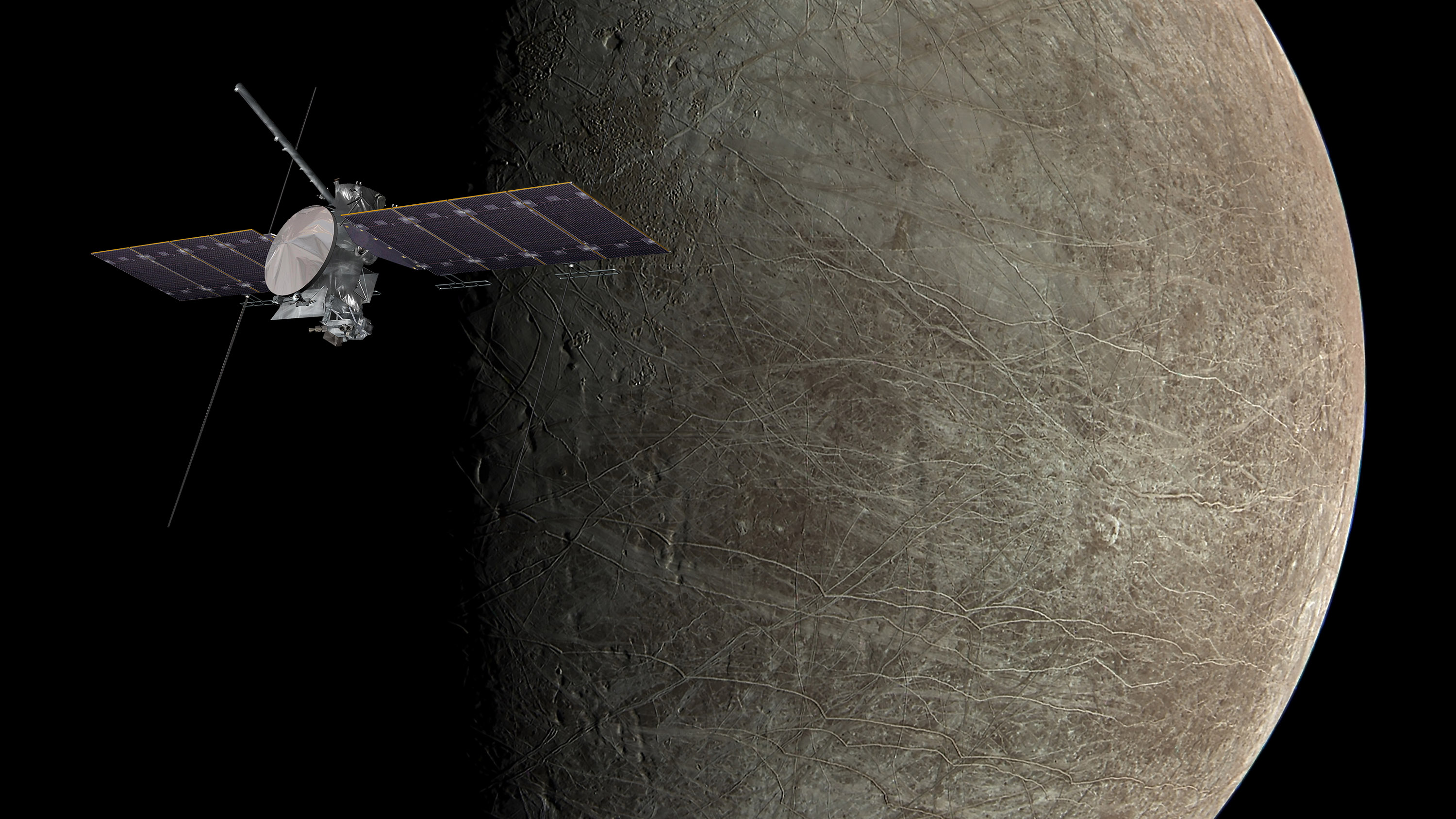
As astronomers have discovered more about Europa over the past few decades, Jupiter’s fourth-largest moon has excited planetary scientists interested in the geophysics of alien worlds.
All that water and energy—and hints of elements essential for building organic molecules —point to an extraordinary possibility. In the depths of its ocean, or perhaps crowded in subsurface lakes or below icy surface vents, Jupiter’s big, bright moon could host life.
To find further evidence, NASA is now searching for signs of alien existence on Europa. Read the full story on the mission.
—Stephen Ornes
We can still have nice things
A place for comfort, fun and distraction to brighten up your day. (Got any ideas? Drop me a line.)
+ Here’s a fun look at the secret collaborations of pop history.
+ Meet the mannequins showing how the “ideal” body has evolved.
+ A photographer has cataloged all 12,795 objects in her home into an archive of a life.
+ Slime molds are unexpectedly beautiful when viewed through these high-detail macro shots.
In the past, even with an icebreaker and during peak melt season, getting to the North Pole wasn’t a sure bet. It took favorable winds to crack the frozen ocean surface, and ships had to fight through ice that had grown many meters thick over several winters. In the summer of 2025, though, Jochen Knies from the Arctic University of Norway, Tromsø, and his team met little resistance on their way to 90 degrees North with the research vessel Kronprins Haakon. The geologist “didn’t hear the usual grinding of ice” against the hull that he remembered from 1996, when he first reached the pole by ship. Instead, thin floes and large stretches of open water made for an easy, quiet passage. To him, it was “a reminder of how quickly the Arctic is changing.”
Since the late 1970s, when satellite observations of the polar seas began, summer ice cover of the Arctic Ocean has declined by more than 40%. In less than half a century, a frozen area the size of the Mediterranean Sea has turned into blue open water with the rapid warming of the high northern latitudes. If this trend continues, there could soon be summers at the North Pole with no sea ice whatsoever. The last time this happened may have been some 120,000 years ago. But no one knows for certain.
That’s why Knies and his colleagues, a team of researchers from Norway and Germany, set out from Svalbard to the central Arctic last August. The aim of their five-week mission was to determine whether this region had been ice-free in recent Earth history—and if so, when. As part of a €12.5 million project financed by the European Union, they also came to answer some questions about the future of the Arctic and beyond: How does the loss of sea ice affect the marine ecosystem? What are the consequences for ocean circulation and global climate?
In search of clues, the expedition collected sediment cores up to 22 meters in length at different locations across the Arctic seafloor. Marine sediments are valuable climate archives that give scientists a window into bygone eras. Like diligent record keepers, they can log past water temperatures, sea-ice coverage, and the strength of ocean currents. These data are encrypted in the chemical and physical properties of the plankton remains and weathered rock deposited on the seabed.


While sediment cores several meters long had been recovered on earlier expeditions in the central Arctic, there is no scientific consensus on how old the deposits actually are or whether sea ice ever completely disappeared in summer.
To decode the Arctic’s climate archive, Knies brought a team of experts from various disciplines onboard the Kronprins Haakon to dig deeper and obtain fresh samples they could subject to the latest analytical techniques.


Some of this work was done while the researchers were still at sea. Now, at their home laboratories, they are finalizing their analysis of the seafloor samples. One important task is dating the sediments, which may be up to 2 million years old. The team uses a combination of methods to do this, including measuring magnetization, the decay of radioactive elements, and the exposure of mineral grains to sunlight before sinking to the depths. Once they can place them on a timeline, the materials in the cores will help researchers paint a picture of what the Arctic Ocean looked like in times that were warmer than today. For example, the presence or absence of the molecule IP25, which is produced exclusively by ice algae, could tell them how far the sea ice receded at a given time.

At the end of the study, the team hopes to have data that could improve climate projections for a future ice-free “blue Arctic,” helping us understand how it could affect marine life and carbon storage, Atlantic Ocean circulation, or extreme weather events in Europe and North America.
Tim Kalvelage is a freelance science reporter based in Bremen, Germany, who focuses on climate, ocean, and polar research. He has been to the North Pole twice.