

10x Genomics Acquires Proteintech Genomics, Expanding Proteomics Capablities

10x Genomics has acquired Proteintech Genomics for an undisclosed price, the companies said, in a deal driven by the buyer’s commitment to expanding its multiomics presence—in this case, by strategically expanding its proteomics capabilities.

The acquisition is intended to bring together 10x’s expertise in scalable single-cell and spatial biology platforms with Proteintech Genomics’ capabilities in protein detection. Founded in 2022, Proteintech Genomics specializes in life science technologies enabling researchers to apply single-cell and spatial multiomics tools toward discovery. The company develops fully optimized and highly multiplexed proteomic assays designed for ready integration into various single-cell and spatial analysis application workflows.

By helping researchers harmonize RNA and protein analysis, Proteintech Genomics has positioned itself as an alternative to the multiple vendors and their workflows traditionally needed to accomplish both analyses, as researchers increasingly combine transcriptomic- and proteomics-based data to gain complementary insights into cellular identity, state, and function.

“Proteintech Genomics strengthens our capabilities in one of the most exciting and rapidly evolving areas of biology: proteomics,” Michael Schnall-Levin, 10x’s CTO, chief strategy officer, and founding scientist, told GEN. “While transcriptomic technologies have advanced tremendously over the last decade, we believe there is still significant opportunity to push protein-based analysis much further, particularly in combination with RNA and other analytes.”

“We believe the future of biological analysis will increasingly integrate single-cell, proteomic, and spatial information,” Schnall-Levin added. “This acquisition reflects our conviction that proteomics will be an important part of that future and expands our ability to support richer multiomic workflows across our portfolio.”

Among Proteintech Genomics’ technologies is its Human Discovery Panel, which, according to the company, is the largest antibody-based single-cell protein panel. The panel allows researchers to simultaneously profile 347 DNA-barcoded antibodies covering 325 distinct protein targets, alongside transcriptomic measurements.

“Significant opportunities”

“We see significant opportunities to continue expanding both plex and content over time. One of the exciting aspects of bringing Proteintech Genomics into 10x is the ability to invest more deeply in future proteomic innovation,” Schnall-Levin explained. “While we aren’t announcing specific products today, directionally we’re interested in enabling higher-plex measurements, broader biological content, and more accessible workflows. Those are all areas where we see substantial opportunity going forward.”

The Human Discovery Panel is also designed to support integrated analysis of intracellular proteins, cell surface proteins, and transcriptomic profiles within sequencing-compatible workflows. The panel is compatible with 10x’s Flex chemistry, including the Flex Apex assay, the company’s fastest-growing single-cell assay.

“Proteintech Genomics brings innovative protein detection technologies, including the Human Discovery Panel, as well as deep expertise in protein biology, antibody panel development, and assay design. Together, we believe we can move faster, pursue more ambitious product development efforts, and make high-quality multiomic workflows more accessible and scalable for researchers,” Schnall-Levin said.

He said one attraction to 10x of combining with Proteintech Genomics was the combination it offered to 10x of technical performance and ecosystem fit: “Proteintech Genomics has been a longtime 10x partner, and its products were purpose-built to work with 10x workflows. Our customers are already using these technologies together today, which gives us a strong foundation to innovate more quickly and bring even more powerful multiomic capabilities to the field.”

Through its acquisition of Proteintech Genomics, 10x aims to achieve its vision of enabling multimodal biological analysis across its single-cell and spatial platforms—including protein capabilities planned for the Atera spatial platform, unveiled during the American Association for Cancer Research (AACR) conference.

Atera can run up to 800 1 cm2 whole transcriptome samples (FFPE and fresh frozen) per year, with flexible run configurations, and a greater than 5 cm² imageable area per slide (for greater than 2,000 mm² total tissue per run when using all four slides). The Atera WTA (Whole Transcriptome Analysis) panel targets more than 18,000 genes, with stackable customization of 1,000-gene Atera Select panels available now—and optional stacking of up to three 1,000-gene panels coming in the future.

“We’ve already spoken publicly about future protein capabilities planned for Atera, and this acquisition strengthens our ability to deliver on that vision while continuing to advance integrated approaches across both our single-cell and spatial platforms, Schnall-Levin said.

Higher-plex proteomics challenge

10x’s interest in higher-plex proteomics makes sense since it is the fastest-growing submarket in the $11 billion core proteomic space, set to grow by double digits, according to Leerink Partners. But a Leerink analyst cautioned that the company will find it challenging to grow in the space as it absorbs costs associated with Atera and Flex Apex.

“TXG leveraging itself to higher-plex proteomics is helpful,” Puneet Souda, senior managing director, life science tools and diagnostics, and a senior research analyst with Leerink, wrote in a research note. “We believe the deal accelerates higher-plex proteomics content for Atera, which adds to its long-term value. TXG can also bundle single-cell proteomic kits, which is a small but growing area of single-cell research.”

“Nonetheless, we still expect the digestion of Flex Apex and Atera-driven freezing/impact to weigh on near-term growth, particularly in a challenged academic funding backdrop,” Souda added.

Investors did not appear to share that concern, as 10x shares dipped 0.6% as of 12:21 p.m. ET, to an even $29.00 from $29.18 at Monday’s close. The share fluctuated between $28.93 and $30.87 during Tuesday morning trading.

Ci Chu, senior vice president, AI-enabled discovery for Xaira Therapeutics, said in a statement included within 10x’s announcement that the acquisition reflected the importance of integrating protein biology with single-cell and spatial technologies.

“Biology is bigger than transcriptomics alone,” Chu stated. “Bringing scalable protein measurements into single cell and spatial biology is an important step toward richer, more predictive views of cellular state—and ultimately, virtual cell models that better reflect the complexity of living systems.”

Potential clinical applications

In addition to facilitating expansion in multiomics, the acquisition of Proteintech Genomics could help 10x achieve another longer-term goal, namely, looking beyond its traditional focus on research tools for academic, government, and industry customers, by strengthening its clinical diagnostic offerings.

10x expanded into clinical diagnostics during the J.P. Morgan 44th Annual Healthcare Conference, when the company announced three partnerships with top-tier institutions: Brigham and Women’s Hospital and Dana-Farber Cancer Institute, both in Boston, as well as the New York-based Cancer Research Institute. 10x also committed to building its own CLIA-certified laboratory within about a year, with the goal of enabling clinical deployment of diagnostics that will come up with such collaborations.

Integrating Proteintech Genomics tools into clinical settings will be a longer-term priority since the company’s offerings are for research use only and not intended for diagnostics procedures.

“Protein measurements are highly relevant to many translational research applications, particularly in areas such as immunology, oncology, and neurology. Researchers in academia and biopharma increasingly want to combine protein and RNA measurements to better understand cellular function, therapeutic response, and disease biology,” Schnall-Levin said. “Longer term, we believe single-cell and spatial proteomics are likely to play a meaningful role in diagnostics.”

10x and Proteintech Genomics did not disclose the price or other financial terms of the acquisition, though 10x said it believes the transaction “will not meaningfully impact its near-term financial outlook.”

10x finished the first quarter with a net loss of $13.47 million, less than half its $34.358 million net loss of Q1 2025, on revenue that shrunk 3% year-over-year, to $150.843 million from $154.883 million in the first three months of last year. The company reported $490.285 million in cash and cash equivalents as of March 31, up 3% from $473.966 million as of December 31, 2025.

Proteintech Genomics is a subsidiary of Proteintech Group, a developer of high-plex proteomic solutions for single-cell and spatial applications; both companies are privately held.

San Diego-based Proteintech Genomics’ workforce consists of what Schnall-Levin described as “a small team of eight people,” including CEO Kristopher Nazor, PhD.

“We’re going to keep that team,” Schnall-Levin declared.

Added Nazor: “From day one, Proteintech Genomics was built around the belief that RNA and protein measurements are most powerful when used together.”

“Because our technologies were designed to integrate with 10x workflows, joining the 10x team feels like a natural next chapter,” Nazor continued. “We are excited about the opportunity to accelerate innovation together and expand access to integrated multiomic approaches for researchers around the world.”

The post 10x Genomics Acquires Proteintech Genomics, Expanding Proteomics Capablities appeared first on GEN – Genetic Engineering and Biotechnology News.
Mass Spectrometry’s Discovery Revolution

Mass spectrometry (MS) has quietly undergone one of the most consequential evolutions in modern drug discovery. Once viewed primarily as a confirmatory analytical tool, it is now reshaping how researchers identify, validate, and optimize therapeutic candidates. Across chemoproteomics, metabolomics, immunopeptidomics, and beyond, MS is increasingly positioned not at the end of the pipeline—but at its beginning, where the most crucial decisions are made.

“Mass spectrometry is no longer just a downstream analytical checkpoint,” says Aaron Robitaille, PhD, the senior director of product & vertical marketing of mass spectrometry at Thermo Fisher Scientific. “It is increasingly serving as a discovery engine.”

This shift reflects a broader transformation across the pharmaceutical industry: from hypothesis-driven experimentation toward data-rich, systems-level interrogation of biology.

Seeing biology more clearly

Drug discovery has always struggled with a fundamental problem: Biology is complex, noisy, and often opaque. Many of the molecules that determine therapeutic success are low in abundance, transient, or entirely unknown. MS addresses this challenge by enabling researchers to observe biological systems with unprecedented depth and specificity.

According to Robitaille, MS now supports nearly every stage of early discovery—from target identification and engagement to pharmacokinetics and mechanism-of-action studies. One of its most transformative applications is chemoproteomics, where researchers can directly measure drug-protein interactions within living cells. This enables scientists to evaluate not just whether a compound binds its intended target, but also whether it interacts with unintended ones.

Crucially, MS is moving upstream in the discovery pipeline. “What makes that important is not merely breadth. It is timing,” Robitaille notes. By enabling high-throughput screening with detailed molecular readouts, MS helps eliminate poor candidates earlier—saving time, cost, and effort.

Technological advances are driving this shift. Historically, researchers faced trade-offs between speed and sensitivity, or between targeted and untargeted analyses. Newer platforms are collapsing these compromises. Hybrid acquisition methods, for example, allow targeted and untargeted data to be collected simultaneously in a single experiment, enabling both hypothesis testing and discovery.

The Thermo Scientific Orbitrap Astral Zoom MS exemplifies this convergence. Built around parallelized acquisition and enhanced ion handling, the system delivers high throughput, deep proteome coverage, and precise quantitation—all in one platform. Its ability to process hundreds of samples per day while quantifying thousands of proteins illustrates how MS is becoming both scalable and decision-ready.

Interrogating biology at scale

For Mike Knierman, biopharma workflow manager at Agilent, the expanding role of MS reflects the growing complexity of new therapies. “Drug discovery today spans multiple therapeutic modalities, including small molecules, monoclonal antibodies, oligonucleotides, and cell-based therapies,” he explains. MS provides a unifying analytical backbone across this diversity.

One of the most significant recent developments, Knierman emphasizes, is MS’s ability to interrogate biology at scale. Techniques such as proteomics, metabolomics (See Sidebar), and lipidomics allow researchers to observe how candidate drugs perturb entire cellular systems, rather than isolated targets. This systems-level insight is essential for understanding the mechanism of action and identifying off-target effects early in development.

Emerging measurements—such as protein turnover—are also enabling new therapeutic strategies. These include targeted protein degradation approaches, which require a detailed understanding of dynamic protein lifecycles rather than static abundance.

Agilent’s Revident LC/Q-TOF platform reflects this trend toward intelligent, high-resolution analysis. Designed for accurate-mass performance with built-in diagnostics, the system incorporates features that automate quality control and maintain data consistency. Its ultra-fast detector supports a wide dynamic range without sacrificing resolution, enabling confident identification and quantitation in complex biological samples.

Equally important are workflow innovations. The platform’s Intelligent Reflex capabilities automate routine checks—such as calibration verification and carryover detection—reducing manual intervention and ensuring consistent performance. In drug discovery environments where throughput and reproducibility are crucial, these features help maintain data integrity while accelerating timelines.

Ultimately, Knierman highlights MS as a driver of “biology-driven discovery,” where decisions are guided by comprehensive molecular data rather than limited readouts.

A shift in discovery models

Todd Stawicki, senior global market development manager for pharma, SCIEX, places MS within a broader transformation of drug discovery itself. The industry is moving away from traditional in vivo models toward more complex in vitro systems—such as organoids and tissue-based assays—in an effort to reduce impacts to laboratory animals and rising global regulatory efforts.

This shift dramatically increases the number and complexity of experimental endpoints. “Many or most of these endpoints are best served by mass spectrometry,” Stawicki notes. As a result, MS is becoming indispensable for analyzing the rich datasets generated by these models.

MS is also deeply embedded throughout the discovery lifecycle. In the early stages, it supports proteomics and complements genomic studies. It plays a central role in hit identification and lead optimization, and remains crucial in ADME (absorption, distribution, metabolism, and excretion) and DMPK (drug metabolism and pharmacokinetics) studies.

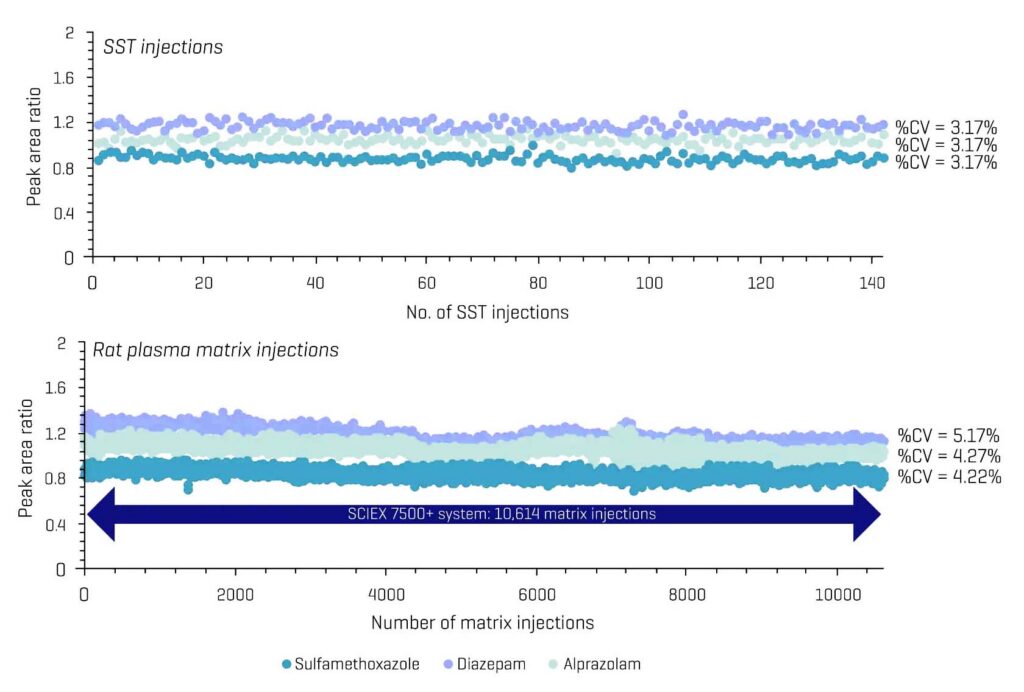
Analysis of a system suitability test and rat plasma matrix
Analysis of a system suitability test (SST, top) and rat plasma matrix (bottom) injections on the SCIEX 7500+ system for three drug compounds shows coefficients of variation (%CV) of three to five percent across more than 10,000 injections of rat plasma. [SCIEX]

Technological innovation continues to expand MS’s capabilities. Acoustic ejection-based MS, for example, enables rapid, label-free screening, while advanced systems—like the SCIEX 7500+ system—address one of the field’s most persistent challenges: balancing sensitivity with dynamic range.

As new drug modalities become more potent and targeted, they often exist at extremely low concentrations in complex biological matrices. This creates a dual requirement for high sensitivity and a broad quantitation range. The SCIEX 7500+ system meets this need, enabling accurate measurement across diverse tissues and concentration levels.

Robustness is another key consideration. SCIEX Mass Guard technology, for instance, enhances system uptime, ensuring that high-throughput workflows can run reliably over extended periods. In an environment where delays can be costly, this operational stability is as important as analytical performance.

Balancing throughput and insight

Shimadzu’s perspective underscores the importance of versatility in modern MS workflows. “Mass spectrometry has become one of the most versatile analytical tools in drug discovery,” says Lihini Mendis, PhD, LCMS product specialist at Shimadzu Scientific Instruments, noting that it now supports everything from early screening to preclinical development.

Triple-quadrupole MS systems
Triple-quadrupole MS systems can be used in drug discovery for bioanalysis and studies of drug metabolism and pharmacokinetics. [Shimadzu Scientific Instruments]

A major recent trend is the push toward higher throughput without compromising data quality. Rapid LC-MS methods and triple quadrupole systems are increasingly used to process large sample volumes efficiently, particularly in quantitative workflows such as bioanalysis and DMPK studies.

At the same time, qualitative MS capabilities are expanding. High-resolution instruments, combined with advanced fragmentation techniques, allow researchers to gain deeper structural insights into complex molecules such as lipids and metabolites. This dual capability—quantitative precision and qualitative depth—enables scientists to answer both “how much” and “what exactly” within the same experiment, Mendis explains.

Shimadzu’s portfolio reflects this balance. Single-quadrupole systems provide accessible, high-throughput screening, while triple-quadrupole platforms emphasize stability and reproducibility for quantitative analysis. High-resolution instruments extend capabilities into accurate-mass analysis and structural elucidation, all while maintaining user-friendly operation.

The overarching goal is not complexity for its own sake, but meaningful data that supports confident decision-making. By focusing on workflow efficiency and reliability, Shimadzu aims to streamline the path from data acquisition to actionable insight.

A proteoform-centric vision

While incremental improvements in speed and sensitivity have driven much of MS innovation, Bruker’s recently introduced timsOmni system points toward a more fundamental shift: a move toward protein-centric analysis at the level of intact proteoforms—structurally distinct variants of proteins that arise from genetic mutations, alternative splicing, or post-translational modifications.

The platform introduces a multimodal trapping approach that enables precise control over ion reactions, supporting a wide range of fragmentation techniques. This flexibility allows researchers to tailor experiments to extract detailed structural information from complex biomolecules.

Rather than focusing solely on peptides or simplified representations of proteins, the system emphasizes intact protein analysis. This is particularly important for identifying proteoforms. These variants often play critical roles in disease but are difficult to detect using conventional approaches.

The timsOmni platform enables detailed mapping of such variations, including modifications, such as acetylation and glycosylation, that influence protein function and cellular signaling. By combining high sensitivity with advanced fragmentation methods, it allows researchers to generate comprehensive sequence information and localize modifications with precision.

Importantly, this capability extends beyond discovery into biopharma development and quality control. The ability to characterize therapeutic antibodies and other biologics at the proteoform level has significant implications for both efficacy and safety.

Supporting software further enhances this capability by translating complex spectral data into actionable insights. Advanced algorithms enable de novo sequencing, charge state assignment, and modification identification, making it easier for researchers to navigate the complexity of proteoform analysis.

Accelerating insights

As therapeutic modalities become more complex, the need for faster, more precise characterization tools has never been greater. David Curtin, vice president and general manager, biologics business, Waters Analytical Sciences, Waters Corporation, highlights how emerging platforms are enabling researchers to generate deeper insights earlier in the development cycle—when those insights can have the greatest impact.

As one example, Curtin describes the Xevo CDMS platform as a breakthrough in capability and accessibility. As the first dedicated benchtop charge-detection mass spectrometry system, it enables measurement across a wide spectrum of mega-mass biomolecules. Crucially, it supports “characterization in process development when decisions matter most,” Curtin says, allowing teams to act on high-quality data in real time.

Speed is one of its most transformative advantages. “Xevo CDMS delivers accurate analysis in less than 10 minutes,” Curtin explains. This represents a dramatic improvement over traditional workflows that could take hours, days, or even weeks when outsourced. The result is a shift to same-day decision-making, fundamentally changing how process development is executed and optimized.

Efficiency is another key differentiator. Curtin notes that “the system requires up to 100 times less sample than current methods,” addressing a long-standing limitation in biopharma research. With reduced sample demands, scientists can run more experiments per batch, leading to “lower cost, higher yields, fewer impurities, and faster time to market,” he says.

Beyond operational improvements, the platform unlocks new scientific possibilities. Curtin emphasizes that it delivers direct mass and charge measurements for individual 100-kilodalton to 150-megadalton molecules, including complex structures such as glycosylated proteins, viral vectors like AAV, and lipid nanoparticles. In many of these cases, “CDMS isn’t just a better option; it’s the only option,” Curtin says.

Ultimately, Curtin underscores the broader impact: researchers are now generating “fast, accurate orthogonal data” that validates existing approaches while opening entirely new lines of inquiry. Scientists, he says, are “asking and answering questions they couldn’t tackle before”—a powerful indicator of how this technology is advancing the development of therapies for diseases including cancer, heart disease, and Alzheimer’s.

From data to decisions

Across all these perspectives, a common theme emerges: MS is no longer defined by its ability to generate data, but by its ability to inform decisions. This clarity is transforming drug discovery. By revealing off-target effects, validating mechanisms of action, and identifying biomarkers at early stages, MS helps reduce uncertainty and improve success rates. It allows researchers to prioritize the most promising candidates and eliminate those unlikely to succeed.

As Robitaille puts it, the ultimate value of modern MS lies in “the ability to see meaningful biology early enough to act on it.” In an industry where time, cost, and complexity are ever-increasing, that capability might prove to be one of the most important advances of all.

The post Mass Spectrometry’s Discovery Revolution appeared first on GEN – Genetic Engineering and Biotechnology News.

Disease-associated RNA and protein signatures in iPSC-derived microglia model of Alzheimer’s disease

IntroductionMicroglia, the resident immune cells of the central nervous system, play a critical role in maintaining neural homeostasis and regulating inflammatory responses in the brain. Increasing evidence suggests that microglial dysfunction contributes to the progression of neurodegenerative diseases, including Alzheimer’s disease (AD). However, the molecular mechanisms underlying these alterations remain incompletely understood. This study aimed to characterize disease-associated molecular changes in microglia derived from induced pluripotent stem cells (iPSCs) of sporadic AD patients and healthy donors.MethodsiPSC-derived microglia from sporadic AD patients and healthy controls were analyzed using integrated multi-omics approaches, including total RNA sequencing, proteomics, and small non-coding RNA (sncRNA) sequencing. Gene Ontology (GO) analysis was performed to identify dysregulated biological pathways from transcriptomic and proteomic datasets. In addition, a modified T4 polynucleotide kinase (T4 PNK)-based sncRNA sequencing method was used to profile disease-associated sncRNAs and identify previously uncharacterized RNA species.ResultsComparative analyses revealed significant AD-associated alterations in mRNA, protein, and sncRNA expression profiles in iPSC-derived microglia. GO analysis demonstrated dysregulation of pathways related to extracellular communication, intracellular transport, cytoskeletal organization, and protein–protein interactions. Furthermore, the modified T4 PNK–sncRNA sequencing approach identified multiple disease-associated sncRNAs, including several novel and previously uncharacterized RNA species potentially linked to AD pathology.DiscussionThese findings demonstrate that iPSC-derived microglia provide a valuable model for studying molecular mechanisms associated with sporadic AD. The identified transcriptomic, proteomic, and sncRNA alterations highlight key pathways potentially involved in microglial dysfunction and neurodegeneration. In particular, the discovery of novel disease-associated sncRNAs may provide new insights into AD pathogenesis and reveal potential therapeutic targets for future investigation.

Spatial proteomic analysis in human Alzheimer’s disease brains enables identification of microenvironment-dependent microglial cell states

Nature Neuroscience, Published online: 18 May 2026; doi:10.1038/s41593-026-02267-3

Myeloid cells show marked heterogeneity in Alzheimer’s disease. This study introduces CODEX-CNS, a single-cell spatial proteomics pipeline, and identifies a human microglial subpopulation enriched in Alzheimer’s disease brains that associates with dense amyloid-β plaques.

[Comment] Integrated proteomic and immune subtyping: a two-tier framework for biomarker-guided therapy in high-grade serous ovarian cancer

Ovarian cancer remains one of the deadliest gynaecological malignancies, with high-grade serous ovarian cancer (HGSOC) accounting for the majority of deaths.1,2 Despite advances in surgery and chemotherapy, most patients are diagnosed at an advanced stage, and the 5-year survival rate has stubbornly remained below 50% for decades.3 A major obstacle is that the traditional FIGO staging system, while useful for prognosis, does not explain why patients within the same stage often follow dramatically different clinical trajectories.

ParcelBio Unveils Programmable mRNA Platform Backed by $13M Financing

Biotechnology company ParcelBio said this week that it has raised $13 million in a seed financing round led by Breyer Capital with participation from General Catalyst, Y Combinator, Metaplanet, SurgePoint Capital, ZAKA VC, and other investors. The financing will support the development of the company’s proprietary Amplified and Prolonged EXpression mRNA (APEXm™) platform and advance its pipeline including an in vivo CAR T program for autoimmune disease, as well as additional programs in oncology and encoded protein therapeutics.

The company, which is developing what it describes as a new class of durable mRNA medicines, will debut APEXm and share some preclinical data at the American Society of Gene and Cell Therapy annual meeting. This year’s meeting is being held in Boston, Massachusetts and will run from May 11-15. The company claims that its data will demonstrate that ParcelBio’s APEXm RNA drives significantly higher and more durable protein expression compared to another clinical mRNA design, and yields more complete target cell depletion in in vivo CAR T models. 

“mRNA has transformed medicine, but today’s technologies are fundamentally limited in how much protein they can produce and for how long,” said David Weinberg, PhD, chief executive officer and co-founder of ParcelBio. His company’s proprietary technology addresses this problem by engineering RNA molecules to recruit the cell’s native RNA-stabilizing machinery, which enables higher and more durable protein expression. The company claims that its approach will result in medicines that reach thresholds that have historically been challenging for mRNA-based therapeutics. “We engineered RNA to work with the cell’s machinery rather than against it, enabling meaningful improvements in both expression and durability that we believe are essential for true disease modification,” Weinberg said. 

Furthermore, ParcelBio’s platform maintains a simple, linear RNA architecture unlike circular RNA and other approaches, whose structure introduces manufacturing complexity or reduces output. Its broad applicability across proteins and cell types makes it suited for various therapeutic applications including immune programming and protein replacement. 

“Most RNA platforms force a tradeoff between potency, durability, and manufacturability,” said Chris Carlson, PhD, chief scientific officer and co-founder of ParcelBio. “Our approach eliminates that tradeoff, enabling both higher peak expression and longer duration within a manufacturable system, and opening the door to entirely new classes of medicines.”

ParcelBio’s lead program focuses on in vivo CAR T therapies that target pathogenic B cells across autoimmune diseases, with the goal of achieving deep B-cell depletion for durable, drug-free remission. By enabling sustained CAR expression without viral delivery or ex vivo manufacturing, the company aims to develop scalable, off-the-shelf therapies. Additional programs leveraging the technology are currently in development in oncology and encoded protein therapeutics.

The post ParcelBio Unveils Programmable mRNA Platform Backed by $13M Financing appeared first on GEN – Genetic Engineering and Biotechnology News.

Microproteins and Peptideins Expand Boundaries of the Human Proteome

A research team led by scientists at the Princess Máxima Center for Pediatric Oncology, the University of Michigan Medical School, EMBL European Bioinformatics Institute, and the Institute for Systems Biology, has uncovered more than 1,700 new proteins that could have implications for human diseases, including cancer.

Mostly very small, these proteins have been discovered in what’s known as the “dark proteome,” which covers gene products from previously overlooked sections of DNA. These proteins have unusual properties, motivating scientists to coin a new concept, peptideins, to help understand their potentially unique biology. Research co-lead Sebastiaan van Heesch, PhD, a group leader at the Princess Máxima Center, commented, “We know that the current overview of recognized proteins doesn’t capture the full picture. With this study, we show that thousands of overlooked genetic sequences contribute to the dark proteome by producing a new class of protein-like molecules, microproteins, that had been missed before now. But for most of them, we don’t yet know what they do.”

Research co-lead and co-corresponding author Robert Moritz, PhD, professor and head of proteomics at the Institute for Systems Biology, further noted, “Biology has long relied on a relatively small cast of well-characterized proteins to explain the regulatory logic of the cell, but peptideins suggest that beneath that familiar layer lies an entire untapped layer of molecular actors whose functional roles in gene regulation, signaling, and cytopersistence, many we are only beginning to imagine. Given their smaller size and the diversity of cellular contexts in which they appear, I believe peptideins may prove to be among the most versatile and consequential regulatory molecules we have yet encountered in human biology. This is not the end of a search—it is the opening of a vast and fertile new territory for the entire scientific community to explore and exploit, and I look forward to seeing what the broader scientific community uncovers as these molecules, and many more that are yet to be confirmed, are brought into the light.”

Research co-lead John Prensner, MD, pediatric neurooncologist at the University of Michigan Medical School, together with Van Heesch and Moritz, are co-senior and co-corresponding authors of the researchers’ published paper in Nature titled “Expanding the human proteome with microproteins and peptideins.” The team is sharing its discoveries with scientists worldwide in an open-source format to stimulate further research.

Van Heesch added, “With growing interest in industry and academia, peptideins are at the center of multiple drug development initiatives. Similarly, we see them increasingly turning up as important players in diseases, including childhood cancers. We hope to inspire a new wave of research into peptideins and to unlock new insights and drug targets across human biology, particularly for the development of cellular immunotherapies and cancer vaccines.”

The study is the work of the TransCODE Consortium, an international collaboration of more than 60 researchers at over 30 institutions worldwide, co-led by the Princess Máxima Center for Pediatric Oncology in the Netherlands, the University of Michigan Medical School, the EMBL European Bioinformatics Institute in Hinxton, and the Institute for Systems Biology in Seattle.

Genes in DNA provide the recipe for cells to produce peptides. Historically, peptides have been called proteins if they are long enough and have existing evidence for a biological role, such as the appearance of the same protein across species in evolution. “Protein-coding genes are the bedrock of biomedical investigations, including the overwhelming majority of drug development programs,” the authors wrote. A large, curated international database of proteins contains some 19,500 entities.

But increasingly, scientists believe the traditional definition of a protein needs to be broadened. “Whether the human genome encodes substantially more than the approximately 19,500 canonical protein-coding genes has sparked a spirited debate in recent years,” the scientist continued. “Therefore, any wholesale addition of protein-coding genes creates ripple effects across human bioscience.”

Through their newly reported study the team looked at more than 7,200 previously understudied sections of the DNA called non-canonical open reading frames (ncORFs). They found that some 25% of these sections—more than 1,700—generated detectable protein-like molecules. These proteins, smaller than traditional proteins, are referred to as “microproteins.”

Generating their results involved looking at 3.7 billion individual bits of raw data that may support known and previously unknown proteins—drawing upon 95,520 experiments. “We show that about 25% of a set of 7,264 ncORFs gives rise to detectable peptides in a large-scale analysis of 95,520 proteomics experiments,” they wrote. The process took around 20,000 hours for computers to complete, working non-stop. They found 1,785 microproteins, a number that at first glance would increase the protein databases by nearly 10%.

Predicted binding between a non-canonical open reading frame (blue) and traditional protein (yellow). [Leron Kok/Princess Máxima Center for pediatric oncology]
Predicted binding between a non-canonical open reading frame (blue) and traditional protein (yellow). [Leron Kok/Princess Máxima Center for Pediatric Oncology]

Moritz further explained, “By deploying our battle-hardened Trans Proteomic Pipeline across nearly 100,000 mass spectrometry experiments encompassing 3.7 billion spectra—derived from the world’s collective publicly available mass spectrometry data, with the results housed within PeptideAtlas at ISB for the scientific community to view and share—we were able to confirm, with high confidence, the existence of more than 1,700 of these newly identified peptideins that would otherwise have largely remained invisible to science.”

But most of these 1,785 microproteins didn’t resemble the other 19,500 traditional proteins. For example, they were very small: 65% were fewer than 50 amino acids in length, compared to less than 1% of the 19,500 previously catalogued. Looking more closely at the microproteins the investigators saw that only a few—perhaps a dozen—resembled the traditional proteins. The team then spent more than a year trying to make sense out of the remaining bulk.

Working with protein experts from across the globe in the TransCODE consortium, the scientists coined a new biological concept, which they coined peptidein. For decades, the research community has had a binary view of the relationship between human DNA and human proteins.  A given piece of DNA either does or does not produce a protein. In their new study, the scientists propose a third choice, which is that DNA could make a protein, a peptidein, or neither.

The team defined a peptidein as existing in cells as a protein-like molecule, meaning that it is made of amino acids, as are proteins. But the role of a peptidein is ambiguous. Perhaps it has a function in normal human biology, or perhaps not; this is the key distinction with traditional proteins, where all are believed to have a function in normal human biology even if the details of that function are not fully known yet. “To advance these ncORFs in biological inquiry, we invoke the emerging umbrella term of peptidein, which we define as an ORF with experimentally confirmed RNA translation and protein synthesis, but for which the data are currently insufficient to claim conventional protein-coding gene status,” the investigators stated in their report.

Importantly, this definition of peptidein leaves the door open for it to become a ‘protein’ in the future—that is, if scientists gather more evidence on it.  To start exploring this idea, the team searched for peptideins without which cells cannot survive. These so-called pan-essential peptideins can be important candidate drug targets in cancer and other diseases.

Using large-scale CRISPR gene editing, the scientists found six peptideins that looked promising. For example, one of these was a peptidein produced from OLMALINC, a genetic sequence previously thought not to produce proteins. When the researchers switched this gene off, 85% of more than 485 cancer cell lines showed impaired survival. The researchers confirmed that this effect comes from the peptidein itself, not the RNA molecule it sits on, and found that it plays a role in cell division and DNA damage response. “Our work here highlights c10riboseqorf92 (in the OLMALINC transcript),” they commented. “… while we do not yet have sufficient evidence that this ncORF encodes a bona fide protein, its CRISPR-based phenotypes in the context of cancer cells are intriguing.”

Many of the newly detected peptideins are presented on cell surfaces for recognition by the immune system, making them potential targets for cancer immunotherapy. A number of such molecules presented to the immune system are already under development as drug targets, and there is growing interest from both academia and industry in exploiting this new class of cancer antigens. Peptideins could also shed light on genetic diseases that conventional gene analysis has been unable to explain, simply because genetic diagnostics were unaware that these molecules were encoded by the human genome.

Members of the consortium had previously uncovered an essential role for a microprotein, ASNSD1-uORF, in children with a high-risk form of the brain cancer, medulloblastoma. Scientists at the Princess Máxima Center are now carrying out further research to determine its role in additional pediatric cancers with the activated MYC oncogene, such as neuroblastoma.

van Heesch commented, “It felt really special to discuss and decide what to do with this new class of molecules, as we had gathered enough early evidence to suspect that they might be widespread across cell types and tissues. By classifying these molecules of unknown functionality as peptideins, we’ve given them a formal place in reference databases so the wider community can study them.”

In their paper the researchers concluded, “The extent of the undiscovered proteome is one of the central questions in human biomedicine. This work reflects the multi-consortium collaboration between the TransCODE Consortium, the HUPO-HPP/PeptideAtlas project, the HIPP immunopeptidomics project and the GENCODE gene annotation group to coalesce a generalizable approach towards understanding which ncORFs can be understood as encoding proteins … Through our efforts, we bring microproteins and alternative protein molecules into reference gene annotation by defining them as either a protein-coding gene or a peptidein, a new concept referring to confirmed protein molecules of indeterminate consequence.”

Prensner added, “We’re just beginning to see what this ‘dark proteome’ has to offer.  It’s like the trailer to a movie. We see the outline of a game-changing view of human biology.  We’re incredibly excited that the coming years will open new doors to help solve and treat human diseases such as cancer.”

Moritz further stated, “Our collaborative work represents a culmination of decades of investment from federal funding agencies in building the computational and data infrastructure needed to interrogate the proteome at truly unprecedented scale at the Institute for Systems Biology … What excites me most is not simply that these molecules exist, but what their existence implies.”

The researchers are making we make all ncORFs, peptides and spectra publicly available through PeptideAtlas.

The post Microproteins and Peptideins Expand Boundaries of the Human Proteome appeared first on GEN – Genetic Engineering and Biotechnology News.

Analysis of risk factors for tic disorders in children in Hubei region based on liquid chromatography-tandem mass spectrometry

ObjectiveThis study aims to investigate the correlation between trace element concentrations, 25-hydroxyvitamin D [25(OH)D] levels, and the severity of tic disorders (TD) in children from the Hubei region. Additionally, it seeks to explore the interrelationships among these monitored indicators to provide a reference for the clinical diagnosis and treatment of pediatric TD.MethodsA retrospective review was conducted on the medical records of 237 children diagnosed with TD (TD group) and 137 healthy controls, admitted to the Department of Neurology at Hubei Maternal and Child Health Care Hospital. The TD group was further divided into mild and moderate-to-severe subgroups based on the Yale Global Tic Severity Scale scores. General clinical data were collected, and serum trace element levels were measured using inductively coupled plasma mass spectrometry (ICP-MS), while serum 25(OH)D levels were quantified via liquid chromatography–tandem mass spectrometry (LC–MS/MS). Group comparisons, Spearman correlation analysis, and univariate/multivariate logistic regression analyses were performed.ResultsThe findings indicated that serum 25(OH)D levels were significantly lower in children with TD compared to controls (p < 0.001). Logistic regression analysis demonstrated that 25(OH)D was an independent protective factor against tic disorders.(p < 0.001). Compared to the control group, children with TD exhibited significantly lower levels of calcium and copper (p < 0.001), along with higher levels of iron and cadmium (p < 0.01). These differences were more pronounced in the subgroup of children older than 6 years. An age-stratified subgroup analysis revealed no significant differences in any other indicators except for cadmium between the TD and control groups among children aged 6 years or younger (p > 0.05). Spearman correlation analysis demonstrated that within the TD group, 25(OH)D levels had the most significant correlations with calcium and copper (p < 0.001). No statistically significant differences were observed in the levels of the 10 trace elements or 25(OH)D between the mild and moderate-to-severe TD subgroups (p > 0.05).ConclusionChildren with Tic Disorders in Hubei Province demonstrate a distinctive alteration in their micronutrient profile, primarily characterized by a deficiency in 25(OH)D, alongside reduced levels of calcium and copper, and elevated levels of iron and cadmium. This association is particularly pronounced in male children over the age of six. While 25(OH)D deficiency is identified as an independent risk factor for TD, its concentration does not significantly correlate with the severity of the disorder.