President Trump recently signed an executive order which aims to increase access to psychedelic drug treatments. He was joined at the signing by podcaster Joe Rogan, who said he’ ha’d messaged the president about research on the psychedelic ibogaine.
In this week’s STATus Report, host Alex Hogan chats with STAT Washington correspondent Daniel Payne about what the executive order does and doesn’t do. Hogan also looks at why ibogaine, and psychedelic drugs more broadly, are increasingly being taken seriously for stubbornly hard-to-treat conditions like addiction, depression, and PTSD.
A longstanding focus in the causal learning literature has been on inferring causal relations from contingencies, where these abstract away from time by collating independent instances or by aggregating over regularly demarcated trials. In contrast, individual causal learners encounter events in their daily lives that occur in a continuous temporal flow with no such demarcation. Consequently, the process of learning causal relationships in naturalistic environments is comparatively less understood. In this article, we lay out a rational framework that foregrounds the role of time in causal learning. We work within the Bayesian rational analysis tradition, starting by considering how causal relations induce dependence between events in continuous time and how this can be modeled by stochastic processes from the Poisson–Gamma distribution family. We derive the qualitative signatures of causal influence and the general computations needed to infer structure from temporal patterns. We show that this rational account can parsimoniously explain the human preference for causal models that invoke shorter, more reliable, and more predictable causal influences. Furthermore, we show this provides a unifying explanation for human judgments across a wide variety of tasks in the reanalysis of seven experimental data sets. We anticipate the framework will help researchers better understand the many manifestations of continuous-time causal learning across human cognition and the tasks that probe it, from explicit causal structure induction settings to implicit associative or reinforcement learning settings. (PsycInfo Database Record (c) 2026 APA, all rights reserved)
The days of “Just Say No,” it seems, are long gone.
Over the weekend, President Trump signed an executive order to increase the availability of certain psychedelics as treatments for mental health conditions, ordering that $50 million be spent, and that the Food and Drug Administration fast-track reviews to usher in their approval. At one point, the president joked to the motley assembly of administration officials, a former Navy SEAL, and the podcaster Joe Rogan: “Can I have some, please?”
On Wednesday, the Trump administration announced it had downgraded medical marijuana from the highest tier of controlled substances, and was pushing the Drug Enforcement Administration to do the same for recreational marijuana.
The president’s lenient tack on some mind-altering drugs ushers in a new world of right-wing drug policy. While the administration has emphasized hardline, militaristic tactics when it comes to fentanyl, its recent actions on “softer” drugs could represent a new era not just for Republican politics but also for American drug policy writ large.
“With this imminent move, we are now confronted with the most pro-drug administration in our history,” Kevin Sabet, the CEO of the anti-legalization advocacy group Smart Approaches to Marijuana, said in a statement. “Policy is now being dictated by marijuana CEOs, psychedelics investors, and podcasters in active addiction — it is a travesty and injustice to the American people of unprecedented proportions. The marijuana industry is the new Big Tobacco, and President Trump is welcoming them to the homes of families across this country with open arms.”
BackgroundThe detrimental effect of stigma on healthcare for individuals with alcohol use disorders (AUDs) is well-established, often resulting in social distance and diminished helping behavior tendencies. However, contemporary neuroscience reconceptualizes addiction as a brain disease, potentially altering emotional responses to stigma. This study examines a seemingly paradoxical possibility: that under specific conditions, perceived stigma is primarily associated with sympathy (rather than anger or fear), which in turn is linked to helping behavior tendencies among nurses.MethodsA cross-sectional survey was administered to 348 clinical nurses from tertiary hospitals in China. Participants completed standardized scales assessing perceived stigma of patients with AUDs, causal attributions, emotional responses (including sympathy, anger, and fear), and helping behavior tendencies. Data were analyzed using Pearson correlation and mediation analysis (PROCESS macro, Model 4) with 5,000 bootstrap samples to test the mediating role of sympathy.ResultsPerceived stigma showed a significant positive correlation with sympathy (r= .160, p<.05), which was in turn positively correlated with helping behavior tendencies (r= .269, p<.05). Critically, mediation analysis revealed that sympathy fully mediated the relationship between perceived stigma and helping behavior tendencies. The standardized indirect effect was significant (β= 0.15, 95% CI [0.08, 0.23]), accounting for the total observed relationship, as the direct effect was non-significant. Additionally, compared to non-psychiatric nurses, psychiatric nurses perceived patients as significantly less dangerous and reported lower levels of fear and anger, along with a stronger intention to help and a lower tendency to avoid patients.ConclusionChallenging conventional perspectives, this study supports a dual-pathway model in which perceived stigma can indirectly associated with professional helping behavior tendencies through the elicitation of sympathy. While other emotions like anger and fear were also measured, the findings highlight the pivotal role of cognitive-affective processes, shaped by neurobiological understandings of addiction, in determining nursing care. Specifically, sympathy, but not anger or fear, was found to mediate the stigma-helping relationship. Enhancing neuroscience-informed education and targeted empathy training, particularly for general nurses, could transform stigmatizing attitudes into supportive care, ultimately improving outcomes for patients with AUDs.
IntroductionSocial media addiction (SMA) is often comorbid with anxiety and depression. This study examined the temporal stability of core SMA symptoms and the bridging symptoms with anxiety and depression.MethodsA total of 1,240 adolescents (179 males, 1,061 females; mean age = 15.46 ± 0.63 years, age range: 14 – 18) completed the Bergen Social Media Addiction Scale (BSMAS), the Patient Health Questionnaire–9 (PHQ–9), and the Generalized Anxiety Disorder–7 (GAD–7) on two separate occasions in 2023 (T1) and 2024 (T2). The four symptom networks, including the BSMAS networks, two comorbidity networks (the BSMAS–GAD and the BSMAS–PHQ), and the integrated BSMAS–GAD–PHQ network, were estimated using Gaussian graphical models. Core symptom centrality was assessed using Expected Influence (EI), whereas bridge symptoms were identified using Bridge Expected Influence (BEI).Results1) Although SMA, anxiety, and depression levels of respondents rose significantly over the year, all four networks showed strong temporal stability, with the edge weights (r = .892 –.973, p < .001), the EI (r = .806 – .961, p ≤ .002), and the BEI (r = .699 – .804, p ≤ .008) highly correlated between T1 and T2; network comparison tests showed no significant changes in overall structures of all four networks, with most edges showing stable weights. 2) Within the BSMAS network, BSMAS2 (tolerance) and BSMAS6 (conflict) exhibited the highest EI at both time points. 3) In the comorbidity networks, BSMAS3 (mood modification), BSMAS5 (withdrawal), and BSMAS6 (conflict) consistently served as bridge symptoms on the SMA side at both T1 and T2. 4) Across both time points, PHQ1 (anhedonia) and PHQ7 (concentration problems) exhibited the highest BEI on the depression side, whereas GAD1 (nervousness) and GAD5 (restlessness) did so on the anxiety side. 5) These bridge symptoms were also confirmed in the integrated network.DiscussionThese findings illuminate the temporal persistence and development of symptom relationships, offering a more dynamic understanding of SMA–depression–anxiety comorbidity in adolescents.
BackgroundInternet addiction is widely reported and heterogeneous among nursing students. However, variable-centered approaches may not fully capture profile differences and core symptom patterns, potentially limiting precise interventions. Therefore, identifying distinct profiles and key symptoms is important for informing effective prevention.ObjectiveThis study aims to identify distinct internet addiction profiles among nursing students, explore the characteristics and core symptoms of these profiles, and investigate the factors associated with their variation.MethodsA cross-sectional survey was conducted among undergraduate nursing students from September to November 2025. Latent profile analysis (LPA) and network analysis were performed to characterize the patterns of problematic internet use across identified profiles.ResultLatent Profile Analysis revealed four distinct problematic internet use profiles: No-Problematic Internet Use Profile (17.895%), Low-Problematic Internet Use Profile (41.957%), Moderate-Problematic Internet Use Profile (26.676%), and High-Problematic Internet Use Profile (13.472%). Multinomial logistic regression identified gender, monthly household income, and physical activity as significant factors associated with profile membership. Network analysis highlighted central symptoms specific to each profile: Health-related problems (RP-IH) and compulsive internet use and withdrawal symptoms (Sym-C & Sym-W) exhibited the highest centrality within the Moderate- and High-Problematic Internet Use Profiles.ConclusionInternet addiction among undergraduate nursing students is a heterogeneous phenomenon that can be categorized into four distinct profiles. Our findings clarify key associated factors and identify central symptoms specific to each profile, potentially providing an empirical basis for nursing educators to develop targeted psychological interventions.
Posted on
<![CDATA[Chatbot makers face rising lawsuits over suicide, addiction, and psychosis.]]>
Damage to the liver in patients developing end-stage liver disease has become too severe for the organ’s normally extraordinary regenerative capacity to repair or compensate for that damage. Once this point of no return has been reached the only option is an organ transplant. However, donor livers are in high demand and very limited supply.
Ambitious efforts are on the way that eventually could enable the engineering of entire implantable liver organs. However, the maximum size of laboratory-engineered liver constructs remains limited and cannot yet provide therapeutic benefits for patients. A research team at the Wyss Institute at Harvard University, Boston University, and MIT has now approached this important problem from a different angle.
“We asked if it would be possible to first implant a small-scale liver construct and then drive it to expand in the body following its engraftment,” said Christopher Chen, MD, PhD, a Wyss Institute core faculty member and the William Fairfield Warren Distinguished professor of biomedical engineering and director of the Biological Design Center at Boston University. “A sufficiently grown, functional ‘satellite liver’ could immediately relieve the metabolic burden in a damaged liver and help bridge the time until a transplant becomes available.”
Chen co-led the research together with associate faculty member Sangeeta Bhatia, MD, PhD, who is the John J. and Dorothy Wilson Professor of Health Sciences and Technology and of Electrical Engineering and Computer Science at the Koch Institute for Integrative Cancer Research at MIT, and a Howard Hughes Medical Institute investigator. Chen is also a leader of the Wyss Institute’s 3D Organ Engineering Initiative, and team lead of the recently awarded ARPA-H PRINT-supported ImPLANT project, which focuses on whole organ liver engineering at the Wyss and collaborating institutions.
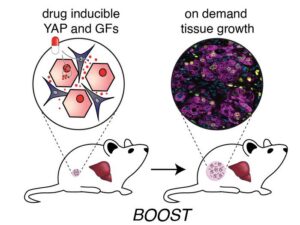
The project, spearheaded by Amy Stoddard, PhD, (MIT ’25), who developed the approach in her doctoral research and then as a postdoctoral fellow, integrates tissue engineering and synthetic biology tools in a genetic strategy the team has named “bioengineered on-demand outgrowth via synthetic biology triggering,” or BOOST. By specifically rewiring the gene expression of primary liver hepatocytes and supportive fibroblast cells, the scientists were able to effectively switch on a tissue growth program in small, engineered liver constructs after their implantation into mice.
“Using engineered liver tissue as a proof-of-concept application, we integrated synthetic biology and tissue engineering tools to build liver tissues that can be expanded on-demand after implantation in vivo,” the team reported in their published paper in Science Advances, which is titled “Synthetic control of implanted engineered liver tissue growth.” In the paper they concluded “In this study, we define the first steps toward an unconventional approach to cell therapy scale-up: engineering a small construct and then inducing it to grow in situ … “This strategy, which we have named BOOST, could provide several key advantages, including circumventing the need for large quantities of cellular raw materials and bypassing the formidable challenge of generating a rapidly perfusable construct that can survive the engraftment period.”
The authors wrote, “Organ transplant is currently the only curative treatment for patients with end-stage organ failure, yet this therapy is inaccessible to many due to the paucity of organs available for transplant.” And while significant progress has been made in the field of engineering tissue-based cell therapies that could represent alternatives, or bridges to transplant, they acknowledge, “… scaling of these constructs to sizes of therapeutic relevance remains a barrier to clinical translation.”
In order to address current challenges associated with fabrication, Chen and colleagues looked at the problem from different angle, asking whether it would be possible to first implant a small-scale construct and then trigger it to expand in situ, after its engraftment into the host.
To be able to induce growth of an implanted small liver constructs in situ within a recipient’s body the researchers first needed to identify the relevant cues that would allow them to do so. “A key first step toward this method of in situ scale-up would be the successful control of cellular growth within the engineered construct after engraftment,” they wrote. Since liver growth is known to be regulated by soluble growth factors (GFs), Stoddard screened a collection of candidate factors to identify those that, when added to cultured human primary hepatocyte cells (HEPs), had the strongest growth-inducing effects.
The genetic “BOOST” strategy integrates tissue engineering and synthetic biology tools to enable on-demand liver growth inside the body. By specifically rewiring the gene expression of primary liver hepatocytes and supportive fibroblast cells, a tissue growth program is switched on in a small, engineered liver construct after its implantation into recipients and upon addition of an inducing agent (shown as a pill). As a result, the hepatocytes in the construct start and continue to proliferate until a desired construct size has been reached and the inducing signal is not provided anymore. In mice, BOOST resulted in robust and healthy liver growth. [Wyss Institute at Harvard University]
“We ended up with a set of four growth factors, HGF, TGFa, WNT2 and RSPO3, that potently induced sparsely scattered HEPs to grow in the culture dish,” said Stoddard. “But when we tested whether they could do the same in 3D liver tissues consisting of densely packed HEPs and fibroblasts, they turned out to be ineffective. This led us to hypothesize that there must be an additional mechanism at work in human HEPs that inhibits cell proliferation in high-density conditions.”
The team homed in on a protein, YAP, that senses mechanical signals, and which was known to move from cells’ cytosol to their nucleus in low-density conditions to help express genes involved in cell proliferation. However, in high-density conditions when cells are compressed, YAP is degraded in the cytosol, which prevents the activation of those target genes and restricts proliferation.
“Importantly, when we overexpressed a non-degradable version of YAP in HEPs, which also reaches the nucleus in high-density conditions to partake in gene regulation, we successfully overrode this density checkpoint in HEPs,” Stoddard said. “Interestingly, we found that HEPs needed to be stimulated with both YAP and GFs in order to grow in densely packed 3D liver tissues.”
Toward the goal of safely inducing and controlling HEP proliferation in a living organism, and eventually human patients, the researchers deployed synthetic biology tools to locally install control of these signaling pathways in HEPs and fibroblast cells within the engineered 3D liver tissues themselves. “We set out to engineer a synthetic biology toolkit capable of locally modulating growth factor and YAP signaling within engineered liver tissue, enabling on-demand control of proliferation even after implantation,” they noted.
The team engineered fibroblast cell lines that each secreted one of the four GFs, and HEPs that expressed the non-degradable YAP protein. And they made the expression of all proteins doxycycline (DOX)-inducible. They determined in time course experiments that a continuous seven-day treatment with DOX led 3D liver tissue composed of engineered cells to robustly expand in size and cell numbers in the culture dish. On DOX removal the HEPs reverted back to a non-proliferating state.
However, Stoddard noted, “… when we compared the gene expression of single cells in BOOST-engineered, DOX-induced 3D liver tissue to that of cells in non-engineered or BOOST-engineered, non-induced 3D liver tissue, we noticed that the expansion came with a trade-off: high proliferation rates went hand in hand with a less functional HEP state. While we believe this is a natural trade-off seen in a wide variety of biological settings, we hope to be able to address this in the future, recognizing that the liver also has native re-functionalization signals to harness.”
The litmus test for BOOST-engineered growth in 3D liver tissues was to see whether they would similarly expand following their implantation into living mice that were systemically treated with DOX for the same seven-day duration. Experiments showed that the implanted tissue exhibited a striking 500% increase in proliferation with a doubling of the engineered HEPs alone, and was vascularized to accommodate the metabolic demands of the expanded tissue. The tissue implants were also well tolerated by the mice, with no signs of fibrosis due to invading immune cells and fibroblast inflammation, or of tumor growth.
“These results were particularly exciting to us,” said Stoddard. “Prior to our work, injury to the host liver has always been required to trigger hepatocyte engraftment and proliferation. Here we were able to relieve this dependence, and trigger on-demand growth of implanted liver tissue in a completely healthy host.”
In the future, the team will explore the capacity of BOOSTed liver tissue to rescue the host in the setting of liver injury. “Our BOOST strategy lays the foundation for a future when solid organ cell therapies can be controlled non-surgically according to the needs of patients and their physicians,” Bhatia noted. “Beyond treating liver disease, the premise of BOOST could be applied to other engineered tissue therapeutics that are similarly constrained by challenges associated with tissue scale-up, such as engineered heart or pancreatic tissue to address serious diseases.”
In their paper the authors concluded, “… this work serves as an exciting proof-of-concept demonstration that scale-up of tissues via growth could be possible … Together, this work helps lay the foundations for a future of ‘smart’ tissue therapeutics that can be scaled to a patient’s needs and thereby offer treatment for numerous, previously incurable, diseases.”
<![CDATA[ASAM’s new youth SUD criteria help clinicians deliver developmentally tailored, prevention-first care with coordinated family and community supports.]]>