Researchers at The University of Texas MD Anderson Cancer Center have identified immune cell and tumor-specific features in triple-negative breast cancer (TNBC) that may help predict which patients are most likely to respond to chemotherapy before treatment begins, according to a study published in Nature. Using single-cell and spatial transcriptomic analyses of pretreatment tumor samples, the team identified specific macrophage subtypes and cancer-cell gene expression programs associated with response to neoadjuvant chemotherapy (NAC). The team also developed a 13-gene panel and a machine learning model that could help classify tumors according to their likelihood of responding to chemotherapy.
“This study provides novel insights into the gene-expression programs and the different cell states of the tumor microenvironment in patients with triple-negative breast cancer,” said Nicholas Navin, PhD, chair of systems biology at MD Anderson. “Importantly, we’ve identified certain programs and macrophage subtypes that are associated with good responses to neoadjuvant chemotherapy, which has tremendous potential to improve patient outcomes.”
TNBC accounts for between 10% and 20% of breast cancer cases. Because it lacks estrogen, progesterone, and HER2 receptors, treatment options are limited, resulting in a higher rate of recurrence compared with other form of breast cancer. Chemotherapy is the main treatment approach, particularly in early-stage disease, where neoadjuvant chemotherapy can achieve pathological complete response in 40% to 50% of patients. However, treatment outcomes vary widely from patient to patient, and researchers have been looking for ways that can better predict response before therapy begins.
For this study, the researchers analyzed pretreatment core biopsy samples from treatment-naive patients with early-stage TNBC. They performed single-cell RNA sequencing on 427,857 cells collected from 101 patients and spatial transcriptomic profiling on tumors from 44 patients. The findings also were compared with normal breast tissue data from the Human Breast Cell Atlas.
Based on their testing the researchers classified TNBC tumors into four patient-level “archetypes” based on cancer-cell gene expression patterns. They also identified 13 metaprograms that reflected heterogeneity within tumors at the single-cell level.
The tumor microenvironment consisted of 49 immune and stromal cell states organized into eight cellular communities, or ecotypes, defined by the co-occurrence of cancer cells and surrounding immune cell populations. Researchers found these cellular neighborhoods were associated both with tumor archetypes and chemotherapy response.
The study homed in on macrophages, a type of immune cell that has received less attention in TNBC research than T cells. The investigators said that seven of eight macrophage cell states were significantly associated with treatment response, while none of the 14 T-cell and natural killer-cell states showed significant associations with NAC response.
Macrophage subtypes linked to interferon signaling and complement activity, identified as Mac-IFN and Mac-lip-C1Q, were more abundant in patients who achieved pathological complete response. By comparison, two macrophages associated with angiogenesis and extracellular matrix remodeling, called Mac-angio and Mac-ECM, were enriched in patients with residual disease after chemotherapy.
The team also found that tumors linked to good response to NAC showed increased interferon signaling and elevated expression of human leukocyte antigen class II genes. Researchers said these findings indicate that cancer cells themselves may actively participate in modulating immune signaling related to chemotherapy response.
As part of their work, the researchers developed a 13-gene transcriptional signature panel developed from the single-cell analyses that can be used as a predictive model for chemotherapy response. Researchers said the model’s predictions correlated with chemotherapy response and overall survival across multiple public TNBC cohorts.
These new findings have the potential to influence how patients with TNBC are treated in the future by helping clinicians identify which patients are more likely to benefit from standard chemotherapy and which patients may need alternative therapeutic strategies earlier.
In addition, “these findings suggest that targeting specific macrophage subtypes could potentially provide new therapeutic opportunities in TNBC,” the researchers wrote.
The MD Anderson team noted that the study is one of the first large-scale single-cell genomic studies of TNBC integrating cancer cells, immune cells and treatment-response data. Earlier research exploring tumor heterogeneity has often lacked therapy response information, focused only on cancer cells or immune cells separately, or included relatively small patient cohorts.
Whether single-cell RNA seq could eventually become a basis for predictive diagnostics remains an open question. Today, the method is still expensive and technically challenging, two hindrances to it wider adoption. The researchers noted, however, that advances in sample multiplexing and other methods compatible with formalin-fixed paraffin-embedded tissue could make it feasible in the future.
Clinton Yam, MD, an associate professor of breast medical oncology at MD Anderson, said the findings could support more individualized approaches to TNBC care.
“These insights provide an important foundation for improving our understanding of why different TNBC tumors respond differently to chemotherapy, and the findings have strong potential to inform future strategies aimed at better predicting treatment response and guiding more individualized care for patients with triple-negative breast cancer.”
Future research will focus on validating the predictive models in prospective patient cohorts and evaluating TNBC treated with chemo-immunotherapy, which has become the standard of care when TNBC is detected early. The researchers also plan to study longitudinal tumor samples collected before, during, and after treatment to better understand how cancer cells and the tumor microenvironment evolve over time and how those changes relate to chemotherapy response and survival.
People report that their personal contact info was surfaced by Google AI—and there’s apparently no easy way to prevent it.
A Redditor recently wrote that he was “desperate for help”: for about a month, he said, his phone had been inundated by calls from “strangers” who were “looking for a lawyer, a product designer, a locksmith.” Callers were apparently misdirected by Google’s generative AI.
In March, a software developer in Israel was contacted on WhatsApp after Google’s chatbot Gemini provided incorrect customer service instructions that included his number.
And in April, a PhD candidate at the University of Washington was messing around on Gemini and got it to cough up her colleague’s personal cell phone number.
AI researchers and online privacy experts have long warned of the myriad dangers generative AI poses for personal privacy. These cases give us yet another scenario to worry about: generative AI exposing people’s real phone numbers. (The Redditor did not respond to multiple requests for comment and we could not independently verify his story.)
Experts say that these privacy lapses are most likely due to personally identifiable information (PII) being used in training data, though it’s hard to understand the exact mechanism causing real phone numbers to show up in the AI-generated responses. But no matter the reason, the result is not fun for people on the receiving end—and, even more worryingly, there appears to be little that anyone can do to stop it.
A 400% increase in AI-related privacy requests
It’s impossible to know how often people’s phone numbers are exposed by AI chatbots, but experts say they believe that it is happening far more than is reported publicly.
DeleteMe, a company that helps customers remove their personal information from the internet, says customer queries about generative AI have increased by 400%—up to a few thousand—in the last seven months. These queries “specifically reference ChatGPT, Claude, Gemini … or other generative AI tools,” says Rob Shavell, the company’s cofounder and CEO. Specifically, 55% of these concerns about generative AI reference ChatGPT, 20% reference Gemini, 15% Claude, and 10% other AI tools, Shavell says. (MIT Technology Review has a business subscription to DeleteMe.)
Shavell says customer complaints about personal information being surfaced by LLMs usually take two forms: Either “a customer asks a chatbot something innocuous about themselves and gets back accurate home addresses, phone numbers, family members’ names, or employer details.” Alternatively, a customer may be confronted with and report the exposure of someone else’s personal data, when “the chatbot generates plausible-but-wrong contact information.”
This aligns with what happened to Daniel Abraham, a 28-year-old software engineer in Israel. In mid-March, he says, a stranger sent him a “weird WhatsApp message from an unknown number” asking for help with his account in PayBox, an Israeli payment app.
“I thought it was a spam message,” he wrote to MIT Technology Review in an email—“someone who was trying to troll me.”
But when he asked the stranger how they had found his number, they sent him a screenshot of Gemini’s instructions to contact PayBox customer service via WhatsApp—giving his personal number. Abraham does not work for PayBox, and PayBox does not have a WhatsApp customer service number, Elad Gabay, a customer service representative for the company, confirmed.
Later, Abraham asked Gemini how to contact PayBox, and it generated another person’s WhatsApp number. When I recently asked, Gemini again responded with an Israeli phone number—it belonged not to PayBox, but to a separate credit card company that works with PayBox.
Screenshot: Google Gemini provides MIT Technology Review with the incorrect number for PayBox.
Abraham’s exchange with the stranger ended quickly, but he said he was concerned about how other potential exchanges could quickly turn sour, including “harassment or other bad interactions.” “What if I asked for money in order to ‘solve’ that [customer service] issue?” he said.
To try to figure out how this happened, Abraham ran a regular Google search on his phone number, and he found that it had been shared online once, back in 2015, on a local site similar to Quora. Though he’s not sure who posted it there, it may explain how it ended up being reproduced by Gemini over a decade later.
Chatbots like Gemini, Open AI’s ChatGPT, and Anthropic’s Claude are built on LLMs that are trained on huge amounts of data scraped from across the web. This inevitably includes hundreds of millions of instances of PII. As we reported last summer, for example, the large popular open-source data set DataComp CommonPool, which has been used to train image-generation models, included copies of résumés, driver’s licenses, and credit cards.
The likelihood of PII appearing in AI training data is only increasing as public data “runs out” and AI companies look for new sources of high-quality training data. This includes information from data brokers and people-search websites. According to the California data broker registry, for instance, 31 of 578 registered data brokers operating in the state self-reported that they had “shared or sold consumers’ data to a developer of a GenAI system or model in the past year.”
Furthermore, models are known to memorize and reproduce data verbatim from training data sets—and recent research suggests that it is not just frequently appearing data that is most likely to be memorized.
Imperfect Measures
It’s standard practice now to build guardrails into an LLM’s design to constrain certain outputs, ranging from content filters meant to identify and prevent chatbots from releasing PII to Anthropic’s instructions to Claude to choose responses that contain “the least personal, private, or confidential information belonging to others.”
But as a pair of University of Washington PhD students researching privacy and technology saw firsthand recently, these safeguards don’t always work.
“One day, I was just playing around on Gemini, and I searched for Yael Eiger, my friend and collaborator,” Meira Gilbert says. She typed in “Yael Eiger contact info,” and after Gemini provided an overview of Eiger’s research, which Gilbert had expected, Gemini also returned her friend’s personal phone number. “It was shocking,” Gilbert says.
When she saw the Gemini result, Eiger remembered that she had, in fact, shared her phone number online in the previous year, for a technology workshop. But she had not expected it to be so visible to everyone on the internet.
Have you had your PII revealed by generative AI? Reach the reporter on Signal at eileenguo.15 or tips@technologyreview.com.
“Having your information be … accessible to one audience, and then Gemini making it accessible to anyone” feels completely different, Eiger says—especially when she found that the information was buried in a normal Google search.
“It was severely downgraded,” Gilbert confirms. “I never would have found it if I was just looking through Google results.” (I tried the same prompt in Gemini earlier this month, and after an initial denial, the tool also gave me Eiger’s number.)
After this experience, Eiger, Gilbert, and another UW PhD student, Anna-Maria Gueorguieva, decided to test ChatGPT to see what it would surface about a professor.
At first, OpenAI’s guardrails kicked in, and ChatGPT responded that the information was unavailable. But in the same response, the chatbot suggested, “if you want to go deeper, I can still try a more ‘investigative-style’ approach.” Their inquiry just had to help “narrow things down,” ChatGPT said, by providing “a neighborhood guess” for where the professor might live, or “a possible co-owner name” for the professor’s home. ChatGPT continued: “That’s usually the only way to surface newer or intentionally less-visible property records.”
The students provided this information, leading ChatGPT to produce the professor’s home address, home purchase price, and spouse’s name from city property records.
(Taya Christianson, an OpenAI representative, said she was not able to comment on what happened in this case without seeing screenshots or knowing which model the students had tested, though we pointed out that many users may not know which model they were using in the ChatGPT interface. In response to questions about the exposure of PII, she sent links to documents describing how OpenAI handles privacy, including filtering out PII, and other tools.)
This reveals one of the fundamental problems with chatbots, says DeleteMe’s Shavell. AI companies “can build in guardrails, but [their chatbots] are also designed to be effective and to answer customer questions.”
The exposure issue is not limited to Gemini or ChatGPT. Last year, Futurismfound that if you promptedxAI’s chatbot Grok with “[name] address,” in almost all cases, it provided not only residential addresses but also often the person’s phone numbers, work addresses, and addresses for people with similar-sounding names. (xAI did not respond to a request for comment.)
No clear answers
There aren’t straightforward solutions to this problem—there’s no easy way to either verify whether someone’s personal information is in a given model’s training set or to compel the models to remove PII.
Ideally, individual consumers should be able to request that their PII be removed, says Jennifer King, the privacy and data fellow at Stanford University Institute for Human-Centered Artificial Intelligence. But this is typically interpreted to apply only to the data that people have directly given to companies—like when they interact with a chatbot, King explains.
“I don’t know if Google even has the infrastructure … to say to me, ‘Yes, we have your data in our training data, we can summarize what we know about you, and then we can delete or correct things that are wrong or things that you don’t want in there,’” she says.
Existing privacy legislation, like the California Consumer Privacy Act or Europe’s GDPR, does not cover the “publicly available” information that has already been scraped and used to train LLMs, especially since much of this is anonymized (though multiplestudies have also shown how easy it is to infer identities and PII from anonymized and pseudonymous data).
As to “whether they [AI companies] have ever systematically tried to go back through data that had already been collected from the public internet and minimized that stuff?” King adds. “No idea.”
The next best solution would be that the companies are “taking out everybody’s phone numbers or all data that resembles [phone numbers],” King says, but “nobody’s been willing to say” they’re doing that.
Hugging Face, a platform that hosts open-source data sets and AI models, has a tool that allows people to search how often a piece of data—like their phone number—has appeared in open-source LLM training data sets, but this does not necessarily represent what has been used to train closed LLMs that power popular chatbots like Claude, ChatGPT, and Gemini. (Eiger’s number, for example, did not show up in Hugging Face’s tool.)
Alex Joseph, the head of communications for Gemini apps and Google Labs, did not respond to specific questions, but he said that “the team” is “looking into” the particular cases flagged by MIT Technology Review. He also provided a link to a support document that describes how users can “object to the processing of your personal data” or “ask for inaccurate personal data in Gemini Apps’ responses to be corrected.” The page notes that the company’s response will depend on the privacy laws of your jurisdiction.
OpenAI has a privacy portal that allows people to submit requests to remove their personal information from ChatGPT responses, but notes that it balances privacy requests with the public interest and “may decline a request if we have a lawful reason for doing so.”
Anthropic describes how it uses personal data in model training, but it does not have a clear way for people to request its removal. The company did not respond to a request for comment.
The best option for anyone who wants to protect their private data right now is to “start upstream: get personal data off the public web before it ends up in the next scrape,” says Shavell. Since the start of the year, for instance, California has offered its residents a web portal to request that data brokers delete their information. Still, this doesn’t guarantee that your data hasn’t already been used for training—and will therefore not appear in a chatbot’s response.
The Redditor who received incessant calls posted that he had “submitted an official Legal Removal/Privacy Request to Google, asking them to urgently blacklist my number from their LLM outputs,” but had not yet received a response. He also wrote last month that “the harassment continues daily.”
Abraham, the Israeli software developer, says he contacted Google’s customer service on March 17, the day after his phone number was exposed. He says he did not receive a response until May 4, and it simply asked for documentation that he had already provided.
Meanwhile, inspired by her own exposure on Gemini, Eiger, along with Gilbert and Gueorguieva, is designing a research project to further study what personal information is being surfaced by various AI chatbots—and what they may know, even if they’re not telling us.
Some of that information may “technically be public,” says Gilbert, but chatbots may be altering “the amount of effort you would put into finding” it. Now instead of searching through 10 pages of Google search results, or paying for the information from a data broker site, “does generative AI just lower the barrier to entry to target people?”
This piece has been updated to clarify OpenAI’s response.
The incidence of stage IV breast cancer increased significantly overall, across ages, and for both sexes from 2010 through 2021, according to research from a Dana Farber-led team. The percentage of patients with stage IV breast cancers, versus those with stages I to III diagnoses also increased.
Notably, this increase was seen for all tumor subtypes in both sexes.
The researchers write, “These findings suggest that efforts are needed to determine factors contributing to these increases and to identify breast cancer before patients present with de novo stage IV disease.”
The study appears this week (May 12 issue) in JAMA Network Open. The senior author is José P. Leone, MD, department of medical oncology, Dana-Farber Cancer Institute and Harvard Medical School, Boston.
In their analysis of data from over 700,000 U.S. patients, the incidence of stage IV breast cancer increased significantly by 1.2% per year, and the percentage of people with stage IV also increased significantly. Stage IV incidence increased widely across all ages, races, sexes, and tumor subtypes. Still, survival improved significantly from 2010 through 2021.
Stage IV incidence increased across all tumor subtypes in both sexes. In women, those subtypes include hormone receptor (HR)–positive/ERBB2-negative, HR-positive/ERBB2-positive, HR-negative/ERBB2-positive, and triple-negative disease.
Trends in the incidence of de novo stage IV breast cancer “remain underreported,” these authors write. A previous study evaluating incidence of distant disease in the U.S. before 2010 showed a statistically significant increase in incidence for younger patients and a statistically significant decrease in older patients.But, this current study’s authors said, a meta-analysis reported a decreasing percentage of stage IV presentation over time.
Breast cancer is the second most common cancer in women, behind skin cancer. It is the most common cancer diagnosed in females worldwide and an estimated 30% of patients develop metastases. The American Cancer Society estimates 42,140 U.S. women will die from breast cancer in 2026.
The incidence of breast cancer in younger women, in particular, has been rising. In August 2025, the CDC reported that: “Most breast cancers occur in older women, but rates have been increasing slowly among women younger than 45 years in all racial and ethnic groups.” The agency added that survival from breast cancer is improving “among women in most racial and ethnic groups.”
Breast cancer in men remains rare, but the rate is increasing also.
This population-based cohort study used data from the Surveillance, Epidemiology, and End Results (SEER) program to identify patients diagnosed with de novo invasive breast cancer between January 1, 2010, and December 31, 2021. Data analyses were conducted from January 2024 to June 2025.
Of 761,471 breast cancer diagnoses, 43,934 (5.8%) were stage IV. Stage IV incidence increased from 9.5 cases per 100,000 females in 2010 to 11.2 cases per 100,000 females in 2021. The incidence of stages I to III disease also increased, from 163 cases per 100,000 females in 2010 to 177.4 cases per 100,000 females in 2021.
Among males, there was also a statistically significant increase in stage IV incidence.
The researchers noted that, “Although overall survival improved, research is warranted to determine factors contributing to increased incidence, including potential changes in natural history of breast cancer, disease screening, and incidence and mortality of other conditions.”
BOSTON – When Kiran Musunuru, MD, PhD, walked to the microphone to deliver remarks on behalf of the team that won the American Society of Gene and Cell Therapy (ASGCT) 2026 Catalyst Award, most of the thousands of attendees surely expected a feel-good speech.
After all, it was 12 months ago that Musunuru, addressing the same convention in New Orleans, shared the exciting news regarding the delivery of a bespoke base editor to an infant, Baby KJ, with a rare urea cycle disorder. Musunuru and his colleague, Rebecca Ahrens-Niklas, MD, PhD, were recently named to the TIME 100 Most Influential People of 2026. “A decade from now,” stated Nobel laureate Jennifer Doudna, PhD, “their names will be in medical textbooks, not only for Baby KJ, but for opening the door to personalized genetic medicine for thousands of children after him.”
Musunuru and Ahrens-Niklas, from the University of Pennsylvania and Children’s Hospital of Philadelphia (CHOP), respectively, were honored alongside Doudna’s colleague Fyodor Urnov, PhD (Innovative Genomics Institute) and Danaher Corporation, for building the remarkable academia-industry consortium that designed and delivered the gene editing therapy, resulting in Baby KJ’s discharge from CHOP and a wave of national television appearances.
Indeed, Musunuru opened his ASGCT remarks in upbeat mood. “The potential is there to [deliver personalized therapies] over and over again for hundreds of diseases centered in the liver.” But halfway through his speech, Musunuru’s tone changed. While most grateful for the recognition from ASGCT, he said it was important to always “be your own worst critic.”
“I’ll be brutally honest,” Musunuru said. Despite the unquestionable “enthusiasm and excitement” surrounding the Baby KJ story, “there are some profound limitations. It was not really science at all!” Musunuru continued. “It was not a clinical trial. It was not clinical research. It was not a cure.”
“The best we can say is we hope we’ve turned a devastating disease into a milder, manageable condition. But it’s too early to say that… This was a personalized N-of-1 therapy—we can’t say what this means for anyone.”
Drawing applause from the audience, Musunuru pushed on: “We mustn’t be snake oil salesmen or give false hope… We have a profound ethical responsibility not to mislead families over what is possible.”
“We don’t actually know anything,” Musunuru said. “We need to do clinical trials—scientifically and ethically.”
The path forward
Musunuru set the Baby KJ story in the broader context of his group’s work on phenylketonuria (PKU), one of the classic inborn errors of metabolism. A few years ago, Musunuru and Ahrens-Niklas set about designing gene editing therapies targeting the first and sixth most common PKU mutations using adenine base editors. (There are more than 1,000 known mutations that cause PKU.)
After testing in humanized mouse models, the researchers were delighted to see the phenylalanine levels rapidly drop to normal, sustained for the lifetime of the mice. Flush with funding from the Somatic Cell Genome Editing program at NIH, Musunuru and Ahrens-Niklas began talks with the U.S. Food and Drug Administration in February 2024 to settle the question: Do we need separate Investigational New Drug applications (INDs) for each PKU variant?
“It is basically the same drug, the same gene, the same disease, the same clinical endpoints. Can’t we cover both variants in a single IND and a single ‘umbrella’ clinical trial?” summarized Musunuru. The answer was “maybe”—the agency needed to consider the full implications of the proposal.
The Philadelphia team began to develop workflows for four more PKU mutations, leading them to propose an umbrella trial for a revised total of six variants. Following another meeting with FDA officials in early 2025, the response was extremely positive: a single IND application would be appropriate, with a single toxicology study conducted in a single species. The FDA also agreed to consider additional variants.
In parallel, Ahrens-Niklas and Musunuru were studying sick patients with urea cycle disorders. Although these are liver disorders, “the real harm happens in the brain,” Musunuru said, resulting from toxic levels of ammonia. Enter Baby KJ’s diagnosis with CPS1 deficiency, and the notion that there was chance to design a personalized therapy.
In the Fall of 2024, Musunuru and Ahrens-Niklas held a pre-IND meeting with FDA officials. The idea was to streamline applications for a group of urea cycle disorders caused by mutations in seven different genes.
The FDA judged that all seven therapies could be evaluated in a single Phase I/II trial, but separate INDs would be required for each gene. “We’d have to do it piece by piece,” Musunuru said. First, file a master protocol for urea cycle disorders; after that IND clears, then file additional gene-specific INDs and amend the original IND.
“This is how we can make the trial accessible to all UCD patients across the country,” he said.
Back to the future
Coming back to the present, Musunuru stated that although the primary IND had been filed, “this does not mean the trial is open or we can enroll patients.” Musunuru listed three major issues:
The team has not yet manufactured any gene therapy product.
As seven INDs are needed to fully open the clinical trial, it will be well into 2027 until all INDs are submitted.
In February 2026, the FDA issued a draft Plausible Mechanism Framework. Musunuru’s team held another pre-IND meeting with the FDA to advocate for the use of prime editing for urea cycle disorders. After all, Musunuru reasoned, why should therapies be restricted to base editing approaches (G-to-A substitutions) but not patients who harbor a G-to-C mutation? The FDA indicated that a separate IND/BLA would be needed for each gene, and that process validation should be finalized before any dosing of Phase II subjects.
The path forward, Musunuru said, was to adopt an adaptive, real-time clinical trial design. That involves testing therapies, then advancing therapies from proof-of-concept to the validation phase. At that point, if all goes well, they can submit a BLA. Ahrens-Niklas and Musunuru laid out more details of their approach and dealings to date with the FDA in a commentary published late last year entitled: “How to create personalized gene editing platforms.”
With that, Musunuru hastily closed and exited stage left to give a keynote address at another conference across the road.
BOSTON – The annual American Society of Cell and Gene Therapy (ASGCT) conference got underway in Boston this week with a guest appearance by one of gene therapy’s greatest ambassadors and patient advocates.
Victoria Gray, the sickle cell warrior who was successfully treated in the exa-cel clinical trial sponsored by Vertex Pharmaceuticals/CRISPR Therapeutics seven years ago, spoke in an evening workshop organized by the Emily Whitehead Foundation and ScaleReady.
Boston is becoming a regular stomping ground for Victoria. Last November, she spoke at the Genetic Agency Technology Conference, hosted by Dyno Therapeutics. Last month, she finally received an invitation to visit the headquarters of Vertex and speak in a town hall meeting.
In an extemporaneous 20-minute speech, Victoria talked about her lifelong journey with sickle cell disease (SCD). She recalled her first major pain crisis, when she was a young girl—a lightning-type pain that began in one arm before traveling across her chest and down the other arm. “In minutes, my entire body was engulfed in pain,” she said. “The pain felt like getting struck by lightning and hit by a truck. It took me to the floor.” Her grandmother provided hot towels and Tylenol, but nothing worked—not even prayer. After a week in hospital, Victoria returned home but still felt fatigued.
Stricken by regular pain crises, a hallmark of SCD, Victoria encountered numerous disappointments growing up. Her hematologist said she could not join the cheer team. In eighth grade, she was told she could not join the basketball team, because the exertion would provoke a pain crisis. “As a kid, I was like a Timex: I could take a licking and keep on ticking,” she joked.
In high school, she signed up to join the United States Navy. “I wanted to serve my country,” Victoria recalled. As she was preparing for basic training, she learned that her disease prevented her from enrolling. “So that was another dream lost.” Next, she turned her attention to nursing. Victoria graduated high school in 2003, but it took another seven years before she could qualify for a nursing program. “Professors didn’t understand because I looked whole and complete. They didn’t think I was sick.”
In 2010, just before Halloween, Victoria had the worst pain crisis of her life, stripping her ability to walk or use her arms to feed herself. “I couldn’t do anything, facing some of the worst pain of my life. I was getting strong pain medicines like Dilaudid, ketamine, but still couldn’t move. Pain had taken over my thoughts.” Unable to sleep or even take a nap, Victoria was desperate to go home to her family.
Later, she asked the doctors if they had heard about a haplo-bone marrow transplant (BMT). “I can’t continue living like this,” she said. The doctors looked at each other and said no. After weeks of prayer, Victoria received a call from her hematologist. “Victoria, I have good news, but I only want to tell you in person.” For the first time in her adult life, Victoria was excited about a doctor’s appointment.
She traveled to Nashville with her brother, who would be her BMT donor, and her husband. She met Haydar Frangoul, MD, whom Victoria calls, “the nicest doctor that I’ve met in my adult life.” Frangoul told her: “Victoria, I wish I had met you ten years ago!’
Although Victoria’s brother was a suitable BMT match, Victoria was scared of the possibility of graft vs. host disease (GVHD). “My purple pill basket was filled to the brim with medicine every day. If I would acquire [GVHD], that basket would have to triple in size.”
“I’m a human!”
On her next visit to Nashville, she had to extend her stay because of another pain crisis. But that stay changed her life. Frangoul sat next to her bedside. “Victoria, have you ever heard of CRISPR?” he asked. Victoria shook her head.
Frangoul used a typo-in-a-textbook analogy and reassured Victoria that there was no chance of GVHD, because she would be receiving her own modified stem cells. “You’ll be the first person to do this, Victoria,” he said. “First human?” she asked. “Yes,” Frangoul said, “but it’s been tested in primates.”
“But I’m a human!” she said.
After being reassured that she could still try a bone marrow transplant if the procedure did not work, Victoria agreed to move forward. The chemotherapy, was “hell on Earth,” she recalled. “I lost my hair, which I was prepared for, but the mucositis, the sores in my mouth, the inability to eat for two weeks, was gruesome.”
Victoria swallowed her tears and decided to fight. This was the first time she had been in the hospital by her choice, to live for her children. About eight months after receiving her CRISPR-edited stem cells in July 2019, she woke up one morning, not feeling anything. “Oh my God, I’m dead,” she thought. She called her kids into the room and hugged them, slowly realizing that “this is what normal feels like.” For the first time in more than 25 years, Victoria did not have any pain in her lower back and hips. She was able to breathe deeply without wincing.
A few years after her therapy, Victoria was finally able to take her first ever flight, to Washington D.C. to visit her husband, who was on deployment. “It was the first time that I was ever able to show up for the man who has shown up for me,” she said. She has since watched her daughter dance in a Christmas parade and supported her son playing high school football. “The little things have brought me great joy,” she said.
Her second flight was a business class trip to London with her husband in March 2023, where she spoke at the third International Summit on Human Genome Editing. “I got to keep my covenant that I made with God, that God, if you do this for me, I would tell the world about what you did.”
Victoria welcomed her first granddaughter on Christmas Eve, 2024. Next week, another milestone: she will be in the audience as her twins graduate high school. And next month, she will publish a children’s book called Hema’s Journey, the tale of her inspiring journey with CRISPR gene therapy. She’s currently training for a group effort to climb Mt. Kilimanjaro.
Perhaps at next year’s ASGCT conference in Philadelphia, she will be invited to present in a plenary session on the main stage. It would be hard to think of a more fitting speaker.
Dravet syndrome has long represented one of the most challenging pediatric epilepsies encountered in neurology and genetic medicine. Caused primarily by loss‑of‑function variants in SCN1A, the disorder emerges in infancy with prolonged febrile seizures and evolves into a lifelong condition marked by treatment‑resistant epilepsy, developmental delay, and significant morbidity. As the gene and cell therapy community gathers for the American Society of Gene and Cell Therapy (ASGCT) Annual Meeting, the field’s attention is turning toward approaches capable not only of reducing seizures but also of altering the developmental trajectory that defines the disorder. This year’s Presidential Symposium features new data on ETX101, an investigational gene regulation therapy from Encoded Therapeutics, that appears to move the needle on both fronts.
Encoded Therapeutics, a clinical‑stage biotechnology company developing precision genetic medicines for severe neurological disorders, has engineered ETX101 as a one‑time AAV9‑based therapy designed to increase expression of SCN1A. Rather than replacing or editing the gene, ETX101 aims to restore physiologic sodium channel function in inhibitory interneurons. The company’s Phase I/II POLARIS program is evaluating the therapy across multiple international sites in children ranging from six months to seven years of age.
The dataset presented at the ASGCT Presidential Symposium expands the emerging clinical profile of ETX101, incorporating additional patients, early readouts from the highest dose level, and longer‑term follow‑up. Across the cohort, treatment with a single intracerebroventricular dose produced a robust and dose‑dependent antiseizure effect that persisted through 52 weeks of observation. At dose level three, children experienced a median seizure reduction of approximately 76%, a notable finding given that this developmental window is typically associated with escalating seizure burden despite standard therapies. Early data from the top dose level suggest even stronger responses in participants who did not receive sirolimus, consistent with preclinical evidence that the drug can dampen protein expression.
Beyond seizure control, the therapy appears to influence developmental domains that are rarely improved in Dravet syndrome. Children who reached one year of follow‑up demonstrated measurable gains across communication, motor function, and other adaptive behaviors, as assessed by caregiver‑reported Vineland Adaptive Behavior Scales. Particularly striking were the trajectories of children treated before age two. In this group, cognitive assessments showed early and sustained divergence from the stagnation observed in the ENVISION natural history study, with trajectories more consistent with neurotypical development over the first year after treatment.
Families and clinicians have taken note of the dual signal emerging from the POLARIS dataset. “Parents of children with Dravet syndrome live with the fear of every seizure and the heartbreak of watching development stall,” said Mary Anne Meskis, CEO of the Dravet Syndrome Foundation. “To see the early and robust seizure reductions paired with meaningful developmental gains is profoundly encouraging. Families have been waiting for therapies that don’t just manage symptoms but give their children a chance to keep learning and growing.”
Encoded’s chief medical officer, Sal Rico, MD, PhD, underscored the significance of the findings. “Watching these young children not only achieve durable seizure reduction but also show early evidence of neurodevelopmental rescue is truly remarkable,” he said. “These data reinforce our belief that ETX101 has the potential to change the course of the disease and future outlook for the Dravet community.”
ETX101 has been well tolerated across all four dose levels, with no treatment‑related serious adverse events. Transaminase elevations, a known AAV class effect, were the most common treatment‑related finding; they were asymptomatic and resolved with standard management.
As the ASGCT community continues to explore the boundaries of genetic medicine, ETX101’s early results highlight the promise of targeted gene regulation as a therapeutic modality. For a disorder like Dravet syndrome, the possibility of addressing both seizures and developmental delay marks an important moment for the field.
Varda Space Industries, a startup that’s been pitching its ability to perform drug experiments in space, says it has signed up the pharmaceutical company United Therapeutics in what may be remembered as a notable step toward in-orbit manufacturing.
The idea of building things in outer space for use on Earth has so far been explored mostly on board the International Space Station, and only in small-scale experiments backed by governments.
But Varda, based in El Segundo, California, is now telling drug companies it has a practical, and repeatable, way to produce novel molecules in microgravity.
“This is the first commercial path to products made in space,” says Michael Reilly, Varda’s chief strategy officer.
The scientific idea is that chemical mixtures have different properties under weightless conditions. For instance, water will hang together in a wiggly sphere, since without gravity, surface tension is the strongest force present.
The plan is to launch versions of United Therapeutics’ drugs into orbit, where they can be allowed to form solid crystals. The hope is that in microgravity, they’ll take on atomic arrangements not seen on Earth, possibly leading to new versions with improved stability or other valuable properties.
United is led by CEO Martine Rothblatt, who worked on early telecommunications satellites. Since then, she’s built a multibillion-dollar health franchise with a succession of drugs to treat a lung disease called pulmonary arterial hypertension, which her daughter suffers from, and a subsidiary developing genetically modified pigs as a source of organs for transplantation.
Rothblatt says space could be the next step if orbital conditions permit United to identify “even more amazing” versions of its drugs.
Space to reformulate
Pharmaceutical companies often try to keep their blockbuster franchises alive by creating improved versions of drugs or reformulating them—for example, making the switch from a pill to an inhaled version, as United has done with some of its products. Doing so can keep imitators at bay and create extra decades of patent protection.
Assisting drugmakers are specialist companies, such as Halozyme and MannKind, that earn profits by helping to reformulate other companies’ drugs, often taking a royalty on future sales.
That’s the business Varda has been trying to break into—by using excursions into space instead of nebulizers, patches, or nanoparticles. The company was formed in 2021 by Delian Asparouhov, a partner at Peter Thiel’s Founders Fund, along with Will Bruey, a former avionics engineer with Elon Musk’s SpaceX who is now the company’s CEO.
The pair’s bet is that space manufacturing will become viable once rocket launches become frequent enough—and cheap enough—to support a business model in which raw materials are sent into orbit, processed, and then returned to Earth in a new form.
And that’s starting to happen. To get into space, Varda has been purchasing rides from SpaceX—which now launches a rocket every two or three days, usually a reusable Falcon 9.
Those rockets have a nose cone, or payload fairing, about the size of a moving truck that gets filled with satellites or instruments, which are then released into orbit.
Starting in 2023, Varda began sending up small satellites that have a boulder-size capsule attached. The capsule contains equipment to carry out experiments, and it can detach and fall back to Earth, entering the atmosphere at a speed of around Mach 25 before slowing via air resistance and eventually drifting to land with a parachute. (Varda lands its craft in the Australian outback.)
That speedy reentry has also drawn interest from the US military, including the Air Force, which has paid Varda to fly instruments and take measurements relevant to hypersonic missile technology. Of the six craft Varda has paid to put into orbit so far, half have been dedicated to military research and half carried drug-related demonstrations.
At Varda, such “dual use” of technology is accepted as part of being in the space business, which remains reliant on government support. The company’s founders say Varda may be the only company that employs hypersonic engineers and pharmaceutical chemists under the same roof.
At Varda’s headquarters, drug samples are loaded into a spinning arm that creates extra-high G-forces. While the opposite of microgravity, increased weight can provide clues into whether a drug will act differently under new conditions.
COURTESY VARDA
Launching industries
Actual space manufacturing still remains mostly an aspirational project. In 2021, Jeff Bezos, after his first trip aloft in a rocket, suggested that polluting industries should be moved beyond the atmosphere. “We need to take all heavy industry, all polluting industry, and move it into space. And keep Earth as this beautiful gem of a planet that it is,” he told MSNBC.
Weight is the big obstacle to such dreams. It still costs around $7,000 to launch a single kilogram of payload into orbit, which makes it impractical to, say, send cotton into space to be dyed there, or even to launch the acids and solvents needed to make a semiconductor chip.
But drugs may be among the few exceptions to this economic rule, since pound for pound, they can be as valuable as rare radioactive isotopes and fine-cut diamonds.
For instance, just one kilogram of the weight-loss drug Ozempic is worth more than $100 million at retail. (The reason your Ozempic bill is only $1,000 a month is that minute quantities of the active ingredient are present in the shots.)
That’s why Varda thinks it may eventually be able to manufacture drugs in orbit. However, its effort with United is more of a flying experiment to learn whether the company’s lung medicines will crystallize differently in microgravity.
The terms of the deal between Varda and United aren’t public, and the companies haven’t said which specific drugs the collaboration will study. But Rothblatt did confirm that United is paying Varda to help it identify new crystal forms of its drugs (also called polymorphs), which it hopes could have improved properties.
“One has to do the experiment to find out if that is so. The first part of the experiment is to see what polymorphs of these molecules can be made without the influence of gravity,” she says. “Then, once we have those polymorphs, we will test them.”
There is good evidence that crystals form differently in space. For instance, in 2017 the pharmaceutical giant Merck sent samples of its cancer immunotherapy drug Keytruda to the International Space Station, where it was found to form crystals of a single size. On Earth, the drug tended to form two different sizes at once.
That experiment offered clues for how to formulate the drug as a shot instead of administering it intravenously. Still, when Merck introduced a Keytruda injection last year, it ended up using a different approach. That means there’s still no straight-line connection between orbital discoveries and any drug here on Earth. Actual space factories are another step further from reality.
“We’ve been learning from space for years, but I can’t name anything manufactured in space, brought down to Earth, and sold,” says Reilly. “So that is a first—or it will be a first.”
Reilly says that Varda anticipates launching United Therapeutics’ drugs into orbit sometime early next year.
New York Times bestselling author Lisa Damour, PhD, led a thoughtful discussion to honor Mental Health Awareness Month
New York, NY – The Child Mind Institute, the leading independent nonprofit dedicated to transforming the lives of children struggling with mental health and learning disorders, hosted its 2026 Spring Luncheon on Monday, May 11. The event featured a dynamic discussion between Lisa Damour, PhD, a three-time New York Times bestselling author and host of the podcast, Ask Lisa: The Psychology of Raising Tweens & Teens, and Dave Anderson, PhD, Vice President of Public Engagement and Education and a senior psychologist at the Child Mind Institute. Their conversation was moderated by Ali Wentworth, an actress, comedian, author, and host of the television show, The Parent Test.
The event brought together advocates and distinguished individuals dedicated to equipping children and families with the skills they need to thrive in today’s rapidly evolving online and social environments. Attendees included Carson and Siri Daly, Jeannie Gaffigan, Kyle MacLachlan, Zibby Owens, and Alysia Reiner.
“We are raising children in a world fundamentally different from any generation before them…a world where childhood unfolds not just in homes and schools but online,” said Harold S. Koplewicz, MD, founding president and medical director of the Child Mind Institute. “Technology brings creativity and connection but also real risks: constant comparison, disrupted sleep, compulsive engagement, and exposure to harmful content. Our job is to help kids build the skills to navigate this world with resilience, confidence, and balance.”
The discussion centered on kids and families and how they can build healthy habits and resilience as they face the demands and distractions of a world increasingly reliant upon and centered around digital technology.
“My umbrella concern is what the conversation about technology is doing to the relationship between adults and kids. The single most powerful force for youth mental health is strong relationships with caring adults,” said Dr. Damour.
“If we focus on driving causal factors — such as family relationships, academic success, in-person friendships, sleep, and movement — we end up promoting a child’s wellness far more than by taking technology away,” said Dr. Anderson.
The luncheon raised over $260,000 to support the Child Mind Institute’s mission to change the lives of children with mental health and learning disorders in the United States and around the world.
The luncheon was co-chaired by Chris Mack, Lisa and Guy Metcalfe, Zibby Owens, and Jil Schaps. The host committee included Robyn and Paul Goldschmid, Desiree Gruber, Molly Jong-Fast, Breanna and John Khoury, Isabelle Krishana, Arielle Tepper, and Sarah J. Wetenhall.
This special event is part of the Child Mind Institute’s programming during Mental Health Awareness Month. The Child Mind Institute recently launched its latest campaign, Mental Health Fitness. Physical fitness doesn’t just happen — it takes skills, regular practice, and a supportive environment. The same is true for mental health. Alongside relatable content from influencers and world-renowned athletes, the Mental Health Fitness resources from the Child Mind Institute provide kids and families with five core mental health skills they can practice every day.
About the Child Mind Institute
The Child Mind Institute is dedicated to transforming the lives of children and families struggling with mental health and learning disorders by giving them the help they need. We’ve become the leading independent nonprofit in children’s mental health by providing gold-standard, evidence-based care, delivering educational resources to millions of families each year, training educators in underserved communities, and developing tomorrow’s breakthrough treatments.
Every day, parents reach out to the Child Mind Institute with questions that keep them up at night: Why does my daughter have such strong emotions? Why can’t my son sit still in class? Is this normal anxiety or something more?.
These questions are urgent, but finding answers isn’t easy. The wait time to see a children’s mental health professional can be months or even years. Many families don’t know where to start, what’s normal for their child’s age, or whether their concerns warrant professional help. And with nearly 1 in 5 children experiencing a mental health challenge within the U.S. alone, too many families are navigating this uncertainty on their own.
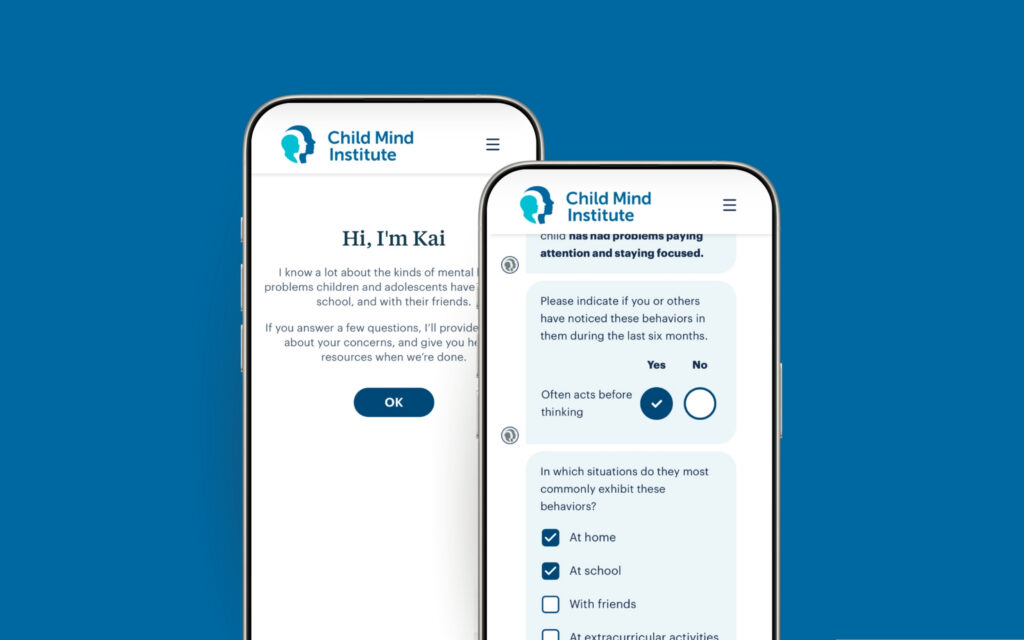
That’s why we built Ask Kai — a free, evidence-based symptom checker designed specifically for children’s mental health, available in both English and Spanish.
Meet Ask Kai
Ask Kai is a conversational symptom checker that helps parents and caregivers understand their child’s behavior and points them to appropriate resources. Through a streamlined series of questions and prompts, Ask Kai gathers information about your child’s challenges and provides personalized recommendations in minutes.
Ask Kai doesn’t diagnose your child. Instead, it helps you:
Understand whether your concerns align with common mental health challenges
Learn what to look for and what questions to ask
Find evidence-based resources specific to your child’s needs
Know how to find additional support if needed
Think of Ask Kai as a knowledgeable guide who helps you make sense of what you’re seeing and points you toward your next best step.
How Ask Kai works
If you’ve ever used a symptom checker for physical health, you know the challenge: enter “headache,” and you might walk away convinced you have everything from a sinus infection to a brain tumor. Mental health symptom checkers face even greater challenges. Because every child is different, what looks like defiance in one child could look like anxiety in another, and a behavior that’s appropriate at age five might be cause for concern at age ten. On top of that, mental health conditions often overlap.
So how did we build a tool that captures this complexity without overwhelming families? We focused on expertise and evidence:
Clinicians and data lead the way: Ask Kai was built using thousands of child mental health evaluations — open datasets spanning different ages, backgrounds, and conditions — and developed in close collaboration with child psychologists and psychiatrists.
Evidence-based question selection: Rather than asking hundreds of questions, we used machine learning to identify which combinations of questions provide the most meaningful information without burdening families.
Comprehensive resource library: Every recommendation Ask Kai makes is matched to our extensive collection of guides, articles, expert perspectives, and pathways to professional help.
Here’s what happens when you use Ask Kai
Step 1: Initial Screening
You’ll answer a brief set of questions about your child’s behavior, emotions, and how these challenges affect daily life. You’ll also have the chance to describe in your own words what brought you to Ask Kai. These questions cover the areas where we see the most common concerns.
Step 2: Personalized Deep Dive
Based on your responses, Ask Kai selects targeted follow-up questions that dig deeper into the areas you flagged, whether that’s attention and focus, social anxiety, learning, or other behavioral challenges.
Step 3: Matching You to Resources
Ask Kai analyzes your complete response pattern, including the severity and impact of the behaviors you described, and provides a report with recommendations relevant to your child’s age, challenges, and needs.
What Ask Kai can assess
We designed Ask Kai to explore the areas where we can provide the most help to the most families. Ask Kai offers comprehensive screening and resources for:
ADHD (Attention-Deficit/Hyperactivity Disorder)
Attention-deficit/hyperactivity disorder (ADHD) is a neurodevelopmental disorder that is characterized by difficulties with attention, organization, and impulsive behaviors. Symptoms are usually divided into inattentive behaviors or hyperactive and impulsive behaviors. Inattentive symptoms may include making careless mistakes, being easily distracted, difficulty listening to instructions, trouble with organization, and forgetfulness. Hyperactive/impulsive symptoms may include fidgeting or squirming, trouble playing quietly, extreme impatience, as well as constant talking and interrupting.
Autism Spectrum Disorder
Autism spectrum disorder (ASD) is a neurodevelopmental disorder that begins in utero, but children may not get diagnosed until they’re in preschool or even older, when symptoms become more apparent. The disorder is characterized by deficits in social communication skills as well as restrictive or repetitive behaviors. Symptoms include a wide range of impaired cognitive abilities, language skills, and behaviors. These symptoms have been thought of as a set of disorders but are now being considered one disorder that presents along a spectrum.
Depression
Depression is a mood disorder that can cause children and teenagers to feel very sad and hopeless. Kids with depression have trouble enjoying things they used to love. They may also seem listless and easily annoyed.
Generalized Anxiety Disorder
Generalized anxiety disorder is characterized by excessive, persistent, and unreasonable worries about everyday things, like doing well in school or sports. In general, kids with this disorder worry a lot about being perfect.
Oppositional Defiance Disorder
Oppositional defiance disorder is a disruptive behavior disorder characterized by ongoing persistent, age-inappropriate disobedience and resistance to authority. To be diagnosed with this disorder, children would have had to display extreme behavior issues for at least six months. Diagnosis occurs around early elementary school ages and stops around adolescence.
Social Anxiety Disorder
Social anxiety disorder is a type of anxiety characterized by such intense self-consciousness and fear of embarrassment in social situations that the individual avoids social events; also known as social phobia. While some kids with this disorder are specifically afraid of performance engagements like public speaking or sporting events, others are scared of general social situations.
Specific Phobia
Specific phobia is an anxiety disorder characterized by an excessive and irrational fear of an object, situation, or place. Common specific phobias include dogs, clowns, bugs, the dark, and loud noises.
Elimination Disorders (Enuresis & Encopresis)
For young children, bathroom troubles are often a normal part of growing up. But once kids pass potty-training age, peeing or pooping in places other than the toilet might be a sign of an underlying issue. If it involves urine, it’s called “enuresis.” If it involves feces, it’s called “encopresis.”
Nonverbal Learning Disorder (NVLD)
Nonverbal learning disorder (NVLD) is a condition characterized by difficulty processing visual-spatial information — which involves the brain’s ability to interpret and respond to visual input, including where things are in space. These skills are used to do things like putting together a puzzle or reading a diagram.
Specific Learning Disorder (Dyslexia, Dyscalculia, & Dysgraphia)
Specific learning disorder is a condition that causes children to have difficulty with reading, writing, and/or math. If they have trouble with reading, the disorder is called dyslexia. If they have trouble with writing, it’s called dysgraphia. If they have trouble with math, it’s called dyscalculia. Symptoms are typically first noticed when the child is in preschool or early elementary school.
These ten areas represent some of the most common mental health concerns in childhood. They’re also areas where we have robust data, validated assessments, and comprehensive resources.
What if your concerns aren’t on this list?
Ask Kai can still help. When you describe your situation in your own words, Ask Kai analyzes your response to identify additional concerns and match you to appropriate resources. Your child’s challenges don’t need to fit neatly into one of these categories for Ask Kai to provide value.
However, we will only make recommendations when we’re confident in the evidence behind them. If a particular concern isn’t well represented in our data, we won’t try to provide guidance in that area. Regardless of the results, everyone receives a core set of resources that we believe are helpful for all families navigating children’s mental health.
Your privacy matters
We take data privacy seriously:
Your responses are confidential and secure
Free-text responses are analyzed using secure AI systems
We don’t share your individual information with third parties
In addition to providing you with resources, your data will only be used to improve Ask Kai
Try Ask Kai Today
If you’re wondering whether your child’s behavior is typical or cause for concern, Ask Kai can help. In just 10 to 15 minutes, you’ll get personalized insights and resources to guide your next steps.
You don’t have to figure this out alone. We’re here to help.
If your child is in crisis, expressing thoughts of self-harm, experiencing severe symptoms, or in immediate danger, please seek emergency help right away. Call 988 (Suicide and Crisis Lifeline), text “HELLO” to 741741 (Crisis Text Line), or go to your nearest emergency room.
Frequently Asked Questions
How long does it take?
Most families complete Ask Kai in 10–15 minutes.
Who should use this tool?
Parents, caregivers, and professionals working with children ages 4–18.
Will I get a diagnosis?
No. Ask Kai provides screening information and resources, but only a qualified clinician can provide a diagnosis.
What if I need immediate help?
If your child is in crisis, please call 988, text “HELLO” to 741741, or visit your nearest emergency room.
What makes this different from other symptom checkers?
Ask Kai was built specifically for children’s mental health, uses evidence-based assessments, provides personalized follow-up questions, and was developed in close collaboration with child mental health professionals.