This is today’s edition of The Download, our weekday newsletter that provides a daily dose of what’s going on in the world of technology.
There’s a lot of hype around perimenopause. Don’t buy it.
Perimenopause used to be considered taboo, but not anymore. Thanks at least in part to TV doctors and social media influencers, conversations about the sometimes years-long period before menopause are now more open than ever. But the conversation is increasingly shaped by misinformation.
Despite what some marketers will claim, there is no test for perimenopause. That doesn’t mean women should have to put up with symptoms, but treatment suggestions often lack scientific evidence. And not all the symptoms women experience in midlife can be blamed on hormones.
This article is from The Spark, our weekly climate tech newsletter. Sign up to receive it in your inbox every Wednesday.
The must-reads
I’ve combed the internet to find you today’s most fun/important/scary/fascinating stories about technology.
1China’s AI gap with the US may have just narrowed A Chinese startup has released the world’s largest open AI model. (Reuters $) + It competes with some Anthropic and OpenAI models. (Gizmodo) + The model’s launch sent AI and semiconductor stocks sliding. (Bloomberg $) + Chinese Nvidia alternatives are also gaining traction. (SCMP) + Xi Jinping pitched China as an AI partner to the developing world. (CNBC) + The country is betting big on open-source. (MIT Technology Review)
2 Trump Media is selling instant access to “market-moving’ social posts It’s developed a new way to monetize the president’s posts. (Quartz) + And Trump could profit directly from selling access to his statements. (BBC) + Kalshi says it caught Trump’s teleprompter operator insider trading. (Verge)
3 Astronomers have found an atmosphere on a nearby Earth-like planet It’s the first potentially habitable world known to host an atmosphere. (NYT $) + Making it a top contender in the search for aliens. (404 Media) + But you need to know how to spot one. (MIT Technology Review)
4 A brain implant has restored feeling in a paralysed hand The recipient can now feed himself and drink from a cup. (Guardian) + Movement continued when the stimulation was turned off. (New Scientist $) + China has approved a world-first brain chip. (MIT Technology Review)
5 The EU has told Google to share search data and open up AI on Android It will be forced to share data with competing search providers. (Ars Technica) + And open Android phones to rivals’ AI bots. (WP $)
6 Period trackers are hiding privacy problems New research uncovers how they’re sharing users’ health data. (BBC)
7 The Tesla driver in a fatal Texas crash overrode FSD, investigators say He bypassed the tech by pressing the gas pedal to 100%. (Verge)
8 A new stealth drone spins so fast that it disappears Though its creators admit it can still be easily heard. (New Scientist $)
9 A space-station study suggests why astronauts’ bodies waste away Microgravity disrupts mitochondria, reducing protein production. (Nature)
10 “Adversarial clothing” that confuses facial recognition is all the rage Privacy could be the next big trend. (Guardian)
Quote of the day
“Xi’s message is clear: China is not going to follow anyone on both AI technology and standards. Instead, China is going to lead the world in both aspects.”
—George Chen, chair in digital practice at The Asia Group consultancy, gives Reuters his take on Xi Jinping’s speech at the World Artificial Intelligence Conference (WAIC) in Shanghai.
One More Thing
BRYN NELSON
How poop could feed the planet
A new industrial facility in suburban Seattle is giving off a whiff of futuristic technology. It can safely treat fecal waste from people and livestock while recycling nutrients that are crucial for agriculture but in increasingly short supply across the nation’s farmlands.
It’s among a range of systems reframing feces, urine, and their ingredients as invaluable natural resources to reuse instead of waste products to burn or bury. Several companies are now showing how to safely scale up the transformation with energy-efficient technologies.
For the last year, a small California startup has been making extraordinary claims about the ability of its technology to potentially treat Duchenne muscular dystrophy — and maybe a slew of other genetic diseases, too.
The company, Sonothera, does not yet have clinical data. But it’s presented data in animals so stunning that other experts can’t quite wrap their minds around it.
“I find it hard to believe,” said Eric Olson, molecular biology chair at UT-Southwestern Medical Center. “It seems a bit too good to be true,” said Jeffrey Chamberlain, a longtime Duchenne gene therapy expert at the University of Washington.
At a May MAHA Institute summit organized around the theme of “overmedicalization,” the health secretary announced an action plan to promote psychiatric deprescribing. At first look, it seemed innocuous. The Substance Abuse and Mental Health Services Administration (SAMHSA) would study prescribing trends and publish fact sheets. Medicare would clarify how clinicians can be paid for the attentive work of tapering a patient off of a medication (which is already a part of routine clinical care). Webinars would teach prevention and “holistic” care. A technical expert panel would convene over the summer to make further recommendations.
In reality, this announcement, and the steady stream of actions over the past 18 months, mark a quiet rewriting of the vocabulary of American mental health care — a massive rhetorical shift enacted while programs and protections that would actually solve the problem are dismantled.
Interventions: Behavioral: Acceptance and Commitment Therapy for Moral Injury (ACT-MI); Behavioral: Present Centered Therapy for Moral Injury (PCT-MI)
Sponsors: VA Eastern Colorado Health Care System; Denver Research Institute; Northern California Institute of Research and Education; Henry M. Jackson Foundation for the Advancement of Military Medicine; Palo Alto Veterans Institute for Research
Turmoil at the American Diabetes Association has taken a fresh turn, with leaders blocking editors at its flagship journal from publishing an opinion piece and first-person accounts detailing a high-profile controversy at the group’s own annual meeting just last month.
Nearly five weeks after five diabetes specialists were escorted out of a convention center in New Orleans for handing out reprints of an editorial expressing concern over cuts to federal research, the ADA’s flagship journal, Diabetes Care, was preparing to publish an editorial and several accounts detailing the episode, which drew national attention and prompted the ADA to both apologize for the evictions and pledge a formal review. But the organization says it delayed publication pending the outcome of that review — even as there is disagreement about how it is being carried out.
In the spiked editorial and personal accounts, now available on an open-access website, the diabetes specialists who were ejected in early June detail their treatment. Prominent ADA members, including past leaders and one who resigned in the wake of the confrontation, also express dismay over how the events were handled initially and afterward. All voice disappointment over the decision to suppress views opposing policies of the Trump administration while also disagreeing with how ADA’s leadership handled the episode and its aftermath.
A new paper published in Science describes using artificial intelligence (AI) to design functional synthetic RNA-guided nucleases whose activity matches or exceeds that of natural enzymes. In the paper, titled “Structure and evolution-guided design of minimal RNA-guided nucleases,” the scientists wrote that the results “establish a strategy for creating non-natural RNA-guided nucleases and conformationally active nucleic acid binders, enlarging the designable protein space.”
The team includes scientists from Innovative Genomics Institute and the California Institute for Quantitative Bioscience, both at the University of California, Berkeley, and collaborators at other institutions.The findings highlight AI’s ability to expand the CRISPR toolbox to include RNA-guided nucleases with novel properties beyond those found in nature. It is a task that has been challenging for protein design methods because of the complexity of multi-domain proteins, “whose activity depends on coordinated RNA and DNA recognition, activation, and cleavage by distinct conformational states,” the scientists wrote. As such, seemingly small changes can disrupt enzyme activity.
Sequence-based biological language models have been used to successfully design new nucleases by inferring sequence-function relationships, but they often produce versions of these proteins that closely resemble the reference sequences used to train them. Meanwhile, structure-guided rational design approaches, which “offer a robust strategy to sample highly divergent protein sequences” as well as “structures not found in nature” have been used to generate things like dynamic switches and DNA binders. However, designing complex proteins like RNA-guided nucleases with multiple functional domains and conformations has remained challenging for these methods.
In the Science paper, the scientists present an alternate strategy for generating novel functional proteins that combines the ESM Inverse Folding (ESM-IF1) model with evolution-informed residue constraints. As a test case, they used it to generate new variants for TnpB, a family of CRISPR-cas12-like nucleases that mediate RNA-guided DNA cleavage and regulate transcription among other tasks. Members of this enzyme family are “an attractive target for protein design because they couple programmable DNA targeting and a variety of natural functions to a minimal architecture,” the scientists explained in the paper.
The results showed that compared to sequence-based biological language models which generated proteins with binding domains with over 99% identity to natural homology, their approach created “DNA- and RNA-interacting lobes with AI-generated contacts that had 83% and 72% identity to their closest counterparts in nature.”
As part of the study, the scientists screened the activity of the designed proteins, dubbed SynTnpBs, first in the bacterial cells and then selected the most active ones for further testing in plant and human cells. They also used cryo-electron microscopy to determine the structures of the most divergent variants. Their analysis showed that many AI-designed nucleases either retained or surpassed the activity of natural TnpB in multiple cell types. Microscopy studies further revealed that the engineered proteins formed new electrostatic and hydrogen-bonding networks that stabilize interactions at the RNA-DNA interface across different conformations.
Medical experts are divided on Defense Secretary Pete Hegseth’s announcement that U.S. service members will undergo testosterone deficiency screenings with their annual physical exams.
“War fighters aged 30 and older are going to be tested annually as part of their periodic health assessment,” said Hegseth in a video, posted with the caption “The High-T Department of War.” Elective testosterone testing will be available to younger service members, too, and if recommended, testosterone replacement therapy would be at the individual’s discretion.
A consortium led by scientists at the Institute for Bioengineering of Catalonia (IBEC) has developed a series of light-activated small molecule drugs that in preclinicial tests restored sight in blind mice. The team’s approach is based on photopharmacology, a technique for reversibly control drug activity using light.
The newly developed compounds, called prosthe6, mimic the function of light sensing photoreceptor cells, which degenerate in blinding diseases such as age-related macular degeneration (AMD) and retinitis pigmentosa (RP).
The prosthe6 compounds target ON-bipolar neurons and in tests were found to successfully restore saccadic eye movements (optokinetic reflex) in blinded zebrafish larvae, a widely used model for studying visual acuity. Even more strikingly, the researchers demonstrated recovery of innate light-avoidance behavior in mouse models of age-related macular degeneration and retinitis pigmentosa.
Test results suggest that the prosthe6 compounds may be administered by injecting them in the eye, or administered as eye drops. In animal studies the photoswitchable molecules also showed promising preliminary safety profiles, pointing to the development of potential drug candidates for restoring vision in patients with degenerative retinal diseases, without the need for genetic manipulation or implanted devices. Importantly, these compounds are designed to work under normal lighting conditions and do not require light-enhancing devices as optogenetics. They are small, water-soluble molecules that respond to ordinary visible or white light, such as indoor lighting or daylight, without requiring intense or specialized light sources.
“These molecules do not cure blindness, because they do not address the cause of photoreceptor degeneration,” said study co-lead Pau Gorostiza, PhD, ICREA Research Professor at IBEC, leader of the Nanoprobes and Nanoswitches group, member of CIBER-BBN. “But they are remarkably effective at restoring sight, and they do so using a very simple and potentially patient-friendly approach.”
Rosalba Sortino, former PhD student at the University de Barcelona, and currently post-doctoral researcher at Gorostiza’s group at IBEC, added, “Our goal was to restore vision using a molecular mechanism that is as close as possible to how the healthy retina works … Instead of bypassing retinal processing, we aimed to reactivate it right at the same level of the retinal circuit than the lost photoreceptor cells.”
Diseases such as age-related macular degeneration and retinitis pigmentosa affect 200 million people worldwide and are the leading causes of visual impairment and blindness. Beyond the personal impact on quality of life and independence, vision loss places a global economic burden estimated at over US$400 billion per year in healthcare costs and lost productivity.
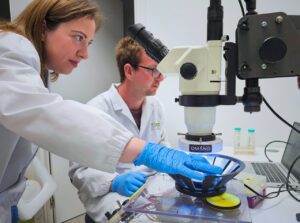
Researchers Rosalba Sortino (left) and Joaquin Martinez Tambella (right) working in the laboratories of the Institute for Bioengineering of Catalonia (IBEC). Sortino is a post-doctoral researcher at the Nanoprobes and Nanoswitches group at IBEC and co-first author of the study. Martinez is a PhD student at the Nanoprobes and Nanoswitches group at IBEC and co-first author of the study. [Institute for Bioengineering of Catalonia (IBEC)]
In many of these conditions, photoreceptor (PhR) cells—the retina’s light detectors—progressively degenerate and die. Although the downstream retinal neuronal circuitry remains largely intact and functionally viable, it no longer receives the light signals needed to drive visual processing towards the brain. This opportunity has fueled intense research efforts to develop treatments capable of restoring light sensitivity to the eye. Current strategies include gene therapy—effective only for a very small subset of patients with specific mutations—and electronic retinal prostheses, which are invasive, expensive, and require extensive training for effective use.
More recently, optogenetics and light-responsive drugs have entered clinical testing, the latter with encouraging safety results. “Photopharmacology can develop photoswitchable small molecules to restore vision impairment by conferring light sensitivity to ion channels that are widely expressed in the remaining inner retinal neurons, and a first-in-human clinical trial is ongoing,” the team noted. However, achieving high-quality vision at ambient illumination levels remains a major challenge.
The (IBEC)-led consortium has now developed a new class of photoswitchable small-molecule drugs that are capable of restoring key visual functions in animal models of blindness. The team’s photopharmacology-based technique involves modifying a drug’s chemical structure by adding a light-activated molecular switch, enabling control of the pharmacological action using light. “Unlike (opto)genetic manipulation and surgically implanted retinal electronic prostheses, pharmacotherapy is noninvasive, readily reversible, and can be upgraded when new drugs are approved,” the authors noted. “Medicines are preferred by patients, clinicians, and public healthcare systems, they can be developed and manufactured at lower costs than other approaches and assessed by conventional regulatory procedures and clinical assays.”
The reported work builds on more than a decade of research and was carried out in collaboration with the team co-led by Pedro de la Villa at the University of Alcalá (UAH), as well as researchers from the Institut de Química Avançada de Catalunya (IQAC-CSIC), the University of Barcelona (UB), the Institute Ramón y Cajal of Health Research (IRYCIS), the Autonomous University of Barcelona (UAB), and the Fundació Eduard Soler.
Researcher Joaquin Martinez Tambella working in the laboratories of the Institute for Bioengineering of Catalonia (IBEC). Martinez is a PhD student at the Nanoprobes and Nanoswitches group at IBEC and co-first author of the study. [Institute for Bioengineering of Catalonia (IBEC)]
The prosthe6 compounds work by acting on a specific type of retinal cells called ON bipolar cells, which normally receive signals from the photoreceptors. “In healthy vision, ON bipolar cells play a key role in passing on information about the presence of light to the rest of the visual circuit,” explained study co-lead de la Villa. “In degenerative eye diseases, although the photoreceptors are lost, much of this underlying circuitry remains intact but inactive. This creates a major therapeutic opportunity.”
By targeting a protein (mGlu6) in this preserved part of the retina, prosthe6 compounds can take over the role of the missing photoreceptors. “… we have targeted metabotropic glutamate 6 (mGlu6) receptors, which are exclusively expressed in ON bipolar cells (OBCs) and localized postsynaptic to PhR cells, thereby leveraging a privileged position to drive physiological visual circuit,” the investigators explained. When light enters the eye, the molecules respond by changing their shape, triggering signals inside the retina in a way that closely resembles natural vision. In this way, the drugs effectively act as “molecular prostheses,” helping the eye process light again without the need for implants or genetic modifications.
Healthy mice naturally prefer to remain in dark environments and instinctively avoid brightly lit areas, a behavior that relies entirely on a functional visual system. Blind mice, by contrast, lose this preference and move indistinctly between light and dark spaces, as they are unable to perceive light. The team showed that after treatment with prosthe6, blind mice once again showed a clear and spontaneous preference for dark areas, indicating that they could perceive light and use this information to guide their behavior.
This recovery occurred without any training and under light levels comparable to those found indoors or on an overcast day, demonstrating that the treatment restores functional light perception capable of driving natural, visually guided behavior.
Two lead compounds, prosthe6-12 and prosthe6-15, showed particularly promising results. The restored behaviors were observed not only after intraocular injection, but also after topical administration as eye drops. “… at least two compounds (prosthe6-12 and -15) appear to be devoid of adverse effects and restore sight by topical administration, which is linked to higher overall clinical success rate than systemic routes for neurological drugs, and to stronger patient adherence,” the investigators pointed out.
The prosthe6 technology is protected by patent and the researchers are now evaluating its safety and formulation to extend the duration of visual rehabilitation. The team is working with Eyelumina, a spin-off company in formation to secure investments that support translational development and future clinical trials.
“Turning this into a therapy is a long and laborious process,” says Gorostiza. “But the results show that there is a realistic possibility of restoring high-quality vision with drugs, non-invasively, reversibly and with a mechanism that is independent of the specific retinal disorder or genetic mutation to reach a majority of patients.”
If successful in humans, the drug-based approach would offer a widely accessible and affordable alternative to existing vision restoration technologies, especially relevant for patients with advanced retinal degeneration for whom no effective treatments currently exist.
In their paper the team further stated, “From a fundamental perspective, prosthe6 constitute new tools for ophthalmology to study the physiopathology of mGlu6 receptors and retinal circuits in vitro and in vivo and contribute to the medicinal chemistry of allosteric modulators. They also achieve the prediction that upstream targeted photopharmacology can deliver nearly native output signals, taking full advantage of the retinal circuit for high-quality vision restoration.”
Results from one of the largest and diverse genetic studies of Parkinson’s disease to date reveal that genetics may play a much greater role in the condition than previously recognized, especially in some ancestries that have historically been underrepresented in clinical studies. Published in The Lancet Neurology, the findings highlight the importance of representative genetic data for the development of targeted treatments that are effective across diverse populations.
Parkinson’s disease is a progressive neurodegenerative condition that affects more than 10 million people worldwide. While decades of research have uncovered key genetic drivers, most cases arise from a complex combination of genetic and environmental factors that can vary widely across populations and individuals.
“The genetic architecture of Parkinson’s disease varies considerably across ancestries, yet most previous genetic studies have focused on individuals of European ancestry,” write the authors of the study, led by Christine Klein, MD, professor of neurogenetics at the University of Lübeck. “This large-scale, multi-ancestry genetic study offers crucial insights into the population-specific genetic architecture of Parkinson’s disease.”
Klein’s team analyzed genome and exome sequencing data from nearly 100,000 individuals across 11 ancestries, using retrospective data from the Global Parkinson’s Genetic Program (GP2). In particular, the study focused on 18 genes with a well-established link to Parkinson’s disease, including both causal and risk variants.
While some genetic contributors were shared across ancestries, the analysis revealed that certain ancestry-specific differences are larger than previously thought. For instance, risk variants of GBA1, the most common across all ancestries, were present in just about 4% of individuals with east Asian ancestry, compared to nearly 53% of those with African ancestry.
The study also identified the first carriers of causal variants in the LRRK2 gene of African ancestries, highlighting the need to include underrepresented populations in large-scale genetic studies. Overall, 2% of Parkinson’s patients were found to carry a single causal genetic variant across 16 genes, ranging from 0.4% among individuals from African ancestry to 10.7% for those with Ashkenazi jew ancestry.
These findings have important implications for ongoing clinical trials evaluating targeted therapies aimed at Parkinson’s patients carrying GBA1 and LRRK2 variants. Without representative data accounting for the broad differences seen across ancestries, precision medicine approaches will fail to be effective for the global population.
Standard genetic screening panels are mainly built using data from individuals of European ancestry, meaning certain variants more common in other populations might end up being overlooked. If key genetic drivers go undetected, patients from underrepresented populations are generally more likely to be locked out of targeted clinical trials evaluating the next generation of Parkinson’s therapeutics.
“Whereas clinical trials targeting GBA1 and LRRK2 variant carriers are primarily performed in Europe and the U.S.A., increased ancestral diversity in Parkinson’s disease research will be crucial to improve diagnostic accuracy, enhance our understanding of disease mechanisms across populations, and ensure equitable application of and access to emerging genetically informed therapies,” Klein and colleagues conclude.