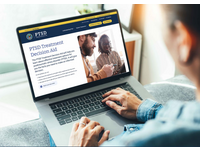
<strong>Background:</strong> Posttraumatic stress disorder (PTSD) is associated with significant health and societal economic burdens, making treatment a priority. There are effective treatments, but there is no indication at this point which treatments will work best for which patients. Patient decision aids (DAs) are evidence-based tools designed to support patients and providers in weighing the benefits and risks of different treatment options and in making value-informed choices as one part of shared decision-making. The National Center for PTSD published an online PTSD Treatment DA in 2017. <strong>Objective:</strong> This paper outlines a collaborative process for significantly updating the PTSD Treatment DA in line with newer clinical practice guidelines and updated technological needs. <strong>Methods:</strong> The development and updating process was conducted by a small team in consultation with an expert panel and consumer input. User experience testing with people who screened positive for PTSD focused on the experience of completing specific core tasks such as comparing treatment options using the DA. Field testing included Veterans Administration patients and providers using the DA in clinical appointments to gather feedback about feasibility, satisfaction, acceptability, balance, fidelity, decisional conflict, and decisional self-efficacy. <strong>Results:</strong> Pilot field testing suggested that the PTSD Treatment DA was acceptable, satisfactory, balanced, feasible to implement, and associated with improvements in decisional conflict and in decisional self-efficacy in this small sample. Design decisions based on stakeholder feedback are described, including which treatments to include, what design format to use, how to assess preferences, and how to most effectively convey treatment effectiveness information. <strong>Conclusions:</strong> The revised PTSD Treatment Decision Aid is freely available online and is consistent with the International Patient Decision Aid Standards.