WASHINGTON — Two high-ranking Democratic senators are questioning the credentials and financial conflicts of members of an advisory committee established by health secretary Robert F. Kennedy Jr. that aims to improve and modernize the health care system.
In a letter sent Tuesday to Kennedy and Centers for Medicare and Medicaid Services Administrator Mehmet Oz, Oregon Sens. Jeff Merkley, ranking member of the budget committee, and Ron Wyden, ranking member of the finance committee, write that they have “serious concerns” about credibility and conflicts of interest among those on the Healthcare Advisory Committee, which was announced in March.
At the time, Kennedy and Oz said they had reviewed 400 candidates before settling on 18, including motivational coach Tony Robbins, a venture capitalist who previously worked alongside Kennedy’s son, and a number of health care executives.
Women who undergo medically assisted reproduction (MAR) may have a slightly higher risk of developing certain hormone-related cancers, but a large Australian study suggests much of that increase is likely explained by underlying infertility, greater medical surveillance, and other patient characteristics rather than the fertility treatments themselves.
The findings, published in JAMA Network Open, analyzed data from nearly 1.75 million Australian women and represent one of the largest investigations to date of cancer risk following fertility treatment. Using an emulated target trial design—a statistical approach intended to better approximate the conditions of a randomized clinical trial—the researchers examined whether three common forms of MAR were associated with later cancer diagnoses.
The study included 1,748,927 women aged 18 to 55 years between 1991 and 2018, including 396,661 who had received some form of MAR. Treatments evaluated included assisted reproductive technology (ART), intrauterine insemination (IUI) or ovarian stimulation, and ovulation induction with clomiphene citrate.
Researchers found modest increases in the relative risk of several hormone-related cancers—including breast, ovarian, uterine, thyroid, colorectal cancers, and melanoma—after some fertility treatments. However, the absolute increase in risk was small.
For any individual invasive cancer, the investigators estimated that treated women experienced fewer than 20 additional cancers per 100,000 women per year compared with women who had not undergone MAR.
The authors emphasized that the observed associations should not be interpreted as evidence that fertility treatment causes cancer. “Although we observed increased relative risk for most hormone-related cancers following MAR, this corresponded to only small increases in estimated absolute excess risk,” the authors wrote.
To better distinguish treatment effects from other influences, the investigators incorporated several bias analyses rarely included in previous studies. They calculated E-values to estimate the impact of unmeasured confounding and analyzed cancers not believed to be hormonally driven—including pancreatic, lung, and hematologic cancers—as negative controls.
Those analyses suggested that underlying infertility-related conditions, such as endometriosis and polycystic ovary syndrome, as well as factors including obesity, anovulation, and demographic differences, could account for much of the increased risk observed for ovarian, uterine, and thyroid cancers.
The researchers also found that cancer diagnoses tended to cluster during the first few years after fertility treatment. According to the investigators, “Several emulated trials suggested a greater likelihood of incident cancer shortly after first treatment.” They noted that this pattern could reflect either accelerated growth of preexisting cancers or increased medical monitoring during fertility treatment and pregnancy.
After examining the data, the authors concluded that enhanced surveillance was the more likely explanation. “We believe detection bias is the more likely explanation for these results. This finding is the first empirical indication using a negative control that medical surveillance may be responsible for an increased risk of cancer following MAR,” they wrote.
Women pursuing fertility treatment often undergo repeated medical evaluations and may also be more likely to participate in cancer screening programs, increasing the likelihood that existing cancers are detected earlier than they otherwise would be.
Overall, the researchers concluded that while associations between MAR and hormone-related cancers were observed, the evidence does not support a simple causal relationship.
The investigators said the findings should reassure patients while also encouraging careful counseling and follow-up. They recommend that clinicians discuss the possibility of a small increase in cancer risk but explain that the excess risk “may be partially or fully due to the health and sociodemographic profile of women who receive MAR and increased surveillance during treatment.”
The authors added that routine surveillance after fertility treatment remains appropriate, but they cautioned that observed increases in cancer diagnoses should be interpreted within the broader context of infertility-related health conditions and differences in healthcare utilization rather than being attributed solely to fertility medications themselves.
Nebius, an AI cloud company, sponsored its second “AI Discovery Awards” event and dinner earlier this month in London, where the winning companies were announced. The event highlighted leading startups in biopharma, genomics, medical devices, and digital health that are using AI to deliver advances in healthcare and life sciences.
During the evening awards ceremony, artificial intelligence demonstrated that it is rapidly reshaping biomedical research. However, practitioners agree that AI’s success depends on more than advanced algorithms. [Nebius]
At a Nebius-hosted morning discussion before the awards dinner, several researchers highlighted the importance of powerful computing infrastructure, high-quality biological data, and laboratory validation.
Examples included AI models that predict osteoarthritis years before symptoms and an Alzheimer’s platform, which achieved 97% diagnostic accuracy when paired with protein biomarkers. A Stanford Medicine scientist described CRISPR-GPT, an AI assistant that helps design and troubleshoot gene editing.
The investigators also spotlighted AI-powered lab automation, multimodal datasets, and AlphaFold’s dramatic acceleration of protein structure prediction. Across every application, participants emphasized that collaboration among academia, healthcare, industry, and governments will be essential to advance preventive, personalized medicine and to translate AI discoveries into clinical practice.
Ilya Burkov, PhD, who has a background in clinical medicine, is now global head of healthcare and life science at Nebius. Burkov began his research career focusing on osteoarthritis, osteoporosis, hip and knee replacements, and trying to figure out how such diseases develop and progress.
“My goal was to work backward from the end stage of disease and determine whether we could predict who was at risk years before serious joint damage occurred,” he explained. “If we could identify those patients early enough, perhaps we could delay disease progression.”
Machine learning
Speaking with colleagues in a hospital, he was asked: “Have you looked at it from any machine learning perspective?” Burkov had no formal background in artificial intelligence, but he was intrigued by the idea of using emerging AI models and advanced algorithms to analyze long-term medical imaging data.
Ilya Burkov, PhD [Nebius]
The concept was simple but powerful: if AI could identify patterns shared by patients who later developed osteoarthritis or osteoporosis, it might be able to detect subtle biomarkers long before the disease became clinically apparent.
“That idea became the focus of my PhD research. AI models were not a thing ten years ago when I was in the hospital. There were transformer models and algorithmic-based approaches.
“I developed techniques capable of predicting the early onset of osteoarthritis and osteoporosis with an accuracy of roughly 80% to 90%,” he pointed out. “The models identified imaging features that consistently appeared years before patients required joint replacement surgery.
“This made it possible to examine scans from otherwise healthy individuals and estimate their future risk. In some cases, we could tell patients that, without changes to certain lifestyle factors, they had a high probability of requiring a hip replacement within the next 10 to 15 years.”
For Burkov, that was transformative. AI made it possible to move beyond treating individual patients and instead create tools that could benefit entire healthcare systems. Rather than applying clinical expertise one patient at a time, scalable technologies could be created capable of helping clinicians identify high-risk patients earlier and intervening before irreversible damage occurred.
That realization ultimately convinced him to transition from clinical medicine into industry, where he saw the opportunity to build technologies that could have a much broader impact. Whether it’s a small academic lab with only a handful of researchers or a global pharmaceutical company operating at massive scale, every organization faces different computational challenges.
“At Nebius, our role is to provide the computing infrastructure and technology that enables researchers to train increasingly sophisticated AI models and accelerate scientific discovery to advance biomedical research and improve patient care,” he said.
Alzheimer’s disease
Artificial intelligence is rapidly reshaping drug discovery, but many researchers believe the greatest challenge is not designing drugs—it’s knowing what biological targets to pursue.
Prima Mente, a previous AI Discovery Award winner, is tackling that problem by building foundation AI models designed to uncover the molecular mechanisms behind Alzheimer’s disease and other neurodegenerative disorders. By combining blood-based biomarkers, multimodal biological data, and transformer-based AI, the London startup hopes to identify the molecular drivers of neurodegenerative disease—and ultimately accelerate the development of new therapies.
“If we can diagnose disease earlier, better stratify patients, and understand what’s actually driving Alzheimer’s, we can help create better treatments,” said co-founder Hannah Madan, PhD.
Based in London’s King’s Cross innovation district, Prima Mente has grown to approximately 35 employees across London, San Francisco, and the United Arab Emirates. Madan, whose academic background includes a master’s degree in pharmacology and a PhD investigating the relationship between bowel cancer and diabetes, has spent most of her career building biotechnology startups. Prima Mente is the fifth company she has helped launch.
The company’s mission addresses one of healthcare’s most pressing challenges. Dementia is the leading cause of death in the U.K. and the sixth highest in the U.S. Alzheimer’s disease remains the most common form of dementia worldwide.
Looking beyond traditional biomarkers
Prima Mente’s scientific strategy draws inspiration from advances in cancer diagnostics, particularly liquid biopsy technologies that detect circulating tumor DNA in blood samples. The company wondered whether a similar approach could work for neurodegenerative disease.
“When we started three years ago, many people thought we were a little crazy,” noted Madan. “The prevailing view was that very little DNA from dying brain cells entered the bloodstream.”
Hannah Madan, PhD [Nebius]
The team has since demonstrated that cell-free DNA originating from neurons, microglia, and astrocytes can be detected in blood. More importantly, those DNA fragments retain epigenetic information that may reveal the biological state of brain cells before they died.
Rather than focusing solely on DNA sequences, Prima Mente analyzes methylation patterns carried on cell-free DNA. Because methylation reflects how genes are regulated within specific cell types, these signals can provide insight into disease progression and cellular dysfunction.
“When cells die, they release fragmented DNA into the bloodstream,” Madan explained. “Those fragments preserve methylation signatures that tell us what state those brain cells were in.”
The biological strategy is paired with an equally ambitious computational one. Prima Mente believes that transformer architectures—the same AI technology underlying large language models such as ChatGPT—can learn the language of biology.
“If ChatGPT can understand human language, our hypothesis is that similar models can understand biological languages,” noted Madan.
Instead of converting sequencing data into simplified numerical counts, the company trains models directly on raw biological sequences, including DNA, methylation signals, RNA transcripts, and proteomic data. By preserving more of the underlying biological information, Prima Mente believes its models could uncover relationships that conventional bioinformatics pipelines often overlook.
The company’s first foundation model, known as Pleiades 1, demonstrated the potential of that approach. Initially trained to identify Alzheimer’s disease from blood-derived molecular data, the model successfully diagnosed a subset of patients. After protein biomarkers were incorporated, diagnostic accuracy increased to approximately 97% within the study dataset—exceeding the performance of current clinical standards, according to Madan.
AI tokens are the fundamental units of data processed by AI models during training and inference. They represent smaller components of text, audio, images, or other modalities, enabling models to understand, predict, and generate outputs effectively. Pleiades 1 was trained on 1.9 trillion tokens. Its successor, Pleiades 2, is being trained on 80 trillion tokens spanning five biological data modalities, with the long-term goal of building a 100-billion-parameter foundation model.
Prima Mente partnered with AI infrastructure provider Nebius, which supplied a dedicated 32-node computing cluster powered by NVIDIA GPUs. The additional computing capacity enabled the company to scale from a 1-billion-parameter model to a 10-billion-parameter model within weeks while increasing training throughput from roughly 8,000 tokens per second per device to more than 1.1 million tokens per second across a 16-node cluster.
Beyond model development, Prima Mente is collaborating with the U.K.’s National Health Service (NHS) through the Sandbox Study, which collects blood samples from patients with suspected neurological disease. The real-world data help researchers develop AI models aimed at detecting Alzheimer’s earlier, potentially enabling treatment before irreversible brain damage occurs.
Dementia is the leading cause of death in the U.K. and the sixth highest in the U.S. Alzheimer’s disease remains the most common form of dementia worldwide. [Cecille Arcurs/Getty Images]
Unlike AI companies that rely primarily on public datasets, Madan said Prima Mente is generating much of its own training data. The company collaborates with 20 NHS memory clinics throughout the U.K., collecting blood samples, speech recordings, clinical notes, and imaging data from patients at the earliest stages of cognitive decline. It also participates in the U.K.’s Sovereign AI initiative.
Lab validation is integrated into the company’s development process. Candidate discoveries generated by AI models are tested using stem cell systems, brain tissue, and additional blood-based experiments, creating a continuous feedback loop between computational prediction and experimental validation.
That combination of proprietary data generation, lab experimentation, and AI model development represents what the company views as a significant competitive advantage.
While AI has attracted enormous attention for accelerating drug discovery, Madan argues that identifying the right biological target remains the industry’s greatest bottleneck. She compares today’s AI revolution to the impact AlphaFold had on protein structure prediction. As computational tools become increasingly capable, designing drug candidates may become faster, cheaper, and more routine.
“But if you don’t know what biology actually matters,” she said, “there’s little value in having better tools to build drugs.”
For Prima Mente, Madan says the opportunity lies upstream of drug development—discovering the cellular pathways, biomarkers, and molecular mechanisms that should become tomorrow’s therapeutic targets.
That strategy recently received external validation when the company won the AI Insights Prize for Alzheimer’s from the Gates Foundation, receiving $1 million to expand research into microglial biology. The funding will support AI models designed to identify gene perturbations in specific brain cell types that could serve as the basis for future Alzheimer’s therapies.
As foundation models continue to expand beyond language into biology, Madan is betting that the next major AI breakthrough in medicine will not simply generate better drugs—it will reveal entirely new biology that makes those drugs possible.
CRISPR-GPT
CRISPR-GPT is a large language model developed by Stanford Medicine to automate key steps in CRISPR gene-editing research. Acting as an AI agent, it interprets scientific literature, designs guide RNAs, suggests experimental parameters, and integrates with lab automation systems to execute and refine experiments. By reducing manual planning and accelerating iterative testing, the system enables researchers to complete complex gene-editing workflows more efficiently and consistently, noted Stanford researchers.
CRISPR-GPT is also credited with lowering the barrier for scientists with limited CRISPR expertise, improving accessibility. The platform represents an emerging class of AI tools that can “reason” through complex scientific tasks, recommend next steps, and accelerate discovery. Potential applications include developing gene therapies, improving cancer research, engineering cell therapies, and expanding access to genome-editing technologies.
The goal, according to Le Cong, PhD, assistant professor of pathology and genetics is to help scientists produce life-saving drugs faster. “The hope is that CRISPR-GPT will help us develop new drugs in months instead of years,” he said.
Le Cong, PhD [Stanford Medicine]
Cong and team developed CRISPR-GPT using Nebius AI Cloud as its core infrastructure. The group leveraged Nebius’ GPU clusters to train their specialized CRISPR-Llama3 model, rapidly iterate on architectures, and scale from prototyping to full model training.
CHAT-GPT could also expand the pool of scientists who can effectively use gene editing technology—no experience required, pointed out Cong. “Trial and error is often the central theme of training in science, but what if it could just be trial and done?” he added. Cong is the senior author of a study “CRISPR-GPT for agentic automation of gene-editing experiments,” published July 2025, in Nature Biomedical Engineering.
AI Discovery Awards
At the AI Discovery Awards dinner in the evening, the sponsors announced that the 2026 program added medical devices and medical imaging to the existing biopharma, genomics, and digital health tracks to reflect the growing role of AI in connected medical equipment and diagnostic imaging.
“Our winners—and indeed all of the 647 submissions we reviewed—reflect how rapidly AI is changing the pace of healthcare research,” said Ilya Burkov during a short presentation. “Across all categories, startups are compressing timelines that once took years into months or even weeks, and bringing capabilities to clinical and laboratory settings that simply did not exist before.
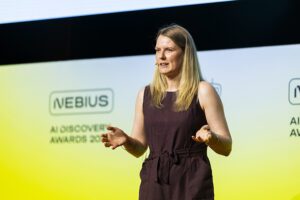
Margaret Hua, founding chief of staff at Phylo, accepts $100,000 in GPU cloud credits for first prize in the biopharma category. The company is building AI research assistants that can independently help biomedical scientists think through problems, design experiments, analyze data, and suggest what to do next, with the aim of speeding up scientific and biomedical discovery. [Nebius]
“The AI Discovery Awards exist to accelerate that momentum, and to connect the most promising teams with the compute resources, investor networks, and mentorship they need to move from promising research to bringing products to market.”
Alongside the awards program, Nebius previewed its Nebius Scientific AI and Healthcare Platform, which is an AI infrastructure built to meet the specialist needs of healthcare and life sciences organizations, explained a Nebius official.
The 2026 AI Discovery Awards were open to companies from pre-seed through to Series D that put AI and machine learning at the core of their product. Category winners were selected from 647 applications from around the world by an independent panel of 28 judges representing leading pharmaceutical companies, academic institutions, and venture capital firms. Submissions were evaluated based on the use of AI within the product, use of compute, technical innovation, functionality and advantages, performance and efficiency, global impact, market potential, and business sustainability.
A full list of shortlisted companies, as well as qualification criteria and a jury list, can be found on Nebius’s website.
The country’s biggest hospital chain lowered its 2026 profit outlook on Tuesday after treating more uninsured patients than expected in the second quarter.
Many of those uninsured patients had dropped their Affordable Care Act plans after losing enhanced subsidies, HCA Healthcare said, an early indicator of the fallout from the expiration of ACA enhanced premium tax credits in January.
All in, HCA now expects the increase in uninsured patients stemming from the end of those subsidies to lower its income by between $1 billion and $1.2 billion this year, up from an earlier projection of a $600 million to $900 million hit.
Wearable electronic “tattoos” painted onto the skin could allow comfortable and reliable health monitoring to personalized designs.
The flexible electrodes, outlined in PNAS, represent a pathway to the next generation of wearable systems for healthcare.
The novel devices are made of intrinsically conductible polymers that conform to the skin and maintain reliable connections to electronic systems, allowing stable electrophysiological monitoring.
Their ability to create bespoke designs could be particularly useful for long-term use in children, adolescents, and people sensitive to potential stigmatization.
WE-PDD electrode [Wanqing Zhang]
The researchers describe their invention “as a personalized and scalable solution for next-generation electronic tattoos that combine ultra conformality, customizability, and long-term reliability, accelerating their translation into clinical diagnostics and interactive bioelectronic systems.”
The current gold-standard electrodes of wet silver/silver chloride gels can dry out and produce inaccurate readings during motion.
The team therefore developed a paintable, drawn-on-skin dry electrode based on the biocompatible polymer poly (3,4-ethylenedioxythiophene): poly (styrene sulfonate (PEDOT:PSS).
The conductive ink can be painted onto microtextured skin with a commercial paintbrush and even go through hair.
It comprises polyvinyl alcohol as a mechanically supportive network, PEDOT:PSS as a conductive filler, and 4-dodecylbenzenesulfonic acid (DBSA) as both conductive additive and plasticizer, in a water-ethanol cosolvent system.
The resulting WE-PPD (water-ethanol-PVA/PEDOT:PSS/DBSA) electrode is breathable, sticks well to the skin, and conforms to it closely, minimizing skin contact impedance.
The paintable formulation also enables it to penetrate porous silver textile to form a robust soft-rigid connection.
In proof-of-concept demonstrations, the team demonstrated the versatility of the electrodes for biopotential monitoring and human-machine interfaces.
It was tested across wireless long-term electrocardiography recordings, robotic hand control based on electromyogram, and electroencephalogram-based neural response detection.
The absence of imaging artifacts also demonstrated its potential for multimodal MRI imaging and electrophysiological (EP) recordings, noted first author Wanqing Zhang, a PhD research assistant at Penn State University, and co-workers.
The team added: “The ability to customize the electrode appearance transforms WE-PPD from a conventional medical device into a user-friendly and aesthetically integrated wearable technology.
“For example, electrodes can be designed with cartoon patterns, which may reduce anxiety and improve acceptance among pediatric users by making EP monitoring less intimidating.
“Such personalization not only improves physiological comfort but also enhances social acceptance, user experience, and long-term compliance during continuous health monitoring.”
<![CDATA[AI chatbots flood mental health care—convenient and validating, yet risky. Learn where they help, where they harm, and why therapists still matter.]]>
Posted on
<![CDATA[New treatments, responsible deprescribing, and encouraging 988 gains reshape US mental health on our 250th anniversary.]]>
The results of a preclinical study by researchers at the University of Texas MD Anderson Cancer Center have found that an investigational epigenetic therapy called NTX-301 remained effective in treatment-resistant acute myeloid leukemia (AML) by activating the Hippo pathway, a tumor-suppressing pathway linked to cancer growth and drug resistance.
In preclinical models, the hypomethylating agent (HMA) NTX-301 was more effective than standard hypomethylating agent therapy and retained anti-leukemia activity in treatment-resistant and TP53-mutant AML. The team also found that the therapy activated the Hippo pathway through targeted epigenetic changes, revealing a previously unrecognized mechanism that may contribute to its anti-leukemia effects.
“Leukemia cells are remarkably adaptable and often find new pathways to survive after treatment,” said Michael Andreeff, MD, PhD, professor of medicine at the University of Texas MD Anderson Cancer Center and research co-lead. “These findings suggest NTX-301 may disrupt several of those survival mechanisms simultaneously while reactivating pathways that normally restrain cell growth. That dual effect could help explain why NTX-301 remained active in some of the most therapy-resistant forms of AML.”
First-generation hypomethylating agents, including 5-azacytidine (5-AZA) and decitabine (DAC), are used as standard clinical care for patients with AML and myeloid dysplastic syndromes (MDS), the authors wrote. Combining HMAs with the BCL-2 inhibitor venetoclax has further improved outcomes for patients.
“Hypomethylating agent (HMA) and the BCL-2 inhibitor venetoclax (VEN) combinations have evolved into frontline therapies for patients with acute myeloid leukemia (AML), yielding high response rates,” they stated. However, while such combination therapy works well initially, resistance and relapse remain common.
The challenge is particularly significant in AML with mutations in the TP53 gene, which normally helps cells respond to damage and prevent uncontrolled growth. When that gene is mutated, leukemia cells can become resistant to therapy and more difficult to eliminate. “… most patients ultimately relapse, particularly those with TP53 mutations,” the researchers continued.
Efforts have been made to develop improved and more effective HMAs, they noted, and NTX-301 is such a next-generation HMA. But as they pointed out, “… previous reports of NTX-301 preclinical studies in leukemia were conducted primarily in cell lines and xenograft models … its activities in therapy-resistant settings have not been investigated.” And while a Phase I study (NCT04167917) of the oral agent NTX-301in patients with AML and MDS has been completed, the team noted in their paper that the study has not yet been reported.
For their newly reported preclinical study, the researchers evaluated NTX-301 across multiple preclinical models of treatment-resistant AML, including patient-derived xenograft (PDX) models of AML with acquired resistance. Their results showed that NTX-301 therapy consistently reduced leukemia cell survival more effectively than azacitidine (AZA), a commonly used hypomethylating agent.
Importantly, NTX-301 remained active in leukemia cells that had already developed resistance to both hypomethylating therapy and venetoclax, and demonstrated anti-leukemia activity in TP53-mutant AML models. When combined with venetoclax in resistant leukemia samples, NTX-301 produced stronger anti-leukemia effects than either treatment alone. The combination was effective not only against leukemia blasts but also against leukemia stem and progenitor cells, which are believed to contribute to disease persistence and relapse.
In summary, they wrote, “Therapeutically, NTX-301 is more potent than 5-AZA in AML cells with various genetic backgrounds, is active in AML cells with acquired resistance to HMA or VEN, overexpressing VEN-resistant factors MCL-1 or BCL-2A1, and in isogenic AML cells with TP53 deletions/mutations in vitro and in vivo in xenograft models, exhibits activities against AML blasts and stem/progenitor cells from patients resistant to/relapsed from VEN-based therapies and with TP53 mutations in vitro and in vivo VEN/DAC-resistant PDX models, and enhances VEN activity.”
To understand why NTX-301 appeared more effective than existing drugs, researchers analyzed changes in DNA methylation, a process that can switch genes on or off without altering the underlying genetic code. Unlike current hypomethylating therapies, which broadly affect DNA methylation, NTX-301 focused on a more selective set of genes and pathways, including the Hippo pathway, which functions as a natural cell growth regulator.
NTX-301 increased activity of key Hippo pathway genes while reducing activity of YAP, a protein frequently linked to cancer cell survival, treatment resistance, and stemness. These findings suggest Hippo pathway reactivation may be an important reason the therapy remained effective in resistant leukemia models and could represent a new strategy for overcoming treatment resistance in AML. “Collectively, our data suggest that NTX-301 exhibits more potent anti-leukemia activities compared to current HMAs and synergizes with VEN in VEN-resistant and TP53-mutant AML and AML stem/progenitor cells,” the team concluded.
Additional studies are needed to determine whether these results translate to patients and to identify which populations may benefit most. The findings suggest that patients with relapsed AML, venetoclax-resistant disease, and TP53 mutations may be important groups for future clinical evaluation. “Taken together, the numerous NTX-301 targets identified here, its novel mechanism of action, and its superior activity against VEN-resistant and TP53-mutant AML compared to 5-AZA, warrant the future clinical development,” the investigators noted. “Given the strong preclinical data in TP53-mutant AML and the unmet clinical need, this should be a primary target group in the next clinical trial.”
Carter said, “An encouraging aspect of this study is that it identified both a potential therapeutic opportunity and a biological explanation for why it may be effective. The results provide a rationale for continued clinical development and suggest that targeting Hippo signaling may help address treatment resistance in AML.”
BackgroundHumanized APOE mouse models are widely used to study late-onset Alzheimer’s disease (LOAD) risk, yet it remains unclear whether they reproduce the macrostructural brain changes observed in human aging and disease.MethodsWe performed ex vivo magnetic resonance imaging to quantify total and voxelwise brain volumes in male and female mice across APOE genotypes (ε3/ε3, ε3/ε4, ε4/ε4) and ages spanning 6–25 months.ResultsTotal brain volume increased with age (cross-sectional estimate: 2.12 mm3/month) and was greater in APOE-ε4 carriers, with no effect of sex. Voxelwise analyses revealed regionally specific changes independent of total volume, characterized by cortical volume decreases and subcortical preservation or increases, as well as sex-dependent spatial patterns. No localized volumetric effects of APOE genotype were detected.ConclusionThese findings indicate that, despite incorporating a major genetic risk factor for LOAD, this model does not reproduce the atrophy phenotype characteristic of human aging and Alzheimer’s disease. Instead, the observed pattern is more consistent with non-pathological or vulnerable aging, suggesting that humanized APOE alone is insufficient to induce MRI-detectable macrostructural atrophy within this cross-sectional comparison, though this finding does not preclude other APOE-dependent pathological mechanisms.


![During the evening awards ceremony, event, artificial intelligence demonstrated that it is rapidly reshaping biomedical research. However, practitioners agree that AI’s success depends on more than advanced algorithms. [Nebius]](https://www.genengnews.com/wp-content/uploads/2026/07/Nebius_Highlights-28.jpg)



![Margaret Hua, founding chief of staff at Phylo, accepts $100,000 in GPU credits for first prize in the biopharma category. The company is building AI research assistants that can independently help biomedical scientists think through problems, design experiments, analyze data, and suggest what to do next, with the aim of speeding up scientific and biomedical discovery. [Nebius]](https://www.genengnews.com/wp-content/uploads/2026/07/Nebius_Highlights-33-300x200.jpg)