

Comprehensive characterization of islet cells facilitated by national organ donation program.
<![CDATA[How antidepressant myths can raise suicide risk—and what evidence-based prescribing, tapering, and crisis supports really look like.]]>
Therapeutic Interventions Targeted at Problematic Use of Digital Technology: Systematic Review and Meta-Analysis of Evidence
Background: Problematic use of digital technology has increased across the world. Despite growing research, evidence on treatment effectiveness across digital behaviors remains fragmented. Objective: This study aimed to systematically evaluate and compare the effectiveness of therapeutic interventions targeted at problematic use of digital technology across various behavioral domains. Methods: A systematic review and meta-analysis was conducted in accordance with PRISMA (Preferred Reporting Items for Systematic Reviews and Meta-Analyses) 2020 guidelines (PROSPERO: CRD420251052442). Electronic searches of PubMed, Scopus, and Embase (up to April 2025) were conducted. It identified 125 eligible studies, including 73 randomized controlled trials (RCTs), 32 non-RCTs, 14 pre-post studies, and 6 pilot studies. The interventions that were assessed in these studies included psychological therapies, digital or web-based programs, exercise-based interventions, pharmacological treatments, neuromodulation, parent-focused programs, virtual reality–based interventions, educational programs, and multicomponent approaches. Random-effects meta-analyses using standardized mean differences (SMDs) were performed. Results: For problematic internet use, psychological treatments showed a strong effect (effect size=−2.68; <.001). Digital interventions also showed significant benefit (effect size=−1.16; <.001). For smartphone addiction, psychological treatments (effect size=−1.49; <.001) and exercise-based programs (effect size=−3.07; =.001) showed significant improvement. For gaming disorder, psychological treatments showed improvement (effect size=−1.01; =.02), but results were mixed. There were limited studies to calculate pooled results for social media addiction, pornography use, gambling, screen time, and over-the-top content watching. No treatment studies were found for problematic over-the-top content watching. High heterogeneity and evidence of small-study effects were observed in several studies. Conclusions: Overall, structured psychological therapies showed the most consistent benefit. These findings support structured interventions that aim for control of use and reduce cues linked to high use. Evidence remains limited for several emerging digital behaviors. More high-quality studies are needed in clinical settings and for less-studied forms of digital addiction.

Alexa Grasso on Mental Health Fitness
Alexa Grasso shares her routine for staying mentally strong in and out of the Octagon
In recognition of Mental Health Awareness Month, the Child Mind Institute has launched the Mental Health Fitness campaign — a national call to action highlighting the importance that caring for one’s mental health is just as important as physical health.
Alexa Grasso knows the importance of prioritizing her mental well-being alongside her physical training. She uses breathwork to stay grounded, acknowledges emotions instead of suppressing them, and practices mindfulness — highlighting that true strength comes from training the mind with the same discipline as the body.
“What I do when I feel stressed or overwhelmed by life, is breathing. It’s super important to breathe, to think clearly and give time to each emotion. To live it.”
About Anna Sitar
Alexa Grasso is a Mexican mixed martial artist and one of the top competitors in women’s flyweight diving of the UFC. Known for her sharp boxing and calm presence in the Octagon, she made history in 2023 by becoming the first Mexican-born woman to win a UFC championship. Grasso’s rise through the sport has been marked by discipline and resilience, earning her recognition as a trailblazer for Mexican athletes in MMA.
About Mental Health Fitness
For decades, we’ve understood that physical fitness doesn’t just happen — it takes skills, regular practice, and a supportive environment. The same is true for mental health. Developed by experts at the Child Mind Institute for three different age groups, our Mental Health Fitness guides have been used by more than 1.8 million students, caregivers, and educators to build emotion regulation skills and resilience. Whether your child is 5 or 15, struggling or thriving, they can learn these skills. And you can practice alongside them. Learn more at Mental Health Fitness.
Related Resources
- How to Help Children Calm Down
- What Is Co-Regulation?
- How to Model Healthy Coping Skills
- Raising Confident, Independent Children
The post Alexa Grasso on Mental Health Fitness appeared first on Child Mind Institute.
The Child Mind Institute Hosts 2026 Spring Luncheon “Future-Proofing Your Kids: Empowered Parenting in the Digital Age”
New York Times bestselling author Lisa Damour, PhD, led a thoughtful discussion to honor Mental Health Awareness Month
New York, NY – The Child Mind Institute, the leading independent nonprofit dedicated to transforming the lives of children struggling with mental health and learning disorders, hosted its 2026 Spring Luncheon on Monday, May 11. The event featured a dynamic discussion between Lisa Damour, PhD, a three-time New York Times bestselling author and host of the podcast, Ask Lisa: The Psychology of Raising Tweens & Teens, and Dave Anderson, PhD, Vice President of Public Engagement and Education and a senior psychologist at the Child Mind Institute. Their conversation was moderated by Ali Wentworth, an actress, comedian, author, and host of the television show, The Parent Test.
The event brought together advocates and distinguished individuals dedicated to equipping children and families with the skills they need to thrive in today’s rapidly evolving online and social environments. Attendees included Carson and Siri Daly, Jeannie Gaffigan, Kyle MacLachlan, Zibby Owens, and Alysia Reiner.
“We are raising children in a world fundamentally different from any generation before them…a world where childhood unfolds not just in homes and schools but online,” said Harold S. Koplewicz, MD, founding president and medical director of the Child Mind Institute. “Technology brings creativity and connection but also real risks: constant comparison, disrupted sleep, compulsive engagement, and exposure to harmful content. Our job is to help kids build the skills to navigate this world with resilience, confidence, and balance.”
The discussion centered on kids and families and how they can build healthy habits and resilience as they face the demands and distractions of a world increasingly reliant upon and centered around digital technology.
“My umbrella concern is what the conversation about technology is doing to the relationship between adults and kids. The single most powerful force for youth mental health is strong relationships with caring adults,” said Dr. Damour.
“If we focus on driving causal factors — such as family relationships, academic success, in-person friendships, sleep, and movement — we end up promoting a child’s wellness far more than by taking technology away,” said Dr. Anderson.
The luncheon raised over $260,000 to support the Child Mind Institute’s mission to change the lives of children with mental health and learning disorders in the United States and around the world.
The luncheon was co-chaired by Chris Mack, Lisa and Guy Metcalfe, Zibby Owens, and Jil Schaps. The host committee included Robyn and Paul Goldschmid, Desiree Gruber, Molly Jong-Fast, Breanna and John Khoury, Isabelle Krishana, Arielle Tepper, and Sarah J. Wetenhall.
Photos from the luncheon can be found here.
This special event is part of the Child Mind Institute’s programming during Mental Health Awareness Month. The Child Mind Institute recently launched its latest campaign, Mental Health Fitness. Physical fitness doesn’t just happen — it takes skills, regular practice, and a supportive environment. The same is true for mental health. Alongside relatable content from influencers and world-renowned athletes, the Mental Health Fitness resources from the Child Mind Institute provide kids and families with five core mental health skills they can practice every day.
About the Child Mind Institute
The Child Mind Institute is dedicated to transforming the lives of children and families struggling with mental health and learning disorders by giving them the help they need. We’ve become the leading independent nonprofit in children’s mental health by providing gold-standard, evidence-based care, delivering educational resources to millions of families each year, training educators in underserved communities, and developing tomorrow’s breakthrough treatments.
Visit Child Mind Institute on social media: Instagram, Facebook, X, LinkedIn
For press questions, contact our press team at childmindinstitute@ssmandl.com or our media officer at mediaoffice@childmind.org.
The post The Child Mind Institute Hosts 2026 Spring Luncheon “Future-Proofing Your Kids: Empowered Parenting in the Digital Age” appeared first on Child Mind Institute.
Finding Answers When Your Child Is Struggling: Introducing Ask Kai
Every day, parents reach out to the Child Mind Institute with questions that keep them up at night: Why does my daughter have such strong emotions? Why can’t my son sit still in class? Is this normal anxiety or something more?.
These questions are urgent, but finding answers isn’t easy. The wait time to see a children’s mental health professional can be months or even years. Many families don’t know where to start, what’s normal for their child’s age, or whether their concerns warrant professional help. And with nearly 1 in 5 children experiencing a mental health challenge within the U.S. alone, too many families are navigating this uncertainty on their own.
That’s why we built Ask Kai — a free, evidence-based symptom checker designed specifically for children’s mental health, available in both English and Spanish.
Meet Ask Kai
Ask Kai is a conversational symptom checker that helps parents and caregivers understand their child’s behavior and points them to appropriate resources. Through a streamlined series of questions and prompts, Ask Kai gathers information about your child’s challenges and provides personalized recommendations in minutes.
Ask Kai doesn’t diagnose your child. Instead, it helps you:
- Understand whether your concerns align with common mental health challenges
- Learn what to look for and what questions to ask
- Find evidence-based resources specific to your child’s needs
- Know how to find additional support if needed
Think of Ask Kai as a knowledgeable guide who helps you make sense of what you’re seeing and points you toward your next best step.
How Ask Kai works
If you’ve ever used a symptom checker for physical health, you know the challenge: enter “headache,” and you might walk away convinced you have everything from a sinus infection to a brain tumor. Mental health symptom checkers face even greater challenges. Because every child is different, what looks like defiance in one child could look like anxiety in another, and a behavior that’s appropriate at age five might be cause for concern at age ten. On top of that, mental health conditions often overlap.
So how did we build a tool that captures this complexity without overwhelming families? We focused on expertise and evidence:
- Clinicians and data lead the way: Ask Kai was built using thousands of child mental health evaluations — open datasets spanning different ages, backgrounds, and conditions — and developed in close collaboration with child psychologists and psychiatrists.
- Evidence-based question selection: Rather than asking hundreds of questions, we used machine learning to identify which combinations of questions provide the most meaningful information without burdening families.
- Comprehensive resource library: Every recommendation Ask Kai makes is matched to our extensive collection of guides, articles, expert perspectives, and pathways to professional help.
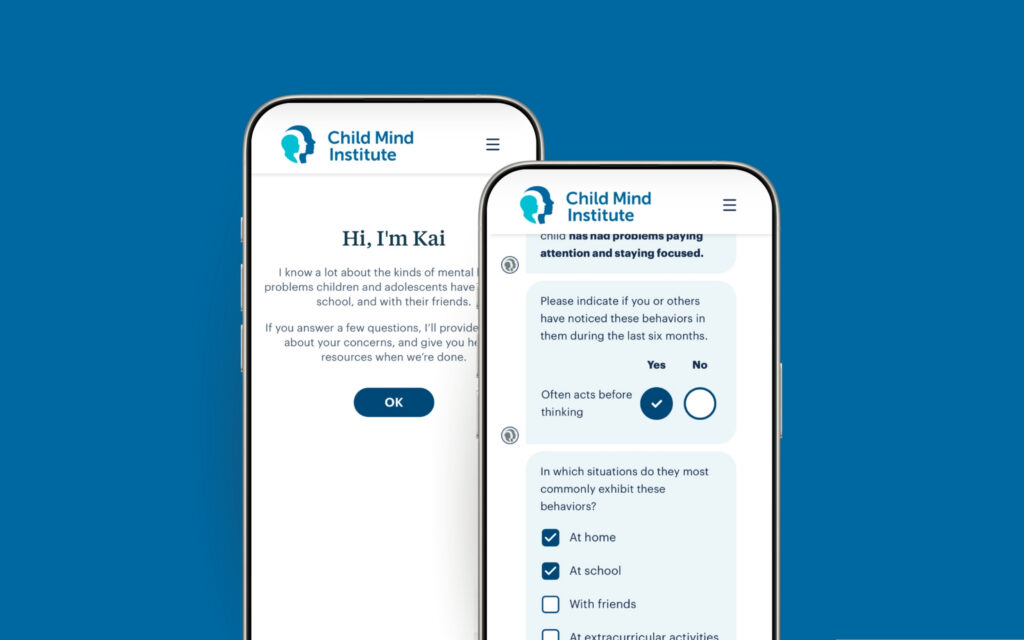
Here’s what happens when you use Ask Kai
Step 1: Initial Screening
You’ll answer a brief set of questions about your child’s behavior, emotions, and how these challenges affect daily life. You’ll also have the chance to describe in your own words what brought you to Ask Kai. These questions cover the areas where we see the most common concerns.
Step 2: Personalized Deep Dive
Based on your responses, Ask Kai selects targeted follow-up questions that dig deeper into the areas you flagged, whether that’s attention and focus, social anxiety, learning, or other behavioral challenges.
Step 3: Matching You to Resources
Ask Kai analyzes your complete response pattern, including the severity and impact of the behaviors you described, and provides a report with recommendations relevant to your child’s age, challenges, and needs.
What Ask Kai can assess
We designed Ask Kai to explore the areas where we can provide the most help to the most families. Ask Kai offers comprehensive screening and resources for:
Attention-deficit/hyperactivity disorder (ADHD) is a neurodevelopmental disorder that is characterized by difficulties with attention, organization, and impulsive behaviors. Symptoms are usually divided into inattentive behaviors or hyperactive and impulsive behaviors. Inattentive symptoms may include making careless mistakes, being easily distracted, difficulty listening to instructions, trouble with organization, and forgetfulness. Hyperactive/impulsive symptoms may include fidgeting or squirming, trouble playing quietly, extreme impatience, as well as constant talking and interrupting.
Autism spectrum disorder (ASD) is a neurodevelopmental disorder that begins in utero, but children may not get diagnosed until they’re in preschool or even older, when symptoms become more apparent. The disorder is characterized by deficits in social communication skills as well as restrictive or repetitive behaviors. Symptoms include a wide range of impaired cognitive abilities, language skills, and behaviors. These symptoms have been thought of as a set of disorders but are now being considered one disorder that presents along a spectrum.
Depression is a mood disorder that can cause children and teenagers to feel very sad and hopeless. Kids with depression have trouble enjoying things they used to love. They may also seem listless and easily annoyed.
Generalized anxiety disorder is characterized by excessive, persistent, and unreasonable worries about everyday things, like doing well in school or sports. In general, kids with this disorder worry a lot about being perfect.
Oppositional defiance disorder is a disruptive behavior disorder characterized by ongoing persistent, age-inappropriate disobedience and resistance to authority. To be diagnosed with this disorder, children would have had to display extreme behavior issues for at least six months. Diagnosis occurs around early elementary school ages and stops around adolescence.
Social anxiety disorder is a type of anxiety characterized by such intense self-consciousness and fear of embarrassment in social situations that the individual avoids social events; also known as social phobia. While some kids with this disorder are specifically afraid of performance engagements like public speaking or sporting events, others are scared of general social situations.
Specific phobia is an anxiety disorder characterized by an excessive and irrational fear of an object, situation, or place. Common specific phobias include dogs, clowns, bugs, the dark, and loud noises.
For young children, bathroom troubles are often a normal part of growing up. But once kids pass potty-training age, peeing or pooping in places other than the toilet might be a sign of an underlying issue. If it involves urine, it’s called “enuresis.” If it involves feces, it’s called “encopresis.”
Nonverbal learning disorder (NVLD) is a condition characterized by difficulty processing visual-spatial information — which involves the brain’s ability to interpret and respond to visual input, including where things are in space. These skills are used to do things like putting together a puzzle or reading a diagram.
Specific learning disorder is a condition that causes children to have difficulty with reading, writing, and/or math. If they have trouble with reading, the disorder is called dyslexia. If they have trouble with writing, it’s called dysgraphia. If they have trouble with math, it’s called dyscalculia. Symptoms are typically first noticed when the child is in preschool or early elementary school.
These ten areas represent some of the most common mental health concerns in childhood. They’re also areas where we have robust data, validated assessments, and comprehensive resources.
What if your concerns aren’t on this list?
Ask Kai can still help. When you describe your situation in your own words, Ask Kai analyzes your response to identify additional concerns and match you to appropriate resources. Your child’s challenges don’t need to fit neatly into one of these categories for Ask Kai to provide value.
However, we will only make recommendations when we’re confident in the evidence behind them. If a particular concern isn’t well represented in our data, we won’t try to provide guidance in that area. Regardless of the results, everyone receives a core set of resources that we believe are helpful for all families navigating children’s mental health.
Your privacy matters
We take data privacy seriously:
- Your responses are confidential and secure
- Free-text responses are analyzed using secure AI systems
- We don’t share your individual information with third parties
- In addition to providing you with resources, your data will only be used to improve Ask Kai
Try Ask Kai Today
If you’re wondering whether your child’s behavior is typical or cause for concern, Ask Kai can help. In just 10 to 15 minutes, you’ll get personalized insights and resources to guide your next steps.
You don’t have to figure this out alone. We’re here to help.
If your child is in crisis, expressing thoughts of self-harm, experiencing severe symptoms, or in immediate danger, please seek emergency help right away. Call 988 (Suicide and Crisis Lifeline), text “HELLO” to 741741 (Crisis Text Line), or go to your nearest emergency room.
Frequently Asked Questions
How long does it take?
Most families complete Ask Kai in 10–15 minutes.
Who should use this tool?
Parents, caregivers, and professionals working with children ages 4–18.
Will I get a diagnosis?
No. Ask Kai provides screening information and resources, but only a qualified clinician can provide a diagnosis.
What if I need immediate help?
If your child is in crisis, please call 988, text “HELLO” to 741741, or visit your nearest emergency room.
What makes this different from other symptom checkers?
Ask Kai was built specifically for children’s mental health, uses evidence-based assessments, provides personalized follow-up questions, and was developed in close collaboration with child mental health professionals.
The post Finding Answers When Your Child Is Struggling: Introducing Ask Kai appeared first on Child Mind Institute.
10x Genomics, Harvard Target Element’s Multiomics Platform in Patent Lawsuit
10x Genomics and Harvard University have sued Element Biosciences, alleging that Element’s AVITI24 multiomics platform, Teton chemistry, and related services infringe on four university-owned patents exclusively licensed by the genomics and sequencing tools giant—while Element has denied wrongdoing and promises to fight the lawsuit.
At issue are four patents—three of which cover technologies related to methods of analyzing the nucleic acids of a cell, awarded between 2021 and 2023, and all titled, “Compositions and methods for analyte detection”: U.S. Patent Nos. 11,021,737 (‘737), 11,566,276 (‘276), 11,566,277 (‘277).
The fourth patent in question, U.S. Patent No. 12,264,358 (‘358), covers methods of selectively sequencing amplicons in a biological sample, and was awarded in April 2025 under the title, “Method of selectively sequencing amplicons in a biological sample.”
“Element’s employees, customers, collaborators, and partners have practiced and continue to practice (with Element’s knowledge) one or more claims of the Harvard patents by using the AVITI24 platform and Teton workflow,” 10x and Harvard alleged in a court complaint filed May 7 in U.S. District Court for the District of Delaware. “Through the development and subsequent making, using, selling, offering for sale, and/or importing of the Accused Instrumentalities, Element has and continues to infringe the Harvard Patents.”
At the deadline, the case, 1:26-cv-00538-UNA, had not been assigned to a U.S. District Judge.
10x and Harvard have asked the court to find that Element infringed the four patents in question, declare that Element’s infringement “has been willful and deliberate;” declare each Harvard-owned patent to be “valid and enforceable;” issue a permanent injunction barring Element from using technologies based on the patents—otherwise pay 10x and Harvard “an award of post-judgment royalty to compensate for future infringement;” as well as require Element to pay 10x’s and Harvard’s attorneys’ fees and “such other and further relief as the Court may deem just, reasonable, and proper.”
Element responds
Element responded to the complaint a day later with a statement denying wrongdoing and promising to fight the lawsuit.
“Element strongly disagrees with the allegations made by 10x Genomics and believes the claims are without merit,” the firm stated. “Element will vigorously defend its technology and remains focused on delivering differentiated solutions that expand scientific discovery and customer choice. Element was founded to expand innovation and competition in the life sciences industry. We remain confident in our technology, our intellectual property, and the differentiated value our products provide to customers,” the company added. “We will continue to focus on supporting our customers and advancing the next generation of scientific innovation.”
AVITI24, launched in 2024 as a top-tier successor to its AVITI benchtop DNA sequencer and introduced two years earlier as a next-gen sequencing (NGS) platform, aims to enable simultaneous analysis of multiple biological signals—DNA, RNA, proteins, phosphoproteins, and cell structure within single cells—through a 5D multiomics system designed to deliver both spatial, single cell multiomics as well as high-quality, affordable sequencing.
Earlier this year, Element announced plans to begin offering Direct In Sample Sequencing to tissue—both FFPE and fresh frozen—during the second half of this year through AVITI24. “By contrast, 10x’s Xenium product included fresh frozen and FFPE tissue capabilities at the time it was introduced in 2022,” 10x countered in the complaint.
Element has applied AVITI24 to offer customers a combined in situ multiomics and next generation sequencing service through its AVITI24 Technology Access Program.
“Element practices the Harvard patents by using the AVITI24 platform on behalf of its own scientists and researchers and for its AVITI24 TAP customers,” 10x and Harvard alleged in their complaint, adding: “Through the AVITI24 TAP, customers submit samples to Element. Element practices the Harvard Patents by analyzing the samples using the Teton workflow on the AVITI24 platform.”
Stifling or protecting?
In its statement, Element also repeated an argument made by several other companies sued by 10x in recent years: “We believe this lawsuit yet again reflects a broader pattern of using the same patent portfolio to stifle innovations across the industry.”
Countered Michael Schnall-Levin, 10x’s chief technology officer, chief strategy officer, and founding scientist: “We strongly disagree with that characterization. 10x welcomes competition and innovation. “Over the past decade, we’ve invested more than $2 billion in R&D that has transformed how biology is studied. Protecting that work is part of our responsibility as innovators and is what enables us to continue investing in the next generation of technologies.”
Element is the latest of 10x’s rivals to find itself the target of a patent infringement lawsuit filed by 10x. Last year, 10x settled separate lawsuits with Vizgen and Bruker—the latter acquiring NanoString in 2024 from U.S. Bankruptcy Court after the company sought protection from creditors under Chapter 11 of the U.S. Bankruptcy Code, blaming a $31 million jury award assessed against it in 2023 in a patent infringement case filed by 10x.
In October, 10x joined with two licensor partners, Prognosys Biosciences and Roche Sequencing Solutions, to file a pair of federal lawsuits accusing sequencing and multiomics giant Illumina of infringing on nine patents related to spatial biology and single-cell sequencing. Earlier last year, Illumina sued Element, accusing its smaller rival of infringing on five of its patents covering flow cell and imaging technologies used in automated genetic sequencing.
Schnall-Levin said 10x’s latest wave of litigation, starting last year, was not a response to competitive pressures the company has discussed publicly, such as academic customers slowing down spending due to federal budget cuts: “Our litigation is driven by the merits of each case based on clear evidence of others infringing our patents.”
“We consistently act when others infringe our single cell and spatial patents,” Schnall-Levin added.
Speaking with GEN last year, Serge Saxonov, PhD, co-founder and CEO of 10x Genomics, defended the company’s approach to protecting its intellectual property: “If others end up infringing and copying our inventions, then we have to protect them. It is incumbent on us, both as a means of serving our mission and as a means of being fair to all our stakeholders.”
Patents detailed
In their lawsuit, 10x and Harvard allege that the ‘358 amplicon sequencing patent’s claims cover “concrete, unconventional” methods for sequencing RNA molecules in cell or tissue samples by generating circularized RNA molecules by crosslinking or copolymerizing circular DNA, amplifying the circular DNA to produce amplicons, then using selective sequencing primers to sequence different subsets of the amplicons at a time: “These additional unconventional combinations include sequencing by synthesis (Claim 15) and using at least sixteen different selective sequencing primers (Claim 18).”
The other three patents, which cover analyte detection, include claims directed to “concrete, unconventional methods that cover:
- ‘276: multiplex detection of analytes in biological samples by contacting the biological sample with ‘detection reagents.’
- ‘277: multiplex detection of analytes in cell and tissue samples by binding ‘detection reagents’ to the cell or tissue sample.
- ‘737: Multiplex detection of analytes in cell and tissue samples by contacting the cell or tissue sample with ‘detection reagents.’”
10x says the methods of all three patents are practiced by its two spatial biology platforms—the Xenium In Situ single-cell spatial imaging platform, launched in December 2022, and the Atera spatial platform, unveiled last month during the American Association for Cancer Research (AACR) conference.
Atera, which is designed to enable whole-transcriptome spatial biology at scale, offers more plex, throughput, and sensitivity than Xenium, thus enabling whole-transcriptome at scale. Atera includes an all-in-one instrument for sample imaging, liquid handling, hardware stabilization, and onboard analysis.
According to 10x, Atera enables 800 whole transcriptome samples per year, a 500 mm2 imageable area per slide, and four slides per instrument run. Users can choose from Atera WTA, which allows for analysis of 18,000 genes, or Atera Select 1,000 custom gene panels with optional stacking of up to two 1,000-gene panels. Compared to Xenium, Atera has four times the throughput, six times higher plex capacity for targeted assays, 3.6x higher plex, and 2–3x sensitivity for whole transcriptome assays.
10x has said it plans to make Atera available in the second half of this year, though it has begun taking orders for the Atera, which is list-priced at $495,000 and measures roughly 53” x 36” x 64” or (4.42 ft × 3 ft × 5.33 ft).
Acquired for $350M
Xenium In Situ was developed by 10x using technology from ReadCoor, a company that 10x acquired in 2020 for $350 million. In 2016, Harvard licensed patents covering the technology exclusively to ReadCoor, a company founded by George M. Church, PhD, of Harvard Medical School.
Church and Je Hyuk Lee, MD, PhD, founder of Terrain Life Science and an investigator who developed Fluorescent In Situ Sequencing while a research fellow in Church’s lab more than a decade ago, are listed as first and second investors on all four patents.
The analyte detection patents (‘737, ‘276, and ‘277) also list two other Church lab alumni: Daniel Levner, PhD, co-founder and CTO of Emulate; and Michael Super, PhD, senior director, translational R&D with the Hansjörg Wyss Institute for Biologically Inspired Engineering at Harvard University, as co-inventors.
The amplicon sequencing patent (‘358) lists as co-inventors two other Church lab alumni: Richard C. Terry, who became ReadCoor’s CEO before his current post as CEO, CTO, and founder of cell therapy manufacturer Harton, and Evan R. Daugharthy, PhD, Harton’s president, CSO, and founder.
The post 10x Genomics, Harvard Target Element’s Multiomics Platform in Patent Lawsuit appeared first on GEN – Genetic Engineering and Biotechnology News.
Orforglipron for maintenance of body weight reduction: the double-blind, randomized phase 3b ATTAIN-MAINTAIN trial
Nature Medicine, Published online: 13 May 2026; doi:10.1038/s41591-026-04386-7
As presented at the European Congress on Obesity, this randomized, placebo-controlled trial demonstrates that oral orforglipron, a nonpeptide GLP-1 receptor agonist, preserves weight loss and cardiometabolic benefits achieved with injectable GLP-1 receptor agonist therapies, making it a viable oral maintenance strategy.
Pasteurized Akkermansia muciniphila MucT for weight loss maintenance in people with overweight and obesity: a controlled randomized trial
Nature Medicine, Published online: 13 May 2026; doi:10.1038/s41591-026-04394-7
In a randomized trial, pasteurized Akkermansia muciniphila improved weight loss maintenance and metabolic health after a low-energy diet, especially in individuals with initially lower Akkermansia levels. The work suggests leveraging gut A. muciniphila as a potential target for weight management.
Framework for the pharmacological treatment of obesity and its complications from the European Association for the Study of Obesity (EASO): 2026 update
Nature Medicine, Published online: 13 May 2026; doi:10.1038/s41591-026-04397-4
This 2026 update integrates emerging trial evidence — particularly for weight loss and liver disease — to refine EASO’s treatment algorithm for obesity management.