

Novel Therapeutic Modalities Target the Undruggable

From small molecules and protein therapeutics to gene therapies, biotech industry players have placed their bets on a wide range of modalities that push the limits of what was once considered “druggable.”

AI biologics company, Absci, focuses on rational antibody design to bypass labor-intensive experimental screens. The ability to computationally design antibodies from scratch, or de novo, without reference to a known binder, could transform an antibody drug market projected to reach $445 billion within the next five years.

Unveiled in January, the company’s latest protein design model, Origin-1, generated developability-optimized antibodies that achieved nanomolar binding affinity and functional inhibition of IL36RA, a therapeutic target for squamous cell carcinomas. By simulating the delivery of pro-inflammatory cytokine, IL-36, the AI-designed drug candidate boosts intratumor immune response for cancer control.

Origin-1 generates de novo antibodies for “zero-prior” epitopes, or target sites that lack structural data from known protein-protein complexes. Sean McClain, CEO of Absci, emphasizes the approach as a “more expansive” version of de novo design that requires only a monomeric structure as input to generate viable candidates.

Nathaniel Bennett, PhD, co-founder at Xaira Therapeutics, highlights that Absci’s atomic-level experimental validation contributes to the field’s understanding of how AI will play a major role in therapeutic development, particularly for expanding the range of tractable drug targets.

“This is a solid piece of work that shows how AI-driven antibody design continues to mature,” says Bennett, “particularly in settings with limited prior structural information.”

Janani Iyer, PhD, head of AI/ML product at Absci, emphasizes that the targets that most often strike interest from pharma partners are typically less studied and lack epitope structure in the public domain. “We’re focused on building an AI platform technology that unlocks really unmet needs,” she said.

Permanently bound

While highly precise therapeutics, biologics, such as antibodies, are typically constrained to intravenous delivery. A growing number of biotech companies are expanding the capabilities of small molecules, which offer the advantage of convenient oral administration.

Unveiled from stealth last October, Expedition Medicines leverages generative AI to design small-molecule drugs that target shallow pockets using covalent chemistry. The Flagship Pioneering spinout targets a range of traditionally undruggable sensors, regulators, and transcription factors, where disease is driven by interactions across protein surfaces. These small molecules remain inert inside the body until activated by the appropriate protein catalyst.

“Small molecules have historically been more challenging for generative AI, but I think we are at an inflection point, with the right chemistry insights, data, algorithms, and compute finally coming together,” said Molly Gibson, PhD, CEO of Expedition.
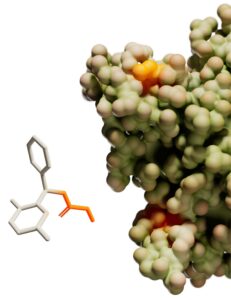
small-molecule
Expedition Medicines leverages generative AI to design small-molecule drugs that hit shallow pockets using covalent chemistry. The approach targets a wealth of traditionally undruggable sensors, regulators, and transcription factors, where interactions across surfaces drive disease.
[Expedition Medicines]

She notes that Expedition’s technology contrasts with many of today’s molecular design efforts, which use 3D atomic positions to model reversible interactions in deep pockets.

The company’s tech stack trains AI models on high-throughput mass spectrometry data that measures the potency of each small molecule against 20,000 sites in the proteome. These fit-for-purpose datasets are advantageous over DNA-encoded libraries (DELs), which are burdened by substantial noise that can limit predictive power.

Expedition is focusing on demonstrating clinical proof points. In a partnership with Pfizer, the startup is identifying target molecules correlated with prostate cancer disease progression and treatment resistance. As a long-term goal, the team plans to expand the proteomics platform to additional modalities, such as proximity events that drive protein degradation or stability.

Biologic in a pill

AI drug developer, 1910 Genetics, has recently tackled macrocyclic peptides, a class that aims to combine the oral convenience of small molecules with the high specificity of biologics. Historically, these compounds have struggled to balance cell-membrane permeability with key therapeutic properties such as potency and solubility.

To address this gap, 1910’s AI model, PEGASUS, is trained on a multi-modal dataset that generates billions of cyclic peptides separated by permeability-related characteristics and solvent-dependent computational simulations. PEGASUS was able to demonstrate the first cyclic peptides with more than two polar or ionizable fragments to achieve in vitro cell-membrane permeability.

Jen Asher, PhD, founder and CEO of 1910, describes the model as a “versatile tool” that accelerates the design-make-test cycle by triaging compounds for synthesis, supporting lead optimization, and designing new starting peptides with desired properties.

With a company name that references the year that the first patient was diagnosed with sickle cell disease in the United States, the first condition for which the field identified a molecular basis, 1910 is committed to multi-modality drug discovery. The company’s platform also houses CANDID-CNS, an AI model that predicts small molecule blood-brain barrier (BBB) penetration within Beyond-Rule-of-5 (bRo5) chemical space to advance therapies for neurological disease.

With only about two percent of small-molecule drugs able to cross the BBB, accurate penetration prediction can identify promising candidates that are more likely to succeed in the clinic. The model achieved an 87% success rate for predicting bRo5 small molecule brain penetration and distribution, outperforming a 56% success rate for the industry standard, Pfizer’s CNS Multiparameter Optimization (CNS-MPO) score.

Encrypted message

Jacob Becraft, PhD, CEO at Strand Therapeutics, is placing his bet on programmable mRNA therapeutics for cancers and autoimmune diseases. Strand is among a vibrant genetic medicine ecosystem, where engineered vehicles, such as adeno-associated vectors (AAVs) and lipid nanoparticles (LNPs), deliver therapeutic genetic material into patient cells to produce therapeutic proteins. These medicines must achieve therapeutic potency in the right tissues while avoiding off-target effects. Yet, targeted delivery beyond the liver remains a challenge.

STX-005 illustration
STX-005 extends the same programmable mRNA platform behind STX-001 to in vivo CAR T therapy, using circular RNA and targeted systemic delivery to generate CAR T cells directly inside the body. The approach is designed to produce long-term, cell-specific expression without the ex vivo manufacturing required by conventional CAR T. The program extends the company’s work in targeted, safe, and effective systemic delivery and has potential applications to autoimmune diseases and blood cancers. [Strand Therapeutics]

Strand’s technology addresses this gap by enabling selective mRNA expression within cancer cells while sparing healthy tissue. This approach allows mRNA to be delivered broadly while targeting expression to the intended tumor cells.

“It’s like an encrypted message. It doesn’t matter who picks up my message because they can’t read it,” Becraft said. “If the protein doesn’t get created, then it’s not off-target.” The tech stack challenges the “old school mentality” that mRNA biodistribution is the key metric that defines off-target effects.

Strand’s technology leverages a machine learning–driven approach that applies molecular sensors to detect microRNA expression signatures distinguishing tumor cells from healthy cell types. As an example, liver-specific microRNAs bind to target sites in the 3¢ UTR of the delivered mRNA to suppress its expression in healthy hepatocytes and prevent off-target effects.

Last May, Strand announced the Phase I dose-escalation trial for STX001, a programmable, self-replicating mRNA therapy designed to treat advanced solid tumors by producing IL-12 directly in the tumor microenvironment. Notably, STX001 demonstrated an abscopal response, in which localized treatment of a single tumor led to a systemic immune response that reduced distant tumor sites. The company looks to advance the candidate to Phase II trials.

As the therapeutic toolbox continues to expand, the field is working to close the “undruggable” gap.

The post Novel Therapeutic Modalities Target the Undruggable appeared first on GEN – Genetic Engineering and Biotechnology News.
Mass Spectrometry’s Discovery Revolution

Mass spectrometry (MS) has quietly undergone one of the most consequential evolutions in modern drug discovery. Once viewed primarily as a confirmatory analytical tool, it is now reshaping how researchers identify, validate, and optimize therapeutic candidates. Across chemoproteomics, metabolomics, immunopeptidomics, and beyond, MS is increasingly positioned not at the end of the pipeline—but at its beginning, where the most crucial decisions are made.

“Mass spectrometry is no longer just a downstream analytical checkpoint,” says Aaron Robitaille, PhD, the senior director of product & vertical marketing of mass spectrometry at Thermo Fisher Scientific. “It is increasingly serving as a discovery engine.”

This shift reflects a broader transformation across the pharmaceutical industry: from hypothesis-driven experimentation toward data-rich, systems-level interrogation of biology.

Seeing biology more clearly

Drug discovery has always struggled with a fundamental problem: Biology is complex, noisy, and often opaque. Many of the molecules that determine therapeutic success are low in abundance, transient, or entirely unknown. MS addresses this challenge by enabling researchers to observe biological systems with unprecedented depth and specificity.

According to Robitaille, MS now supports nearly every stage of early discovery—from target identification and engagement to pharmacokinetics and mechanism-of-action studies. One of its most transformative applications is chemoproteomics, where researchers can directly measure drug-protein interactions within living cells. This enables scientists to evaluate not just whether a compound binds its intended target, but also whether it interacts with unintended ones.

Crucially, MS is moving upstream in the discovery pipeline. “What makes that important is not merely breadth. It is timing,” Robitaille notes. By enabling high-throughput screening with detailed molecular readouts, MS helps eliminate poor candidates earlier—saving time, cost, and effort.

Technological advances are driving this shift. Historically, researchers faced trade-offs between speed and sensitivity, or between targeted and untargeted analyses. Newer platforms are collapsing these compromises. Hybrid acquisition methods, for example, allow targeted and untargeted data to be collected simultaneously in a single experiment, enabling both hypothesis testing and discovery.

The Thermo Scientific Orbitrap Astral Zoom MS exemplifies this convergence. Built around parallelized acquisition and enhanced ion handling, the system delivers high throughput, deep proteome coverage, and precise quantitation—all in one platform. Its ability to process hundreds of samples per day while quantifying thousands of proteins illustrates how MS is becoming both scalable and decision-ready.

Interrogating biology at scale

For Mike Knierman, biopharma workflow manager at Agilent, the expanding role of MS reflects the growing complexity of new therapies. “Drug discovery today spans multiple therapeutic modalities, including small molecules, monoclonal antibodies, oligonucleotides, and cell-based therapies,” he explains. MS provides a unifying analytical backbone across this diversity.

One of the most significant recent developments, Knierman emphasizes, is MS’s ability to interrogate biology at scale. Techniques such as proteomics, metabolomics (See Sidebar), and lipidomics allow researchers to observe how candidate drugs perturb entire cellular systems, rather than isolated targets. This systems-level insight is essential for understanding the mechanism of action and identifying off-target effects early in development.

Emerging measurements—such as protein turnover—are also enabling new therapeutic strategies. These include targeted protein degradation approaches, which require a detailed understanding of dynamic protein lifecycles rather than static abundance.

Agilent’s Revident LC/Q-TOF platform reflects this trend toward intelligent, high-resolution analysis. Designed for accurate-mass performance with built-in diagnostics, the system incorporates features that automate quality control and maintain data consistency. Its ultra-fast detector supports a wide dynamic range without sacrificing resolution, enabling confident identification and quantitation in complex biological samples.

Equally important are workflow innovations. The platform’s Intelligent Reflex capabilities automate routine checks—such as calibration verification and carryover detection—reducing manual intervention and ensuring consistent performance. In drug discovery environments where throughput and reproducibility are crucial, these features help maintain data integrity while accelerating timelines.

Ultimately, Knierman highlights MS as a driver of “biology-driven discovery,” where decisions are guided by comprehensive molecular data rather than limited readouts.

A shift in discovery models

Todd Stawicki, senior global market development manager for pharma, SCIEX, places MS within a broader transformation of drug discovery itself. The industry is moving away from traditional in vivo models toward more complex in vitro systems—such as organoids and tissue-based assays—in an effort to reduce impacts to laboratory animals and rising global regulatory efforts.

This shift dramatically increases the number and complexity of experimental endpoints. “Many or most of these endpoints are best served by mass spectrometry,” Stawicki notes. As a result, MS is becoming indispensable for analyzing the rich datasets generated by these models.

MS is also deeply embedded throughout the discovery lifecycle. In the early stages, it supports proteomics and complements genomic studies. It plays a central role in hit identification and lead optimization, and remains crucial in ADME (absorption, distribution, metabolism, and excretion) and DMPK (drug metabolism and pharmacokinetics) studies.

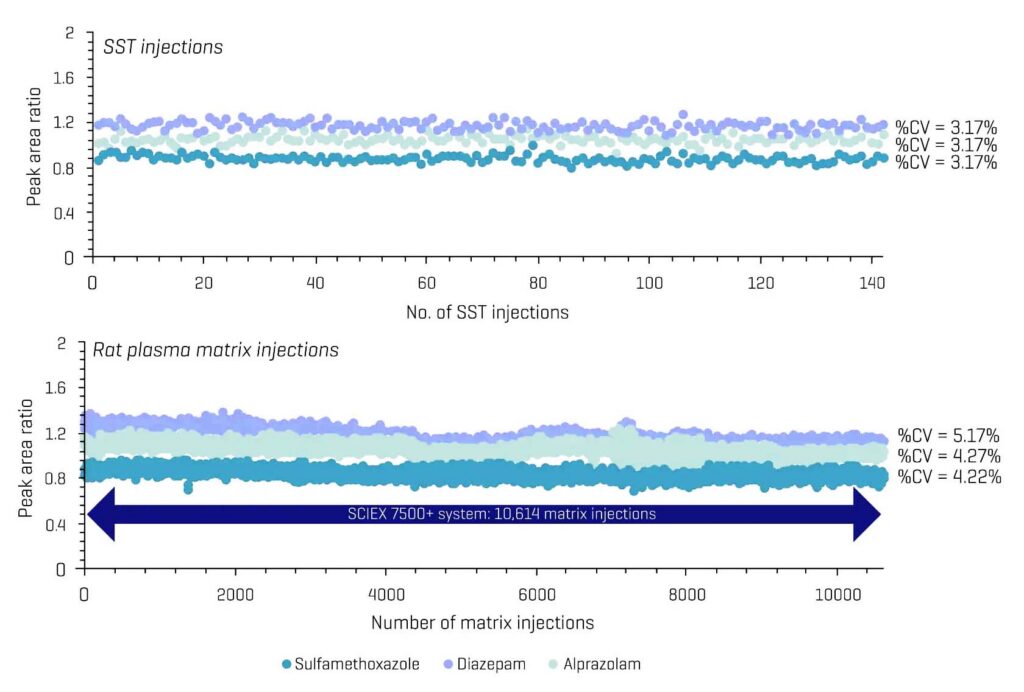
Analysis of a system suitability test and rat plasma matrix
Analysis of a system suitability test (SST, top) and rat plasma matrix (bottom) injections on the SCIEX 7500+ system for three drug compounds shows coefficients of variation (%CV) of three to five percent across more than 10,000 injections of rat plasma. [SCIEX]

Technological innovation continues to expand MS’s capabilities. Acoustic ejection-based MS, for example, enables rapid, label-free screening, while advanced systems—like the SCIEX 7500+ system—address one of the field’s most persistent challenges: balancing sensitivity with dynamic range.

As new drug modalities become more potent and targeted, they often exist at extremely low concentrations in complex biological matrices. This creates a dual requirement for high sensitivity and a broad quantitation range. The SCIEX 7500+ system meets this need, enabling accurate measurement across diverse tissues and concentration levels.

Robustness is another key consideration. SCIEX Mass Guard technology, for instance, enhances system uptime, ensuring that high-throughput workflows can run reliably over extended periods. In an environment where delays can be costly, this operational stability is as important as analytical performance.

Balancing throughput and insight

Shimadzu’s perspective underscores the importance of versatility in modern MS workflows. “Mass spectrometry has become one of the most versatile analytical tools in drug discovery,” says Lihini Mendis, PhD, LCMS product specialist at Shimadzu Scientific Instruments, noting that it now supports everything from early screening to preclinical development.

Triple-quadrupole MS systems
Triple-quadrupole MS systems can be used in drug discovery for bioanalysis and studies of drug metabolism and pharmacokinetics. [Shimadzu Scientific Instruments]

A major recent trend is the push toward higher throughput without compromising data quality. Rapid LC-MS methods and triple quadrupole systems are increasingly used to process large sample volumes efficiently, particularly in quantitative workflows such as bioanalysis and DMPK studies.

At the same time, qualitative MS capabilities are expanding. High-resolution instruments, combined with advanced fragmentation techniques, allow researchers to gain deeper structural insights into complex molecules such as lipids and metabolites. This dual capability—quantitative precision and qualitative depth—enables scientists to answer both “how much” and “what exactly” within the same experiment, Mendis explains.

Shimadzu’s portfolio reflects this balance. Single-quadrupole systems provide accessible, high-throughput screening, while triple-quadrupole platforms emphasize stability and reproducibility for quantitative analysis. High-resolution instruments extend capabilities into accurate-mass analysis and structural elucidation, all while maintaining user-friendly operation.

The overarching goal is not complexity for its own sake, but meaningful data that supports confident decision-making. By focusing on workflow efficiency and reliability, Shimadzu aims to streamline the path from data acquisition to actionable insight.

A proteoform-centric vision

While incremental improvements in speed and sensitivity have driven much of MS innovation, Bruker’s recently introduced timsOmni system points toward a more fundamental shift: a move toward protein-centric analysis at the level of intact proteoforms—structurally distinct variants of proteins that arise from genetic mutations, alternative splicing, or post-translational modifications.

The platform introduces a multimodal trapping approach that enables precise control over ion reactions, supporting a wide range of fragmentation techniques. This flexibility allows researchers to tailor experiments to extract detailed structural information from complex biomolecules.

Rather than focusing solely on peptides or simplified representations of proteins, the system emphasizes intact protein analysis. This is particularly important for identifying proteoforms. These variants often play critical roles in disease but are difficult to detect using conventional approaches.

The timsOmni platform enables detailed mapping of such variations, including modifications, such as acetylation and glycosylation, that influence protein function and cellular signaling. By combining high sensitivity with advanced fragmentation methods, it allows researchers to generate comprehensive sequence information and localize modifications with precision.

Importantly, this capability extends beyond discovery into biopharma development and quality control. The ability to characterize therapeutic antibodies and other biologics at the proteoform level has significant implications for both efficacy and safety.

Supporting software further enhances this capability by translating complex spectral data into actionable insights. Advanced algorithms enable de novo sequencing, charge state assignment, and modification identification, making it easier for researchers to navigate the complexity of proteoform analysis.

Accelerating insights

As therapeutic modalities become more complex, the need for faster, more precise characterization tools has never been greater. David Curtin, vice president and general manager, biologics business, Waters Analytical Sciences, Waters Corporation, highlights how emerging platforms are enabling researchers to generate deeper insights earlier in the development cycle—when those insights can have the greatest impact.

As one example, Curtin describes the Xevo CDMS platform as a breakthrough in capability and accessibility. As the first dedicated benchtop charge-detection mass spectrometry system, it enables measurement across a wide spectrum of mega-mass biomolecules. Crucially, it supports “characterization in process development when decisions matter most,” Curtin says, allowing teams to act on high-quality data in real time.

Speed is one of its most transformative advantages. “Xevo CDMS delivers accurate analysis in less than 10 minutes,” Curtin explains. This represents a dramatic improvement over traditional workflows that could take hours, days, or even weeks when outsourced. The result is a shift to same-day decision-making, fundamentally changing how process development is executed and optimized.

Efficiency is another key differentiator. Curtin notes that “the system requires up to 100 times less sample than current methods,” addressing a long-standing limitation in biopharma research. With reduced sample demands, scientists can run more experiments per batch, leading to “lower cost, higher yields, fewer impurities, and faster time to market,” he says.

Beyond operational improvements, the platform unlocks new scientific possibilities. Curtin emphasizes that it delivers direct mass and charge measurements for individual 100-kilodalton to 150-megadalton molecules, including complex structures such as glycosylated proteins, viral vectors like AAV, and lipid nanoparticles. In many of these cases, “CDMS isn’t just a better option; it’s the only option,” Curtin says.

Ultimately, Curtin underscores the broader impact: researchers are now generating “fast, accurate orthogonal data” that validates existing approaches while opening entirely new lines of inquiry. Scientists, he says, are “asking and answering questions they couldn’t tackle before”—a powerful indicator of how this technology is advancing the development of therapies for diseases including cancer, heart disease, and Alzheimer’s.

From data to decisions

Across all these perspectives, a common theme emerges: MS is no longer defined by its ability to generate data, but by its ability to inform decisions. This clarity is transforming drug discovery. By revealing off-target effects, validating mechanisms of action, and identifying biomarkers at early stages, MS helps reduce uncertainty and improve success rates. It allows researchers to prioritize the most promising candidates and eliminate those unlikely to succeed.

As Robitaille puts it, the ultimate value of modern MS lies in “the ability to see meaningful biology early enough to act on it.” In an industry where time, cost, and complexity are ever-increasing, that capability might prove to be one of the most important advances of all.

The post Mass Spectrometry’s Discovery Revolution appeared first on GEN – Genetic Engineering and Biotechnology News.

StockWatch: Agilent Shares Jump on Better than Expected Quarterly Results

A strong quarterly earnings report that beat analyst expectations, growth that extended into core pharma and biotech tools, plus improved investor guidance on revenue, operating margin, and earnings per share (EPS) were enough to send shares of Agilent Technologies (NYSE: A) jumping to their best one-day increase in nearly 24 years this past week.

Agilent shares surged 17% from $115.79 to $135.42 Thursday, the first trading day after the tools giant announced better-than-expected results for the second quarter of its 2026 fiscal year ending April 30. Agilent operates on a fiscal year that ends October 31. That was the best one-day performance since November 19, 2002, when the stock ballooned 16% to $134.50.

Shares inched up another 0.12% Friday, closing the week at $135.54—giving Agilent an 18% gain for the week and seven straight positive trading days.

Agilent finished Q2 of FY’26 with net income of $339 million or $1.20 a share, up 58% from $215 million or 75 cents a share a year earlier, on revenue that rose 10% to $1.835 billion from $1.668 billion in the year-ago quarter, the company announced after the close of trading on Wednesday.

Agilent’s “core” growth—which excludes the impact of currency and acquisitions and divestitures within the past 12 months—was 6.3%, exceeding the 4.8% growth forecasted by a consensus of Wall Street analysts cited by the company, as well as its earlier investor guidance of growth ranging from 4% to 5.5%. The consensus also predicted Q2 revenue of $1.79 billion, according to FactSet data cited by Barron’s.

Agilent moved quickly to raise the low end of its FY 2026 revenue guidance, from $7.3 billion to $7.39 billion, while trimming the upper end to $7.49 billion from $7.5 billion. The latest guidance remains above the initial FY 2026 forecast of between $7.3 billion and $7.4 billion.

Agilent also raised its guidance on operating margin from 75 to 85 basis points, and on FY 2026 non-GAAP EPS, which is now projected to range from an even $6 to $6.10, an increase of eight cents at the midpoint from the previous range of $5.90 to $6.04, which was raised in February from the initial range of $5.86 to $6. The analyst consensus predicts a lower EPS of $5.97.

“Strong follow-up quarter”

“All in, F2Q was a strong follow-up quarter to the weather-related headwinds seen in F1Q and, looking ahead, we continue to see Agilent as a clean tools story to own with upside from reshoring, CDMO [contract development and manufacturing organization] capacity ramping and AI [artificial intelligence] investments in pharma over the long-term,” Casey Woodring, vice president, equity research with J.P. Morgan, and three colleagues wrote in a research note.

In a separate report also issued by J.P. Morgan, Woodring and colleagues concluded that AI-driven shortening of timelines for target identification and hypothesis generation “could increase subsequent wet lab validation volume, benefiting high-throughput instruments and multi-omics tool providers, while potentially pressuring lower-throughput/animal-model-adjacent tools.”

Agilent is one of seven biopharma tools developers likely to benefit as a result, the J.P. Morgan analysts wrote. The firm retains an “Overweight” rating and $180 price target on Agilent.

Agilent president and CEO Padraig McDonnell told analysts on the company’s May 27 earnings call that pharma customers are leaning into AI to accelerate drug development and reduce the odds of costly late-stage failures.

“There is a growing need for large-scale multi-modal datasets to train AI models, which will require significant investments in the wet lab,” McDonnell said. “By moving the needle on drug development ROI, AI holds the promise of putting our largest customer constituency on a better footing. A higher number of approvals coming through the drug pipeline should be a strong tailwind for us, given our leading position in downstream manufacturing QA/QC workflows.

“Attractive setup”

Puneet Souda, senior managing director, life science tools and diagnostics and a senior research analyst with Leerink Partners, added that given Agilent’s guidance mostly rose by the amount results beat consensus forecasts, “we continue to see an attractive setup for A [Agilent]” and likes the company’s position across multiple end-markets—citing chemicals and applied markets (C&AM), QA/QC instrumentation, and biopharma.

Souda maintained Leerink’s “Outperform” rating on Agilent shares and raised the firm’s 12-month price target by 3%, to $170 from $165, based on the improved guidance.

Michael Ryskin, research analyst with BofA Securities, showed even more enthusiasm about Agilent’s prospects, upgrading his firm’s rating on the company’s shares from “Neutral” to “Buy”—but trimming by 3% its price target from $150 to $145, a multiple reflecting a lower estimate of 18 times Agilent’s FY 2027 earnings before interest, taxes, depreciation, and amortization (EBITDA), from 19 times EBITDA.

“Key growth drivers such as LC and GC replacement cycles continue to deliver (and remain in early innings), execution is solid across the board, and there were few new negative surprises to derail the momentum (despite widespread fears of chemicals slowdown),” Ryskin wrote. “Combined with a very reasonable valuation, and a myriad of issues elsewhere in tools, we see Agilent as an increasingly attractive asset.”

So too did analysts from four other investment firms, which responded to Agilent’s results by raising their price targets on Agilent stock:

  • TD Cowen (Dan Brennan)—Up 5% from $147 to $155, maintaining “Buy” rating.
  • Barclays (Luke Sergott)—Up 3.6% from $140 to $145, maintaining “Overweight” rating.
  • RBC Capital (Dan Leonard)—Up 1.3%, from $153 to $155, maintaining “Outperform” rating.
  • Baird (Catherine Ramsey Schulte)—Up 1.3% from $156 to $158, maintaining “Outperform” rating. Schulte raised the target price 0.6% from $155 just on Tuesday.

But Brandon Couillard, managing director, Life Science Tools & Diagnostics and an equity research analyst at Wells Fargo, lowered his firm’s price target on Agilent’s shares 3%, to $160 from $165, reasoning that the lower price would yield a more realistic 18.71% difference between the stock’s current price and what the firm predicts it is worth. Couillard maintained Wells Fargo’s “Overweight.”

Instruments grew by high single digits during Agilent’s fiscal second quarter, driven by continued positive low double-digit revenue increases in liquid chromatography (LC), LC/mass spectrometry (MS), and gas chromatography (GC) instrument sales.

“Best market share data I’ve seen”

“I think we’ll continue to see strong momentum on the LC-MS and GC,” McDonnell told analysts. “We expect the LC replacement cycle to be a 200–300 bps [basis points, or 2–3%] tailwind to the LC growth. We’ve seen that normal trajectory of the replacement cycle, but continued momentum and funnels look really strong. I will say it was actually the best market share data I’ve seen.”

“Not only are we replacing, but we’re also taking share in competitive accounts, which again, continues the momentum,” he added.

McDonnell said the instrument sales surge was driven by three compelling reasons: Past underinvestment in replacing aging tools by biopharma customers; favorable capital expenditure or “CapEx” conditions in the United States and Europe, “and, of course, customer-focused innovations.”

“We expect that to continue, and we’re seeing it across all markets,” McDonnell added.

During the second fiscal quarter, Agilent said, its core pharma and biotech business rose 6%. Tycho Peterson, equity analyst with Jefferies, noted that Agilent’s biopharma results marked its fifth straight quarter of mid-single-digit growth, led by factors that, according to the company, include:

  • Replacement by customers of Agilent LC tools, which sent revenue in that segment up by low double digits
  • A third straight quarter of growth from biotech customers
  • A 20% jump year-to-date in tool purchases driven by the development of glucagon-like peptide 1 (GLP-1) receptor agonist drugs for obesity and diabetes indications, though down from the 50% leap seen in Agilent’s first fiscal quarter of this year
  • Low single-digit growth among small molecule drug developers

“Large cap” biotechs with a market capitalization (share price times the number of outstanding shares) of $10 billion or more accounted for a low double-digit increase in sales that outpaced sales from small- and mid-cap biotech—though positive demand signals are emerging, tied to funding. And while China sales fell by high single digits overall, Agilent generated revenue that grew in the high teens year-over-year from biotech companies there, Peterson reported.

Consumables “momentum”

Biopharma activity is recorded within Agilent’s Life Sciences and Diagnostics Group (LDG) segment, which year-over-year rose 12% (9% core) to $732 million during the quarter. Among the company’s two other reporting segments, the Applied Markets Group (AMG) saw growth of 14% (11% core) to $344 million, while the Agilent CrossLab Group (ACG) grew 6% (2% core) to $759 million.

LDG includes LC-MS instrument platforms, cell and biomolecular analysis, specialized CDMO services, pathology, companion diagnostics, and genomics. AMG includes GC-MS, spectroscopy, and vacuum technology platforms. ACG supports customers in all end markets through services, software and informatics, automation, and consumables.

In consumables, Agilent said sales of its Altura Ultra Inert HPLC [high-performance LC] columns grew more than 50% quarter-over-quarter, reaching 75% of the top 20 biopharma accounts.

“This rapid adoption reinforces the strength of the innovation engine and the unified commercial organization. We will continue to build on that strong initial momentum with additional waves of column launches,” McDonnell vowed.

Another expected source of biopharma growth in the coming months, Peterson of Jefferies observed, is orders for new tools from drug and tools developers reshoring their operations in the United States. Re-shoring orders are expected by fiscal year-end 2026, with revenue contributions beginning in the 2027 fiscal year that begins on November 1 of this year.

Biopharma is part of Agilent’s Life Sciences and Diagnostics Markets segment, which consists of seven areas of activity: Providing active pharmaceutical ingredients for oligo-based therapeutics, as well as solutions that include reagents, instruments, software, and consumables, which enable customers in the clinical and life sciences research areas to interrogate samples at the cellular and molecular level.

“You look at the long-term drivers in pharma, you see redistribution of supply chains, expansion of biologics, and, of course, you see many other factors really helping. What I would say is that we’re very much downstream in QA/QC,” McDonnell said during the earnings call. “We’re in development as well. We’re right in that sweet spot for reshoring, replacement cycle, and any capacity or supply chain resilience around, feel really good about that.”

Leaders and laggards

  • Q32 Bio (NASDAQ: QTTB) shares zoomed 81% from $7.09 to $12.85 Wednesday after the developer of therapies for alopecia areata and other autoimmune and inflammatory diseases entered into an approximately $55 million private placement of common stock and pre-funded warrants with “new and existing institutional and accredited investors.” Q32 agreed to issue and sell 6.725 million shares of its stock at $8 per share, plus pre-funded warrants to buy 150,000 shares at $7.9999. Q32 finished the first quarter with $50.8 million in cash and cash equivalents—enough to fund operations into the first half of 2028 when combined with guaranteed near-term milestone payments from selling Phase II complement inhibitor ADX-097 to Akebia Therapeutics, plus proceeds from an at-the-market stock offering received after Q1. BVF Partners led the financing with participation from RA Capital Management, OrbiMed, and Atlas Venture. Morgan Stanley acted as lead placement agent, and Oppenheimer & Co. acted as a placement agent.
  • Replimune Group (NASDAQ: REPL) shares rocketed 86% from $4.68 to $8.69 Friday after the developer of oncolytic immunotherapies agreed with the FDA on a path toward resubmission and reconsideration of the Biologics License Application (BLA) for its lead product candidate RP1 (vusolimogene oderparepvec) in combination with nivolumab to treat advanced melanoma. Repligen said it agreed to resubmit its BLA for RP1 “in the coming days,” while the FDA agreed to treat the BLA resubmission as an urgent matter and prioritize its review “in recognition of the significant unmet need for patients in the advanced melanoma community.” In April, the FDA stunned Repligen by rejecting its BLA for a second time, issuing a complete response letter (CRL) contending that data were not sufficient to allow for RP1 approval—an assertion Replimune vehemently rejects. The BLA is supported by data from the Phase II IGNYTE trial (NCT03767348)—a 34% response rate with a median duration of 24.8 months and a favorable safety profile.

The post StockWatch: Agilent Shares Jump on Better than Expected Quarterly Results appeared first on GEN – Genetic Engineering and Biotechnology News.

Pfizer, Innovent Ink Up-to-$10.5B+ Cancer Treatment Collaboration

Pfizer and Innovent Biologics will partner to research and develop 12 early-stage and de novo antibodies and antibody-drug conjugates (ADCs) designed to treat various cancers, the companies said today, through a collaboration that could generate up to $10.5 billion for the Chinese biotech.

The companies said they have signed a strategic global licensing and collaboration agreement that includes licensing, co-development, and co-commercialization deals for both the ADCs, which would be created with payloads that differentiate them from other conjugates, as well as multi-specific antibodies, to be developed with unique designs and differentiated immune-engaging features.

Pfizer and Innovent plan to work across a portfolio of 12 programs—eight early-stage programs originating with Innovent, and four Pfizer discovery programs. The companies said they will co-develop and share costs for selected programs as they advance them through clinical development.

The collaboration is intended to marry Pfizer’s global scientific, clinical development, regulatory, and commercial scale capabilities with Innovent’s scientific discovery and clinical capabilities in oncology.

“By combining Innovent’s discovery and early clinical development with Pfizer’s global research and development and commercialization capabilities, we have an opportunity not only to strengthen our pipeline, but to accelerate the delivery of breakthroughs that can redefine standards of care and make a meaningful difference in patients’ lives,” Jeff Legos, Pfizer’s chief oncology officer, said in a statement.

Racing the ‘patent cliff’

Like other biopharma giants, Pfizer is racing the proverbial “patent cliff” by building a pipeline of new treatments capable of recouping the billions that it stands to lose in coming years as its aging blockbuster drugs lose patent exclusivity in the U.S. and other key markets.

GEN’s A-List of Top 20 Drugs Heading for the Patent Cliff through 2029 includes two Pfizer treatments. One is Prevnar 13/Prevenar 13 (pneumococcal 13-valent conjugate vaccine [diphtheria CRM197 Protein]), which lost U.S. exclusivity starting March 31; and the prostate cancer drug Xtandi® (enzalutamide), co-marketed with Astellas Pharma and set to lose U.S. exclusivity in 2027.

Pfizer generated $6.494 billion last year, up 1% from 2024, and another $1.69 billion in the first quarter, up 2% from a year ago, in revenues from its Prevnar family, which includes Prevnar 20/Prevenar 20 (Pneumococcal 20-valent Conjugate Vaccine), as well as the Prevnar 13/Prevenar 13 vaccines.

Xtandi racked up $2.194 billion in 2025, up 8% from a year earlier, and $444 million in Q1, down 3% from the year-ago quarter, in revenues in the U.S. and more than 90 other countries, including the EU and Japan—primarily reflecting alliance revenues and royalty revenues.

Oncology focus

Oncology is among therapeutic areas where Pfizer has sought to bolster its pipeline and portfolio of marketed drugs in recent years. The pharma giant acquired ADC-focused drug developer Seagen for $43 billion in 2023, a deal that cleared expected antitrust hurdles and doubled Pfizer’s oncology pipeline to some 60 programs spanning multiple modalities, including ADCs, small molecules, bispecifics and other immunotherapies.

Last year, Pfizer launched an up-to-$1.5 billion global ex-China licensing agreement with another Chinese biotech, 3SBio. In that deal, Pfizer agreed to pay $1.25 billion upfront, make a $100 million equity investment in 3SBio equity, and pay up to $150 million in return for an option for exclusive development and commercialization rights in China to SSGJ-707, a bispecific antibody targeting PD-1 and VEGF.

Outside of oncology, Pfizer acquired obesity drug developer Metsera for up-to-$10 billion last October following a bidding war with Novo Nordisk that ended with some help from Washington.

And in February, Pfizer inked a commercialization deal of undisclosed value with Chinese drug developer Hangzhou Sciwind Biosciences giving Pfizer exclusive commercialization rights in China to the obesity therapy ecnoglutide, an new‑generation cAMP‑biased glucagon-like peptide 1 (GLP‑1) receptor agonist delivered via injection.

While Innovent has successfully developed an obesity treatment, mazdutide, the company specializes in cancer drug development, building a combined portfolio and development pipeline of 37 programs—23 of them in oncology including the PD-1 inhibitor Tyvyt® (sintilimab). The fully human IgG4 monoclonal antibody was first approved in China in 2018 and is now indicated to treat three forms of non-small cell lung cancer, classic Hodgkin’s lymphoma, and forms of endometrial, gastric/esophageal, kidney, and liver cancers.

‘Greater speed and impact’

“By leveraging both companies’ complementary resources, we can develop our early-stage oncology pipeline with greater speed and impact to help bring innovative therapies to patients more efficiently worldwide,” stated Hui Zhou, MD, PhD, Innovent’s chief R&D officer for its oncology pipeline. “Furthermore, co-developing and co-commercializing key projects in the U.S. and Europe expands Innovent’s global reach.”

Innovent plans to carry out development of the Pfizer-partnered programs through Phase I, applying its discovery engine and robust early clinical capabilities, after which Pfizer will oversee future global development. Pfizer will receive an exclusive global license for four programs, and assume their global development costs, as well as an exclusive license outside Greater China for four other programs, having agreed to shoulder an unspecified majority of the development costs.

Pfizer and Innovent also agreed to co-develop four programs globally, sharing their development costs. The companies plan to co-commercialize in the U.S., the European Union (E.U.), and the United Kingdom (U.K.), agreeing in return to share their profits—while Innovent will retain Greater China rights to these programs.

Pfizer has agreed to pay Innovent $650 million upfront and up to $9.85 billion in payments tied to achieving development, regulatory, and commercial milestones. Pfizer also agreed to pay Innovent up to double-digit royalties on sales of each licensed product if approved, with the companies agreeing to share their profits in the U.S., the EU, and the U.K.

The collaboration transaction is expected to close in the third quarter, subject to regulatory approvals.

In October, Innovent launched an up to $11.4 billion collaboration with Takeda Pharmaceutical aimed at speeding up the development of Innovent’s next-generation immuno-oncology therapies as well as ADCs.

The post Pfizer, Innovent Ink Up-to-$10.5B+ Cancer Treatment Collaboration appeared first on GEN – Genetic Engineering and Biotechnology News.

STAT+: Pharmalittle: We’re reading about Replimune drug getting third try at FDA approval, a Pfizer deal in China, and more

And so, another working week will soon draw to a close. Not a moment too soon, yes? This is, you may recall, our treasured signal to daydream about weekend plans. Our agenda, so far, is very low-key. We hope to catch up on our reading, promenade with the official mascots, and take a few naps. We may also manicure the Pharmalot grounds. And of course, we hope to hold still another listening party, where the rotation will likely include this, this, this, this and this. And what about you? The choices are endless this time of year. In particular, the great outdoors are beckoning — trails can be hiked, streets can be walked, country roads can be driven. If this fails, there is always the great indoors. You could cook a fabulous meal, shop for something that looks spiffy, or binge watch on the telly. Or you could be totally zen and do absolutely nothing. Well, whatever you prefer, have a grand time. But be safe. Enjoy, and see you soon…

A U.S. Food and Drug Administration advisory panel recommended updating this fall’s Covid shots to target the XFG variant, a fast-growing strain nicknamed “stratus,” NBC News tells us. The recommendation — from the FDA’s Vaccines and Related Biological Products Advisory Committee — is meant to help vaccine makers prepare shots for the fall and winter, when Covid infections typically rise. The meeting was the agency’s first since FDA Commissioner Marty Makary resigned. His resignation did not play a role; the meeting was already on the calendar before he resigned. Makary drew criticism last year after the agency imposed stricter requirements on who could get Covid shots.

Pfizer and China’s Innovent Biologics agreed to a global licensing and collaboration deal worth up to $10.5 billion to develop 12 early-stage cancer medicines, as global drugmakers race ​to tap China’s booming biotech pipeline, Reuters says. The deal also includes a $650 million upfront payment ​to Innovent and up to $9.85 billion in potential development, regulatory and ⁠commercial milestone payments. The value of such deals in the greater China region rose nearly tenfold from 2021 to an unprecedented $137.7 billion last year. The partnership spans a portfolio of antibody-drug conjugates ​with novel differentiated payloads and multi-specific antibodies, comprising eight Innovent-originated early-stage assets and four Pfizer-proposed discovery ‌programs.

The World Health Organization identified drugs from Regeneron Pharmaceutical, Mapp Bio, and Gilead Sciences that should be fast-tracked through clinical testing to respond to the current Ebola outbreak, Pharmaphorum notes. The WHO’s independent experts have said Regeneron’s maftivimab, Mapp’s MBP134, and Gilead’s remdesivir should be studied in patients infected with the Bundibugyo form of Ebola currently infecting more than 1,000 people in the Democratic Republic of the Congo, with cases also reported in neighbouring Uganda. At last count, the Bundibugyo outbreak had led to 10 confirmed deaths, with another 223 suspected, although the WHO has said it could be much larger as the virus is thought to have circulated undetected for some time.

Continue to STAT+ to read the full story…

STAT+: Biotech veteran Jeremy Levin on why the industry’s future is secure, but American leadership is at risk

Biotech is producing scientific breakthroughs that once seemed impossible. But according to longtime industry executive Jeremy Levin, the institutions that support these advances, from regulators, to investors, and even public trust in science itself — are beginning to fracture.

Levin is the founder and chairman of Ovid Therapeutics and former CEO of Teva Pharmaceuticals. In his new book, “Biotech in the Balance: Saving a Strategic Industry in an Age of Distrust,” he argues that political upheaval, weakening institutions, short-term investing, and more are putting the future of the industry at risk, even though the science itself continues to accelerate.

On this week’s episode of “The Readout Loud,” Levin advocates for federal changes that could incentivize biotech investment, and for pharmaceutical companies, in particular, to call out how regulatory upheaval is harming the drug industry. “When an institution such as this, which is critical, is shaken, the industry must stand firm. It must call out why this is a problem. … The titans are dead silent right now,” he said. 

Below are highlights from his conversation with hosts Elaine Chen, Adam Feuerstein, and Allison DeAngelis.

This transcript of the interview has been lightly edited for length and clarity.

Continue to STAT+ to read the full story…

STAT+: Trump’s pharma deals get tested

You’re reading the web edition of D.C. Diagnosis, STAT’s twice-weekly newsletter about the politics and policy of health and medicine. Sign up here to receive it in your inbox on Tuesdays and Thursdays.

RFK Jr. removed two snakes from Dr. Oz’s patio, bare-hand grabbing the black racers, one of which briefly tangled with his tie. That species, while not venomous, often bites and defecates a foul-smelling musk when handled. Send news tips and bad ideas to John.Wilkerson@statnews.com or John_Wilkerson.07 on Signal.

What is MFN anyway?

Let’s be honest. Most favored nation is one of those odd terms, like “direct and indirect remuneration,” that drug policy folks casually use as though they mean something.

Continue to STAT+ to read the full story…

Oligo Therapy Firms Moving Toward Less Expensive, High Production Methods

A wide range of new technologies offers the next generation of oligonucleotide manufacturers a choice in how they will commercially manufacture their products. That’s the view of a technical expert with experience working with small biotechs and large pharmaceutical companies.

According to Barrie Cassey, PhD, a former technical director at GSK, the tide of oligonucleotide therapies now reaching the clinical stage is driving companies to commit to cheaper high-production techniques, such as enzymatic ligation.

“What’s driving this technology is the ability to make [oligonucleotide therapies] at scale,” he says.

According to Cassey, most oligonucleotide drugs are currently produced by solid-phase techniques, but the capacity for commercial manufacturing is limited globally, with most therapies being for rare disease patients. However, looking at products in Phase III, 40% target large patient populations, Cassey says, and this rises to around 50% for products in Phase II.

“If you extrapolate, assuming 70% of these Phase III assets become commercial (which is pretty conservative), your total demand could rise to six to seven tons globally, which is more than all global capacity today,” he explains.

Overall, within eight years, global manufacturing demand could reach as high as 30 tons—far outstripping current manufacturing capabilities, Cassey says. Moreover, drugs targeting large patient populations (e.g., statins) have traditionally needed to be cheap to manufacture, he says.

To get around this, large pharmaceutical companies are increasingly looking at new techniques for oligonucleotide manufacture, such as experimenting with fragmentation versus whole molecule approaches. One company has invested $250 million in a manufacturing plant using enzymatic ligation, Cassey adds.

Overall, Cassey says, the take-home message is that new techniques are closer than many people think, with some companies already offering them for preclinical manufacture.

“These technologies are almost ready to go and, if someone wanted to use them in twelve months, it might be possible,” he says. “It’s just about getting the right conditions for everything to coalesce together.”

The post Oligo Therapy Firms Moving Toward Less Expensive, High Production Methods appeared first on GEN – Genetic Engineering and Biotechnology News.

STAT+: Pharmalittle: We’re reading about an AstraZeneca breast cancer pill, an ADAP deal in Florida, and more

Good morning, everyone, and how are you today? The middle of the week has finally arrived, and you should congratulate yourselves for making it this far and deciding to soldier on. After all, consider the alternatives. None too pleasant, yes? This calls for a delicious cuppa stimulation. Our choice today is pomegranate green tea. As always, we invite you to join us. Meanwhile, here are some tidbits. Hope you have a meaningful and productive day, and please do keep in touch. We treasure your messages. …

The U.S. Food and Drug Administration ​has extended the decision deadline for an experimental breast cancer pill from AstraZeneca in order to review additional data, Reuters notes. The delay comes after a majority of an FDA ​advisory panel in April voted against the drug in ​combination with another type of therapy known ⁠as CDK4/6 inhibitor, due to concerns about the ​design of a key late-stage trial rather than ​its safety or efficacy. The company said it has submitted additional analyses requested by the FDA to support ​its new drug application, including data linked to ​longer-term efficacy outcomes that will be presented at a conference ‌on ⁠June 2. AstraZeneca’s camizestrant ​pill ⁠is designed for patients with a type of breast cancer in which tumors carry a specific mutation.

Brazil approved the country’s first generic version of Novo Nordisk’s Ozempic shot, opening the door to cheaper competition in one of the world’s fastest-growing markets for weight loss and diabetes drugs, Bloomberg News writes. EMS, a Brazilian pharmaceutical company, was cleared to sell its copycat drug, Ozivy, to treat adults with type 2 diabetes as an adjunct to diet and exercise. EMS plans to sell Ozivy for 30% less than Ozempic, and expects it to hit the market within 30 days. The approval marks a milestone for Brazil’s pharmaceutical industry as local drugmakers seek to enter the booming market for GLP-1 medicines, the class of drugs that includes Ozempic. The company plans to make 350,000 pens available initially and expects to sell about 1.2 million units in the first year.

Continue to STAT+ to read the full story…

Triple Play: Lilly Acquires Three Developers of Infectious Disease Vaccines for Up-to-$3.8B

Eli Lilly has agreed to acquire three privately-held developers of vaccines for infectious diseases for a combined up to $3.83 billion cash, the companies said today, in deals intended to expand the acquisitive pharma giant’s R&D efforts into infectious disease—and which represent Lilly’s eighth, ninth, and 10th planned buyouts of smaller biotechs this year alone.

Lilly announced planned acquisitions of Vaccine Company for up to $1.55 billion, Curevo for up to $1.5 billion, and LimmaTech Biologics for up to $780 million. The planned triple play of buyouts, Lilly said, will enable it to apply differentiated technology platforms toward attacking infectious diseases, focusing on viral pathogens linked to long-term neurological and oncological risk, plus bacterial pathogens long considered difficult to prevent or treat.

“These acquisitions reflect a deliberate strategy to prevent disease at its source rather than treat its consequences,” Daniel M. Skovronsky, MD, PhD, chief scientific and product officer, and president, Lilly Research Laboratories, said in a statement.

“Decades of evidence now link common infections to diseases that potentially emerge years later, including neurological disease, cancer and infertility. And as antimicrobial resistance erodes our ability to treat bacterial infections, vaccines are increasingly the only path to prevention,” Skovronsky added. “Combining these companies’ platforms and teams with Lilly’s global scale positions us to change that trajectory.”

Investors appeared to support the triple play, sending Lilly shares up 1.36% to $1,079.19 as of 11:56 a.m. ET, from $1,065 at Friday’s close of trading.

Capitalizing on tirzepatide billions

The deal spree reflects Lilly’s desire to capitalize on the billions of dollars it is generating from sales of its obesity and diabetes drugs based on glucagon-like peptide 1 (GLP-1) receptor analysts alone or in tandem with a glucose-dependent insulinotropic polypeptide (GIP).

Those drugs account for 58% or $49.329 billion of the $84.978 billion in revenues reported by Lilly in 2025 and the first quarter of 2026. Lilly markets tirzepatide, a GLP-1/GIP dual agonist, in obesity as Zepbound® ($13.542 billion in 2025, $4.16 billion in first quarter 2026) and in diabetes as Mounjaro® ($22.965 billion, $8.662 billion in Q1 ‘26).

Lilly executives did not mention infectious diseases as a potential area of future growth during the company’s most recent earnings call last month with analysts following Q1 results, even as it cited three other therapeutic areas: I&I (immunology and inflammation), neuroscience, and oncology.

“We’re proud of what we’re doing in those three areas, and I think each of them has very significant unmet medical needs that we can scale into as our medicines are successful. We like what we got, and we like the direction we’re going. Of course, in each of those areas, we also see opportunities to get a lot bigger, and we’ve highlighted some of the themes already in those areas,” Skovronsky said on the April 30 call.

“Even without the obesity and metabolic business, Lilly would be the fastest or surely one of the fastest-growing pharmaceutical companies in the industry,” Skovronsky added.

Parade of purchases

Lilly’s long parade of purchases began January 7 when it inked a $1.2 billion acquisition of Ventyx Biosciences, an NLRP3-targeting oral drug developer focused on inflammatory diseases. A month earlier, Lilly announced plans to buy out circular RNA cell therapy developer Orna Therapeutics for up to $2.4 billion, targeting advancements in cell therapy. And in March, Lilly committed up to $7.8 billion to acquire Centessa Therapeutics, a developer of sleep disorder drugs.

Last month, Lilly agreed to acquire three cancer drug companies—in vivo chimeric antigen receptor T-cell (CAR T) developer Kelonia Therapeutics for up to $7 billion; JAK inhibitor developer Ajax Therapeutics for up to $2.3 billion; and next-generation dual-payload antibody-drug conjugate (ADC) developer CrossBridge Bio for up to $300 million.

Just last week on May 20, non-viral DNA delivery-focused drug developer Engage Biologics announced it had been acquired by Lilly for up to $202 million cash, including an upfront payment and payments upon achieving specified development milestones.

As for the latest planned acquisitions:

South San Francisco, CA-based Vaccine Company is developing in vivo nanoparticle (IVN) technologies designed to enable the antigen display known to elicit durable immune responses associated with virus-like particle vaccines, while avoiding the manufacturing burden of traditional VLP production. The company is advancing a preclinical pipeline spanning multiple viral pathogens; the lead program applies this technology to Epstein-Barr Virus (EBV) with a five-antigen Phase I-ready candidate.

Preventing mono and consequences

Lilly and Vaccine Company reason that a prophylactic vaccine could prevent not only acute infectious mononucleosis but also long-term neurological and oncological consequences that may follow infection, given what it said was growing evidence linking EBV to multiple sclerosis and several malignancies,

Under the acquisition deal, Lilly agreed to give Vaccine Company shareholders up to $1.55 billion, which would include an undisclosed upfront payment and additional payments tied to achieving specified clinical and commercial milestones.

LimmaTech Biologics, based near Zurich in Schlieren, Switzerland, is a developer of vaccines targeting bacterial pathogens for which rising antimicrobial resistance is steadily closing therapeutic options, including Staphylococcus aureus, Neisseria gonorrhoeae, and Chlamydia trachomatis. LimmaTech’s platform is designed to generate broad, durable immune responses against complex bacterial targets by targeting the toxins and superantigens that drive disease.

LimmaTech’s lead program, LTB-SA7, is in Phase I development as a vaccine against S. aureus, the leading cause of surgical-site infection. The company has also developed a preclinical pipeline of candidates targeting additional bacterial pathogens, including those that drive infertility and other long-term consequences of infection that fall disproportionately on women.

Lilly has agreed to acquire LimmaTech for up to $780 million, which will include an undisclosed upfront payment and additional potential payments also tied to achieving specified clinical and regulatory milestones.

Seeking greater tolerability

Bothell, WA-based Curevo has an infectious disease vaccine pipeline led by amezosvatein, an adjuvanted subunit vaccine being developed for the prevention of shingles in adults. Curevo acknowledges that the current standard of care for shingles prevention, GlaxoSmithKline (GSK)’s Shingrix® (Zoster Vaccine Recombinant, Adjuvanted) is effective, but says tolerability challenges can limit overall vaccination rates and contribute to second-dose hesitancy, leaving a meaningful portion of patients with reduced or no protection against shingles and its long-term consequences.

To prevent that problem, amezosvatein has been engineered with a next-generation synthetic adjuvant. In a Phase II trial head-to-head against Shingrix, amezosvatein matched immune response across all primary endpoints and reduced side effects such as activity-limiting fatigue, chills, and pain at the injection site by more than half. Lilly and Curevo reason that in light of growing evidence linking shingles to elevated risk of stroke and tying shingles vaccination to lower risk of dementia, a better-tolerated vaccine could reduce these long-term risks, thus expanding the reach of shingles prevention.

Lilly’s up to $1.5 billion deal price for Curevo includes another upfront payment and an additional payment hinging upon achievement of a certain milestone, all unspecified.

All three deals are subject to customary closing conditions, including expiration of the waiting period under the Hart-Scott-Rodino Antitrust Improvements Act of 1976. Lilly said it will determine the accounting treatment of the transactions upon closing, in accordance with Generally Accepted Accounting Principles (GAAP). The transactions will be reflected in Lilly’s future financial results and financial guidance to investors.

That guidance was raised last month after Lilly reported stellar first quarter earnings tied to booming sale of its blockbuster tirzepatide-based drugs. Lilly raised its full-year 2026 revenue guidance to between $82 billion and $85 billion, and non-GAAP earnings per share (EPS) guidance to be in the range of $35.50 to $37.00.

In February, Lilly guided investors to between $80 billion and $83 billion in revenue, and non-GAAP EPS ranging from of $33.50 to $35.00.

The post Triple Play: Lilly Acquires Three Developers of Infectious Disease Vaccines for Up-to-$3.8B appeared first on GEN – Genetic Engineering and Biotechnology News.