Nature Biotechnology, Published online: 01 June 2026; doi:10.1038/s41587-026-03142-z
Selection increases the purity of blood stem cells bearing targeted homologous recombination.


Radically different
Nature Biotechnology, Published online: 01 June 2026; doi:10.1038/s41587-026-03142-z
Selection increases the purity of blood stem cells bearing targeted homologous recombination.
Sponsored content brought to you by

In biomedical research, promising programs rarely collapse for lack of scientific ambition. More often, they collapse under the weight of inconsistency. One assay produces compelling results, the next model delivers confusion, and suddenly, researchers are left wondering whether the biology changed or whether the tools did.
That uncertainty sits at the heart of translational continuity, a concept gaining increased attention as drug-discovery pipelines become more complex and expensive. According to Cody Spencer, PhD, Director of Scientific Affairs at Bio X Cell, maintaining continuity across experimental systems is less about rigidly replicating conditions and more about reducing unnecessary variability.
“I define translational continuity as the ability to study the same underlying biology as you move from early discovery into more complex preclinical models without introducing unnecessary variability,” Spencer explains.
In practice, translational continuity means researchers can move from in vitro assays to organoids to in vivo mouse models while remaining confident that their findings reflect real biological phenomena, not artifacts created by inconsistent reagents or shifting methodologies. That distinction matters more than many researchers realize.
The greatest threat to continuity, Spencer argues, is often surprisingly mundane: switching antibodies or suppliers midway through a research program. Even antibodies marketed against the same target protein can behave differently depending on clone selection, sequence, production methods, formulation, or purification standards. When an antibody’s functional profile—whether blocking, agonistic, or depleting—is well characterized, researchers can select tools aligned with their experimental goals from the start, reducing the need to switch reagents mid-program. “When you switch suppliers, you’re often introducing a new variable without fully realizing it,” Spencer says.
Those differences might seem subtle initially, but they can snowball dramatically in translational studies. Inconsistent potency, altered dose responses, or unintended immune engagement can suddenly emerge even when earlier experiments appeared rock solid. Researchers then face a dangerous interpretive trap: Are they observing a genuine biological effect or merely the consequences of a reagent change? “That’s where you start to see promising early data that doesn’t hold up in more complex models,” Spencer notes.
The consequences extend beyond scientific frustration. Failed translation burns time, funding, and institutional confidence. Entire programs can stall while teams attempt to reconcile conflicting datasets generated by technically different reagents presenting as equivalent tools. For companies operating in high-stakes therapeutic areas like immuno-oncology, autoimmune disease, and inflammatory disorders, that level of ambiguity can become extraordinarily expensive.
The formulation of antibodies also plays a surprisingly large role in reproducibility, particularly in vivo. Preservatives, endotoxin contamination, and formulation inconsistencies can introduce unintended biological effects that distort experimental outcomes. “For in vivo studies, antibodies need to have ultra-low endotoxin levels and be free of preservatives to avoid introducing unintended biological effects,” Spencer explains.
This emphasis on reproducibility has reinforced the case for recombinant antibodies, which are derived from defined sequences rather than traditional hybridoma methods. Recombinant production offers stronger lot-to-lot consistency and allows researchers to better control host species, isotype selection, and Fc functionality.
That predictability becomes even more critical as antibody engineering grows more sophisticated. Bispecific antibodies, for example, can engage two targets simultaneously, enabling researchers to model increasingly complex biological interactions. But those advanced formats also amplify the risks associated with inconsistency. “Small changes can significantly impact activity,” Spencer warns.
Ultimately, translational continuity is about preserving confidence. In an era where reproducibility concerns continue to challenge biomedical science, researchers are increasingly recognizing that experimental reliability depends not only on biological insight but also on the consistency of the tools used to generate it. “When translational continuity is strong, the data become much easier to interpret,” Spencer says. “If the biology is real, it should carry across systems.”

Learn more bioxcell.com.
The post One Antibody, Fewer Scientific Surprises appeared first on GEN – Genetic Engineering and Biotechnology News.
Sponsored content brought to you by

The rapid rise of new approach methodologies (NAMs) is reshaping drug development, and organoids are emerging as one of the field’s most promising technologies. With the FDA Modernization Act 2.0 removing the long-standing requirement for animal testing in many drug-development pathways, researchers and industry leaders are increasingly looking toward human-relevant systems that better predict clinical outcomes. Against this backdrop, Corning Life Sciences is positioning itself as a key enabler of the organoid revolution by helping scientists overcome persistent barriers related to complexity, reproducibility, and throughput.
“Corning is helping to overcome challenges to adopting NAMs such as organoid models by providing specialized consumables and reagents that are essential to generating more in vivo-like models,” said Hilary Sherman, senior applications scientist at Corning Life Sciences. Sherman pointed to products including “Corning Matrigel Matrix, Transwell Permeable supports, and a wide variety of specialized plasticware for spheroid and organoid culture” as foundational technologies supporting the transition toward more predictive biological systems.
The push toward NAMs adoption gained further momentum this year when the FDA released draft guidance on alternatives to animal testing in drug development. The agency emphasized that NAMs—including organoids, spheroids, organ-on-chip platforms, and computational models—can improve predictivity while reducing reliance on animal studies.
Those priorities align closely with challenges the organoid field has wrestled with for years. During the GEN virtual event Spotlight on Organoids, Hans Clevers, MD, PhD, an organoid pioneer and distinguished professor at the Hubrecht Institute, stressed that standardization remains one of the field’s biggest hurdles.
“We don’t even have a good definition of what an organoid is,” Clevers said during the GEN virtual event. “When is an organoid an organoid?” He added that “nothing is standardized and nothing is automated,” underscoring the need for scalable workflows that can transition organoid science from exploratory academic research into robust industrial platforms.
Clevers nevertheless remains optimistic about the technology’s transformative potential. “The most important part is we can now grow structures that really represent a small part of the human body,” he said. “Animals are complete organisms, but they’re not humans.” According to Clevers, many diseases—particularly chronic human diseases—are poorly modeled in animals, limiting translational success in drug development.
Corning sees education and workflow optimization as crucial to solving those problems. “Corning feels very strongly about supporting our customers by providing resources to educate scientists on how to create more in vivo-like models that are reproducible,” Sherman explained. “We do this through publishing novel applications, protocols, and webinars.”
The company is also helping researchers streamline increasingly sophisticated organoid workflows. “We have several protocols and optimization guides that educate customers on how to culture organoids to ensure they are set up for success,” Sherman noted. “Additionally, we have many application notes demonstrating different ways of automating organoid assays to give researchers a starting point for their own work.”
Automation and scalability are becoming especially important as organoids move deeper into pharmaceutical pipelines. At the GEN virtual event, Maya Gosztyla, PhD, co-founder and CSO of BrainStorm Therapeutics, described how her company’s platform as “a very high throughput and very scalable and reproducible version of brain organoids.”
Her company is studying CDKL5 deficiency disorder, a rare genetic epilepsy. “The whole reason that we’re doing this work in brain organoids is that the mouse models of CDKL5 don’t recapitulate the symptoms of the disease,” Gosztyla explained.
She believes regulatory changes are accelerating industry confidence in organoid-based drug discovery. “These regulatory shifts have basically allowed drug-discovery companies to show efficacy using an alternative like a brain-organoid model,” Gosztyla said, adding that such systems are “a lot more translational compared to something like a mouse.”
For Corning, helping researchers achieve that translational promise means supporting every stage of organoid adoption—from foundational reagents to reproducible protocols and scalable automation strategies. As NAMs continue gaining regulatory and commercial traction, the ability to standardize organoid workflows might ultimately determine how quickly these human-centric systems become mainstream tools in drug discovery and development.

Learn more www.corning.com.
The post Corning Advances the Organoid Revolution appeared first on GEN – Genetic Engineering and Biotechnology News.
Sponsored content brought to you by

Inflammatory pathways involving microglia, astrocytes, and cytokine signaling are widely implicated in disorders including Alzheimer’s disease, Parkinson’s disease, ALS, multiple sclerosis, and traumatic brain injury. Yet despite significant investment in anti-inflammatory therapies, clinical success has remained limited.
A primary reason is that conventional preclinical models do not fully capture the complexity of human neuroimmune biology. Many therapies show encouraging results in animal studies but fail to reproduce those effects in human clinical trials.
These limitations have become increasingly problematic as evidence linking neuroinflammation to disease progression continues to grow. Genome-wide association studies have identified immune-related genes associated with Alzheimer’s disease risk, while imaging and postmortem analyses have demonstrated close relationships between inflammatory activation, synaptic loss, and cognitive decline. Drug developers are therefore pursuing therapies directed at neuroimmune biology using models that lack functional human neuroimmune architecture.
CNS-3D Inflammatory Organoids, recently introduced by 28bio, is an assay-ready immunocompetent 3D brain organoid model incorporating neurons, astrocytes, and microglia to evaluate efficacy of anti-inflammatory drugs by quantifying their ability to reduce inflammatory injury, preserve tissue health, and restore neuronal network activity.
The inclusion of microglia is particularly important because it enables researchers to study inflammatory signaling within a more physiologically relevant cellular environment. Rather than measuring isolated cytokine responses in monoculture, researchers can examine how inflammatory activation propagates across interconnected neural and glial populations and how those changes affect tissue integrity and network behavior.
Data presented recently at the Microphysiological Systems World Summit demonstrated distinct cellular responses following exposure to inflammatory stimuli (Fig. 1) including lipopolysaccharide (LPS) and TNF-α. According to the findings, LPS exposure generated a predominantly microglial inflammatory response, while TNF-α produced stronger astrocytic activation patterns. Cytokine profiling also demonstrated measurable increases in inflammatory mediators following stimulation.
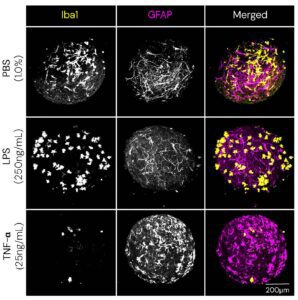
These findings are highly relevant for therapeutic development because neuroinflammation is not a single biological process. Disease states may involve different combinations of microglial activation, astrocytic dysfunction, oxidative stress, and neuronal injury. Models capable of distinguishing between these responses provide a more predictive framework for evaluating therapeutic candidates.
CNS-3D Inflammatory Organoids also support integration of functional calcium imaging with cytokine analysis, immunostaining, cytotoxicity assays, and molecular profiling. This approach addresses another persistent challenge in CNS drug development: many inflammatory assays quantify molecular markers without determining whether those changes correspond to preservation or disruption of neuronal function.
As neurodegenerative drug discovery continues to confront translational issues, interest is growing in models capable of reproducing human-specific cellular interactions and functional neuroimmune responses. Human brain organoid models help bridge the gap between preclinical findings and clinical outcomes by providing a more physiologically relevant framework for evaluating anti-inflammatory therapeutics in the CNS.

To learn more about CNS-3D Inflammatory Organoids, please visit 28bio.com.
The post Evaluating CNS Anti-inflammatory Therapies with Human Brain Organoids appeared first on GEN – Genetic Engineering and Biotechnology News.
Sponsored content brought to you by

Historical data indicate that animal models are not ideal for the determination of the efficacy and safety of human therapeutics. Ninety percent of drugs that pass animal studies do not receive regulatory approval. Improving predictive accuracy in preclinical tests is paramount, thus the movement toward more human-relevant models.
The goal to reduce the use of animals in preclinical testing changes testing paradigms. In April 2025, the U.S. FDA’s Roadmap to Reducing Animal Testing in Preclinical Safety Studies outlined a strategic, stepwise approach to replace animal testing with scientifically validated new approach methodologies (NAMs), such as organ-on-a-chip systems, computational modeling, and advanced in vitro assays. FDA Modernization Acts 2.0 and 3.0 facilitated this activity by empowering the agency to accept NAMs in lieu of animal studies.
Meanwhile, legislation from the EU, Directive 2010/63/EU, requires marketing authorization holders to integrate the 3Rs (Reduction, Refinement, and Replacement) and welfare standards for the treatment of animals in all aspects of the development, manufacture, and testing of medicines. In addition, last year, the U.K. delivered an expedited phase-out plan for animal use.
But it all began in 2020 with the launch of the FDA Innovative Science and Technology Approaches for New Drugs (ISTAND) pilot program to provide a pathway to qualify novel drug development tools (DDTs) that did not fit within the agency’s existing qualification programs. Qualified DDTs are defined as having a proven, specific use and can be incorporated in any drug development program for a particular context of use.
The pilot has advanced to a permanent DDT qualification program. To date, ISTAND has accepted eight submissions–two tools that assess preclinical safety without using animals, two methods involving tissues, and one statistical approach.
In a 2022 Communications Medicine study to test drug-induced liver injury (DILI), 870 human Emulate Liver-Chips created with cells from three different human donors were challenged with 27 different drugs. The human Liver-Chip predicted human DILI with 87% sensitivity and 100% specificity, ~7 to 8 times more accurate than the comparable animal models.1 These results prompted Emulate to submit a Letter of Intent (LOI) to ISTAND in 2024.
ISTAND accepted Emulate’s LOI for the first organ-on-a-chip DDT to predict DILI. The human Liver-Chip S1 was proposed to assess the risk of small molecule candidate drugs inducing DILI in adults to create human-relevant data for candidate drug IND submission.
The LOI acceptance was the entry point in a three-step rigorous qualification process. ISTAND required Emulate to qualify the in vivo-like physiological functionality of the Liver-Chip S1, and quantify its ability to predict DILI risk through changes in tissue morphology as well as alterations in albumin and alanine transaminase (ALT) protein concentrations when the chips were challenged with toxic drugs administered across eight concentrations.
Now, the Emulate Liver-Chip S1 is in the final stages of qualification. Two independent commercial users need to successfully produce similar results. Pending successful completion, the Liver-Chip will be the first FDA-approved DDT to assess the potential of a small-molecule candidate drug to cause DILI when a prior structurally similar small-molecule has shown DILI in the clinic.
Moving toward reduction and, in some cases, replacement of animal models demands both biological fidelity and throughput. For model development and target validation, the Zoë-CM2® Culture Module automates the precise condition needed to culture up to 12 chips.
For high-throughput options, the AVA Emulation System is a self-contained Organ-on-a-Chip workstation that fuses high-throughput microfluidic tissue culture, full environmental control, and real-time imaging into a single, compact benchtop unit. The Chip-Array
consumable integrates 12 independent Organ-Chips into an SBS format for 96-well streamlined workflows with multichannel pipettes and automated liquid handlers.
Reference
1. Ewart, L., Apostolou, A., Briggs, S.A. et al. Performance assessment and economic analysis of a human Liver-Chip for predictive toxicology. Commun Med 2, 154 (2022). doi.org/10.1038/s43856-022-00209-1.

Click Here to learn more about Emulate’s product portfolio emulatebio.com/resources/emulate-product-brochure.
The post Soon…the First Organ-on-a-Chip Qualified Drug Development Tool appeared first on GEN – Genetic Engineering and Biotechnology News.
A strong quarterly earnings report that beat analyst expectations, growth that extended into core pharma and biotech tools, plus improved investor guidance on revenue, operating margin, and earnings per share (EPS) were enough to send shares of Agilent Technologies (NYSE: A) jumping to their best one-day increase in nearly 24 years this past week.
Agilent shares surged 17% from $115.79 to $135.42 Thursday, the first trading day after the tools giant announced better-than-expected results for the second quarter of its 2026 fiscal year ending April 30. Agilent operates on a fiscal year that ends October 31. That was the best one-day performance since November 19, 2002, when the stock ballooned 16% to $134.50.
Shares inched up another 0.12% Friday, closing the week at $135.54—giving Agilent an 18% gain for the week and seven straight positive trading days.
Agilent finished Q2 of FY’26 with net income of $339 million or $1.20 a share, up 58% from $215 million or 75 cents a share a year earlier, on revenue that rose 10% to $1.835 billion from $1.668 billion in the year-ago quarter, the company announced after the close of trading on Wednesday.
Agilent’s “core” growth—which excludes the impact of currency and acquisitions and divestitures within the past 12 months—was 6.3%, exceeding the 4.8% growth forecasted by a consensus of Wall Street analysts cited by the company, as well as its earlier investor guidance of growth ranging from 4% to 5.5%. The consensus also predicted Q2 revenue of $1.79 billion, according to FactSet data cited by Barron’s.
Agilent moved quickly to raise the low end of its FY 2026 revenue guidance, from $7.3 billion to $7.39 billion, while trimming the upper end to $7.49 billion from $7.5 billion. The latest guidance remains above the initial FY 2026 forecast of between $7.3 billion and $7.4 billion.
Agilent also raised its guidance on operating margin from 75 to 85 basis points, and on FY 2026 non-GAAP EPS, which is now projected to range from an even $6 to $6.10, an increase of eight cents at the midpoint from the previous range of $5.90 to $6.04, which was raised in February from the initial range of $5.86 to $6. The analyst consensus predicts a lower EPS of $5.97.
“All in, F2Q was a strong follow-up quarter to the weather-related headwinds seen in F1Q and, looking ahead, we continue to see Agilent as a clean tools story to own with upside from reshoring, CDMO [contract development and manufacturing organization] capacity ramping and AI [artificial intelligence] investments in pharma over the long-term,” Casey Woodring, vice president, equity research with J.P. Morgan, and three colleagues wrote in a research note.
In a separate report also issued by J.P. Morgan, Woodring and colleagues concluded that AI-driven shortening of timelines for target identification and hypothesis generation “could increase subsequent wet lab validation volume, benefiting high-throughput instruments and multi-omics tool providers, while potentially pressuring lower-throughput/animal-model-adjacent tools.”
Agilent is one of seven biopharma tools developers likely to benefit as a result, the J.P. Morgan analysts wrote. The firm retains an “Overweight” rating and $180 price target on Agilent.
Agilent president and CEO Padraig McDonnell told analysts on the company’s May 27 earnings call that pharma customers are leaning into AI to accelerate drug development and reduce the odds of costly late-stage failures.
“There is a growing need for large-scale multi-modal datasets to train AI models, which will require significant investments in the wet lab,” McDonnell said. “By moving the needle on drug development ROI, AI holds the promise of putting our largest customer constituency on a better footing. A higher number of approvals coming through the drug pipeline should be a strong tailwind for us, given our leading position in downstream manufacturing QA/QC workflows.
Puneet Souda, senior managing director, life science tools and diagnostics and a senior research analyst with Leerink Partners, added that given Agilent’s guidance mostly rose by the amount results beat consensus forecasts, “we continue to see an attractive setup for A [Agilent]” and likes the company’s position across multiple end-markets—citing chemicals and applied markets (C&AM), QA/QC instrumentation, and biopharma.
Souda maintained Leerink’s “Outperform” rating on Agilent shares and raised the firm’s 12-month price target by 3%, to $170 from $165, based on the improved guidance.
Michael Ryskin, research analyst with BofA Securities, showed even more enthusiasm about Agilent’s prospects, upgrading his firm’s rating on the company’s shares from “Neutral” to “Buy”—but trimming by 3% its price target from $150 to $145, a multiple reflecting a lower estimate of 18 times Agilent’s FY 2027 earnings before interest, taxes, depreciation, and amortization (EBITDA), from 19 times EBITDA.
“Key growth drivers such as LC and GC replacement cycles continue to deliver (and remain in early innings), execution is solid across the board, and there were few new negative surprises to derail the momentum (despite widespread fears of chemicals slowdown),” Ryskin wrote. “Combined with a very reasonable valuation, and a myriad of issues elsewhere in tools, we see Agilent as an increasingly attractive asset.”
So too did analysts from four other investment firms, which responded to Agilent’s results by raising their price targets on Agilent stock:
But Brandon Couillard, managing director, Life Science Tools & Diagnostics and an equity research analyst at Wells Fargo, lowered his firm’s price target on Agilent’s shares 3%, to $160 from $165, reasoning that the lower price would yield a more realistic 18.71% difference between the stock’s current price and what the firm predicts it is worth. Couillard maintained Wells Fargo’s “Overweight.”
Instruments grew by high single digits during Agilent’s fiscal second quarter, driven by continued positive low double-digit revenue increases in liquid chromatography (LC), LC/mass spectrometry (MS), and gas chromatography (GC) instrument sales.
“I think we’ll continue to see strong momentum on the LC-MS and GC,” McDonnell told analysts. “We expect the LC replacement cycle to be a 200–300 bps [basis points, or 2–3%] tailwind to the LC growth. We’ve seen that normal trajectory of the replacement cycle, but continued momentum and funnels look really strong. I will say it was actually the best market share data I’ve seen.”
“Not only are we replacing, but we’re also taking share in competitive accounts, which again, continues the momentum,” he added.
McDonnell said the instrument sales surge was driven by three compelling reasons: Past underinvestment in replacing aging tools by biopharma customers; favorable capital expenditure or “CapEx” conditions in the United States and Europe, “and, of course, customer-focused innovations.”
“We expect that to continue, and we’re seeing it across all markets,” McDonnell added.
During the second fiscal quarter, Agilent said, its core pharma and biotech business rose 6%. Tycho Peterson, equity analyst with Jefferies, noted that Agilent’s biopharma results marked its fifth straight quarter of mid-single-digit growth, led by factors that, according to the company, include:
“Large cap” biotechs with a market capitalization (share price times the number of outstanding shares) of $10 billion or more accounted for a low double-digit increase in sales that outpaced sales from small- and mid-cap biotech—though positive demand signals are emerging, tied to funding. And while China sales fell by high single digits overall, Agilent generated revenue that grew in the high teens year-over-year from biotech companies there, Peterson reported.
Biopharma activity is recorded within Agilent’s Life Sciences and Diagnostics Group (LDG) segment, which year-over-year rose 12% (9% core) to $732 million during the quarter. Among the company’s two other reporting segments, the Applied Markets Group (AMG) saw growth of 14% (11% core) to $344 million, while the Agilent CrossLab Group (ACG) grew 6% (2% core) to $759 million.
LDG includes LC-MS instrument platforms, cell and biomolecular analysis, specialized CDMO services, pathology, companion diagnostics, and genomics. AMG includes GC-MS, spectroscopy, and vacuum technology platforms. ACG supports customers in all end markets through services, software and informatics, automation, and consumables.
In consumables, Agilent said sales of its Altura Ultra Inert HPLC [high-performance LC] columns grew more than 50% quarter-over-quarter, reaching 75% of the top 20 biopharma accounts.
“This rapid adoption reinforces the strength of the innovation engine and the unified commercial organization. We will continue to build on that strong initial momentum with additional waves of column launches,” McDonnell vowed.
Another expected source of biopharma growth in the coming months, Peterson of Jefferies observed, is orders for new tools from drug and tools developers reshoring their operations in the United States. Re-shoring orders are expected by fiscal year-end 2026, with revenue contributions beginning in the 2027 fiscal year that begins on November 1 of this year.
Biopharma is part of Agilent’s Life Sciences and Diagnostics Markets segment, which consists of seven areas of activity: Providing active pharmaceutical ingredients for oligo-based therapeutics, as well as solutions that include reagents, instruments, software, and consumables, which enable customers in the clinical and life sciences research areas to interrogate samples at the cellular and molecular level.
“You look at the long-term drivers in pharma, you see redistribution of supply chains, expansion of biologics, and, of course, you see many other factors really helping. What I would say is that we’re very much downstream in QA/QC,” McDonnell said during the earnings call. “We’re in development as well. We’re right in that sweet spot for reshoring, replacement cycle, and any capacity or supply chain resilience around, feel really good about that.”
The post StockWatch: Agilent Shares Jump on Better than Expected Quarterly Results appeared first on GEN – Genetic Engineering and Biotechnology News.
CHICAGO — Rachna Shroff, a physician and pancreatic cancer expert, was seeing patients at the University of Arizona Cancer Center in April when she heard the striking clinical results about an experimental pill called daraxonrasib. Patients taking the targeted drug lived nearly twice as long as patients offered standard chemotherapy — an outcome never seen before in the pancreatic cancer field.
“Having treated pancreatic cancer for 16 years, I actually started crying in the clinic,” Shroff said at a media briefing. “This is such an incredibly impactful study for our patients.”
On Sunday, detailed results from the daraxonrasib clinical trial conducted by the drug’s maker, the biotech company Revolution Medicines, were presented here at the plenary session of the annual meeting of the American Society of Clinical Oncology. The study was published simultaneously in the New England Journal of Medicine.
Nature Biotechnology, Published online: 29 May 2026; doi:10.1038/s41587-026-03158-5
Radio waves are shown to modulate fluorescence and associate spin chemistry in proteins.
Pfizer and Innovent Biologics will partner to research and develop 12 early-stage and de novo antibodies and antibody-drug conjugates (ADCs) designed to treat various cancers, the companies said today, through a collaboration that could generate up to $10.5 billion for the Chinese biotech.
The companies said they have signed a strategic global licensing and collaboration agreement that includes licensing, co-development, and co-commercialization deals for both the ADCs, which would be created with payloads that differentiate them from other conjugates, as well as multi-specific antibodies, to be developed with unique designs and differentiated immune-engaging features.
Pfizer and Innovent plan to work across a portfolio of 12 programs—eight early-stage programs originating with Innovent, and four Pfizer discovery programs. The companies said they will co-develop and share costs for selected programs as they advance them through clinical development.
The collaboration is intended to marry Pfizer’s global scientific, clinical development, regulatory, and commercial scale capabilities with Innovent’s scientific discovery and clinical capabilities in oncology.
“By combining Innovent’s discovery and early clinical development with Pfizer’s global research and development and commercialization capabilities, we have an opportunity not only to strengthen our pipeline, but to accelerate the delivery of breakthroughs that can redefine standards of care and make a meaningful difference in patients’ lives,” Jeff Legos, Pfizer’s chief oncology officer, said in a statement.
Like other biopharma giants, Pfizer is racing the proverbial “patent cliff” by building a pipeline of new treatments capable of recouping the billions that it stands to lose in coming years as its aging blockbuster drugs lose patent exclusivity in the U.S. and other key markets.
GEN’s A-List of Top 20 Drugs Heading for the Patent Cliff through 2029 includes two Pfizer treatments. One is Prevnar 13/Prevenar 13 (pneumococcal 13-valent conjugate vaccine [diphtheria CRM197 Protein]), which lost U.S. exclusivity starting March 31; and the prostate cancer drug Xtandi® (enzalutamide), co-marketed with Astellas Pharma and set to lose U.S. exclusivity in 2027.
Pfizer generated $6.494 billion last year, up 1% from 2024, and another $1.69 billion in the first quarter, up 2% from a year ago, in revenues from its Prevnar family, which includes Prevnar 20/Prevenar 20 (Pneumococcal 20-valent Conjugate Vaccine), as well as the Prevnar 13/Prevenar 13 vaccines.
Xtandi racked up $2.194 billion in 2025, up 8% from a year earlier, and $444 million in Q1, down 3% from the year-ago quarter, in revenues in the U.S. and more than 90 other countries, including the EU and Japan—primarily reflecting alliance revenues and royalty revenues.
Oncology is among therapeutic areas where Pfizer has sought to bolster its pipeline and portfolio of marketed drugs in recent years. The pharma giant acquired ADC-focused drug developer Seagen for $43 billion in 2023, a deal that cleared expected antitrust hurdles and doubled Pfizer’s oncology pipeline to some 60 programs spanning multiple modalities, including ADCs, small molecules, bispecifics and other immunotherapies.
Last year, Pfizer launched an up-to-$1.5 billion global ex-China licensing agreement with another Chinese biotech, 3SBio. In that deal, Pfizer agreed to pay $1.25 billion upfront, make a $100 million equity investment in 3SBio equity, and pay up to $150 million in return for an option for exclusive development and commercialization rights in China to SSGJ-707, a bispecific antibody targeting PD-1 and VEGF.
Outside of oncology, Pfizer acquired obesity drug developer Metsera for up-to-$10 billion last October following a bidding war with Novo Nordisk that ended with some help from Washington.
And in February, Pfizer inked a commercialization deal of undisclosed value with Chinese drug developer Hangzhou Sciwind Biosciences giving Pfizer exclusive commercialization rights in China to the obesity therapy ecnoglutide, an new‑generation cAMP‑biased glucagon-like peptide 1 (GLP‑1) receptor agonist delivered via injection.
While Innovent has successfully developed an obesity treatment, mazdutide, the company specializes in cancer drug development, building a combined portfolio and development pipeline of 37 programs—23 of them in oncology including the PD-1 inhibitor Tyvyt® (sintilimab). The fully human IgG4 monoclonal antibody was first approved in China in 2018 and is now indicated to treat three forms of non-small cell lung cancer, classic Hodgkin’s lymphoma, and forms of endometrial, gastric/esophageal, kidney, and liver cancers.
“By leveraging both companies’ complementary resources, we can develop our early-stage oncology pipeline with greater speed and impact to help bring innovative therapies to patients more efficiently worldwide,” stated Hui Zhou, MD, PhD, Innovent’s chief R&D officer for its oncology pipeline. “Furthermore, co-developing and co-commercializing key projects in the U.S. and Europe expands Innovent’s global reach.”
Innovent plans to carry out development of the Pfizer-partnered programs through Phase I, applying its discovery engine and robust early clinical capabilities, after which Pfizer will oversee future global development. Pfizer will receive an exclusive global license for four programs, and assume their global development costs, as well as an exclusive license outside Greater China for four other programs, having agreed to shoulder an unspecified majority of the development costs.
Pfizer and Innovent also agreed to co-develop four programs globally, sharing their development costs. The companies plan to co-commercialize in the U.S., the European Union (E.U.), and the United Kingdom (U.K.), agreeing in return to share their profits—while Innovent will retain Greater China rights to these programs.
Pfizer has agreed to pay Innovent $650 million upfront and up to $9.85 billion in payments tied to achieving development, regulatory, and commercial milestones. Pfizer also agreed to pay Innovent up to double-digit royalties on sales of each licensed product if approved, with the companies agreeing to share their profits in the U.S., the EU, and the U.K.
The collaboration transaction is expected to close in the third quarter, subject to regulatory approvals.
In October, Innovent launched an up to $11.4 billion collaboration with Takeda Pharmaceutical aimed at speeding up the development of Innovent’s next-generation immuno-oncology therapies as well as ADCs.
The post Pfizer, Innovent Ink Up-to-$10.5B+ Cancer Treatment Collaboration appeared first on GEN – Genetic Engineering and Biotechnology News.
Researchers headed by a team at King’s College London have developed a new way of designing antibiotics that could support the discovery of new treatments for drug-resistant infections.
Designed to overcome one of the ways bacteria escape antibiotic treatment, the Efflux Resistance Breaker (ERB) approach allows researcher to chemically redesign antibiotics so that they are less easily removed from the cells by bacterial efflux pumps. The technology could also help revive antibiotics that have lost effectiveness due to the evolution of efflux-mediated resistance.
Study lead Professor Khondaker Miraz Rahman, PhD, a professor of medicinal chemistry at King’s College London, said: “Antimicrobial resistance is rising, but the number of truly new antibiotics in development remains worryingly low. Our work shows that we can redesign antibiotics so they stay inside bacterial cells at higher concentrations and overcome resistance mechanisms that would normally make them ineffective. This approach could help us design better new antibiotics, but it could also help revive existing antibiotic classes that bacteria have learned to defeat.”
Rahman is senior author of the team’s published paper in Journal of Medicinal Chemistry, titled “Designing Antibiotics with Inherent Resistance to Efflux as a Strategy to Revive Discovery against Multidrug-Resistant Pathogens.”
Worldwide increase in antimicrobial resistance (AMR) is threatening new developments in antibiotics, the authors noted. “The development and approval of new antibiotics are currently being outpaced by the emergence of resistance to existing drugs, a trend that must be reversed to ensure the long-term effectiveness of antibiotics.”
Many bacteria use molecular pumps, known as efflux pumps, to push antibiotics out of the cell before the drugs can reach levels high enough to kill them. This reduces the amount of antibiotic inside the bacteria and allows resistant infections to survive. Previous strategies have tried to combine antibiotics with separate efflux pump inhibitors (EPIs), the team continued. “Efflux pump inhibitors (EPIs) have been pursued as adjunct therapies to safeguard approved antibiotics prone to efflux-based resistance.” However, no EPI has yet been approved. “As well as a lack of mechanistic insight and biochemical information regarding efflux pumps, we opine that this failure is rooted in a fundamental flaw in the EPI-antibiotic combination approach: that the antibiotics remain unmodified substrates and can be effluxed by different pumps despite the presence of EPIs,” the authors noted.
The study by Rahman and colleagues has now shown that antibiotics can be chemically redesigned so they are less easily removed by these pumps. Their approach builds resistance-breaking properties directly into the antibiotic molecule, meaning that the antibiotic is designed to protect itself from being pumped out, allowing it to remain inside the bacterial cell at higher concentrations, and so restoring its ability to kill bacteria even when resistance mechanisms are present.
Importantly, the work shows that the ERB approach could support a new way of developing antibiotics by building resistance-breaking properties directly into their design. In their reported study the team developed ERB-modified fluoroquinolones and demonstrated their effectiveness against multiple bacterial pathogens, and in mouse infection models. The study provides an important proof of concept for antibiotic discovery, showing that maintaining high intracellular antibiotic concentration can help overcome resistance, including in bacteria that already show reduced susceptibility to existing antibiotics. “This study demonstrates that ERB modification enhances intracellular accumulation, reduces efflux susceptibility, and preserves antibacterial potency, as supported by complementary mechanistic, biochemical, and in vivo evidence,” the scientists concluded.
Added J. Mark Sutton, PhD, at the UK Health Security Agency, a key collaborator on this project, “Efflux pumps are a major cause of antibiotic resistance because they reduce the concentration of drug inside the bacterial cell. This study shows that rational chemical design can be used to overcome that problem. By building efflux resistance directly into the antibiotic, we may be able to restore activity against bacteria that are no longer controlled by current drugs.”
The researchers believe the ERB platform could be used as a general strategy to design antibiotics with built-in resilience to efflux-mediated resistance. Their team describes the ERB technology as a framework for developing next-generation antibiotics and for revitalizing existing drugs. “Beyond revitalizing existing drugs, ERB technology provides a general framework for designing next-generation antibiotics with built-in resilience to efflux-mediated resistance at the earliest stages of discovery,” they stated.
The team says it will work towards commercializing the ERB technology and advancing antibiotics developed using this strategy towards clinical development, with the aim of translating this discovery into new treatment options for drug-resistant infections.
The post Antibiotic Design Strategy Overcomes Efflux-Mediated Resistance in Preclinical Study appeared first on GEN – Genetic Engineering and Biotechnology News.