Approaches to Reducing Toxicity and Side Effects in Cell and Gene Therapy

Cell and gene therapy encompasses a broad range of therapeutic interventions for diseases that have proved refractory to treatment with conventional pharmaceutical approaches. Perhaps the most familiar FDA-approved modality in the cell and gene therapy field is chimeric antigen receptor (CAR) T-cell therapy, which involves genetic modification of a patient’s own T cells to identify and eliminate malignant cell lineages in acute lymphoblastic leukemia, non-Hodgkin lymphoma, and multiple myeloma.

Although only 20 or so cell or gene therapies have been FDA-approved, the area holds considerable promise for investment. The global market was valued at nearly $9 billion in 2025, and growth has been projected at over 15% per year from 2026 to 2035. As with any pharmaceutical product, however, the potential of cell and gene therapy relies in large part upon minimizing risks to patient health from adverse effects. Numerous companies, from both prominent names in the field to smaller startups, are developing solutions to mitigate the deleterious consequences of cell and gene therapy.

Reducing cytokine release syndrome

Cytokines are a broad family of small proteins and peptides that cell lineages of the innate and adaptive immune systems employ to communicate with each other and coordinate timely and appropriately scaled responses to foreign antigen-containing cells. Cytokine release syndrome (CRS) occurs when hyperactivation of one or more immune lineages results in the release of excessive quantities of cytokines into the circulation.

“As a scientific community, we’ve been researching CAR T-cell therapy for over 30 years and have grown together in our understanding of the body’s immune response to treatment, from both a safety and efficacy perspective,” says Rosanna Ricafort, MD, vice president and global program lead of hematology and cell therapy at Bristol Myers Squibb. “We have evolved our ability to characterize, stage, and manage potential side effects, allowing for timely and thoughtful interventions of the most commonly associated side effects like CRS.”

Ricafort cited clinical data presented at the 2025 American Society for Clinical Oncology (ASCO) meeting in Chicago demonstrating that over 95% of instances of CRS and other adverse events arising from BMS’s CD19-directed CAR T-cell therapy (BreyanziR) occurred in the first two weeks after onset of therapy. “These and other studies have helped establish the largely predictable safety profile of CAR T-cell therapy to date,” Ricafort pointed out.

Minimizing side effects

The NF-κB and prostaglandin E2 pathways are prominent regulators of the activation and differentiation of pro-inflammatory T cell lineages. Excessive signaling through these pathways results in cytokine amplification, which contributes to CRS and immune effector cell-associated neurotoxicity syndrome (ICANS), a complication of some types of CAR T-cell therapy.

CytoAgents, a clinical-stage biotech company, is developing CTO1681, an orally administered prostaglandin signaling inhibitor that has been shown to offset CRS and ICANS toxicities associated with CAR T-cell therapy of lymphoma patients. At the 2025 European Society for Medical Oncology (ESMO) Immuno-Oncology Congress in London, CytoAgents presented non-clinical data showing that CTO1681 treatment reduced secretion of TNF-α, IL6, and other key CRS-associated cytokines with no impairment of CAR T-cell mediated cytotoxicity on lymphoma cells.

“These data suggest CTO1681 could enable safer CAR T-cell therapy administration, support outpatient treatment paradigms, and broaden patient access without compromising anti-tumor efficacy,” said Teresa Whalen, CEO at CytoAgents. CTO1681 is currently in Phase Ib/IIa trials for cancer patients undergoing CAR T-cell therapy, with potential expansion into additional therapeutic spaces including asthma and chronic obstructive pulmonary disease.

Adding immunosuppressants

A potential side effect of adeno-associated virus (AAV)-based gene transfer approaches is acute liver injury resulting in part from CRS in patients receiving AAV therapy. Duchenne muscular dystrophy (DMD) is a progressive, degenerative muscular disorder caused by mutations or changes in the DMD gene, resulting in reduced levels of the protein dystrophin.

Adeno-associated virus
Credit: Kateryna Con / Getty Images / Science Photo Library

Elevidys, developed by Sarepta Therapeutics, is an AAV-based therapy approved for the treatment of DMD that stimulates targeted production of a truncated form of dystrophin in skeletal muscle. “Individuals with non-ambulatory Duchenne face profound unmet need and fewer treatment options,” says Louise Rodino-Klapac, PhD, president of R&D and development and technical operations at Sarepta. Topline data released earlier this year showed that Elevidys treatment resulted in significant improvement in key clinical ambulatory metrics in patients.

As part of its ENDEAVOR clinical trial, Sarepta Therapeutics is evaluating the potential of supplementing Elevidys with sirolimus to reduce potential acute liver injury (ALI) complications. Sirolimus is a mammalian target of rapamycin (mTOR) kinase inhibitor that suppresses responses of T and B cells to interleukin 2, which functions to stimulate proliferation of helper, cytotoxic, and regulatory T cells.

Developing non-integrating therapies

As an alternative approach to supplementing cell and gene therapy modalities with existing immunosuppressants, other companies are modifying CAR T-cell therapy to reduce the risk of CRS and other side effects. Myasthenia gravis, a chronic fatigue-inducing autoimmune disorder in which signals between nerves and muscles are compromised, results in part from the secretion of autoantibodies from B-cell maturation antigen (BCMA)-expressing B plasma cells.

Conventional BCMA-directed CAR T-cell approaches rely on the integration of lentiviral or gamma-retroviral vectors to encode the CAR and typically involve lymphodepletion chemotherapy that can be accompanied by acute and delayed toxicity. In contrast, non-integrating (i.e., mRNA-based) BCMA-directed CAR T-cell therapies may circumvent this toxicity due to the lack of requirement for chemotherapy.

Cartesian Therapeutics is developing an mRNA-based BCMA-targeted CAR T-cell therapy for myasthenia gravis, Descartes-08. At the 2025 American Academy of Neurology (AAN) Annual Meeting in San Diego, results were reported of a Phase IIb clinical trial of Descartes-08 in myasthenia gravis. In the trial, adverse event rates were similar between groups receiving Descartes-08 and the placebo group, and were predominantly mild to moderate in nature, with no cases of CRS or ICANS reported.

“The impressive strength and duration of response shown in the data reinforce our confidence in the potential of Descartes-08 to transform the current treatment landscape in MG, offering patients a safe, flexible, and durable treatment option,” said Carsten Brunn, PhD, president and CEO of Cartesian.

Engineering chimeric receptors

Modifications of CAR T-cell therapy to improve clinical efficacy and reduce side effects can also encompass modification of the molecular structure of the chimeric receptor itself. D domains are highly selective targeting domains incorporated into newer generations of CARs that enhance targeting of pathological cell types and reduce immunogenic responses in patients that give rise to unwanted side effects.

One example of such next-generation CAR T-cell therapies, anito-cell, has been co-developed by Arcellx, Kite Pharma, and Gilead. Anito-cel is an autologous anti-BCMA CAR T-cell therapy for the treatment of relapsed/refractory multiple myeloma patients.

Phase II trial results in multiple myeloma presented at the 2025 American Society of Hematology (ASH) meeting in Orlando showed an overall response rate of 97% and a complete response rate of 68%. Importantly, in the context of side effects, there were no delayed neurological symptoms, and for most patients, only low-grade CRS was observed, which was resolved within a few days.

“The anito-cel D-domain BCMA binder could be important to our work in in vivo cell therapy, further strengthening our potential in oncology and inflammation,” said Daniel O’Day, chairman and CEO of Gilead. “Anito-cel could become a foundational treatment for multiple myeloma over time, including earlier lines of therapy.”

The post Approaches to Reducing Toxicity and Side Effects in Cell and Gene Therapy appeared first on GEN – Genetic Engineering and Biotechnology News.

Top 10 Best Selling Gene Therapies

The groundbreaking partnership that successfully treated a rare metabolic disorder in KJ Muldoon, or “Baby KJ,” with personalized CRISPR therapy last year has led therapy developers, researchers, and regulators, including the FDA, to craft a pathway for expanding the universe of gene therapies to advance the development of N-of-1 gene-editing therapies.

In February, the FDA unveiled its Plausible Mechanism Pathway draft guidance, a series of initiatives designed to increase regulatory flexibility and spur the development of bespoke gene-editing therapies for rare and ultra-rare disorders, which collectively total about 30 million individuals in the United States.

“The Agency anticipates that substantial evidence of effectiveness for individualized therapies could be established based on a single adequate and well-controlled clinical investigation with confirmatory evidence,” the draft guidance stated.

Last June, at a historic roundtable of cell and gene therapy researchers and clinicians hosted by the FDA, base editing pioneer David Liu, PhD, of Harvard University and the Broad Institute of MIT and Harvard, stated: “With sufficient organization and federal support and partnership with the FDA, I believe it will be possible by 2030 to treat at least 1,000 patients with personalized genetic treatments.”

Meanwhile, conventional gene therapy development continued in 2025. Last year saw four U.S. gene therapy approvals, bringing the number of FDA-approved gene and cell therapies up to 26, according to the American Society of Gene and Cell Therapies (ASGCT)—more than half of the 40 tallied by the organization as being approved worldwide.

Of those 26, 18 were gene therapies, of which 10 had disclosed sales high enough to be included on this A-List, which ranks top-selling gene therapies based on sales and net product revenue figures furnished by the companies in regulatory filings, annual reports, and/or press releases. Each gene therapy is listed with its sponsor(s), type, indication, and initial FDA approval date.

Not included are gene therapies with sales below the top 10, a category that includes two gene therapies approved in 2025: Precigen’s Papzimeos™ (zopapogene imadenovec-drba), which generated $3.4 million in net product revenue last year after becoming the first-and-only FDA-approved treatment for adults with recurrent respiratory papillomatosis (RRP) in August; and Abeona Therapeutics’ Zevaskyn® (prademagene zamikeracel), an autologous cell sheet-based gene therapy approved to treat wounds in adults and children with recessive dystrophic epidermolysis bullosa (RDEB).

Three gene therapies did not have disclosed sales in 2025, including:

  • Encelto™ (revakinagene taroretcel-lwey), an allogeneic encapsulated cell-based gene therapy marketed by Neurotech Pharmaceuticals and indicated for the treatment of adults with idiopathic macular telangiectasia type 2 (MacTel).
  • Imlygic® (talimogene laherparepvec), a genetically modified oncolytic viral therapy marketed by BioVex (Amgen) and indicated for local treatment of unresectable cutaneous, subcutaneous, and nodal lesions in patients with melanoma recurrent after initial surgery.
  • Waskyra™ (etuvetidigene autotemcel), a cell-based gene therapy and the first FDA-approved treatment for Wiskott-Aldrich syndrome (WAS). Developer Fondazione Telethon is the first non-profit organization to have successfully led full development of an ex vivo gene therapy from lab research (at Milan’s San Raffaele Telethon Institute for Gene Therapy or SR-Tiget) to regulatory approval.

Also not included this year are sales of three gene therapies that had been marketed by Bluebird Bio: Beta thalassemia treatment Zynteglo™ (betibeglogene autotemcel), sickle cell disease treatment Lyfgenia® (lovotibeglogene autotemcel), and cerebral adrenoleukodystrophy (CALD) treatment Skysona® (elivaldogene autotemcel).

Last year, Bluebird Bio went private after being acquired by funds managed by Carlyle and SK Capital Partners, then rebranded in September as Genetix Biotherapeutics. Genetix does not disclose sales but did announce on March 2 that more than 100 patients received infusions of the three gene therapies during 2025.

Also last year, Pfizer halted development and commercialization of Beqvez™ (fidanacogene elaparvovec-dzkt), which had been co-marketed with Roche-owned Spark Therapeutics, after it generated no sales in 2024. Last August, Pfizer terminated its license agreement with Spark for Beqvez, an adeno-associated virus (AAV) vector-based gene therapy indicated for forms of moderate to severe hemophilia B in adults.


Top 10 Best Selling Gene Therapies


1. Zolgensma®  (onasemnogene abeparvovec-xioi)

2025 Sales: $1.232 billion 1

Sponsor(s): Novartis2

Type: AAV vector-based gene therapy

Indication(s): Treatment of pediatric patients less than two years of age with spinal muscular atrophy (SMA) with biallelic mutations in the survival motor neuron 1 (SMN1) gene.

Initial FDA Approval Date: May 24, 2019


2. Elevidys®  (delandistrogene moxeparvovec-rokl)

2025 Sales: $898.7 million

Sponsor(s): Sarepta Therapeutics

Type: AAV vector-based gene therapy

Indication(s): Treatment of ambulatory pediatric patients aged four through five years with Duchenne muscular dystrophy (DMD) with a confirmed mutation in the DMD gene.3

Initial FDA Approval Date: June 22, 2023 (Accelerated Approval)


3. Vyjuvek®  (beremagene geperpavec-svdt)

2025 Sales: $389.13 million

Sponsor(s): Krystal Biotech

Type: Herpes-simplex virus type 1 (HSV-1) vector-based gene therapy

Indication(s): Treatment of wounds in patients six months of age and older with dystrophic epidermolysis bullosa with mutation(s) in the collagen type VII alpha 1 chain (COL7A1) gene.

Initial FDA Approval Date: May 19, 2023


4. Adstiladrin®  (nadofaragene firadenovec-vncg)

2025 Sales: €172.673 million ($199.329 million)

Sponsor(s): Ferring Pharmaceuticals

Type: Non-replicating adenoviral vector-based gene therapy

Indication(s): Treatment of adults with high-risk Bacillus Calmette-Guérin (BCG)-unresponsive non-muscle invasive bladder cancer (NMIBC) with carcinoma in situ (CIS) with or without papillary tumors.

Initial FDA Approval Date: December 16, 2022


5. Casgevy®  (exagamglogene autotemcel; “exa-cel”)

2025 Sales: $115.8 million

Sponsor(s): Vertex Pharmaceuticals and CRISPR Therapeutics

Type: Autologous genome-edited hematopoietic stem cell-based gene therapy

Indication(s): Treatment of patients aged 12 years and older with sickle cell disease with recurrent vaso-occlusive crises (VOCs), or transfusion-dependent β-thalassemia (TDT).

Initial FDA Approval Date: December 8, 2023


6. Hemgenix®  (etranacogene dezaparvovec-drlb)

2025 Sales: A$92 million ($64.9 million)4

Sponsor(s): CSL Behring

Type: AAV vector-based gene therapy

Indication(s): Treatment of adults with Hemophilia B (congenital Factor IX deficiency) who currently use Factor IX prophylaxis therapy, or have current or historical life-threatening hemorrhage, or have repeated, serious spontaneous bleeding episodes.

Initial FDA Approval Date: November 22, 2022


7. Kebilidi™ / Upstaza®  (eladocagene exuparvovec-tneq)5

2025 Sales: $56.626 million

Sponsor(s): PTC Therapeutics

Type: AAV vector-based gene therapy

Indication(s): Treatment of adult and pediatric patients with aromatic L-amino acid decarboxylase (AADC) deficiency.

Initial FDA Approval Date: November 13, 2024


8. Luxturna®  (voretigene neparvovec-rzyl)

2025 Sales: CHF 41 million ($51.8 million)

Sponsor(s): Spark Therapeutics (Roche)

Type: Adeno-associated virus vector-based gene therapy

Indication(s): Treatment of patients with confirmed biallelic RPE65 mutation-associated retinal dystrophy. Patients must have viable retinal cells as determined by the treating physician(s).

Initial FDA Approval Date: December 18, 2017


9. Lenmeldy™ / Libmeldy™  (atidarsagene autotemcel)6

2025 Sales: ¥6.4 billion ($40.2 million)

Sponsor(s): Orchard Therapeutics (a wholly owned subsidiary of Kyowa Kirin)

Type: Autologous hematopoietic stem cell-based gene therapy

Indication(s): Treatment for children with pre-symptomatic late infantile (PSLI), pre-symptomatic early juvenile (PSEJ), or early symptomatic early juvenile (ESEJ) metachromatic leukodystrophy (MLD).

Initial FDA Approval Date: March 18, 2024


10. Roctavian®  (valoctocogene roxaparvovec-rvox; “val-rox”)

2025 Sales: $36 million

Sponsor(s): BioMarin Pharmaceutical

Type: AAV vector-based gene therapy

Indication(s): Treatment of adults with severe hemophilia A (congenital factor VIII deficiency with factor VIII activity < 1 IU/dL) without pre-existing antibodies to AAV serotype 5 detected by an FDA-approved test.

Initial FDA Approval Date: June 30, 2023

References

  1. Includes sales of ITVISMA® (onasemnogene abeparvovec-brve), approved by the FDA in November 2025 to treat SMA in adult and pediatric patients two years of age and older with a confirmed mutation in the SMN1 gene. ITVISMA has the same active ingredient as Zolgensma but is administered via a single intrathecal injection, while Zolgensma is administered intravenously.
  2. Novartis is the successor to AveXis, which successfully completed the development of Zolgensma in 2019 by receiving FDA approval for the therapy. In 2014, AveXis licensed from REGENXBIO the AAV9 vector used in the Phase I SMA clinical trial at Nationwide Children’s Hospital. REGENXBIO licensed exclusive rights to key intellectual property covering novel recombinant AAV vectors discovered at the University of Pennsylvania in the lab of James M. Wilson, MD, PhD.
  3. Following the deaths of two DMD patients receiving Elevidys last year, Sarepta halted shipments of Elevidys for non-ambulatory patients and paused the Phase III ENVISION trial (NCT05881408). The study remained paused at deadline. Following a third death, that of an eight-year-old Brazilian boy, the FDA demanded Sarepta pause shipments of Elevidys to ambulant patients. Sarepta initially refused before agreeing in July 2025. A few days later, after an FDA reversal, Sarepta resumed Elevidys shipments to ambulant patients, after Brazilian authorities ruled out treatment with the gene therapy as a factor in the boy’s death.
  4. Sales figure is for the fiscal year ending June 30, 2025. CSL Behring has since disclosed sales of $57 million ($40.2 million) for July–December 2025 but has only furnished a comparison to the year-ago period in terms of constant currency without disclosing a specific sales figure.
  5. Eladocagene exuparvovec-tneq is marketed as Kebilidi in the U.S. and as Upstaza outside the U.S.
  6. Atidarsagene autotemcel is marketed as Lenmeldy in the U.S. and as Libmeldy within the European Union.


The post Top 10 Best Selling Gene Therapies appeared first on GEN – Genetic Engineering and Biotechnology News.

Going Non-Viral: Gene Delivery Enters Its Translation Era

Kunwoo Ryan Lee
Kunwoo Ryan Lee, PhD
CEO, BreezeBio

Kunwoo Ryan Lee, PhD, knew as early as 2012 that solving the delivery problem would be crucial in fulfilling the promise of the newly discovered CRISPR-Cas9 gene editing technology. He felt strongly that gene editing had potential to transform medicine by curing genetic disorders, but the viral and non-viral vectors available at the time had significant drawbacks. With the support of CRISPR pioneers Jennifer Doudna and Stanley Qi, Lee completed his doctoral thesis on a gold nanoparticle delivery system for Cas9 ribonucleoprotein. He went on to co-found BreezeBio, formerly GenEdit, in 2016 with the aim of creating the next generation of gene editing-based therapeutics. To realize that goal, Lee and his team looked beyond traditional viral gene delivery systems and instead invented a new technology from the ground up.

Most clinical gene therapy trials use viral vectors, including retroviruses, lentiviruses, adenoviruses, and adeno-associated viruses. However, viral vectors are limited in the size of the gene they can deliver. They also tend to trigger strong immune reactions and usually can’t be dosed more than once due to acquired immunity.

Non-viral vectors are an alternative technology that offer greater gene loading capacity, more straightforward preparation, and less likelihood of triggering problematic immune reactions. BreezeBio and other biotechnology companies are reimagining gene delivery through non-viral approaches like targeted LNPs, transposons, and novel chemistry.

BreezeBio’s laboratory
Flow cytometry analysis of immune cells in BreezeBio’s laboratory. [BreezeBio]

BreezeBio’s hydrophilic nanoparticle (HNP) platform, NanoGalaxy, hearkens back to Lee’s doctoral work. Lee said he and his cofounders realized that a hydrophobic molecule was needed to deliver a gene payload into cells, because the cell membrane is a lipid bilayer. Lee also noted that the best molecule for targeting different cell types is an antibody, a hydrophilic molecule. Pairing these two elements introduced a complex manufacturing challenge that the company solved by using a polyamide as a backbone structure and conjugating a hydrophobic small molecule to that backbone for targeting, resulting in the hydrophilic HNP. The company then used artificial intelligence to optimize HNPs for different tissue types.

“Using the platform, we have demonstrated that we can deliver to the spleen, immune system, heart, and lung,” Lee said. The firm also developed a set of nanoparticles targeted to the central nervous system.

Based on those targeted delivery profiles, the Brisbane, California-based BreezeBio has worked with multiple partners to provide delivery solutions for their products, including a multiyear collaboration with Genentech, a member of the Roche Group, signed in 2024. Meanwhile, the company is also advancing its own pipeline of therapeutics built on the NanoGalaxy platform, including a lead candidate for type 1 diabetes, as well as investigational therapies for autoimmune disease and cancer.

Lee said a key advantage of the NanoGalaxy platform for their pipeline, which heavily leans toward autoimmune disease, is that, unlike a viral vector, the company’s studies have shown it does not activate the innate immune system. “That enabled us to use our technology for autoimmune applications and in more targeted oncology applications, as well,” Lee said.

Snug as a bug in a rug

The red flour beetle, a notorious scourge of grain and cereal stores, is the surprising source of Bio-Techne’s transposon-based, non-viral gene delivery system. The system, dubbed TcBuster for the beetle’s scientific name, Tribolium castaneum, was invented by B-MoGen, a spin-out of the University of Minnesota, which was acquired in 2019 by Minneapolis-based Bio-Techne. Researchers at B-MoGen and Bio-Techne developed a hyperactive version of the natural TcBuster transposon by creating a library of three million unique genetic variants and screening each in mammalian cells. In a proof-of-concept study, CAR NK cells engineered using TcBuster demonstrated in vitro functionality and improved survival in a preclinical model of Burkitt lymphoma with a single dose.1

“The reason you want a hyperactive version is that wild-type transposon systems are fairly low activity,” said Miles Smith, PhD, a product manager for cell and gene therapy at Bio-Techne. “For generating a cell therapy, you want something that’s going to be comparable to the state of the field, and that’s lentivirus.”

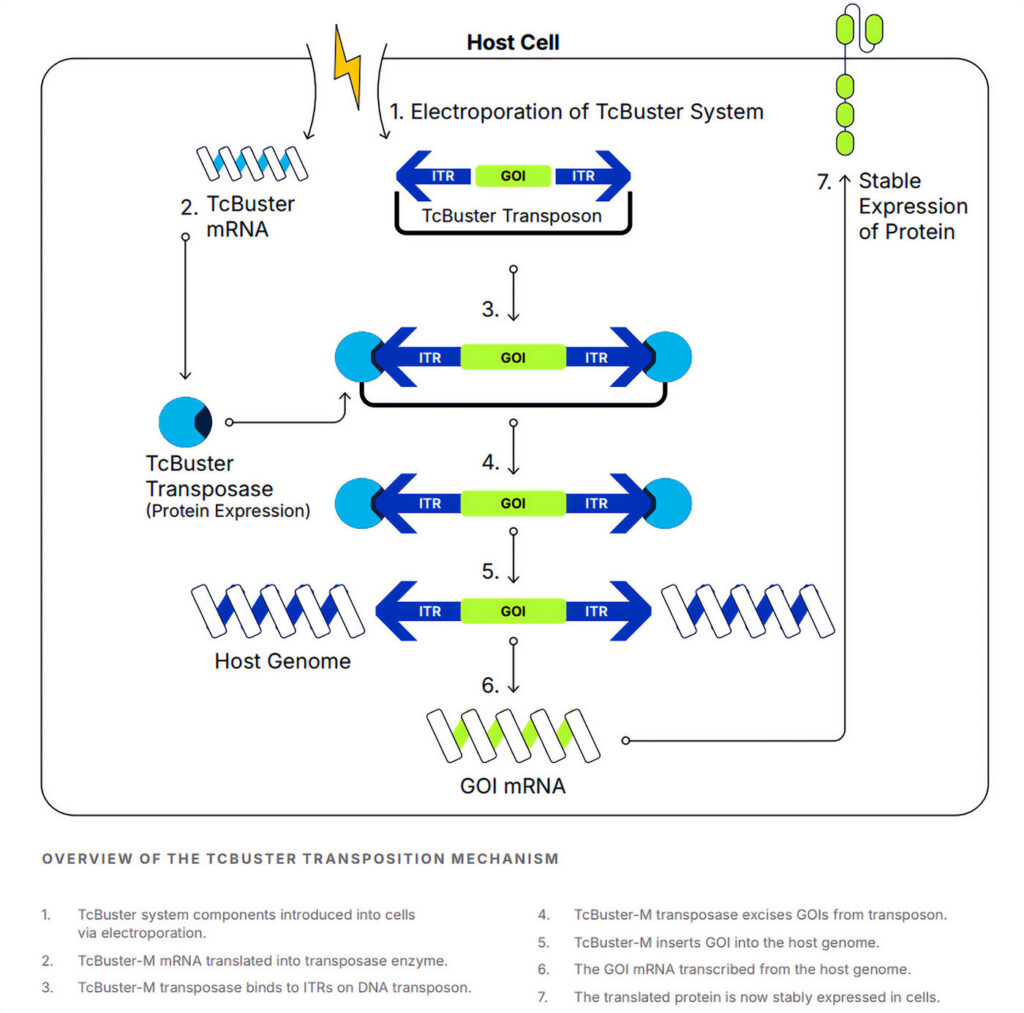
TcBuster system illustration
The TcBuster system is electroporated into cells where its components are translated, and TcBuster transposes and excises genes of interest and inserts DNA cargo into the host cell genome. [Bio-Techne]

Smith said the TcBuster system, which comprises an mRNA encoding transposase and a DNA transposon, can be produced faster than a lentiviral vector. The system is also more scalable, more cost-effective, and has increased gene cargo capacity, according to Smith. TcBuster can deliver multiple genes in a single vector, and it can be multiplexed with other gene therapy tools. “If you wanted to use base editors or CRISPR-based knockout gene editing in conjunction with TcBuster, you could do that in one step, compared to multiple steps with a viral system,” Smith said.

Unlike other commercial transposon systems for gene delivery, like Sleeping Beauty and PiggyBac, Smith said TcBuster is not restricted by exclusive licensing. “The turnaround time for GMP material is just a couple of months,” Smith said. “Versus something that might take a lot longer if you have to go through licensing or create a viral batch.”

Gene therapy SORTed

ReCode Therapeutics is developing a pipeline of genetic medicines based on its selective organ targeting (SORT) LNP platform, which adds an additional lipid to the standard LNP formulation, allowing it to zero in on specific organs. Conventional LNPs comprise four lipids—cholesterol, a helper phospholipid, a PEGylated lipid, and an ionizable lipid—that encapsulate a therapeutic gene cassette. These traditional LNPs are primarily taken up by the liver after intravenous administration, limiting their usefulness for other organs and systems. ReCode engineered its SORT LNPs with a biochemically distinct fifth lipid that enables the body to direct the particle to the targeted organ, such as the lung or spleen, bypassing the liver, if necessary.

“Because mRNA in a cell has a relatively short half-life, maybe a day or so, in order to have constant protein production, you need to administer it relatively frequently,” Vladimir Kharitonov, PhD, senior vice president of CMC and pharmaceutical sciences at ReCode, said. “With viral delivery, you can’t really administer it repeatedly.”

ReCode’s laboratory in Menlo Park
Scientists conducting qualification of the semi-automated filling and stoppering machines at ReCode’s laboratory in Menlo Park. [ReCode]

The Menlo Park, California-based firm’s two clinical-stage therapies are given by inhalation using a nebulizer. SORT lipids enable targeting specific cell types in the lung epithelium.

In 2024, ReCode presented preclinical data from its cystic fibrosis program showing its mRNA-based therapeutic RCT2100 significantly restored CFTR function in human bronchial epithelial cells derived from patients with cystic fibrosis. In vivo studies using a ferret model demonstrated improvement in mucociliary clearance. ReCode launched the first clinical trial of RCT2100 later that year. The LNP for RCT2100 contains SORT lipids to fine-tune its delivery to the airway epithelial cell types that have a defective or mutated CFTR protein, causing cystic fibrosis. The company is also developing a second mRNA therapy delivered via SORT LNP, RCT1100, for primary ciliary dyskinesia, which targets different cell types in the lung epithelium.

From idea to therapy faster

Gene delivery is just one of many services offered by GenScript to support research from discovery through clinical testing, including gene synthesis, CRISPR reagents, antibodies, and more.

Jianpeng Wang
Jianpeng Wang, PhD
Senior Director, GMP Manufacturing
GenScript

“Gene editing is entering a new era, and the focus has shifted from discovery to translation,” said Jianpeng Wang, PhD, senior director of nucleic acid and peptide R&D at GenScript. “Our goal at GenScript is to help scientists move from idea to therapy faster.”

When it comes to non-viral vectors, the firm offers off-the-shelf and bespoke solutions to fit the customer’s need for delivery of DNA, RNA, siRNA, peptides, and other molecules. Through its targeted LNP service, GenScript offers LNPs designed to enhance precision in directing genetic material to cells. GenScript’s ReadyEdit LNP solutions include Cas9 knock-in and knock-out, Cas12 knock-out, and base or prime editing tailored for the customer’s needs.

“In our ecosystem, we include all of the materials needed,” Wang said. “This integration can help scientists evaluate gene editing efficiency early, both ex vivo and in vivo.”

Wang said the choice of a vector is heavily dependent on the specific therapeutic program. “There isn’t a universally effective or better way to deliver a therapy, either viral or non-viral,” Wang said. He noted, for example, that viral vectors remain a good choice when long-term gene expression is desired. And for viral vectors, the manufacturing process might be more mature, easing transfer to a contract development and manufacturing organization.

However, Wang cautioned that viral vectors still present certain safety concerns. “In recent years, an increasing number of scientists and the FDA have recognized these risks,” he said, “leading to a surge in interest for non-viral delivery methods—particularly for in vivo CAR T therapy and gene editing.”

GenScript has provided LNP services to several customers globally. The most advanced of those is using GenScript’s GMP CRISPR materials (gRNA, HDR templates, and nuclease) alongside a customized LNP encapsulation recipe and is preparing an investigational new drug application.

Foundational LNP science

Vancouver-based Genevant traces its scientific lineage through a string of predecessor companies dating back to the early 2000s and controls foundational intellectual property for the field. Based on its scientists’ work at Protiva Biotherapeutics, the intellectual property comes to Genevant via Arbutus Biopharma, which acquired Protiva in 2015 and partnered with Roivant in 2018 to establish Genevant.

Unlike many companies developing nucleic acid delivery platforms that focus on a single payload modality, Genevant has applied its LNP to many payloads, including mRNA, siRNA, and gene editors in fields spanning antiviral, oncology, and metabolic disorders. The firm’s LNP platform is part of the first RNA-LNP product to achieve regulatory approval, Alnylam Pharmaceuticals’ Onpattro (patisiran), a treatment for polyneuropathy in people with hereditary transthyretin-mediated amyloidosis. Genevant’s LNP technology is also behind Moderna’s COVID-19 vaccines, which were confirmed earlier this month with the resolution of a longstanding patent dispute. An infringement case against Pfizer and BioNTech is pending. Genevant collaborated with Chula Vaccine Research Center and the University of Pennsylvania to develop a COVID vaccine for low- and middle-income countries in Southeast Asia during the pandemic. The program had success, demonstrating non-inferiority to Pfizer and BioNTech’s Comirnaty in clinical trials.

Some key differentiators for Genevant’s LNPs include strategies for optimized delivery in non-human primates instead of mice,2 which has resulted in improved gene editing in the liver, and novel chemistries for biodegradable LNPs that prevent accumulation in tissue.3 The company has recently disclosed data showing targeted delivery to T cells for in vivo CAR T therapy, as well as hematopoietic stem and progenitor cells (HSPC) and hepatic stellate cells.


References

  1. Skeate JG, Pomeroy EJ, Slipek NJ, et al. Evolution of the clinical-stage hyperactive TcBuster transposase as a platform for robust non-viral production of adoptive cellular therapies. Mol Ther. 2024;32(6):1817-1834. doi:10.1016/j.ymthe.2024.04.024
  2. Lam K, Schreiner P, Leung A, et al. Optimizing lipid nanoparticles for delivery in primates. Adv Mater. Published online March 27, 2023. doi: 10.1002/adma.202211420
  3. Holland, R, Lam K, Jeng S, et al. 2024. Silicon ether ionizable lipids enable potent MRNA lipid nanoparticles with rapid tissue clearance.” ACS Nano. 2024;18 (15): 10374–87. doi:10.1021/acsnano.3c09028.

The post Going Non-Viral: Gene Delivery Enters Its Translation Era appeared first on GEN – Genetic Engineering and Biotechnology News.

STAT+: Her daughter Mila got a bespoke medicine. Now she’s starting a new biotech to make more

ROME — Julia Vitarello, whose daughter Mila eight years ago received a bespoke medicine designed for her particular disease-causing mutation, said this week that she is in the process of starting a new company to try to create these individualized therapies at scale.

Vitarello’s previous effort, called EveryONE Medicines, recently folded in part because new Food and Drug Administration guidance encouraging the development of customized therapies did not go far enough in creating a pathway to satisfy EveryONE’s investors, Vitarello said. 

Now Vitarello and collaborators are looking for new funders. 

Continue to STAT+ to read the full story…

Brain Glucose Levels Act as a Metabolic Switch for Myelin Formation

Scientists have long known that myelin doesn’t appear everywhere in the brain at once. Some regions myelinate early, others much later, and the timing shapes everything from motor development to cognitive maturation. What has remained elusive is why these regional differences emerge in the first place. A new study in Nature Neuroscience, titled “Glucose-dependent spatial and temporal modulation of oligodendrocyte progenitor cell proliferation via ACLY-regulated histone acetylation,” points to an unexpected driver: shifting glucose levels that act as a metabolic switch, telling progenitor cells when to divide and when to mature into myelin‑forming oligodendrocytes.

The work, led by researchers at the Advanced Science Research Center at the CUNY Graduate Center (CUNY ASRC), maps glucose distribution across the developing mouse brain and reveals that these spatial and temporal fluctuations are not just metabolic background noise. They are instructive signals. “Regions with high glucose levels exhibited greater OPC proliferation and histone acetylation than regions with low glucose,” the authors wrote in the paper’s abstract, suggesting glucose as a key regulator of oligodendrocyte progenitor cell (OPC) population dynamics.

Using MALDI imaging at the CUNY ASRC MALDI Imaging Core Facility, the team visualized glucose concentrations across brain regions during early development in mice. Areas rich in glucose contained actively dividing OPCs, while regions with lower glucose levels harbored cells beginning to differentiate into oligodendrocytes. This pattern suggested that glucose availability helps determine whether OPCs expand their numbers or transition toward myelin production.

“Our findings show that glucose is not just fuel for the brain, it’s also a signal for the cells to divide,” said lead author Sami Sauma, PhD, a postdoctoral researcher with the CUNY ASRC Neuroscience Initiative. “When glucose levels are high in a particular brain region, progenitors use it to drive proliferation. As glucose levels shift, the same cells switch gears and begin maturing.”

An enzyme, ATP‑citrate lyase (ACLY), which converts glucose‑derived citrate into acetyl‑CoA in the nucleus, is central to this process. This acetyl‑CoA fuels histone acetylation, activating genes required for cell proliferation. When the researchers deleted Acly in OPCs, the cells could no longer proliferate efficiently, leading to a temporary reduction in myelin due to decreased OPC numbers. Yet differentiation still occurred, thanks to a compensatory pathway: mature oligodendrocytes can generate acetyl‑CoA outside the nucleus from alternative fuels such as ketone bodies.

This metabolic flexibility proved more than a biochemical curiosity. When mice lacking ACLY in OPCs were placed on a ketogenic diet, their myelin deficits improved. “The same cell lineage interprets different metabolic signals at distinct stages of development,” said senior author Patrizia Casaccia, MD, PhD, founding director of the CUNY ASRC Neuroscience Initiative. “By understanding how glucose and alternative energy sources regulate proliferation and myelin formation, we are uncovering new metabolic strategies that could be harnessed to protect myelin in the developing brain.”

The developmental window examined in mice corresponds to roughly 32 to 40 weeks of human gestation—a period when premature infants are particularly vulnerable to white‑matter injury. The findings raise the possibility that metabolic support during this stage could help preserve the progenitor cells responsible for building myelin. They may also inform future approaches to repairing myelin in disorders such as multiple sclerosis.

The post Brain Glucose Levels Act as a Metabolic Switch for Myelin Formation appeared first on GEN – Genetic Engineering and Biotechnology News.

Remembering J. Craig Venter: a relentless scientist who changed biotech — and was all too easily misunderstood

J. Craig Venter, a scientist whose relentless ambition helped turn genetics from an artisanal trade into an industrialized information machine, died Wednesday at 79. The cause was side effects of a cancer treatment.

Along the way, he did things that can only be described as really cool. He raced against a government-funded project to sequence the first human genome, grabbing headlines around the world; traveled the ocean in his sailboat collecting genetic information about sea life; and removed a bacterium’s genome and rebooted the organism with an identical set of genes he and his team had synthesized. He drove fast cars, drank red wine, and pissed people off.

Read the rest…

STAT+: Hair-raising trial results, and Servier’s M&A wishlist

Why are investors excited about hair loss drugs? Will artificial intelligence make clinical trials run more smoothly? And how does a nonprofit pharma company compete in the M&A arena?

We get into all that and more on this week’s episode of “The Readout LOUD,” STAT’s weekly biotech podcast.

Veradermics CEO Reid Waldman joined us to discuss his company’s data, and why hair loss is such a trendy topic in biotech. Then, Servier Pharmaceuticals CEO David Lee joined us to discuss the company’s acquisition of Day One Biopharmaceuticals. The hosts also discussed the latest news in biotech.

Continue to STAT+ to read the full story…

Genomics Pioneer and Life Sciences Entrepreneur J. Craig Venter Dies at 79

J. Craig Venter, PhD, the founder, board chair, and CEO of the J. Craig Venter Institute (JCVI) has died in San Diego following a brief hospitalization for unexpected side effects that arose from the treatment of a recently diagnosed cancer, noted the JCVI in a press statement.

Venter helped define modern genomics and launch the field of synthetic biology. He was skillful in building interdisciplinary teams, pushing for new ideas and faster methods, and insisting that discovery should translate into real-world impact. He was also a major advocate for strong federal science funding and for partnerships that accelerate progress across government, academia, and industry.

“Craig believed that science moves forward when people are willing to think differently, move decisively, and build what doesn’t yet exist,” said Anders Dale, PhD, president of JCVI. “His leadership and vision reshaped genomics and helped ignite synthetic biology. We will honor his legacy by continuing the mission he built—advancing genomic science, championing the public investments that make discovery possible, and partnering broadly to turn knowledge into impact.”

“Venter has been recognized as an essential force in the impetus to evolve genomics from a slow, academic discipline into a fast-moving, data-driven, and commercially relevant enterprise, leaving a lasting imprint on biotechnology, medicine, and synthetic biology,” says John Sterling, GEN’s Editor in Chief, who has known and worked editorially with Venter over the past 35 years.

“Venter was controversial and often challenged the scientific orthodoxy, with critics accusing him of hype and going overboard on privatization. To many, he was a visionary focusing on technological acceleration and blending academic science with the zeal of an entrepreneur. Supporters saw him as a pioneer who sped up genomics by years.”

At the NIH, he played a key role in driving gene discovery using expressed sequence tags (ESTs), enabling rapid identification of large numbers of human genes and accelerating genome mapping efforts. He went on to lead efforts that, along with the NIH, produced the first draft sequences of the human genome, a milestone that helped usher biology into the digital age. He and colleagues later published the first high-quality diploid human genome, demonstrating the importance of capturing genetic variation inherited from both parents.

In synthetic biology, Venter and his teams constructed the first self-replicating bacterial cell controlled by a chemically synthesized genome—proof that genomes could be designed digitally, built from chemical components, and “booted up” to run a living cell. He also pursued scientific discovery at global scale.

Through the Sorcerer II Global Ocean Sampling Expedition, Venter and his teams used metagenomics to reveal amazing microbial diversity, reporting the discovery of millions of new genes and expanding the known universe of protein families—work that deepened understanding of the ocean microbiome and its impact on planetary systems.

Beyond his scientific achievements, and in addition to founding the JCVI, he also co-founded Synthetic Genomics, Human Longevity, and most recently Diploid Genomics, advancing efforts to translate genomics and synthetic biology into tools for the benefits of human health and environmental sustainability.


The post Genomics Pioneer and Life Sciences Entrepreneur J. Craig Venter Dies at 79 appeared first on GEN – Genetic Engineering and Biotechnology News.

Exclusive eBook: Inside the stealthy startup that pitched brainless human clones

The ultimate plan to live forever is a brand new body.

This subscriber-only eBook explores R3 Bio, a small startup that has pitched a startling and ethically charged vision for “brainless clones” to serve the role of backup human bodies.

by Antonio Regalado March 20, 2026

Related Stories:

Access all subscriber-only eBooks:

Advanced Neural Probes Reveal Predictable Patterns in Epileptic Brain Activity

In addition to suffering seizures, many people with epilepsy also experience bursts of abnormal brain activity called interictal epileptiform discharges (IEDs). These can happen thousands of times a day and interfere with attention, memory, language, and sleep. New data from a study led by scientists at University of California, San Francisco (UCSF) shows that these brain blips are not random events as once thought. The data shows that they unfold in a predictable pattern that can be detected before they occur, suggesting it may be possible to prevent them. 

Details of their work are published in Nature Neuroscience in a paper titled “Laminar organization of cellular microcircuits modulating human interictal epileptiform discharges.” In it, the scientists explain that they used a high-resolution technology recently adapted for humans that records individual neuron activity to track more than 1000 neurons in four patients undergoing surgery for epilepsy. The so-called Neuropixel probes provide “a view into new ways we might address a debilitating aspect of epilepsy that we haven’t been able to tackle,” said Jon Kleen, MD, PhD, an associate professor of neurology at UCSF and co-senior author of the study. 

Preventing brain blips would be a boon for patients’ quality of life because over time, the effects of these mental disruptions can be significant and may account for some of the cognitive impairment experienced by about half of people with epilepsy. 

Neuropixels probes, which are thin devices lined with hundreds of sensors, are designed to record activity throughout the human cortex. This means that unlike current sensors which are limited to brain signals on the surface of the brain, Neuropixels can provide a three-dimensional view of brain activity. For the study, the scientists implanted the probes seven millimeters deep into the part of the brain where patients’ seizures originate—this is the tissue that surgeons typically remove to reduce epilepsy symptoms. 

Inserting the probes here made it possible to observe what happened in the neurons before, during, and after each IED. While seizures appear as a burst of neurons firing in synchrony, when IEDs occur, they unfold sequentially. Specifically, one set of neurons was active about a second before the IED started followed by another set that generated the sharp electrical spike at its peak, and then a third set became active as the IED faded. “We could see individual neurons that were just microns apart from each other playing different roles in the process,” said Alex Silva, the study’s first author and a medical student and doctoral candidate in the UCSF-UC Berkeley Joint PhD program in bioengineering. “It was really striking.”

Previous studies have demonstrated that most neurons involved in IEDs are used in normal cognitive processing. According to this study, nearly 80% of the neurons involved in IEDs were also involved in language and perception. Current implantable devices for epilepsy may be able to help. They include closed loop neurostimulators that can detect abnormal brain activity and deliver electrical pulses that interrupt it. So in the case of IEDs, devices that monitor single neurons could use the activity of the first set of neurons announcing the arrival of the abnormal pattern as a warning signal. “That would be a major step forward, changing treatment from reactively responding to abnormal brain bursts to proactively preventing them in the first place,” Kleen said.

The post Advanced Neural Probes Reveal Predictable Patterns in Epileptic Brain Activity appeared first on GEN – Genetic Engineering and Biotechnology News.