For highly aggressive types of blood cancer, stem cell transplantation is often the only potentially curative therapy. Yet, these cancers can often return even after a transplant. Notably, CAR T cell therapy has not been effective against all blood cancers, including acute myeloid leukemia (AML) and myelodysplastic syndrome (MDS).
A recent Phase I/II multicenter clinical trial, led by researchers at Washington University School of Medicine in St. Louis, shows that a stem cell transplant, that removes CD33 from donor cells using CRISPR, can help prevent cancer recurrence.
Myeloid cancers, such as AML and MDS, are difficult to treat with CAR T cells because the same proteins targets are present on both cancer cells and healthy myeloid cells, leading to toxicity risks.
“We are encouraged by the results of this study showing that a CD33-deleted stem cell transplant looks very similar to the outcomes of standard stem cell transplantation,” said John DiPersio, MD, PhD, professor of medicine at WashU Medicine and corresponding author of the study. “In the future, we are hopeful we will be able to combine this with CD33-targeted immunotherapies, such as CAR T cells, and improve treatment options for patients with these very aggressive blood cancers.”
As proof of concept, patients also received a maintenance therapy that targets CD33, after completion of the stem cell transplant. While not a CD33-targeted CAR T cell, the maintenance therapy, called gemtuzumab ozogamicin, is an engineered antibody that targets CD33 and carries an anti-cancer drug. Gemtuzumab ozogamicin is approved by the Food and Drug Administration (FDA) to treat CD33-positive AML and is in clinical trials for CD33-positive MDS. While it helps prevent relapse, the drug’s use is limited because it can cause liver toxicity and damage to blood cells, including dangerously low counts of white blood cells, red blood cells, and platelets.
All patients from the trial achieved engraftment of their transplanted stem cells by day 28. Some patients met this goal sooner with platelet production returning by day 16 on average. These timeframes are comparable to those of standard transplanted stem cells.
Average survival was just over 14 months. Nineteen patients received at least one cycle of the antibody maintenance therapy as part of a dose-escalation protocol. The authors found that patients maintained blood cell counts across all doses, suggesting that the gene-edited stem cell transplant protected patients from low blood cell counts typically seen following a standard stem cell transplant.
DiPersio and colleagues published a single case study detailing a patient with high-risk AML who received a CD33-deleted stem cell transplant. Upon relapse after the transplant, the patient received a CD33-targeted CAR T cell therapy, which used T cells from the same donor who provided the stem cell transplant.
The treatment resulted in complete remission and the patient remains cancer free over one year after receiving the CAR T cell therapy. Normal blood cell production returned with all blood cells lacking CD33, providing evidence that the genetically engineered donor cells had established themselves in the bone marrow.
DiPersio said the results of the study lay the groundwork for developing paired CD33-deleted stem cell transplant and CD33-targeted immunotherapy interventions that avoid destruction of healthy donor cells in the course of cancer treatment.
Background: Persisting symptoms affect about one-third of youth following concussion. Mental health history, distress, and coping style are key predictors of prolonged recovery. Early and scalable psychological interventions, such as mindfulness-based intervention (MBI) delivered via smartphones, may improve patients’ ability to regulate their emotions and neurophysiologically recover, reducing overall symptom burden. However, no digital therapeutic (DTx) trials in adolescents experiencing concussion exist. Objective: This study primarily aimed to assess the feasibility of conducting a larger randomized controlled trial (RCT) evaluating the effectiveness of a DTx-MBI in adolescents with a concussion compared with an attention-matched sham intervention. Methods: This was a Health Canada-regulated, parallel-group, blinded, single-crossover feasibility RCT. Adolescents aged 12 to <18 years presenting to a Pediatric Emergency Department or interdisciplinary concussion clinic within 7 days of a physician-diagnosed concussion were approached for participation from November 2022 to June 2024. After providing consent, participants were randomized (1:1), stratified by sex, to either the experimental group (DTx-MBI) or the control group (sham, attention-matched math puzzle game). The DTx-MBI was delivered via the AmDTx platform (Mobio Interactive Pte Ltd, Singapore) as a custom-designed 4-to-8-week program of 8 standardized modules for adolescents with concussion, including audio-recorded guided mindfulness exercises, goal setting, journaling, and psychoeducation. The control intervention, delivered through the same interface, excluded mindfulness content and instead featured the open-source game “2048”. Participants in both groups were encouraged to engage with the app for at least 10 minutes/day, at least 4 days/week. Feasibility criteria to support progression to a full-scale RCT included: eligibility rate >40% of those screened; recruitment rate >50% of eligible participants randomized; intervention credibility >70% scoring above the midpoint on the credibility and expectancy questionnaire (CEQ) at 1 week; retention >75% of randomized participants completing 4-week outcomes; and adherence >70% completing 10 minutes of intervention on at least 4 days/week for 4 weeks. Results: A total of 124 out of 195 (63.6%) screened youth met eligibility criteria. Of these, 99/124 (79.8%) consented and were randomized to either the DTx-MBI group (n=49, median [IQR] age=15.28 [13.66‐16.19] years, 30 [61.2%] female) or the Sham group (n=50, median [IQR] age=14.92 [13.32‐16.71] years, 30 [60.0%] female). Credibility was high, with 62/83 (74.7%) of participants scoring above the credibility midpoint (DTx-MBI: 75.0%; Sham: 74.4%). Retention was strong, with 89/99 (89.9%) of participants completing the 4-week outcomes (DTx-MBI: 89.8%; control: 90.0%). Overall adherence was moderate (54/99 [54.5%]; DTx-MBI: 59.2%; control: 50.0%), and a little higher among outcome assessment completers (53/89 [59.6%]; DTx-MBI: 63.6%; Sham: 55.6%). Feasibility indicators were similar between groups. Conclusions: This feasibility trial supports the implementation of a larger RCT, with modifications to enhance adherence, to rigorously evaluate the clinical efficacy of the DTx-MBI. By targeting modifiable psychological risk factors through a scalable digital platform, DTx-MBI could be a low-burden, cost-effective adjunct to pediatric concussion care. Trial Registration: ClinicalTrial.gov NCT05105802; International Registered Report Identifier (IRRID): RR2-10.2196/57226
Women with endometriosis have a small but significant increased risk for having babies with birth defects, such as those affecting the heart, gastric, genital, or musculoskeletal system, compared with women without the condition.
As reported in the Canadian Medical Association Journal, 6.3% of infants born to women with endometriosis included in the study had a congenital anomaly, compared with 5.4% of infants born to those without the condition.
Notably, only around 11% of the increased risk could be attributed to fertility treatment meaning that the condition itself is likely responsible for the small increase in risk. It suggests that endometriosis itself, likely through inflammatory pathways, oxidative stress, or epigenetic mechanisms, may directly disrupt fetal organogenesis.
Endometriosis is a chronic condition where tissue similar to the uterine lining grows outside the uterus, causing severe pelvic pain, painful periods, and often infertility. It affects an estimated 6.5 million women in the U.S., though many go undiagnosed for years.
“Endometriosis can trigger inflammation and oxidative stress, which have been linked to abnormal organogenesis in offspring. This disruption in organogenesis can lead to functional or structural anomalies that occur in utero, which typically develop in the first trimester of gestation,” write lead author Bailey Milne, Queen’s University, Kingston, Ontario, and colleagues.
“Some studies have reported an increased risk of genital defects among infants born to women with endometriosis; however, data are lacking on the risk of other congenital anomalies.”
To investigate this further, Milne and team conducted a large population-based cohort study using Ontario health administrative data, examining over 1.46 million births between 2006 and 2021. The aim was to quantify the risk of congenital anomalies in infants born to women with a pre-existing diagnosis of endometriosis.
Overall, 33,619 (2.3%) women included in the study had endometriosis. Women with endometriosis had a 16% increase in risk for having a baby with a congenital birth defect compared with women without the condition and 89% of this risk could be attributed to the presence of endometriosis and not possible confounding factors like fertility treatment. The most common associated defects were cleft palate, male genitourinary malformations, and cardiovascular abnormalities.
“Although this study contributes to accumulating data on a potential increased risk of birth defects for infants born to patients with endometriosis, the specific mechanistic pathways remain largely unknown,” write Milne and coauthors.
“A theorized mechanism by which endometriosis might increase risk of any congenital anomaly is through inflammatory pathways. The existing literature suggests a need for more comprehensive models that integrate genetic, epigenetic, and environmental factors to better understand this.”
BackgroundThere is rising detection of unregulated stimulants (e.g. cocaine and methamphetamine) in toxicology results among people who died of unregulated drug poisoning. Nevertheless, little research describes the population-level trends of incident (new) stimulant use disorder (StUD) diagnoses. This study reports on trends of incident StUD diagnoses pre- and post-Covid-19 public health emergency in British Columbia (BC), Canada.MethodsInterrupted time series analyses were conducted with BC’s COVID-19 public health emergency declaration on March 16, 2020 as the interruption point. Descriptive statistics on demographic and health service contact were conducted for the population diagnosed before (January 1, 2013 – March 16, 2020) and after (March 17, 2020 – December 31, 2024) the COVID-19 pandemic emergency declaration. Seasonal autoregressive integrated moving average (sARIMA) models were used to .estimate changes to incident StuD diagnoses rates before and after the COVID-19 pandemic declaration.Results38, 217 people were identified with incident StUD diagnoses between January 1, 2013 and March 31, 2024. The average diagnosis rate of incident StUD was 5.18 per 100, 000 in the pre-pandemic period and increased by 19.9% to 6.21 per 100, 000 in the post-pandemic period. The estimated increase in slope (ramp) of incident StUD was 0.0315 cases per 100, 000 population per month (95% CI: -0.00182, 0.06482).ConclusionsWe identified a rate of increase in incident StUD diagnoses since the COVID-19 pandemic declaration in BC that was not statistically significant. Our study highlights the need for more comprehensive linked data -including, administrative health data, surveys, and other services/program data (e.g., community services, private sector) to better disentangle StUD incidence and prevalence to inform services to meet the needs of people with StUD. Stimulant use, Stimulant use disorder, pandemic, Covid-19, methamphetamines, cocaine, interrupted time series.
Background: Neurorehabilitation plays a key role in improving motor recovery for people with neurological conditions. Although 3D printing has emerged as a promising rehabilitation tool, little is known on how it is used for the rehabilitation of adults living with neurological conditions worldwide. Objective: We aimed to provide a comprehensive overview of 3D printing in neurorehabilitation and precisely explore how it is used to improve motor recovery for adults with neurological conditions living in higher- and lower-middle–income countries. Methods: We conducted a scoping review following the Joanna Briggs Institute guidelines. After searching 3 databases (MEDLINE, Web of Science, and Nursing and Allied Health Premium), 2 independent reviewers screened and selected English-language studies involving adults (≥18 years) published between 2019 and 2024 to capture the most recent advancements in this field. We extracted relevant information on neurological conditions, motor recovery outcomes, and types of 3D printing and offered a comparative analysis of 3D printing in physical neurorehabilitation from the perspective of national income levels using a modified Joanna Briggs Institute extraction form. We synthesized the findings narratively with tabular support. Results: After screening 2752 titles and abstracts and 103 (3.7%) full texts, we included 13 (0.5%) studies based on our inclusion criteria. All included studies were conducted in upper-middle–income or high-income countries, and most studies (9/13, 69.2%) focused on stroke, followed by spinal cord injury (2/13, 15.4%), Parkinson disease (1/13, 7.7%), and central nerve disease (1/13, 7.7%). The 3D-printed rehabilitation tools included orthotics (7/13, 53.8% for the upper extremities [UEs]; 3/13, 23.1% for the lower extremities [LEs]), an exoskeleton (1/13, 7.7%; UEs), a modular assistive hand device (1/13, 7.7%; UEs), and an insole (1/13, 7.7%; LEs). In total, 69.2% (9/13) of the studies targeted UE rehabilitation, measured using the Action Research Arm Test, active range of motion, the box and block test, the Fugl-Meyer Assessment, the Modified Ashworth Scale, the manual function test, range of motion, and the Toronto Rehabilitation Institute Hand Function Test, and 30.8% (4/13) targeted LE rehabilitation, measured using the 10-m walk test, anteroposterior ground reaction force analysis, the Barthel index, the Tinetti scale, the RehaWatch system, and the GaitWatch system. Conclusions: Used as a rehabilitation tool, 3D printing technology has demonstrated significant potential in improving upper and lower motor recovery for people with certain neurological conditions in high-middle–income countries. Future research should explore the implementation feasibility and effectiveness of these technologies across different neurological conditions and income settings, particularly in low- and lower-middle–income countries.
<img src="https://jmir-production.s3.us-east-2.amazonaws.com/thumbs/11352972abf74214e055b465780e25ce" />
Researchers at the Institut National de la Recherche Scientifique in Montreal have found that compounds in cranberry juice may enhance the effectiveness of a commonly used antibiotic for urinary tract infections (UTIs) by altering how bacteria take up the drug. The findings, published in Applied and Environmental Microbiology, show that cranberry juice increased the activity of fosfomycin against uropathogenic Escherichia coli (UPEC) in laboratory testing and reduced the emergence antibiotic resistance mutations in 72% of the E. coli strains studied.
While the findings are encouraging, the researchers noted that the work didn’t show whether consumption of cranberry juice would have the same effects as those shown in the lab. “We don’t know if the metabolites will reach the infection,” said lead author Eric Déziel, PhD, a professor at Institut National de la Recherche Scientifique. “But if they could, then juice may increase the efficacy of antibiotic treatment.”
UTIs are most often caused by UPEC, which accounts for the majority of community-acquired infections and a substantial proportion of catheter-associated infections. Standard treatments include antibiotics such as trimethoprim-sulfamethoxazole, nitrofurantoin, and fosfomycin. While fosfomycin is a recommended first-line therapy because of its broad activity and low resistance rates, past studies have shown that some resistant variants can emerge through mutations that influence bacterial transport systems.
Cranberry products have long been associated with UTI prevention. Earlier theories surmised this was due to fruit’s acidity. Subsequent research, however, has identified specific compounds, including proanthocyanidins and fructose, that interfere with the ability of bacterial to attach to cells lining the urinary tract.
Déziel said that cranberry juice has a long history as folk remedy for preventing and treating urinary tract infections. It was the recent finding of the anti-adhesive properties that prompted further investigation into whether cranberry could influence antibiotic performance.
To test this, the research team exposed 32 clinical isolates of UPEC to cranberry juice in combination with fosfomycin under controlled laboratory conditions. The results showed that in 72% of the strains tested, cranberry juice increased the antibiotic’s inhibitory activity. At the same time, the frequency of spontaneous mutations conferring resistance dropped substantially, in some cases by several orders of magnitude.
The effects of the cranberry juice seems to involve changes in how bacterial cells regulate the uptake of sugars and, by extension, the antibiotic since fosfomycin enters bacterial cells through carbohydrate transport systems, primarily the GlpT and UhpT pathways. Resistance often arises when mutations reduce the activity of these transporters, which then limits the drug entering cells.
Specifically, cranberry juice reduced expression of the GlpT transporter while maintaining or promoting activity through the UhpT system. This shift allowed fosfomycin into the bacterial cell even as other pathways were downregulated. Reporter assays showed that this change sustained antibiotic uptake, while genomic sequencing revealed distinct mutation patterns depending on whether cranberry juice was present.
While the researchers were able to characterize the activity related to the presence of cranberry juice, the compounds responsible for this effect have not been fully identified. Déziel noted that “something in the cranberry juice” induces bacteria to increase uptake through one of these channels, leading to greater absorption of fosfomycin. Previous research has pointed to cranberry-derived molecules that interact with bacterial communication and adherence systems, but their role in modulating antibiotic transport has not been identified.
The study builds on earlier work from Déziel’s lab showing that cranberry extracts can act synergistically with antibiotics. The current research showed that this is also the case with cranberry juice itself. The hope is that simply consuming cranberry juice could produce the same effects as the extracts studied previously.
Despite the promising laboratory data, the researchers said that the findings cannot yet be translated to the clinic. It is still unclear whether the active compounds in cranberry juice are found at the needed concentrations in the urinary tract after consumption, or how much juice would be required to produce a measurable effect.
Future research will seek to identify the specific compounds responsible for the effects shown in this study, determine how they behave in vivo, and assess whether they can be incorporated into treatment strategies.
BackgroundDepressive disorders are clinically heterogeneous and mechanistically complex psychiatric conditions. Transcranial direct current stimulation (tDCS), a key non-invasive neuromodulation technique, has expanded rapidly in both therapeutic application and mechanistic research. However, the field is marked by rapid publication growth, thematic diversity, and variability in evidence quality. A systematic quantitative synthesis is therefore needed to map the research landscape, identify hotspots, and inform future directions.MethodsA systematic search was conducted for English-language publications in the Web of Science Core Collection (WoSCC), Scopus, and PubMed using the terms (“Transcranial direct current stimulation” OR “tDCS”) AND (“depression” OR “major depressive disorder” OR “depressive disorder” OR “MDD”). Only articles and reviews were included. Records from 2026 and non-research publications, including conference abstracts, editorials, letters, news items, and errata, were excluded. Deduplication was performed using DOI-based matching followed by title-assisted matching. Bibliometrix (R), VOSviewer, and CiteSpace were used to analyze publication trends, contributions by countries/regions, institutions, authors, and journals, collaboration networks, keyword co-occurrence, thematic clustering, and burst terms. Citation analysis was based on WoSCC data only.ResultsResearch on tDCS for depression showed sustained growth, with marked acceleration after 2020 and a peak in 2024. The United States, Germany, and Brazil occupied central positions in both productivity and international collaboration, with the United States ranking first in publication volume. Major research hubs included the Universidade de São Paulo, the University of Toronto, and Harvard University, while Brain Stimulation, Journal of Affective Disorders, and Frontiers in Psychiatry were the leading publication venues. Highly cited studies mainly focused on neurophysiological mechanisms, pivotal randomized controlled trials, and evidence-based guidelines. Keyword analyses indicated a shift from early attention to cortical excitability, safety, and short-term efficacy toward a more integrated framework involving prefrontal-targeted stimulation, cognitive function, functional connectivity, treatment outcomes, and cross-disorder applications.ConclusiontDCS research in depression is entering a multidimensional and interdisciplinary phase, with increasing emphasis on network-level mechanisms and precision intervention. Functional connectivity is emerging as a potential biomarker for patient stratification and outcome prediction. Further progress depends on multicenter standardization, reproducible analytic pipelines, and high-quality comparative effectiveness research.
Kunwoo Ryan Lee, PhD, knew as early as 2012 that solving the delivery problem would be crucial in fulfilling the promise of the newly discovered CRISPR-Cas9 gene editing technology. He felt strongly that gene editing had potential to transform medicine by curing genetic disorders, but the viral and non-viral vectors available at the time had significant drawbacks. With the support of CRISPR pioneers Jennifer Doudna and Stanley Qi, Lee completed his doctoral thesis on a gold nanoparticle delivery system for Cas9 ribonucleoprotein. He went on to co-found BreezeBio, formerly GenEdit, in 2016 with the aim of creating the next generation of gene editing-based therapeutics. To realize that goal, Lee and his team looked beyond traditional viral gene delivery systems and instead invented a new technology from the ground up.
Most clinical gene therapy trials use viral vectors, including retroviruses, lentiviruses, adenoviruses, and adeno-associated viruses. However, viral vectors are limited in the size of the gene they can deliver. They also tend to trigger strong immune reactions and usually can’t be dosed more than once due to acquired immunity.
Non-viral vectors are an alternative technology that offer greater gene loading capacity, more straightforward preparation, and less likelihood of triggering problematic immune reactions. BreezeBio and other biotechnology companies are reimagining gene delivery through non-viral approaches like targeted LNPs, transposons, and novel chemistry.
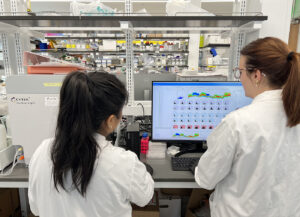
Flow cytometry analysis of immune cells in BreezeBio’s laboratory. [BreezeBio]
BreezeBio’s hydrophilic nanoparticle (HNP) platform, NanoGalaxy, hearkens back to Lee’s doctoral work. Lee said he and his cofounders realized that a hydrophobic molecule was needed to deliver a gene payload into cells, because the cell membrane is a lipid bilayer. Lee also noted that the best molecule for targeting different cell types is an antibody, a hydrophilic molecule. Pairing these two elements introduced a complex manufacturing challenge that the company solved by using a polyamide as a backbone structure and conjugating a hydrophobic small molecule to that backbone for targeting, resulting in the hydrophilic HNP. The company then used artificial intelligence to optimize HNPs for different tissue types.
“Using the platform, we have demonstrated that we can deliver to the spleen, immune system, heart, and lung,” Lee said. The firm also developed a set of nanoparticles targeted to the central nervous system.
Based on those targeted delivery profiles, the Brisbane, California-based BreezeBio has worked with multiple partners to provide delivery solutions for their products, including a multiyear collaboration with Genentech, a member of the Roche Group, signed in 2024. Meanwhile, the company is also advancing its own pipeline of therapeutics built on the NanoGalaxy platform, including a lead candidate for type 1 diabetes, as well as investigational therapies for autoimmune disease and cancer.
Lee said a key advantage of the NanoGalaxy platform for their pipeline, which heavily leans toward autoimmune disease, is that, unlike a viral vector, the company’s studies have shown it does not activate the innate immune system. “That enabled us to use our technology for autoimmune applications and in more targeted oncology applications, as well,” Lee said.
Snug as a bug in a rug
The red flour beetle, a notorious scourge of grain and cereal stores, is the surprising source of Bio-Techne’s transposon-based, non-viral gene delivery system. The system, dubbed TcBuster for the beetle’s scientific name, Tribolium castaneum, was invented by B-MoGen, a spin-out of the University of Minnesota, which was acquired in 2019 by Minneapolis-based Bio-Techne. Researchers at B-MoGen and Bio-Techne developed a hyperactive version of the natural TcBuster transposon by creating a library of three million unique genetic variants and screening each in mammalian cells. In a proof-of-concept study, CAR NK cells engineered using TcBuster demonstrated in vitro functionality and improved survival in a preclinical model of Burkitt lymphoma with a single dose.1
“The reason you want a hyperactive version is that wild-type transposon systems are fairly low activity,” said Miles Smith, PhD, a product manager for cell and gene therapy at Bio-Techne. “For generating a cell therapy, you want something that’s going to be comparable to the state of the field, and that’s lentivirus.”
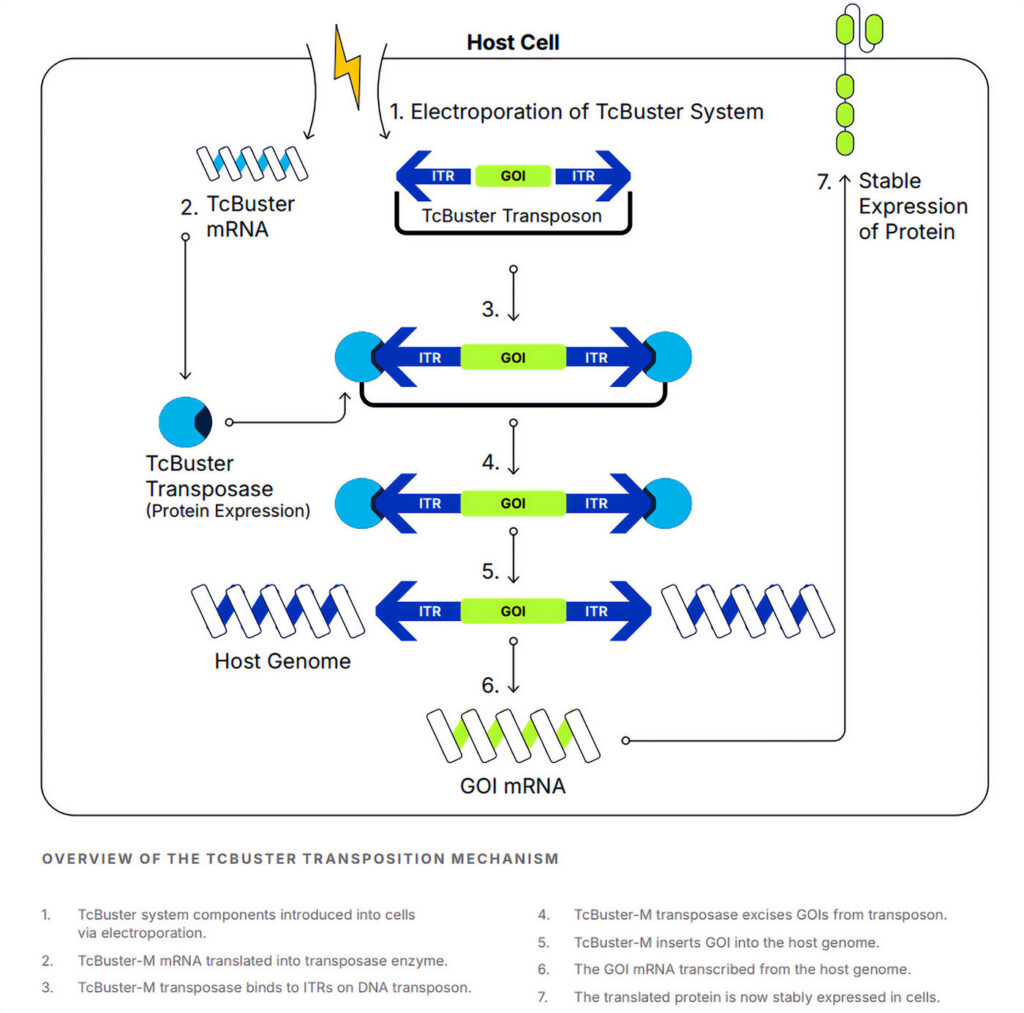
The TcBuster system is electroporated into cells where its components are translated, and TcBuster transposes and excises genes of interest and inserts DNA cargo into the host cell genome. [Bio-Techne]
Smith said the TcBuster system, which comprises an mRNA encoding transposase and a DNA transposon, can be produced faster than a lentiviral vector. The system is also more scalable, more cost-effective, and has increased gene cargo capacity, according to Smith. TcBuster can deliver multiple genes in a single vector, and it can be multiplexed with other gene therapy tools. “If you wanted to use base editors or CRISPR-based knockout gene editing in conjunction with TcBuster, you could do that in one step, compared to multiple steps with a viral system,” Smith said.
Unlike other commercial transposon systems for gene delivery, like Sleeping Beauty and PiggyBac, Smith said TcBuster is not restricted by exclusive licensing. “The turnaround time for GMP material is just a couple of months,” Smith said. “Versus something that might take a lot longer if you have to go through licensing or create a viral batch.”
Gene therapy SORTed
ReCode Therapeutics is developing a pipeline of genetic medicines based on its selective organ targeting (SORT) LNP platform, which adds an additional lipid to the standard LNP formulation, allowing it to zero in on specific organs. Conventional LNPs comprise four lipids—cholesterol, a helper phospholipid, a PEGylated lipid, and an ionizable lipid—that encapsulate a therapeutic gene cassette. These traditional LNPs are primarily taken up by the liver after intravenous administration, limiting their usefulness for other organs and systems. ReCode engineered its SORT LNPs with a biochemically distinct fifth lipid that enables the body to direct the particle to the targeted organ, such as the lung or spleen, bypassing the liver, if necessary.
“Because mRNA in a cell has a relatively short half-life, maybe a day or so, in order to have constant protein production, you need to administer it relatively frequently,” Vladimir Kharitonov, PhD, senior vice president of CMC and pharmaceutical sciences at ReCode, said. “With viral delivery, you can’t really administer it repeatedly.”
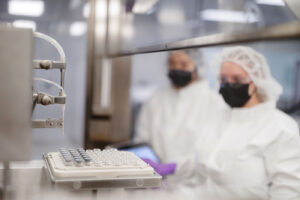
Scientists conducting qualification of the semi-automated filling and stoppering machines at ReCode’s laboratory in Menlo Park. [ReCode]
The Menlo Park, California-based firm’s two clinical-stage therapies are given by inhalation using a nebulizer. SORT lipids enable targeting specific cell types in the lung epithelium.
In 2024, ReCode presented preclinical data from its cystic fibrosis program showing its mRNA-based therapeutic RCT2100 significantly restored CFTR function in human bronchial epithelial cells derived from patients with cystic fibrosis. In vivo studies using a ferret model demonstrated improvement in mucociliary clearance. ReCode launched the first clinical trial of RCT2100 later that year. The LNP for RCT2100 contains SORT lipids to fine-tune its delivery to the airway epithelial cell types that have a defective or mutated CFTR protein, causing cystic fibrosis. The company is also developing a second mRNA therapy delivered via SORT LNP, RCT1100, for primary ciliary dyskinesia, which targets different cell types in the lung epithelium.
From idea to therapy faster
Gene delivery is just one of many services offered by GenScript to support research from discovery through clinical testing, including gene synthesis, CRISPR reagents, antibodies, and more.
“Gene editing is entering a new era, and the focus has shifted from discovery to translation,” said Jianpeng Wang, PhD, senior director of nucleic acid and peptide R&D at GenScript. “Our goal at GenScript is to help scientists move from idea to therapy faster.”
When it comes to non-viral vectors, the firm offers off-the-shelf and bespoke solutions to fit the customer’s need for delivery of DNA, RNA, siRNA, peptides, and other molecules. Through its targeted LNP service, GenScript offers LNPs designed to enhance precision in directing genetic material to cells. GenScript’s ReadyEdit LNP solutions include Cas9 knock-in and knock-out, Cas12 knock-out, and base or prime editing tailored for the customer’s needs.
“In our ecosystem, we include all of the materials needed,” Wang said. “This integration can help scientists evaluate gene editing efficiency early, both ex vivo and in vivo.”
Wang said the choice of a vector is heavily dependent on the specific therapeutic program. “There isn’t a universally effective or better way to deliver a therapy, either viral or non-viral,” Wang said. He noted, for example, that viral vectors remain a good choice when long-term gene expression is desired. And for viral vectors, the manufacturing process might be more mature, easing transfer to a contract development and manufacturing organization.
However, Wang cautioned that viral vectors still present certain safety concerns. “In recent years, an increasing number of scientists and the FDA have recognized these risks,” he said, “leading to a surge in interest for non-viral delivery methods—particularly for in vivo CAR T therapy and gene editing.”
GenScript has provided LNP services to several customers globally. The most advanced of those is using GenScript’s GMP CRISPR materials (gRNA, HDR templates, and nuclease) alongside a customized LNP encapsulation recipe and is preparing an investigational new drug application.
Foundational LNP science
Vancouver-based Genevant traces its scientific lineage through a string of predecessor companies dating back to the early 2000s and controls foundational intellectual property for the field. Based on its scientists’ work at Protiva Biotherapeutics, the intellectual property comes to Genevant via Arbutus Biopharma, which acquired Protiva in 2015 and partnered with Roivant in 2018 to establish Genevant.
Unlike many companies developing nucleic acid delivery platforms that focus on a single payload modality, Genevant has applied its LNP to many payloads, including mRNA, siRNA, and gene editors in fields spanning antiviral, oncology, and metabolic disorders. The firm’s LNP platform is part of the first RNA-LNP product to achieve regulatory approval, Alnylam Pharmaceuticals’ Onpattro (patisiran), a treatment for polyneuropathy in people with hereditary transthyretin-mediated amyloidosis. Genevant’s LNP technology is also behind Moderna’s COVID-19 vaccines, which were confirmed earlier this month with the resolution of a longstanding patent dispute. An infringement case against Pfizer and BioNTech is pending. Genevant collaborated with Chula Vaccine Research Center and the University of Pennsylvania to develop a COVID vaccine for low- and middle-income countries in Southeast Asia during the pandemic. The program had success, demonstrating non-inferiority to Pfizer and BioNTech’s Comirnaty in clinical trials.
Some key differentiators for Genevant’s LNPs include strategies for optimized delivery in non-human primates instead of mice,2 which has resulted in improved gene editing in the liver, and novel chemistries for biodegradable LNPs that prevent accumulation in tissue.3 The company has recently disclosed data showing targeted delivery to T cells for in vivo CAR T therapy, as well as hematopoietic stem and progenitor cells (HSPC) and hepatic stellate cells.
References
Skeate JG, Pomeroy EJ, Slipek NJ, et al. Evolution of the clinical-stage hyperactive TcBuster transposase as a platform for robust non-viral production of adoptive cellular therapies. Mol Ther. 2024;32(6):1817-1834. doi:10.1016/j.ymthe.2024.04.024
Lam K, Schreiner P, Leung A, et al. Optimizing lipid nanoparticles for delivery in primates. Adv Mater. Published online March 27, 2023. doi: 10.1002/adma.202211420