Finding Answers When Your Child Is Struggling: Introducing Ask Kai 

Every day, parents reach out to the Child Mind Institute with questions that keep them up at night: Why does my daughter have such strong emotions? Why can’t my son sit still in class? Is this normal anxiety or something more?.

These questions are urgent, but finding answers isn’t easy. The wait time to see a children’s mental health professional can be months or even years. Many families don’t know where to start, what’s normal for their child’s age, or whether their concerns warrant professional help. And with nearly 1 in 5 children experiencing a mental health challenge within the U.S. alone, too many families are navigating this uncertainty on their own.

That’s why we built Ask Kai — a free, evidence-based symptom checker designed specifically for children’s mental health, available in both English and Spanish.

Meet Ask Kai

Ask Kai is a conversational symptom checker that helps parents and caregivers understand their child’s behavior and points them to appropriate resources. Through a streamlined series of questions and prompts, Ask Kai gathers information about your child’s challenges and provides personalized recommendations in minutes.

Ask Kai doesn’t diagnose your child. Instead, it helps you:

  • Understand whether your concerns align with common mental health challenges
  • Learn what to look for and what questions to ask
  • Find evidence-based resources specific to your child’s needs
  • Know how to find additional support if needed

Think of Ask Kai as a knowledgeable guide who helps you make sense of what you’re seeing and points you toward your next best step.

How Ask Kai works

If you’ve ever used a symptom checker for physical health, you know the challenge: enter “headache,” and you might walk away convinced you have everything from a sinus infection to a brain tumor. Mental health symptom checkers face even greater challenges. Because every child is different, what looks like defiance in one child could look like anxiety in another, and a behavior that’s appropriate at age five might be cause for concern at age ten. On top of that, mental health conditions often overlap.

So how did we build a tool that captures this complexity without overwhelming families? We focused on expertise and evidence:

  • Clinicians and data lead the way: Ask Kai was built using thousands of child mental health evaluations — open datasets spanning different ages, backgrounds, and conditions — and developed in close collaboration with child psychologists and psychiatrists.
  • Evidence-based question selection: Rather than asking hundreds of questions, we used machine learning to identify which combinations of questions provide the most meaningful information without burdening families.
  • Comprehensive resource library: Every recommendation Ask Kai makes is matched to our extensive collection of guides, articles, expert perspectives, and pathways to professional help.
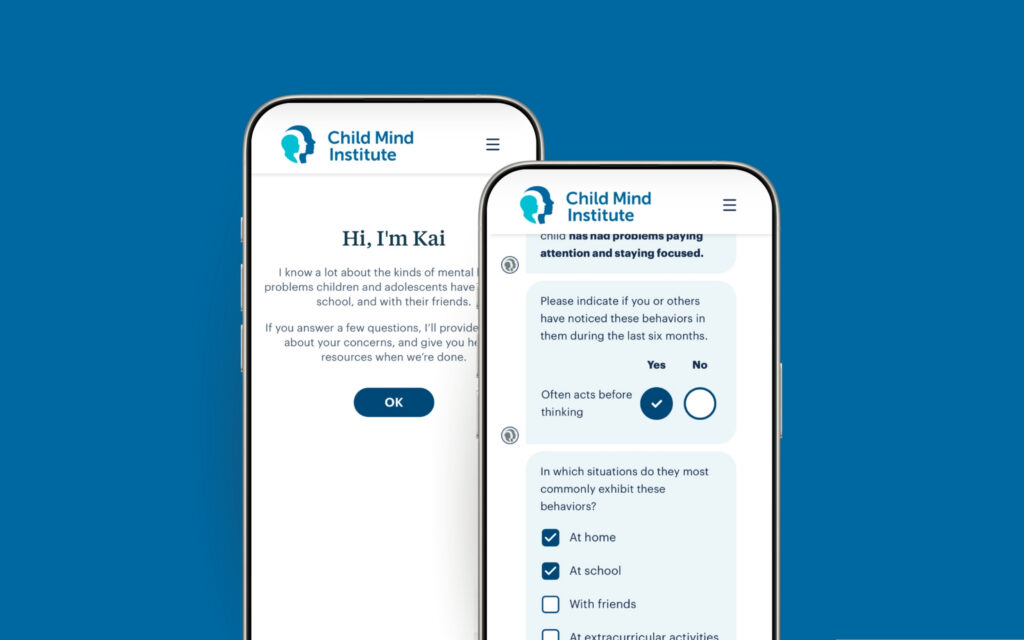
Here’s what happens when you use Ask Kai

Step 1: Initial Screening

You’ll answer a brief set of questions about your child’s behavior, emotions, and how these challenges affect daily life. You’ll also have the chance to describe in your own words what brought you to Ask Kai. These questions cover the areas where we see the most common concerns.

Step 2: Personalized Deep Dive

Based on your responses, Ask Kai selects targeted follow-up questions that dig deeper into the areas you flagged, whether that’s attention and focus, social anxiety, learning, or other behavioral challenges.

Step 3: Matching You to Resources

Ask Kai analyzes your complete response pattern, including the severity and impact of the behaviors you described, and provides a report with recommendations relevant to your child’s age, challenges, and needs.

What Ask Kai can assess

We designed Ask Kai to explore the areas where we can provide the most help to the most families. Ask Kai offers comprehensive screening and resources for:

ADHD (Attention-Deficit/Hyperactivity Disorder)

Attention-deficit/hyperactivity disorder (ADHD) is a neurodevelopmental disorder that is characterized by difficulties with attention, organization, and impulsive behaviors. Symptoms are usually divided into inattentive behaviors or hyperactive and impulsive behaviors. Inattentive symptoms may include making careless mistakes, being easily distracted, difficulty listening to instructions, trouble with organization, and forgetfulness. Hyperactive/impulsive symptoms may include fidgeting or squirming, trouble playing quietly, extreme impatience, as well as constant talking and interrupting.

Autism Spectrum Disorder

Autism spectrum disorder (ASD) is a neurodevelopmental disorder that begins in utero, but children may not get diagnosed until they’re in preschool or even older, when symptoms become more apparent. The disorder is characterized by deficits in social communication skills as well as restrictive or repetitive behaviors. Symptoms include a wide range of impaired cognitive abilities, language skills, and behaviors. These symptoms have been thought of as a set of disorders but are now being considered one disorder that presents along a spectrum.

Depression

Depression is a mood disorder that can cause children and teenagers to feel very sad and hopeless. Kids with depression have trouble enjoying things they used to love. They may also seem listless and easily annoyed.

Generalized Anxiety Disorder

Generalized anxiety disorder is characterized by excessive, persistent, and unreasonable worries about everyday things, like doing well in school or sports. In general, kids with this disorder worry a lot about being perfect.

Oppositional Defiance Disorder

Oppositional defiance disorder is a disruptive behavior disorder characterized by ongoing persistent, age-inappropriate disobedience and resistance to authority. To be diagnosed with this disorder, children would have had to display extreme behavior issues for at least six months. Diagnosis occurs around early elementary school ages and stops around adolescence.

Social Anxiety Disorder

Social anxiety disorder is a type of anxiety characterized by such intense self-consciousness and fear of embarrassment in social situations that the individual avoids social events; also known as social phobia. While some kids with this disorder are specifically afraid of performance engagements like public speaking or sporting events, others are scared of general social situations.

Specific Phobia

Specific phobia is an anxiety disorder characterized by an excessive and irrational fear of an object, situation, or place. Common specific phobias include dogs, clowns, bugs, the dark, and loud noises.

Elimination Disorders (Enuresis & Encopresis)

For young children, bathroom troubles are often a normal part of growing up. But once kids pass potty-training age, peeing or pooping in places other than the toilet might be a sign of an underlying issue. If it involves urine, it’s called “enuresis.” If it involves feces, it’s called “encopresis.”

Nonverbal Learning Disorder (NVLD)

Nonverbal learning disorder (NVLD) is a condition characterized by difficulty processing visual-spatial information — which involves the brain’s ability to interpret and respond to visual input, including where things are in space. These skills are used to do things like putting together a puzzle or reading a diagram.

Specific Learning Disorder (Dyslexia, Dyscalculia, & Dysgraphia)

Specific  learning disorder is a condition that causes children to have difficulty with reading, writing, and/or math. If they have trouble with reading, the disorder is called dyslexia. If they have trouble with writing, it’s called dysgraphia. If they have trouble with math, it’s called dyscalculia. Symptoms are typically first noticed when the child is in preschool or early elementary school.

These ten areas represent some of the most common mental health concerns in childhood. They’re also areas where we have robust data, validated assessments, and comprehensive resources.

What if your concerns aren’t on this list?

Ask Kai can still help. When you describe your situation in your own words, Ask Kai analyzes your response to identify additional concerns and match you to appropriate resources. Your child’s challenges don’t need to fit neatly into one of these categories for Ask Kai to provide value.

However, we will only make recommendations when we’re confident in the evidence behind them. If a particular concern isn’t well represented in our data, we won’t try to provide guidance in that area. Regardless of the results, everyone receives a core set of resources that we believe are helpful for all families navigating children’s mental health.

Your privacy matters

We take data privacy seriously:

  • Your responses are confidential and secure
  • Free-text responses are analyzed using secure AI systems
  • We don’t share your individual information with third parties
  • In addition to providing you with resources, your data will only be used to improve Ask Kai

Try Ask Kai Today

If you’re wondering whether your child’s behavior is typical or cause for concern, Ask Kai can help. In just 10 to 15 minutes, you’ll get personalized insights and resources to guide your next steps.

Start Your Assessment

You don’t have to figure this out alone. We’re here to help.

If your child is in crisis, expressing thoughts of self-harm, experiencing severe symptoms, or in immediate danger, please seek emergency help right away. Call 988 (Suicide and Crisis Lifeline), text “HELLO” to 741741 (Crisis Text Line), or go to your nearest emergency room.

Frequently Asked Questions

How long does it take?

Most families complete Ask Kai in 10–15 minutes.

Who should use this tool?

Parents, caregivers, and professionals working with children ages 4–18.

Will I get a diagnosis?

No. Ask Kai provides screening information and resources, but only a qualified clinician can provide a diagnosis.

What if I need immediate help?

If your child is in crisis, please call 988, text “HELLO” to 741741, or visit your nearest emergency room.

What makes this different from other symptom checkers?

Ask Kai was built specifically for children’s mental health, uses evidence-based assessments, provides personalized follow-up questions, and was developed in close collaboration with child mental health professionals.

The post Finding Answers When Your Child Is Struggling: Introducing Ask Kai  appeared first on Child Mind Institute.

World Models: 10 Things That Matter in AI Right Now

World models recently made our list of 10 Things That Matter in AI Right Now. Watch executive editor Niall Firth explain why this emerging area of AI is gaining so much attention.

Join MIT Technology Review editors and reporters for a subscriber-only Roundtables discussion, “Can AI Learn to Understand the World?” exploring how AI may evolve to better reason about the real world and what this could mean for the future of AI systems.

Related Stories:

Speakers:

Mat Honan
Editor in Chief
Will Douglas Heaven
Senior Editor, AI
Grace Huckins
AI Reporter

The Download: a Nobel winner on AI, and the case for fixing everything

This is today’s edition of The Download, our weekday newsletter that provides a daily dose of what’s going on in the world of technology.

Three things in AI to watch, according to a Nobel-winning economist

A few months before he won the Nobel Prize in economics in 2024, Daron Acemoglu published a paper that earned him few fans in Silicon Valley. He argued that AI would give only a small boost to US productivity and would not eliminate the need for human work.

Two years later, Acemoglu’s measured take has not caught on. The technology has advanced quite a bit since his cautious predictions, but the data is still largely on his side. 

MIT Technology Review spoke with him to understand if any of the latest developments have changed his thesis. Here are the three things Acemoglu is paying closest attention to in AI right now.

—James O’Donnell

This story is from The Algorithm, our weekly newsletter giving you the inside track on all things AI. Sign up to receive it in your inbox every Monday. 

The case for fixing everything

Stewart Brand, the counterculture icon and tech industry legend, considers maintenance a “civilizational” act. His new book argues that taking responsibility for maintaining something, whether a motorcycle, a monument, or the planet, can be radical.

Brand argues that maintainers haven’t gotten the laurels they deserve—and he’s right. Yet his vision of maintenance often feels solitary: profound, but more about personal fulfillment than tending to a shared world or making it better.

Read the full review of his handsome new book, Maintenance: Of Everything, Part One.

—Lee Vinsel

Lee Vinsel is an associate professor of science, technology, and society at Virginia Tech, a cofounder of The Maintainers, and the host of Peoples & Things, a podcast about human life with technology.

This story is from the latest edition of our print magazine, which is all about nature. Subscribe now to read the full issue and receive future print copies once they land.

The must-reads

I’ve combed the internet to find you today’s most fun/important/scary/fascinating stories about technology.

1 The first zero-day exploit built by AI has been discovered
Google spotted and stopped the attempted “mass exploitation event.” (CNBC)
+ The hackers used AI to discover an unknown bug. (NYT $)
+ AI-powered hacking has exploded into an industrial-scale threat. (Guardian)
+ New tools are simplifying online crime. (MIT Technology Review)

2 OpenAI just launched its answer to Claude Mythos
Daybreak patches vulnerabilities before attackers find them. (The Verge)
+ Sam Altman said it will “continuously secure software.” (Gizmodo)
+ It will rival Anthropic’s Claude Mythos, which arrived a month ago. (BBC)
+ OpenAI is allowing wider access to its cyber models than Anthropic. (CNBC)

3 Trump is heading to China to spread the gospel of American tech
While taking cues from Beijing’s more stringent approach. (Guardian)
+ But investors want Trump and Xi to stay out of AI’s way. (Reuters $)
+ Elon Musk and Tim Cook are joining him on the trip this week. (BBC)

4 Ilya Sutskever has testified on Sam Altman’s “pattern of lying”
OpenAI co-founder Sutskever took the stand in the Altman v. Musk trial. (BI)
+ He said he spent a year gathering proof of Altman’s dishonesty. (Reuters $)
+ But he also added to OpenAI’s defense. (Wired $)
+ While Satya Nadella called attempts to remove Altman “amateur city.” (FT $)
+ Here’s what happened last week in the trial. (MIT Technology Review)

5 A new hantavirus vaccine is in the works
Moderna and Korea University are developing an mRNA vaccine. (Wired $)
+ Here’s what you need to know about the cruise ship outbreak. (MIT Technology Review)

6 Texas has sued Netflix over alleged data harvesting and “addictive” design
AG Ken Paxton accuses Netflix of secretly collecting and selling user data. (Quartz)
+ And spying on children while deliberately fostering addiction. (Guardian)

7 A data center guzzled 30 million gallons of water—and no one noticed
The curious case serves as a warning for other data center projects. (Ars Technica)

8 Europe is reportedly selling spyware to human rights abusers
EU states allegedly sold the tech to countries violating rights. (Bloomberg $)

9 The US government’s AI vetting announcement has mysteriously vanished
It had detailed a security test agreement with Google, xAI, and Microsoft. (Gizmodo)

10 Amazon staff are using AI for pointless tasks just to inflate usage scores
In a bid to impress managers. (FT $)
+ An AI expert says we should stop using AI so much. (MIT Technology Review)


Quote of the day

“This is like the cheating husband complaining about the cheating wife.” 

—Anupam Chander, a professor of law and technology at Georgetown Law School, tells the New York Times that Elon Musk’s hypocrisy over OpenAI becoming a for-profit company will undermine his courtroom battle with Sam Altman.

One More Thing

""

STUART BRADFORD


How sounds can turn us on to the wonders of the universe

For decades, astronomy has relied on visual information to make sense of the cosmos: images, charts, and graphs. Now, some researchers are trying something different: listening to the universe.

Using sonification, the process of turning information into sound, they’re helping blind and visually impaired researchers explore the cosmos—and even uncover patterns that might otherwise go unnoticed. The approach is spreading beyond astronomy into fields like climate science, navigation, and education.

Discover how sound could make science more accessible—and even more revealing.

—Corey S. Powell

We can still have nice things

A place for comfort, fun, and distraction to brighten up your day. (Got any ideas? Drop me a line.)

+ This musical mashup beautifully blends LCD Soundsystem with Twin Peaks.
+ Match your speculative ideas to sci-fi stories with the Extrapolated Futures Archive.
+ A live-action animation Coyote vs. ACME is coming soon—and the first trailer just dropped.
+ Want to surf elsewhere in the galaxy? Here’s what it would be like to catch waves on distant planets.

Control adjustment costs limit goal flexibility: Empirical evidence and a computational account.

Psychological Review, Vol 133(4), Jul 2026, 846-863; doi:10.1037/rev0000576

A cornerstone of human intelligence is the ability to flexibly adjust our cognition and behavior as our goals change. For instance, achieving some goals requires efficiency, while others require caution. Different goals require us to engage different control processes, such as adjusting how attentive and cautious we are. Here, we show that performance incurs control adjustment costs when people adjust control to meet changing goals. Across four experiments, we provide evidence of these costs and validate a dynamical systems model explaining the source of these costs. Participants performed a single cognitively demanding task under varying performance goals (e.g., being fast or accurate). We modeled control allocation to include a dynamic process of adjusting from one’s current control state to a target state for a given performance goal. By incorporating inertia into this adjustment process, our model accounts for our empirical finding that people undershoot their target control state more (i.e., exhibit larger adjustment costs) when goals switch rather than remain fixed (Study 1). Further validating our model, we show that the magnitude of this cost is increased when: distances between target states are larger (Study 2), there is less time to adjust to the new goal (Study 3), and goal switches are more frequent (Study 4). Our findings characterize the costs of adjusting control to meet changing goals and show that these costs emerge directly from cognitive control dynamics. In so doing, they shed new light on the sources of and constraints on flexibility of goal-directed behavior. (PsycInfo Database Record (c) 2026 APA, all rights reserved)

Association between childhood ADHD problems and premature mortality: identifying modifiable cardiovascular mechanisms in a UK population cohort

BackgroundIndividuals with attention deficit hyperactivity disorder (ADHD) are at increased risk of premature mortality, but the mechanisms that underlie this association after young adulthood are unknown. As ADHD is associated with cardiovascular disease, modifiable cardiovascular risk factors could contribute to links between ADHD and premature mortality.AimsThis study aims to investigate whether specific cardiovascular risk factors explain the association between childhood ADHD problems and a higher risk of premature mortality.MethodsWe used the UK 1958 birth cohort, the National Child Development study (NCDS), and linked death register data to examine whether children with ADHD problems at age 7 years were at higher risk of premature mortality by age 58 and if specific modifiable cardiovascular risk factors, measured at midlife (age 44 years), mediated this association using path analysis.ResultsA total of 8,016 individuals completed both the age 7 ADHD assessment and the age 44/45 biomedical assessment. Of these individuals, 231 (3.1%) were grouped as likely having ADHD. The odds ratio (OR) for deaths (n = 251) in the ADHD group versus the non-ADHD group was 1.86 (95% CI 1.08–3.17). The risk was largely explained by cigarette smoking status at midlife and by a higher waist–hip ratio (a measure of obesity).ConclusionsChildhood ADHD problems are associated with a higher risk of premature mortality by age 58. This risk seems to be mainly explained by two potentially modifiable cardiovascular risk factors: obesity and smoking. These risks should be prioritized for preventative interventions to reduce the risk of premature mortality in those with a history of ADHD.

Smartphone App–Delivered Mindfulness-Based Intervention for Concussion in Adolescents (MBI-4-mTBI): Feasibility Randomized Controlled Trial

Background: Persisting symptoms affect about one-third of youth following concussion. Mental health history, distress, and coping style are key predictors of prolonged recovery. Early and scalable psychological interventions, such as mindfulness-based intervention (MBI) delivered via smartphones, may improve patients’ ability to regulate their emotions and neurophysiologically recover, reducing overall symptom burden. However, no digital therapeutic (DTx) trials in adolescents experiencing concussion exist. Objective: This study primarily aimed to assess the feasibility of conducting a larger randomized controlled trial (RCT) evaluating the effectiveness of a DTx-MBI in adolescents with a concussion compared with an attention-matched sham intervention. Methods: This was a Health Canada-regulated, parallel-group, blinded, single-crossover feasibility RCT. Adolescents aged 12 to <18 years presenting to a Pediatric Emergency Department or interdisciplinary concussion clinic within 7 days of a physician-diagnosed concussion were approached for participation from November 2022 to June 2024. After providing consent, participants were randomized (1:1), stratified by sex, to either the experimental group (DTx-MBI) or the control group (sham, attention-matched math puzzle game). The DTx-MBI was delivered via the AmDTx platform (Mobio Interactive Pte Ltd, Singapore) as a custom-designed 4-to-8-week program of 8 standardized modules for adolescents with concussion, including audio-recorded guided mindfulness exercises, goal setting, journaling, and psychoeducation. The control intervention, delivered through the same interface, excluded mindfulness content and instead featured the open-source game “2048”. Participants in both groups were encouraged to engage with the app for at least 10 minutes/day, at least 4 days/week. Feasibility criteria to support progression to a full-scale RCT included: eligibility rate >40% of those screened; recruitment rate >50% of eligible participants randomized; intervention credibility >70% scoring above the midpoint on the credibility and expectancy questionnaire (CEQ) at 1 week; retention >75% of randomized participants completing 4-week outcomes; and adherence >70% completing 10 minutes of intervention on at least 4 days/week for 4 weeks. Results: A total of 124 out of 195 (63.6%) screened youth met eligibility criteria. Of these, 99/124 (79.8%) consented and were randomized to either the DTx-MBI group (n=49, median [IQR] age=15.28 [13.66‐16.19] years, 30 [61.2%] female) or the Sham group (n=50, median [IQR] age=14.92 [13.32‐16.71] years, 30 [60.0%] female). Credibility was high, with 62/83 (74.7%) of participants scoring above the credibility midpoint (DTx-MBI: 75.0%; Sham: 74.4%). Retention was strong, with 89/99 (89.9%) of participants completing the 4-week outcomes (DTx-MBI: 89.8%; control: 90.0%). Overall adherence was moderate (54/99 [54.5%]; DTx-MBI: 59.2%; control: 50.0%), and a little higher among outcome assessment completers (53/89 [59.6%]; DTx-MBI: 63.6%; Sham: 55.6%). Feasibility indicators were similar between groups. Conclusions: This feasibility trial supports the implementation of a larger RCT, with modifications to enhance adherence, to rigorously evaluate the clinical efficacy of the DTx-MBI. By targeting modifiable psychological risk factors through a scalable digital platform, DTx-MBI could be a low-burden, cost-effective adjunct to pediatric concussion care. Trial Registration: ClinicalTrial.gov NCT05105802; International Registered Report Identifier (IRRID): RR2-10.2196/57226

Brain-Controlled Hearing Aid Singles Out Voices in a Crowd

Scientists at Columbia University have developed a brain-controlled hearing technology that allows users to amplify the conversation they are focusing on while reducing other voices. Published today in Nature Neuroscience, this study marks the first time this kind of technology has been tested in humans. 

“We have developed a system that acts as a neural extension of the user, leveraging the brain’s natural ability to filter through all the sounds in a complex environment to dynamically isolate the specific conversation they wish to hear,” said Nima Mesgarani, PhD, principal investigator at Columbia’s Zuckerman Institute and associate professor of electrical engineering at Columbia’s Fu Foundation School of Engineering and Applied Science. “This science empowers us to think beyond traditional hearing aids, which simply amplify sound, toward a future where technology can restore the sophisticated, selective hearing of the human brain.”

While modern hearing aids can amplify human speech while suppressing background noise, they cannot separate and enhance specific voices when multiple people are speaking. This can make it difficult for users to concentrate on a specific conversation in everyday scenarios such as restaurants, classrooms, busy workplaces, and family gatherings.

The hearing device developed by Mesgarani’s team mimics the way the human brain can naturally identify and focus on a single speaker out of many within a crowd. Previously, the researchers had found a way of identifying which brain signals are linked to a specific conversation, by matching the timing of peaks and valleys of the brain waves to the sounds and silences of that conversation. They also identified distinct patterns of brain activity that indicate which conversation a person is focusing on and which one they are filtering out. 

In the current study, the scientists developed a machine learning algorithm that could examine the user’s brainwaves and identify which conversation they are paying attention to in real time, making that voice louder and others quieter to make it easier to listen to. This system was tested on epilepsy patients who already had electrodes implanted in their brains. The electrodes were used to measure the user’s brain activity as they focused on two overlapping conversations played simultaneously, and the algorithm automatically detected which conversation they were trying to focus on. 

“The results mark an important step toward a new generation of brain-controlled hearing technologies that align with the listener’s intent, potentially transforming how people navigate noisy, multi-talker environments,” said Vishal Choudhari, PhD, who led the development and evaluation of the system.

More research will be needed before minimally invasive wearable systems can integrate this kind of brain sensing technology with advanced audio processing capabilities, especially to ensure they can accurately decode conversations in real time and in real-world scenarios where multiple voices can be heard. 

“The central unanswered question was whether brain-controlled hearing technology could move beyond incremental advances, towards a prototype that could help someone hear better in real time,” said Choudhari. “For the first time, we have shown that such a system that reads brain signals to selectively enhance conversations can provide a clear real-time benefit. This moves brain-controlled hearing from theory toward practical application.”

The post Brain-Controlled Hearing Aid Singles Out Voices in a Crowd appeared first on Inside Precision Medicine.

The Download: the hantavirus outbreak and Musk v. Altman week 2

This is today’s edition of The Download, our weekday newsletter that provides a daily dose of what’s going on in the world of technology.

Here’s what you need to know about the cruise ship hantavirus outbreak

Last week, eight passengers aboard a Dutch-flagged cruise ship contracted a type of hantavirus transmitted by rats. Three have since died. But health experts stress that this situation is nothing like the coronavirus outbreak in 2020.

The Andes virus is known to spread between people, and there are no specific antiviral treatments or vaccines. Yet transmission appears to require a specific form of contact that the cruise ship fostered.

Here’s what you need to know about the outbreak—and why experts believe it can be contained.

—Jessica Hamzelou

This story is part of MIT Technology Review Explains, our series untangling the complex, messy world of technology to help you understand what’s coming next. You can read more from the series here. 

Musk v. Altman week 2: OpenAI fires back, and Shivon Zilis reveals that Musk tried to poach Sam Altman

In the second week of the landmark trial between Elon Musk and OpenAI, Musk’s motivations for bringing the suit came under intense scrutiny.

OpenAI president Greg Brockman testified that Musk had pushed for the company to create a for-profit entity, while Shivon Zilis, a former board member, revealed that the Tesla tycoon had sought to lure Sam Altman to a new AI venture.

The courtroom also heard about Brockman’s private journals, Musk’s abandoned plans for a rival AI lab, and the moment he stormed out of a pivotal meeting carrying a painting of a Tesla.

Here’s what happened in the second week of the trial—and what’s coming next. 

—Michelle Kim

Michelle Kim, who’s also a lawyer, has been in court on each day of the Musk v. Altman trial. To keep up with her ongoing coverage of their legal showdown, follow @techreview or @michelletomkim on X. 

How LLMs could supercharge mass surveillance in the US: 10 Things That Matter in AI Right Now

There are pieces of your life scattered all over the internet, and some of them are for sale. Data brokers collect web searches, financial records, and location data from millions of people and sell them to various clients, including the US government.

While gathering that data has become easier in the smartphone era, making use of it at scale has remained difficult. But researchers are beginning to show that LLM agents can connect anonymized data to real people quickly, cheaply, and at a massive scale.

Find out why privacy experts fear AI could remove the friction that has long protected the public from mass surveillance.

—Grace Huckin

“How LLMs could supercharge mass surveillance in the US” is a feature accompanying MIT Technology Review’s 10 Things That Matter in AI Right Now, our guide to what’s really worth your attention in the busy, buzzy world of AI. Check out the full list of the big ideas, trends, and advances in the field here.

The must-reads

I’ve combed the internet to find you today’s most fun/important/scary/fascinating stories about technology.

1 Meta’s embrace of AI is making employees miserable
Workers feel pressured to use the tech while fearing AI-driven layoffs. (NYT $)
+ They’re also unhappy about Meta tracking them to train AI. (The Verge)
+ AI’s rise has been described as “the most joyless tech revolution ever.” (WSJ $)
+ Gen-Z is particularly fed up with it. (NYT $)
+ We’ve entered the era of AI malaise. (MIT Technology Review)
 
2 South Korea’s military wants robots to fill gaps in troop numbers
It’s in talks with Hyundai to bring robotics to the front lines. (Bloomberg $)
+ They could include Boston Dynamics’ Spot and a new exoskeleton. (SCMP)
+ South Korea’s military has shrunk by 20% over six years. (BBC)
 
3 OpenAI is being sued over ChatGPT’s alleged role in guiding a mass shooter
A lawsuit claims the bot said targeting children would bring more attention. (NBC)
+ Florida’s AG has opened a criminal investigation into the case. (NPR)
+ Does AI cause or amplify delusions? (MIT Technology Review)

4 The Canvas hack was the biggest-ever student data privacy disaster
It exposes the risks of centralizing the data of millions of students. (404 Media)
+ While the platform is back online, the hack disrupted university exams. (NPR)
+ The breach is part of a trend of edtech vulnerabilities. (WP $)
 
5 Alibaba has joined China’s “chat to buy” shopping craze
By integrating AI assistant Qwen into its e-commerce platforms. (Reuters $)
+ Companies are betting that chat is the future of online shopping. (SCMP)
+ OpenClaw is a driving force behind the trend. (MIT Technology Review)
 
6 Cybercrime increasingly comes with threats of physical violence
In the US, the physical threats rose more than twofold last year. (BBC)
 
7 AI’s next phase plays into TSMC’s hands
Taiwan’s chip-making giant stands to gain from the supply squeeze. (WSJ $)

8 Europe is confronting life without American tech
Dependence on Silicon Valley is a growing geopolitical concern. (FT $)
 
9 The US, UK, and China top new rankings for AI in life sciences
Switzerland and Germany follow in the AI Competitiveness Index. (SCMP)

10 The Pentagon has released a massive trove of declassified UFO files
Including newly declassified documents, images and footage. (New Scientist)
+ The files contain reports of “orbs,” “saucers,” and lunar “flashes.”  (Wired $)
+ Here’s how to spot an alien. (MIT Technology Review)

Quote of the day

“There’s a real sense where ‘safety’ isn’t a bad word anymore.”

—Nathan Calvin, general counsel at Encode, a nonprofit AI advocacy group, tells the Washington Post that Anthropic’s Mythos has forced a White House reset on AI safety.

One More Thing

detail from an image of Mars' surface
This computer-generated image of Mars was built with laser altimeter data from NASA’s Mars Global Surveyor, which operated for nine years in orbit around the planet.
NASA/JPL-CALTECH


Inside NASA’s bid to make spacecraft as small as possible

As NASA’s InSight lander descended to Mars in November 2018, two tiny spacecraft tracked its progress. InSight had touched down, they reported, and survived its treacherous journey.

The mission offered a pathway to cheaper space exploration, with small, low-cost probes launching far more often than multibillion-dollar flagship missions. But there’s a catch: miniaturization can only go so far before it collides with the hard limits of physics.

NASA still hopes small sats could transform planetary exploration. But first, scientists and engineers have to figure out what these tiny spacecraft can realistically do.

Discover how small spacecraft could pave the way for giant leaps into the cosmos.

—David W. Brown

We can still have nice things

A place for comfort, fun, and distraction to brighten up your day. (Got any ideas? Drop me a line.)
+ In a grand tribute to a four-legged hero, Cambodia has erected a statue to honor a rat.
+ A 1957 comedy accidentally made a seriously prescient prediction about office automation.
+ Explore the physics of the train that wouldn’t fall over—a monorail that promised to revolutionize travel.
+ Are you a true cinephile? Prove it with these daily movie quote challenges.

Haemodynamic correlates of bilateral 6 Hz transcranial alternating current stimulation during working memory enhancement revealed by fNIRS

IntroductionTheta-band transcranial alternating current stimulation (tACS) has been proposed to enhance working memory (WM) by entraining endogenous oscillations, yet the haemodynamic signatures accompanying theta-tACS–related WM gains remain unclear. We investigated whether 6 Hz tACS modulates prefrontal task-evoked haemodynamic responses during WM and whether such changes relate to behavioral improvement.MethodsIn a randomized, single-blind, sham-controlled design, healthy adults (18–30 years) were allocated to 6 Hz tACS or sham (initially n = 25 per group). Stimulation (1mA peak-to-peak, 20min, 30-sramp-up/down) was delivered bilaterally over the dorsolateral prefrontal cortex (DLPFC; F3/F4). Participants completed the Digit Span Test and N-back tasks (1-, 2-, 3-back) before and after stimulation. During N-back performance, fNIRS recorded bilateral DLPFC signals. Task-evoked oxygenated hemoglobin (HbO) β coefficients were estimated using a general linear model. Group differences in pre–post changes were tested using within-/between-group analyses and ANCOVA, with brain–behavior coupling assessed via Spearman correlation.ResultsAfter fNIRS quality control, 44 participants were included in the final analysis; six participants were excluded because more than 30% of channels were identified as low quality. Relative to sham, 6 Hz tACS produced greater improvements in backward Digit Span and total Digit Span. In the N-back task, accuracy improved selectively under the high-load 3-back condition (between-group change: [F(1.40) = 12.29, p_adj = 0.0034, η2p = 0.24)], whereas reaction time showed no significant between-group differences. fNIRS revealed post-stimulation increases in left DLPFC HbO-β during 3-back, with a significant between-group β-change at one channel [(F(1.40) = 10.69, p_adj = 0.035)]. Within the 6 Hz group, 3-back accuracy gains correlated positively with β-change in the left DLPFC (ρ = 0.44, p_adj = 0.039).ConclusionBilateral 6 Hz tACS selectively enhances high-load WM accuracy and is accompanied by increased task-evoked haemodynamic activation in the left DLPFC. The observed brain–behavior coupling suggests that theta-frequency neuromodulation may facilitate executive control under high cognitive demand via strengthened prefrontal neurovascular responses.

Diabetes Drug Metformin’s Blood Glucose-Lowering Effects Tied to Action on Gut Cells

For decades, physicians and scientists have thought that metformin, a biguanide drug that is prescribed for millions of people worldwide for type 2 diabetes (T2D), mainly targets the liver to suppress glucose production. A Northwestern University-led study in mice has now found that this “wonder drug” instead acts primarily on the gut, and prevents glucose levels from rising in the blood by driving glucose utilization inside cells lining the intestine.

The research found that metformin slows mitochondrial energy production in gut cells by inhibiting mitochondrial complex I in the intestinal epithelium. This then “co-opts” the intestines to function as a glucose sink, forcing the intestine to metabolize extra sugar. The study also found that another biguanide drug, phenformin, and the structurally unrelated supplement berberine, which is known as “nature’s Ozempic,” appear to engage the same pathway in the gut as does metformin.

The preclinical findings could help to explain several gut-related clinical effects in people who take metformin and suggest that modulating mitochondrial metabolism in the gut may represent an effective strategy for controlling blood sugar. “Metformin essentially helps the intestine suck the glucose out of the bloodstream, which further highlights that the gut plays a major role in regulating blood sugar levels,” said corresponding author Navdeep Chandel, PhD, professor of biochemistry and molecular genetics at Northwestern University Feinberg School of Medicine.

Chandel is senior and co-corresponding author of the researchers’ published paper in Nature Metabolism, titled “Metformin inhibits mitochondrial complex I in intestinal epithelium to promote glycaemic control.” Chandel is also the David W. Cugell, MD, Professor of Medicine (Pulmonology and Critical Care), Biochemistry and Molecular Genetics, and an investigator with the Chan Zuckerberg Initiative. The study’s first author is Zach Sebo, PhD, a postdoctoral fellow in the Chandel lab who will soon start his own research group at the University of Kansas School of Medicine.

Metformin is the most widely prescribed medication for type 2 diabetes and the biguanide class drug approved by the FDA, the authors wrote. However, they noted, “Despite its extensive use, the mechanisms underlying its clinical effects, including attenuated postprandial glucose excursions and elevated intestinal glucose uptake, remain unclear.”

The body relies on glucose as a fast and versatile fuel, but too much glucose can lead to insulin resistance and ultimately damage blood vessels and organs. The newly reported study builds on findings from previous work in Chandel’s lab, which found that metformin lowers blood sugar by blocking a specific part of the cell’s energy-making machinery, mitochondrial complex I, a key enzyme in cellular respiration. The research reported in Nature Metabolism extends that work by pinpointing the specific tissue targeted by metformin.

The study used a mouse model genetically engineered to express a yeast enzyme (NDI1) that mimics mitochondrial complex I but is resistant to inhibition by metformin. By expressing NDI1 specifically in intestinal cells, those gut cells resisted metformin’s effects. In these mice, the drug’s ability to lower blood glucose was significantly reduced, demonstrating that inhibition of mitochondrial complex I in the gut is a key driver of its therapeutic action. “In this study, we show how metformin exerts multiple clinical effects through selective inhibition of mitochondrial complex I in the intestinal epithelium,” they wrote.

Corresponding author Navdeep Chandel in his lab in Chicago. [Kristin Samuelson, Northwestern University]
Corresponding author Navdeep Chandel, PhD, in his lab in Chicago. [Kristin Samuelson, Northwestern University]

Metformin is currently the only FDA-approved biguanide drug, but the team found that another biguanide, phenformin, which had previously been used to control blood glucose but was then withdrawn, also lowered blood glucose through the same mechanism. The findings suggest that directing drugs or supplements to the gut could be an effective strategy for controlling blood sugar, Chandel said. Sebo added, “Our study suggests that revisiting assumptions about metformin’s mechanism may offer a more detailed understanding of how it works.”

The study revealed unexpected parallels with berberine, a popular plant-derived OTC supplement that is often used to control blood sugar. Berberine has recently gained attention on social media as “nature’s Ozempic,” though experts caution that evidence is still limited, and it should not be used as a substitute for approved medications. The study by Chanel and colleagues has now found that berberine appears to engage the same pathway as metformin in the intestine. “Thus, we identify mitochondrial complex I in intestinal epithelium as a shared and essential therapeutic target for metformin, phenformin, and berberine,” the authors stated.

“Metformin has decades of clinical evidence behind it, whereas supplements like berberine are far less rigorously tested,” Chandel said. “If you’re going to use berberine, you may as well use the real deal.”

The study results may help to explain clinical observations among people who take metformin. According to Chandel, individuals who take metformin tend to have lower blood sugar after meals, and the study suggests that metformin turns the gut into a “sponge” that soaks up extra sugar. Individuals taking metformin also tend to have lower levels of circulating citrulline, which is made only by mitochondria in small intestine cells. If metformin inhibits mitochondria, citrulline production drops. Taking metformin also increases levels of GDF15, a hormone linked to reduced appetite and weight loss. The gut senses energy stress and sends out GDF15, which tells the brain to eat less and adjust metabolism.

“In addition to enhanced intestinal glucose utilization and blood glucose clearance, this mechanism accounts for metformin-induced citrulline depletion, improved postprandial glycaemia, and elevated lactoyl-phenylalanine (Lac-Phe) and growth differentiation factor 15 (GDF15) levels—all of which are definitive clinical outcomes caused by metformin treatment,” the authors wrote in summary.

“People have always wondered how one drug can do 10 things,” Chandel said. “Well, it can do that if the drug is hitting a big node in a cell, and hitting mitochondria in a cell is a big node. So, if you can get into those cells and inhibit mitochondria, it’s going to have huge effects.”

The post Diabetes Drug Metformin’s Blood Glucose-Lowering Effects Tied to Action on Gut Cells appeared first on GEN – Genetic Engineering and Biotechnology News.