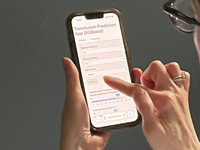
Interventions: Other: App-based bundled mental fitness intervention; Other: App-based wellness module collection
Sponsors: Massachusetts General Hospital
Not yet recruiting
Remotely monitoring patients after they have been released from the hospital for serious infections does not reduce their risk of readmission, particularly for older adults, a randomized trial suggests.
The findings, released simultaneously in JAMA Network Open and at the Critical Care Reviews annual meeting in Belfast, emphasize the importance of studying potentially beneficial care models in real-world scenarios.
Remote monitoring involves the use of resources such as smartphone-based questionnaires, internet-connected scales, or blood pressure monitoring to allow patients to leave hospital.
These enable clinicians to monitor health from afar, while acting on alerts to ensure timely care.
While patients might prefer this type of care, the trial suggested that remote monitoring should be re-evaluated and individually tailored after acute care for sepsis and lower respiratory tract infections.
It did not increase the days patients spent at home and did not support U.S. federal agency efforts to reduce hospital readmissions by reimbursing remote monitoring.
“Health systems, insurers and policymakers all want to reduce hospital readmissions, and most patients prefer to recover safely at home,” explained lead researcher Sachin Yende, PhD, from the University of Pittsburgh.
“Remote monitoring has been held up as a solution, is reimbursed by the Centers of Medicare & Medicaid and its use has grown. But, aside from a few conditions, there’s a dearth of high-quality data to show it reduces readmissions.”
In an attempt to source this information, Yende and team conducted a complex trial in 1286 adults, with a median age of 63 years, who were recovering at home after hospitalization for sepsis or lower respiratory tract infections at 19 institutions. Of these patients, 32.6% received intensive care.
Participants were randomly assigned to one of four remote monitoring strategies or usual care.
Usual care generally involved a phone call from a nurse after discharge followed by continuing management from a primary care physician. The remote monitoring interventions consisted of short or long health questionnaire with standard or enhanced clinical response teams.
The standard response involved nurses who responded to alerts highlighted in the questionnaires together with coordinated care involving the patient’s primary and specialty clinicians.
Enhanced care included certified registered nurse practitioners with palliative care expertise who could coordinate some of the care response and also access social workers.
The primary endpoint was days at home at 90 days after discharge.
The trial showed that remote monitoring programs with high- or low-intensity questionnaires combined with a nurse response team or a nurse practitioner-led response team did not increase the time spent at home.
At least one readmission occurred among 37.8% of patients in the control group, receiving usual care.
This compared with 39.7% in patients receiving the shorter questionnaire and standard response team, 44.2% for those receiving the long questionnaire with standard clinical response, 37.3% receiving the shorter questionnaire but enhanced response team, and 36.3% for those receiving the long questionnaire with enhanced clinical response.
These differences did not reach statistical significance.
However, among patients aged 65 years and older, the remote monitoring programs did reduced time spent at home and increased readmission rates compared with usual care.
In this older age group, both the standard and enhanced response groups had fewer home days compared with usual care, with corresponding cumulative odds ratios of 0.56 and 0.67.
“These findings support reevaluating and tailoring remote monitoring in post–acute care following sepsis and lower respiratory tract infection to support further alignment with patients’ needs and desire for personalized monitoring,” the researchers concluded.
The post Remote Monitoring Benefits Unclear After Hospitalization for Serious Infection appeared first on Inside Precision Medicine.

Netherlands CRDMO Symeres expanded its spray drying capabilities at its Cranbury, NJ CMC development site to support formulation development for poorly soluble and development-challenged small-molecule drug candidates.
The expanded capability is designed to support bioavailability enhancement strategies, including amorphous solid dispersions (ASDs), particle engineering and solubility optimization for compounds progressing from preclinical development through Phase II clinical activities.
The investment strengthens the company’s integrated CMC offering by combining spray drying, formulation sciences, analytical characterization, solid-state sciences, and process development within a single development environment, according to Henning Steinhagen, CEO of Symeres. This enables sponsors to progress from early formulation screening through to clinical-ready material within one coordinated scientific framework, reducing tech-transfer risk, accelerating decision-making, and improving development continuity, he adds.
![By expanding spray drying capabilities within its integrated Cranbury CMC site, Symeres says it can help clients address developability challenges earlier, reduce operational complexity, and support faster progression into clinical development. [Symeres]](https://www.genengnews.com/wp-content/uploads/2026/06/Spray-Dryer-300x200.jpg)
“Our investment in spray drying reflects our commitment to supporting customers across the entire drug development journey,” continues Steinhagen. “While Symeres is widely recognized for its discovery expertise, this expanded capability further strengthens our ability to support complex molecules through development and into the clinic.”
“An increasing proportion of modern small molecule drug candidates require advanced formulation approaches to achieve acceptable bioavailability and clinical performance,” explains Paul O’Shea, managing director at Exemplify BioPharma, a Symeres company. “By expanding our spray drying capabilities within our integrated Cranbury CMC site, we can help clients address developability challenges earlier, reduce operational complexity, and support faster progression into clinical development.”
A Symeres spokesperson, who says the Cranbury site now supports laboratory-scale and pilot-scale spray drying workflows for a range of formulation development activities, including rapid material screening, process optimization and scalable process development, notes that the platform is particularly suited to Biopharmaceutical Classification System (BCS) Class II and IV compounds, highly lipophilic molecules and targeted therapies requiring enhanced oral exposure.
The post Symeres Expands Spray Drying Capabilities at Its U.S. New Jersey Site appeared first on GEN – Genetic Engineering and Biotechnology News.
Using in silico tools to augment physical experiments can help identify manufacturability issues early in development. That’s according to an AI technology company that spoke on a recent panel.
BigHat Biosciences, which was among the companies presenting at PEGS Boston, explained that developing in silico models of antibody yields using a cell-free expression system allows the exploration of a wider range of mutations.
And this, in turn, lets companies better optimize their product for manufacturability.
“There’s only so many experiments you can do by putting an antibody into CHO [Chinese Hamster Ovary] cells,” explains Hunter Elliott, PhD, vice president of machine learning at BigHat Biosciences.
“With in silico tools augmenting that exploration side, we can build models that make predictions for improved sequences, screening many more antibodies in silico than we need to send to the lab.”
Elliott’s talk came alongside a panelist who argued it was important for preclinical researchers to communicate with the manufacturing departments of their companies to make a success of the latest generation of harder-to-manufacture drugs.
Speaking about his own products, Elliott argues that using in silico tools to explore a wider range of possible antibody mutations means it’s possible to select the handful with the highest possible yields as well as other improved biophysical properties.
“You’re derisking your processes because you’re combining your experiments with the in silico tools you’re using,” he says.
Talking about the panel, Elliott adds that discussion around the limitations of models included the lack of publicly available data on manufacturability and developability, especially for potential products that have failed to make it to the clinic.
Some have expressed concern that using in silico tools might also accidentally screen out the best-performing antibodies. Although, he says, “my personal opinion is that the ability to predict properties of sequences without sending them into the lab makes it easier for us to optimize from a suboptimal starting sequence.”
“With these models, we can keep this imperfect antibody in the loop and take it forward through several rounds of optimization, and then, instead of a candidate molecule being killed early on, it might be engineered into manufacturability.”
The post <i>In Silico</i> Devices May Improve Drug Manufacturability appeared first on GEN – Genetic Engineering and Biotechnology News.