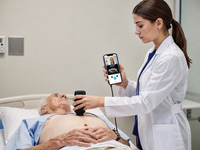
<strong>Background:</strong> Fluid assessment in geriatric inpatients is challenging, as clinical signs are often unreliable. Inferior vena cava (IVC) ultrasound provides a rapid, noninvasive estimation of intravascular volume. Teleguided point-of-care ultrasound (POCUS) allows examiners without prior ultrasound experience to perform scans under real-time supervision. <strong>Objective:</strong> This study aimed to evaluate the feasibility, accuracy, efficiency, and user satisfaction of remote-guided IVC ultrasound performed by medical students and nurses without prior ultrasound experience in a geriatric inpatient setting. <strong>Methods:</strong> This prospective feasibility study was conducted between February and March 2025 in a geriatric inpatient ward at a German tertiary care hospital. Thirty hospitalized geriatric patients were recruited using a pragmatic convenience sampling approach on predefined study days. Each patient underwent 2 IVC ultrasound examinations (n=60) using a handheld device with TeleGuidance; one was performed by a medical student and one by a nurse. All scans were remotely supervised by an ultrasound-experienced cardiologist, who subsequently performed a third, independent IVC scan on each patient, serving as the reference standard. Examiners were 2 final-year medical students and 2 nurses, all without ultrasound experience, each performing 15 scans. Primary outcomes were technical feasibility (successful teleguidance connection), accuracy of IVC diameter measurement (≥80% within +2 mm to –2 mm), and examination duration (≤10 minutes). The secondary outcome was user satisfaction (≥75 on a 0-100 numeric rating scale). <strong>Results:</strong> Connectivity and remote supervision were consistently stable, enabling completion of all scans (feasibility 100%). IVC visualization was successful in 90% (27/30) of cases. Accuracy was achieved in 80% (48/60; 95% CI 67-88) of scans. Mean duration was 3.3 (SD 2.0) minutes. Mean user satisfaction was 89%, with all ratings ≥85%. <strong>Conclusions:</strong> Telemedicine-guided IVC ultrasound was feasible and well accepted in this geriatric inpatient setting. Nonexpert examiners were able to obtain clinically usable measurements under remote supervision within a few minutes after minimal training. These findings suggest that teleguided POCUS is a promising approach to support task sharing in geriatric care. Further studies are needed to confirm these results and to evaluate integration into clinical practice. <strong>Trial Registration:</strong> German Clinical Trials Register DRKS00035821; https://www.drks.de/search/de/trial/DRKS00035821/details
Background: Clinical dashboards are becoming important tools for managing and monitoring hospitalized patients across different wards. Moreover, careful attention to design, usability, and user interaction is essential for developing effective support tools for clinicians. Objective: This study aimed to describe the development, implementation, and preliminary evaluation of an interactive dashboard for patient monitoring and management in the Continuity of Care Centre (CCC). Methods: We developed a dashboard according to clinicians’ requests and the daily workflow of case managers. First, a CCC Data Mart was created to collect all patients’ information automatically extracted from the hospital’s data warehouse. However, case managers had the possibility to enter additional patient information in the dashboard using a dedicated form. Moreover, CCC physicians, nurses, and administrative staff were surveyed using 2 validated questionnaires, the System Usability Scale and the Questionnaire for User Interaction Satisfaction. The Situation Awareness Index was proposed to evaluate user awareness and task efficiency. Results: The first version of the CCC dashboard presented 4 panels with different types of information, both on the individual patient and on metrics related to the overall patient population. The first panel focused on patients’ data, such as demographic factors, admission, transfer, discharge wards (and their dates), etc. The importance of this panel was the possibility of viewing information collected from different sources within a single interface. The other 3 panels displayed different key performance indicators for the overall patient population and presented data both in the form of tables in the second panel and graphs in the third and fourth panels. After 3 months of daily use, a total of 15 participants, 10 nurses, 2 administrative staff members, and 3 physicians, were recruited for the dashboard evaluation. The average System Usability Scale score of the dashboard was 61.5 (SD 15.7) points, which indicates “OK to good” usability, and the median score obtained with the Questionnaire for User Interaction Satisfaction was 5.77 (IQR 4-7), with the highest results in usability (mean 6.33, SD 0) and learning (mean 6.01, SD 0.39). The overall Situation Awareness Index score was 4 points, with the highest score in “familiarity of dashboard” (mean 4.73, SD 1.66 points) and “arousal support” (mean 4.6, SD 1.8 points). Conclusions: We developed an interactive dashboard for patient monitoring and management, with positive evaluations from users across different questionnaires.
<img src="https://jmir-production.s3.us-east-2.amazonaws.com/thumbs/65132239ee389a3c7f7757cc25f46d29" />
Targeted drug delivery is generally beneficial to reduce amounts of drugs used in treatment while minimizing side effects. For diseases like those of the esophageal tissues, targeting this organ presents a larger challenge by virtue of its location and function.
“There are many people with esophageal disease, and if you look at drugs for these conditions, they’re very limited in their ability to target this part of the body and it’s very difficult to develop them,” said Giovanni Traverso, MD, PhD, associate professor of mechanical engineering at MIT, gastroenterologist at Brigham and Women’s Hospital, and associate member of the Broad Institute of MIT and Harvard.
Traverso and his team developed an oral drug formulation which includes hydrogel to coat the mucosal lining of the esophagus. The formulation includes ingredients that support drug absorption, allowing for the delivery of small molecules or antibodies.
“We were interested in delivering anti-TNFs as a model drug, but also to help people who suffer from conditions like Crohn’s disease to have options that could be delivered to the site,” Traverso said. “If we have the possibility of site-directed delivery, we may be able to mitigate systemic side effects from these immunosuppressing agents.”
To test a wide variety of formulations, researchers developed a screening system to quickly identify which mixtures enhanced the delivery of drugs to esophageal tissues. “We developed an esophageal tissue screening system consisting of specialized custom plates,” they wrote, “to incorporate gravity effects, and excised esophageal mucosa tissues.”
Data from the intensive screening of over 100 compounds were used to create a library of the most effective and non-toxic permeation components, along with the formulation that adhered to the esophageal mucosa for an extended time period. These components work in synchrony to both maintain contact of the drug delivery gel while allowing for the target tissues to accept the drugs.
“Our data suggest that the bile salts temporarily loosen these cell–cell junctions, mainly by interacting with calcium ions that help maintain junction integrity. This creates a more permissive pathway between the cells, allowing larger molecules to move into the mucosal tissue more efficiently,” said lead author, Christina Karavasili, PhD, former postdoctoral researcher in the Traverso lab who is now an assistant professor at Aristotle University of Thessaloniki in Greece.
Their selected formulation was validated in both pig and human tissues before being tested in vivo. Pigs treated with the anti-TNF model drug or infliximab (an immunosuppressant antibody dosed systemically, often leading to negative side effects) had effective delivery of the drugs, and while the cell-cell junctions were temporarily loosened, the cells returned to their normal condition within three days.
In these images of human esophageal tissue, green staining shows E-cadherin, a protein involved in maintaining connections between epithelial cells. In untreated tissue (top row), the E-cadherin signal is strong, reflecting an intact epithelial barrier. After treatment with a gel-like drug formulation (bottom row), the E-cadherin signal is reduced, suggesting a temporary loosening of cell–cell junctions. [Traverso Lab]
“The hydrogel helps the formulation remain on the esophageal surface for longer, while the bile salts help increase transport across the tissue,” confirmed Karavasili.
Further testing is currently underway to optimize the formulation for humans. The researchers’ goal is to enable effective and site-specific drug delivery to patients to reduce side effects, while also making the treatment itself as comfortable as possible.
“We hope this platform will make it easier to develop systems that can help patients suffering from these conditions,” Traverso shared. “This is a platform to enable the development of drug-delivery systems for the esophagus, which hasn’t been possible before because the tools haven’t existed.”
Conditions: Early Onset Psychosis; First Psychotic Episode Within the Last 5 Years; First-episode Psychosis; Schizophrenia Spectrum Disorders (SSD); Psychosis; Psychosis NOS; Randomized Controlled Trial (RCT)
Interventions: Behavioral: FEEL GOOD; Other: Treatment as Usual (TAU)
Sponsors: Stephanie Mehl; German Research Foundation; Universitätsklinikum Hamburg-Eppendorf; Central Institute of Mental Health, Mannheim; University Hospital Augsburg; Ludwig-Maximilians – University of Munich; Charite University, Berlin, Germany; University Hospital of Cologne; Vivantes Klinikum am Urban; Philipps University Marburg