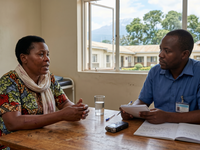
Adaptation of a Smartphone-Based Mobile Health Program to Support Person-Centered Treatment of Tuberculosis in Kilimanjaro, Tanzania: Preimplementation Qualitative Needs Assessment

Background: Despite increasing smartphone penetration worldwide, personalized mHealth (mobile health) care interventions remain largely untapped for the support of people with tuberculosis. An evidence-based multifeature smartphone platform for HIV care tailored and widely implemented in the United States may enhance treatment quality and completion in the Kilimanjaro context. Objective: We aimed to evaluate contextual determinants of mHealth implementation in the Kilimanjaro region to ensure feasibility, acceptability, and effective adaptation of the platform for tuberculosis care within Kilimanjaro. Methods: We conducted semistructured in-depth interviews at Kilimanjaro Christian Medical Centre and Kibong’oto Infectious Diseases Hospital with people with tuberculosis (aged 18+ years with drug-susceptible/-resistant tuberculosis, with or without HIV, and >1 mo on treatment) and providers and staff (eg, clinicians, community health workers, or laboratory staff). Interview guides were designed using Bury’s Framework for Chronic Illness and the Consolidated Framework for Implementation Research, along with an overview of an existing smartphone-based program called PositiveLinks. Interviews were analyzed using thematic analysis, and determinants were mapped to behavior change frameworks to develop a mechanistic understanding of adaptation for the context. Results: We conducted 14 interviews with people with tuberculosis and 11 provider and staff interviews. Several unmet tuberculosis treatment needs emerged, along with suggestions for platform adaptation and implementation strategies. Findings suggest high personal smartphone access among providers and staff (11/11, 100%), less so for people with tuberculosis interviewed (5/14, 36%). High provider digital literacy and capability and usage were noted, with smartphone apps routinely used for tuberculosis care delivery independent of electronic health systems. People with tuberculosis primarily used mobile phones for communication (calls) with clinic providers and staff for care coordination (eg, reminders). Internet access and stability remain major barriers in rural clinics, along with the personal cost of data bundles for both stakeholder groups. Key assets identified within the inner setting of Kilimanjaro Christian Medical Centre and Kibong’oto Infectious Diseases Hospital include existing provider and staff commitment to treatment support outside of clinic visits, and a robust infrastructure of community outreach for support of adherence and retention for people with tuberculosis. Conclusions: Findings suggest a role for broader digital wraparound support beyond adherence monitoring for tuberculosis care in the context. Real-world considerations for the context suggest implementation of provider-facing smartphone interventions was perceived as highly feasible and acceptable, with appropriate consideration of personal cost associated with usage among stakeholders. Patient-facing or bidirectional tools would require modifications to existing mHealth implementation strategies, including more comprehensive assessment of digital literacy and related training, as well as provision of subsidized devices and data bundles.

Feasibility and Preliminary Effectiveness of the ChulaCancer Mobile Chatbot for Supportive Care of Patients With Breast or Colorectal Cancer Receiving Chemotherapy: Pilot Randomized Controlled Trial

<strong>Background:</strong> Chemotherapy-related toxicities often lead to unscheduled health care use and diminished quality of life. Digital health interventions, such as chatbots, offer a scalable solution for supportive care; however, evidence regarding their effectiveness in resource-limited, low- and middle-income settings remains limited. <strong>Objective:</strong> This study aimed to evaluate the feasibility, use, and preliminary effectiveness of a closed-loop chatbot (ChulaCancer Chatbot) in reducing unscheduled hospital visits and stabilizing quality of life among patients receiving chemotherapy for breast or colorectal cancer. <strong>Methods:</strong> This pilot randomized controlled trial enrolled 40 patients at a single academic center in Thailand, randomized 1:1 to either ChulaCancer chatbot plus usual care or usual care alone. The primary end point was the proportion of unscheduled hospital visits due to chemotherapy-related toxicities within 12 weeks of treatment initiation. Secondary end points included longitudinal quality of life changes (30-item EORTC Quality of Life Questionnaire) measured at baseline, following chemotherapy cycle 2, and following cycle 4. Use metrics were extracted from the chatbot platform. Data were analyzed using the Fisher exact test and linear mixed-effects models. <strong>Results:</strong> The platform recorded 2393 total messages with a 70.5% (503/713) successful response rate for user-initiated queries. Unscheduled hospital visits occurred in 15% (3/20) of the chatbot group compared to 35% (7/20) of the usual care group (<i>P</i>=.24). While infection-related visits were similar between groups, the usual care group recorded multiple visits for low-acuity symptoms (eg, anxiety, headache, and edema) that were absent in the chatbot group. Regarding quality of life, the chatbot group demonstrated a significant mitigation of cancer-related fatigue following cycle 4 compared with the usual care group (<i>P</i>=.02 between groups). Additionally, the chatbot group significantly improved in global health status (<i>P</i>=.04) and avoided the decline in physical functioning observed in the control arm (<i>P</i>=.04). <strong>Conclusions:</strong> The integration of a closed-loop chatbot into oncology care is feasible and provides a potential secure triage mechanism that may reduce acute care use for low-acuity concerns. Future large-scale trials incorporating agentic artificial intelligence are warranted to further validate clinical and economic benefits. <strong>Trial Registration:</strong> Thai Clinical Trials Registry TCTR20251220014; https://tinyurl.com/5b6k3e63

STAT+: Executives reveal tech initiatives at Summa Health, eight months after General Catalyst acquisition

COLUMBUS, Ohio — People across northeast Ohio are now receiving AI phone calls to help them prep for surgery and navigate care after they leave the hospital. It’s all part of the “transformation” plan that venture capital firm General Catalyst is implementing at Summa Health, the Akron-based safety-net hospital it bought in October.

In some of the first media interviews since its parent company bought the health system, Health Assurance Transformation Company executives shed light on how the holding company is approaching its “transformation” of the hospital system and planning to share its innovations with more than two dozen of HATCo’s partner health systems.

The firm chose Summa to serve as a proving ground of sorts for health technology tools developed by General Catalyst’s portfolio companies. The purchase, a rare instance of a VC firm buying a hospital, was a response to the frustration that health systems are extremely slow in adopting new technology.

Continue to STAT+ to read the full story…

Group-based ACT for Psychological Distress of Young People

Conditions: Depression – Major Depressive Disorder; Depression Anxiety Disorder; Anxiety; Anxiety Depression

Interventions: Other: Group-based Acceptance and Commitment Therapy; Other: TAU

Sponsors: Sorlandet Hospital HF; University of Oslo; Helse Sor-Ost; Karolinska Institutet; Australian Catholic University

Recruiting

Machine Learning–Based Prediction Model for 30-Day Emergency Department Revisits in a Medically Underserved Tertiary Hospital: Formative Retrospective Cohort Study

Background: Emergency department (ED) revisits are critical quality indicators, particularly in medically underserved areas, where traditional prediction tools show limited performance. Machine learning (ML) approaches may offer improved predictive performance for identifying high-risk patients. Objective: This formative study aimed to develop and validate an ML-based model for predicting 30-day ED revisits using electronic health records from a tertiary hospital serving a medically underserved area in South Korea and to evaluate its clinical utility through interpretability analysis and risk stratification. Methods: This retrospective cohort study analyzed 36,230 adult patients visiting the Gangneung Asan Hospital ED in 2023. We developed and compared 3 ML models (extreme gradient boosting [XGBoost], random forest, and ElasticNet) using electronic health records. Model interpretability was ensured through Shapley additive explanations (SHAP) analysis, and clinical utility was evaluated through 5-tier risk stratification. Results: Among 36,230 patients, 798 (2.2%) revisited within 30 days. XGBoost achieved superior performance with an area under the receiver operating characteristic curve of 0.90 (95% CI 0.88‐0.92), a sensitivity of 0.94, and a specificity of 0.69. The SHAP analysis identified ED length of stay, oxygen saturation, systolic blood pressure, computed tomography performance, antibiotic use, and liver disease as key predictors. Risk stratification demonstrated a 25-fold difference in the actual revisit rates between the lowest (152/8450, 1.8%) and the highest (686/1500, 45.7%) risk groups. Conclusions: The XGBoost model demonstrated excellent predictive performance with high interpretability for 30-day ED revisit predictions. The implementation of this model could enable risk-stratified interventions and more efficient resource allocation in medically underserved settings, potentially reducing unnecessary revisits and improving patient outcomes. This formative study establishes feasibility and provides a foundation for future multicenter validation studies in similar medically underserved settings.
<img src="https://jmir-production.s3.us-east-2.amazonaws.com/thumbs/b4d0c970ac5696468dd8cdba2c4c476a" />