Why heat pumps are still so hot in the US

It feels as if it should be illegal to even think about heating appliances during the height of summer—seriously, these heat waves in New York have been brutal—but we need to talk about heat pumps.

The appliances use electricity for heating, they’re incredibly efficient, and they’re on the rise. (For what it’s worth, many heat pumps can also be run in reverse to cool buildings.) In the US, heat pump sales have doubled over the past 15 years, according to a new report. And they’re winning the heating race against fossil fuels, outpacing natural-gas furnaces by 32% during the first quarter of 2026.

These stats are especially striking at this moment, because a key tax credit for heat pumps just ended with the close of 2025. But you wouldn’t know it from looking at the data. Why are heat pumps still so hot?  

In case you need a quick refresher, heat pumps use electricity to essentially move heat from one spot to another. A refrigerant moves around a loop in the device, expanding and compressing, gathering and releasing heat at different points in the cycle. (For a more in-depth look at the thermodynamics, this explainer I wrote in 2023 still holds up.)

The result is an appliance that can be incredibly efficient. Once you pay for and install a heat pump, it’s generally significantly cheaper to run than a gas or oil furnace or other types of electric heating systems. And because they’re more efficient and don’t involve burning fossil fuels, heat pumps can be a major help in decarbonizing buildings.

One of the major hurdles to wider use of heat pumps is the appliances’ cost: They tend to be more expensive to buy and install than gas furnaces. For this reason, many governments offer incentives to encourage their adoption. In the US, people who installed heat pumps between 2023 and 2025 were eligible for up to $2,000 in tax credits.

Last year, though, the Trump administration slashed those tax credits, along with many of the other incentives that were part of the 2022 Inflation Reduction Act. Effective January 1, 2026, no more financial help for heat pumps.

I think I’ve seen this film before, and I didn’t like the ending. Tax credits of up to $7,500 for new EVs ended on September 30, 2025. In the quarter leading up to that deadline, sales spiked as people rushed to take advantage of the incentive. Then they fell off a cliff. Things are starting to normalize now, but clearly the tax credit’s sunset had a major effect.

But as it turns out, heat pumps are an entirely different story. In the first few months of 2026, sales have actually gone up, as Lucas Davis, an energy economist and UC Berkeley professor, points out in a new analysis.

Heat pump shipments were flat from December to January and have seen a gradual rise since then, according to data from the Air Conditioning, Heating, and Refrigeration Institute, a trade group that represents about 90% of the US market. This increase from winter into spring follows a seasonal trend seen in previous years—and it’s actually a bit stronger in 2026.

This data isn’t what you’d expect to see if losing the tax credit were hurting demand. As Davis lays out in his post, it seems the credit wasn’t really convincing people to install heat pumps, or at least the case for doing so was sufficient without the added incentive.

“It appears that the U.S. market for heat pumps is strong enough that it does not depend on tax credits,” Davis writes.

In 2024, MIT Technology Review put heat pumps on our annual list of breakthrough technologies. “We’ve entered the era of the heat pump,” I wrote at the time.

While heat pump sales have been up and down over the last few years, the era is going strong. The appliances have outsold gas furnaces in the US for the last four years. It’s not just the US, either. Countries including China and Germany have seen strong movement to heat pumps in recent years.

There’s rarely a straight path to adoption for new technology, especially something that requires so many individual households to make a significant change. But it’s encouraging that a major decarbonization tool is going strong, even when roadblocks pop up.

This article is from The Spark, MIT Technology Review’s weekly climate newsletter. To receive it in your inbox every Wednesday, sign up here. 

Designing SaMD for safety and rethinking risk management through system architecture

A workflow-centric, slice-based approach makes risk more visible, traceable, and manageable throughout the lifecycle. By Shreya Sridhar, Medtronic Standards like ISO 14971 define clear processes for identifying hazards, estimating risk and implementing controls. Organizations establish traceability between risks, requirements, and verification activities, and validation frameworks are well understood. Yet despite this rigor, meaningful risks continue…

The post Designing SaMD for safety and rethinking risk management through system architecture appeared first on Medical Design and Outsourcing.

Executive pay decreases at Invisalign maker Align Technology

Align Technology disclosed a big pay decrease for its CEO and a sizable compensation increase for its median employee in 2025, according to a recent filing. The dental device developer was the world’s 32nd-largest medical device company on the latest Medical Design & Outsourcing Medtech Big 100 ranking by revenue. That ranking was based on…

The post Executive pay decreases at Invisalign maker Align Technology appeared first on Medical Design and Outsourcing.

The Download: a useful quantum machine and a record-breaking subsea tunnel

This is today’s edition of The Download, our weekday newsletter that provides a daily dose of what’s going on in the world of technology.

PsiQuantum has a plan to make a massive quantum computer out of light

The machine that could change the world will be housed in a room that looks like a data center crossed with an ice cream factory. 

Inside, some 100 stainless-steel cabinets each hold hundreds of chips. On those chips, thousands of light particles will fly through a maze of optical switches and beam splitters. Each photon must be accounted for, because precisely measuring where it ends up will help answer questions that current computers might take millions of years to solve.

This computer, as described, does not exist. It’s the brainchild of a company called PsiQuantum, founded in 2016 by four physicists from UK universities. In a crowded field of deep-pocketed competitors with similarly fantastical visions, the company aims to be the first to build a useful quantum machine.

Read the full story on the company’s quest.

—James O’Donnell

MIT Technology Review Narrated: inside the world’s deepest and longest subsea road tunnel

—Niall Firth

I’m currently around 1,000 feet beneath the North Sea, in a dark, dank cave. It smells weird. And I’m increasingly aware of the pressure from millions of tons of seawater just above my head.

I’m under the iconic fjords of Norway to visit what will soon become the world’s longest and deepest subsea road tunnel—an exceptional engineering feat that will carry drivers deep beneath the North Sea.

I’m here to understand how you make a 16.6-mile highway that sits 1,280 feet below the sea at its deepest point. And also—at a time when it can feel hard to get anything done—to reassure myself that ambitious engineering is still possible. That we can still make things. 


This is our latest
story to be turned into an MIT Technology Review Narrated podcast, which we publish each week on Spotify and Apple Podcasts. Just navigate to MIT Technology Review Narrated on either platform, and follow us to get all our new content as it’s released.

The must-reads

I’ve combed the internet to find you today’s most fun/important/scary/fascinating stories about technology.

1 Meta allegedly used AI to target workers with health issues for layoffs
Their lawsuit says Meta relied on AI to create a termination list. (Guardian)
+ And pinpointed staff who took maternity or disability leave. (Reuters $)
+ One was allegedly informed the day before her water broke. (Ars Technica)
+ The layoffs aimed to offset Meta’s AI spending. (Gizmodo)
+ AI agents are not your “coworkers.” (MIT Technology Review)

2 OpenAI’s first consumer device will be a mobile smart speaker
The screenless device will serve as an “AI companion.” (Bloomberg $)
+ It’ll let you talk with ChatGPT. (Verge)
+ And use a camera and sensor to understand your environment. (Reuters $)
+ It’s set to launch next year. (Engadget)
 
3 The US military sent explosive drone boats into combat for the first time
They attacked an Iranian midget submarine and naval port. (Ars Technica)
+ Underwater drones may shape a war in Taiwan. (MIT Technology Review)
 
4 DeepMind’s CEO has called for a US-led body to test frontier AI models
Demis Hassabis wants the watchdog to vet national security threats. (FT $)
+ If dangers mount, it would coordinate an industry-wide slowdown. (Axios)
 
5 Data centers are set to add billions in power costs in 13 states
A power auction is slated to produce $6.3 billion in new charges. (NYT $)
+ Australia plans to govern the use of water and power for AI. (WSJ $)

6 xAI’s unpermitted power pollution hits Black communities hardest
Elon Musk’s xAI has been installing gas turbines without permits. (Reuters $)
+ We need to focus on Big Tech’s energy footprint. (MIT Technology Review)
 
7 Stripe and Advent have offered to buy PayPal for more than $53 billion
The payments giant and private equity firm have made a joint bid. (Reuters $)
+ Apple and Google Pay have eroded PayPal’s market share. (Bloomberg $)

8 DeepSeek plans to file for IPO as soon as this year
The Chinese AI pioneer is likely to list in Shanghai. (WSJ $)
+ Here’s why DeepSeek’s latest model matters. (MIT Technology Review)

9 A hard, lightweight “bio-metal” has been discovered in sea worm jaws
It could have applications in engineering. (New Scientist $)

10 A new $3,000 fitness suit electrocutes you to boost your gains
Celebrities love it—but not everyone’s a fan. (404 Media) 

Quote of the day

“By economic and engineering measures, generative AI might be the worst technology ever deployed.” 

—Alex Reisner, a staff writer at The Atlantic, explains why GenAI’s scaling problem is an engineering disaster.

One More Thing

""

FRANZISKA BARCZYK


Hackers made death threats against this security researcher. Big mistake.

In April 2024, an anonymous hacker began posting death threats on Telegram and Discord channels aimed at a cybersecurity researcher named Allison Nixon. It wasn’t long before others piled on. Someone shared AI-generated nudes of her.

They targeted Nixon because she had become a formidable threat. As chief research officer at the cyber investigations firm Unit 221B, named after Sherlock Holmes’s apartment, she had built a career tracking cybercriminals and helping get them arrested. 

For years, Nixon had lurked quietly in online chat channels or used pseudonyms to engage with perpetrators and bring them to justice. Now, she resolved to unmask the people behind the death threats—and take them down for crimes they admitted to committing. 

Find out why they learned to regret their choice of target.

—Kim Zetter

We can still have nice things

A place for comfort, fun, and distraction to brighten up your day. (Got any ideas? Drop me a line.)

+ A musician has discovered the true masters of metal breakdowns: birds.
+ Photographer Fontanesi’s surreal photo splits transform everyday images into spectacular hybrid scenes.
+ Over 30 actors, filmmakers, and friends recount how Steven Spielberg infiltrated Hollywood in this terrific article.
+ Who would win the World Cup if less important things than soccer decided it, like life expectancy and happiness? A new game tests your knowledge.

Paint-on Electrodes Enable Bespoke Health Monitoring

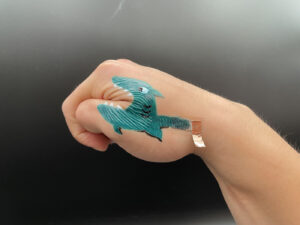
Wearable electronic “tattoos” painted onto the skin could allow comfortable and reliable health monitoring to personalized designs.

The flexible electrodes, outlined in PNAS, represent a pathway to the next generation of wearable systems for healthcare.

The novel devices are made of intrinsically conductible polymers that conform to the skin and maintain reliable connections to electronic systems, allowing stable electrophysiological monitoring.

Their ability to create bespoke designs could be particularly useful for long-term use in children, adolescents, and people sensitive to potential stigmatization.

WE-PDD electrode [Wanqing Zhang]

The researchers describe their invention “as a personalized and scalable solution for next-generation electronic tattoos that combine ultra conformality, customizability, and long-term reliability, accelerating their translation into clinical diagnostics and interactive bioelectronic systems.”

The current gold-standard electrodes of wet silver/silver chloride gels can dry out and produce inaccurate readings during motion.

The team therefore developed a paintable, drawn-on-skin dry electrode based on the biocompatible polymer poly (3,4-ethylenedioxythiophene): poly (styrene sulfonate (PEDOT:PSS).

The conductive ink can be painted onto microtextured skin with a commercial paintbrush and even go through hair.

It comprises polyvinyl alcohol as a mechanically supportive network, PEDOT:PSS as a conductive filler, and 4-dodecylbenzenesulfonic acid (DBSA) as both conductive additive and plasticizer, in a water-ethanol cosolvent system.

The resulting WE-PPD (water-ethanol-PVA/PEDOT:PSS/DBSA) electrode is breathable, sticks well to the skin, and conforms to it closely, minimizing skin contact impedance.

The paintable formulation also enables it to penetrate porous silver textile to form a robust soft-rigid connection.

In proof-of-concept demonstrations, the team demonstrated the versatility of the electrodes for biopotential monitoring and human-machine interfaces.

It was tested across wireless long-term electrocardiography recordings, robotic hand control based on electromyogram, and electroencephalogram-based neural response detection.

The absence of imaging artifacts also demonstrated its potential for multimodal MRI imaging and electrophysiological (EP) recordings, noted first author Wanqing Zhang, a PhD research assistant at Penn State University, and co-workers.

The team added: “The ability to customize the electrode appearance transforms WE-PPD from a conventional medical device into a user-friendly and aesthetically integrated wearable technology.

“For example, electrodes can be designed with cartoon patterns, which may reduce anxiety and improve acceptance among pediatric users by making EP monitoring less intimidating.

“Such personalization not only improves physiological comfort but also enhances social acceptance, user experience, and long-term compliance during continuous health monitoring.”

The post Paint-on Electrodes Enable Bespoke Health Monitoring appeared first on Inside Precision Medicine.