

IntroductionWhen consumers experience mental health crises, carers are often key supporters and are also impacted significantly themselves. The Prevention and Recovery Care (PARC) model offers a community-based residential program for consumers, in times of mental health crisis. The potential of PARC services to engage carers is under-examined. This study addresses two questions: How do carers experience the PARC service; and what are carers’ experiences of their own wellbeing, during and after engagement with PARC?MethodsThis is a mixed-methods convergent study of carer experience, whereby quantitative survey data and qualitative survey and interview data were gathered, analysed concurrently, and integrated to report carers perspectives of PARC services. Carers reported their wellbeing across 4 timepoints (n = 71) and also their experience of PARC services in a Carer Exit Survey (n = 50). An independent sample of six family members, each from a different PARC service, engaged in semi-structured telephone interviews.ResultsFor service experience, carers rated the PARC service as highly satisfactory. Interviewees reported a sense of relief, gratitude, and period of regrouping, while valuing the PARC service and feeling positive about accessing PARC services in the future. Positive experience was defined in contrast with distressing experiences of acute wards; concerns were expressed about limits to timely access of PARC services in future if needed. Regarding carer wellbeing, time 1 levels varied across participants, and all measures showed improvement for carers over time. They reported experience of respite, with confidence to entrust their family member to the team, and learning from PARC service staff ways to cope and interact with their family member.DiscussionCarers considered the PARC service a positive environment for the person to receive treatment and support and also experienced PARC services as supporting their own quality of life and wellbeing. This study contributes evidence about how highly valued these recovery oriented sub acute residential services are for carer service users; however, there is potential to further enhance the engagement of carers in PARC service delivery, including through inclusion of carers in co-design.
Non-Coding RNA Gene Expression in Psychiatric Disorders
Conditions: Schizophrenia Disorders; Major Depression; Bipolar Affective Disorders; Obsessive Compulsive Disorder (OCD); Anxiety Disorder (Panic Disorder or GAD)
Interventions: Genetic: Real-time Polymerase Chain Reaction
Sponsors: Carmen Concerto
Not yet recruiting
Interventions: Genetic: Real-time Polymerase Chain Reaction
Sponsors: Carmen Concerto
Not yet recruiting
The Efficacy and Safety of Temporal Interference Stimulation in the Treatment of Post-Traumatic Stress Disorder
Conditions: Post-traumatic Stress Disorder (PTSD)
Interventions: Device: TI stimulation device (nerviox-1000)
Sponsors: Shanghai Mental Health Center
Recruiting
Interventions: Device: TI stimulation device (nerviox-1000)
Sponsors: Shanghai Mental Health Center
Recruiting
Examining the Efficacy of a Telehealth-Based Virtual Reality Clinic in Treating Adults With Specific Phobia: Feasibility Randomized Controlled Trial
Background: Virtual reality (VR) has the potential to enhance telemental health care (TMH) by enabling accessible, engaging, and personalized treatment from home. Although VR is well-supported for in-person treatment, evidence for telehealth-based VR is limited. Moreover, no prior research has demonstrated the feasibility of therapists and clients conducting therapy sessions remotely within a shared (ie, multiuser) VR experience. Objective: The primary objective of this study was to evaluate the feasibility of conducting a randomized controlled efficacy trial (RCT) comparing exposure therapy delivered via Doxy.me VR (Doxy.me Inc)—a multiuser, telehealth-based VR app—to standard TMH in adults with clinically elevated fear of dogs, snakes, or spiders. A secondary objective was to preliminarily examine clinical (ie, specific phobia symptom severity) and treatment-related outcomes (ie, therapeutic alliance, client satisfaction, system usability, presence, cybersickness, and treatment fidelity). Methods: This study used a single-site, fully remote, parallel, feasibility RCT design. Participants were randomly assigned using a 1:1 ratio to receive 12 weekly exposure therapy sessions over 3 months, delivered via either standard TMH or Doxy.me VR. Assessments were conducted at baseline, each session, midtreatment, and posttreatment. All therapy sessions were audio recorded, 20% of which were randomly selected and rated for treatment fidelity. Feasibility benchmarks during the 12-month trial included: (1) enrolling 30 participants during Months 1‐9 of the trial; (2) collecting 70% of midtreatment self-report data; (3) collecting 70% of posttreatment self-report data; (4) collecting 70% of weekly self-report data; and (5) achieving treatment fidelity ≥80%. Between-group differences in clinical treatment-related outcomes also were examined preliminarily. Results: A total of 54 participants were enrolled between October 25, 2023 and July 26, 2024, and randomly assigned to the Doxy.me VR (n=29) and TMH (n=25) conditions, exceeding our recruitment target by 180%. Among the 30 participants targeted for completion, data were obtained from 29 (96.7%) at midtreatment and 28 (93.3%) at posttreatment. Participants completed 86.5% (180/208) of weekly self-report assessments. Treatment fidelity was 90% based on ratings of 41 session recordings. There were no significant between-group differences in clinical outcomes (all >.05) or most treatment-related outcomes. However, client satisfaction improved significantly more for the Doxy.me VR condition compared to TMH (=.04). Power analyses indicated that a sample of 160 participants would ensure adequate power for a fully powered trial. Conclusions: Telehealth-based, multiuser, synchronous VRET is feasible and shows preliminary evidence of efficacy. These findings are promising, and opportunities to improve procedures identified in this feasibility trial will directly inform the protocol for a fully powered RCT evaluating telehealth-based VR and its potential to improve treatment of mental health disorders. Trial Registration: ClinicalTrials.gov NCT06302868; https://clinicaltrials.gov/study/NCT06302868 International Registered Report Identifier (IRRID): RR2-10.2196/65770
<![CDATA[Teens’ pre-bed smartphone scrolling drives more late-night phone use, disrupting sleep and potentially worsening mental health—experts urge bedtime screen limits and device-free bedrooms.]]>
Sense of Coherence in patients with stable schizophrenia: multidimensional determinants from a cross-sectional study of 438 inpatients in Guangzhou, China
IntroductionSchizophrenia, a chronic psychiatric disorder, profoundly affects social functioning and quality of life. The Sense of Coherence (SOC), a core construct in salutogenic theory, plays a pivotal role in stress coping and recovery outcomes. While SOC has been studied in general populations, its determinants in stabilized schizophrenia inpatients remain underexplored. This study comprehensively investigated the Sense of Coherence (SOC) profile among stabilized schizophrenia inpatients by assessing its current status, exploring the interrelationships between SOC and demographic factors/Big Five personality traits (CBF-PI)/social support (SSRS), and identifying factors associated with SOC to inform potential personalized resilience-enhancing interventions. Findings may guide clinical strategies to enhance resilience and mental health recovery and potentially facilitate functional recovery in this population.Patients and methodsA cross-sectional study was conducted at a Guangzhou tertiary psychiatric hospital with 438 stabilized schizophrenia inpatients from November 2024 to February 2025. Data collection included demographic/clinical variables, Chinese Big Five Personality Inventory (CBF-PI), 13-item Sense of Coherence Scale (SOC-13), and the Social Support Rating Scale (SSRS). Statistical analyses were performed using SPSS version 27.0. Descriptive statistics were used to summarize the data and independent-samples t-tests and one-way analysis of variance (ANOVA) were employed to compare SOC scores across demographic and clinical groups. Pearson correlation analysis was conducted to examine the relationships between personality traits, social support, and sense of coherence and multiple linear regression analysis was utilized to identify independent factors influencing sense of coherence (P < 0.05).ResultThe mean SOC score among the 438 stabilized schizophrenia inpatients was 53.35 ± 11.81. SOC correlated positively with all five dimensions of CBF-PI-B (P < 0.05), as well as subjective social support (P < 0.01), while showing inverse correlations with objective support (p < 0.01) and support utilization subscales (P < 0.01), Multiple regression identified personal income(yes), frequency of physical activity (≥3 times/week), and primary caregiver (Children) as significant SOC predictors.ConclusionThis study demonstrates that stabilized schizophrenia inpatients in a tertiary psychiatric setting exhibit generally lower Sense of Coherence (SOC) levels compared with healthy normative values and moderately lower than several outpatient schizophrenia samples. Higher SOC was significantly associated with having a personal income, frequent physical activity (≥3 times/week), having children as primary caregivers, and Chinese Big Five Personality traits. Notably, while subjective support was positively correlated with SOC, objective support and support utilization showed negative associations. Given the moderate internal consistency of the SSRS (Cronbach’s α = 0.626), the differential associations with social support dimensions should be interpreted cautiously. Concurrently, personality traits are relatively stable, their associations with SOC may inform indirect supportive strategies leveraging existing strengths rather than direct modification. These findings underscore the potential value of tailored interventions that enhance subjective support, promote structured recreational activities, and foster patients’ perceived coping resources. Further cross-sectional and longitudinal outpatient studies are warranted to validate these results and elucidate the mechanisms underlying the support paradox.
Competency-based training and supervision in group problem management plus in the Kurdistan region of Iraq
BackgroundGroup Problem Management Plus (gPM+) is a scalable psychological intervention designed to be delivered by non-specialist mental health workers and has been widely implemented in humanitarian contexts. As part of the ongoing process of integrating refugees into routine national care systems, competency-based training and supervision were implemented in Duhok, within the Kurdistan Region of Iraq. Twelve participants from the Directorate General of Health (DoH), working in Syrian refugee camps, took part in a seven-day training programme, followed by supportive supervision over a six-month period. The programme aimed to enhance participants’ skills in delivering the group intervention to individuals experiencing psychological distress.MethodsThe training programme consisted of a seven-day (56 hours), structured in-person course combining theoretical input, demonstration, and intensive role-play practice, followed by a six-month supervision (30 hours) phase that included regular group supervision sessions and individual on-site coaching focused on real-life implementation challenges. Individual and group-level competency improvements were assessed using the EQUIP (Ensuring Quality in Psychosocial Support and Mental Health Care) methodology, which provides a structured approach to monitoring and tracking participants’ progress in facilitation and intervention skills, enabling trainers to identify skill gaps and tailor supervision sessions effectively. This was supplemented by qualitative evaluations from both participants and trainers.ResultsParticipants showed notable reductions in harmful behaviours and improvements in competencies. Supervision sessions and role-playing exercises further reinforced learning and skill application. Participants also reported increased confidence, with feedback highlighting the value of problem-solving strategies and coping techniques.ConclusionsEQUIP proved effective in monitoring and guiding improvements among non-specialist staff delivering psychological interventions. The EQUIP platform may serve as a valuable tool for strengthening mental health and psychosocial support (MHPSS) training and interventions, and for facilitating the integration of programmes developed in humanitarian contexts into routine systems of care in low-resource settings.
<![CDATA[Carlos H. Schenck, MD, delivered the keynote address at SLEEP 2026 on REM sleep behavior disorder. Here’s what psychiatrists and mental health clinicians need to know. ]]>
TIS for Improving Cognitive Impairment in Schizophrenia
Conditions: Schizophrenia Disorder; Cognitive Impairments
Interventions: Device: temporal interference stimulation; Device: Sham stimulation
Sponsors: Central South University
Not yet recruiting
Interventions: Device: temporal interference stimulation; Device: Sham stimulation
Sponsors: Central South University
Not yet recruiting
Welcome to Our New IOCDF Advocates
The IOCDF is thrilled to announce our newest cohort of Advocate volunteers! We’re welcoming 13 incredible new Advocates to our program, bringing our total to 64 dedicated volunteers working together to create meaningful change for the OCD and related disorders community.
These passionate individuals join us from bustling cities and quiet rural towns across the United States and around the world. From California to Massachusetts, and from countries including Canada and Ireland, this mix of local and global perspectives ensures we can reach and represent diverse communities everywhere.
The Power of Diverse Voices
Our newest cohort has a wide range of experiences and interests. They are passionate about addressing critical topics including:
- Access to treatment
- Diversity, multicultural issues, and LGBTQIA+ inclusion
- Family issues and family accommodation
- Young adult mental health and academic challenges
- Public policy
- Research advancement
- Suicide prevention
- Nutrition, fitness, and anxiety in athletes
This diversity of focus areas ensures that we can better represent and serve the full spectrum of our community’s needs.
Meet the Spring 2026 Advocates:
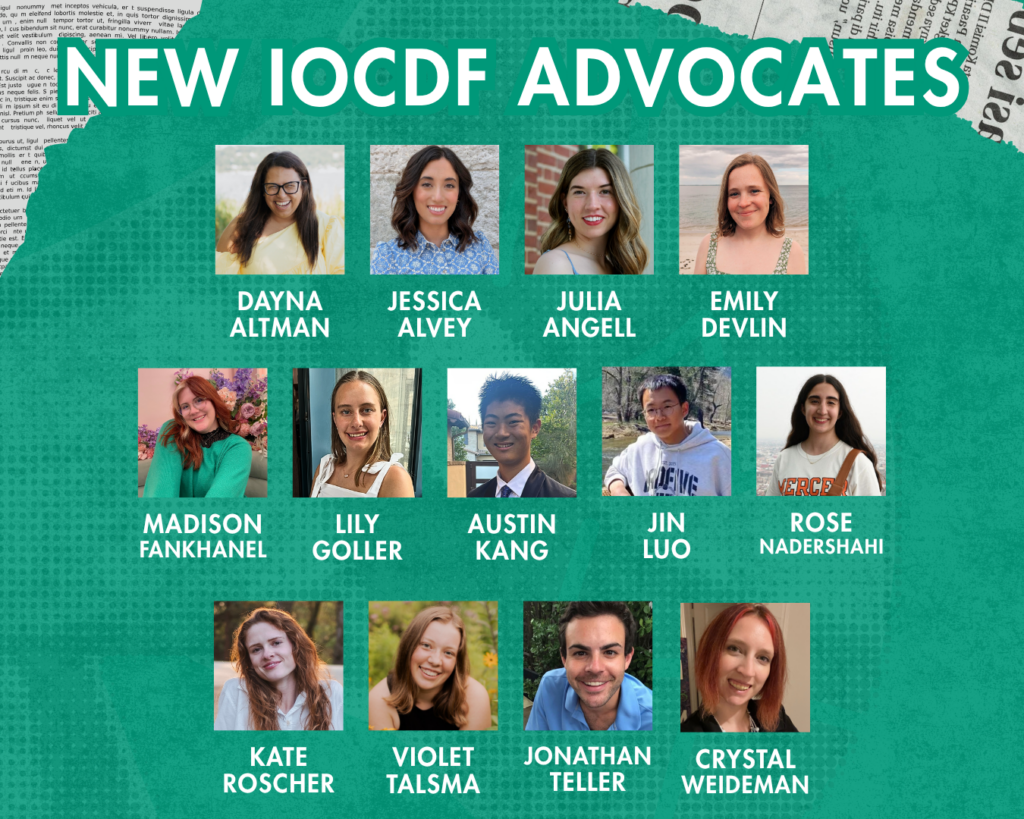
- Dayna Altman
- Jessica Alvey
- Julia Angell
- Emily Devlin
- Madison Fankhanel
- Lily Goller
- Austin Kang
- Jin Luo
- Rose Nadershahi
- Kate Roscher
- Violet Talsma
- Jonathan Teller
- Crystal Weideman
You can see the full list of IOCDF advocates at iocdf.org/advocate-program
Your Voice Matters Too
Inspired by our Advocates? You can make a difference! Here are ways to start advocating today:
Fuel Our Mission Through Fundraising
Turn your passion into action by launching a personal fundraiser. Whether for a birthday, a race, or a creative project, you can rally your friends and family to raise critical funds. Every dollar helps build a world where everyone affected by OCD can thrive. Start your fundraiser here or explore all ways to give back here.
Advocate for policy change
Your voice can shape laws that improve access to care and insurance coverage. The IOCDF Public Policy Action Center makes it simple to find the latest bills and contact your elected officials with just a few clicks. True change starts here.
Join an IOCDF Special Interest Group
Connect with people who share your experiences or professional interests. IOCDF Special Interest Groups (SIGs) provide a platform for deeper discussion.
Whether you advocate on the national stage, share your story to fight stigma, or fundraise your way, every action creates a ripple effect of hope and understanding. Your journey, your voice, and your commitment are powerful tools.
Start today and help us build a world where everyone affected by OCD feels supported, seen, and empowered. Join a dedicated community committed to raising awareness.
Welcome again to our new IOCDF Advocates, we’re grateful to have you joining our mission!
The post Welcome to Our New IOCDF Advocates appeared first on International OCD Foundation.