HEK293 cells may be the most common host used in viral vector production, but they are far from ideal, says the author of a new study, who argues that gene therapy firms will need more effective alternatives to support commercial growth.
The study, by a team at University College Dublin and services firm APC, examined the manufacturing systems used to make the recombinant adeno-associated viruses (rAAVs) on which many gene therapies rely.
And the key finding is that not one of the eight commercial cell lines used to date—including the most widely-used line, HEK293—is ideal.
Lead author, James Conheady, from APC, tells GEN, “Current rAAV production methods using existing cell lines struggle to meet clinical demands, contributing to the expensive price-tag associated with rAAV-based gene therapies.
“Novel cell lines may be able to produce rAAVs at higher yields and/or with improved quality, which ultimately could help make these therapies more accessible to the people who need them.”
Shortcomings
To date, eight different host cell systems have been used to produce rAAVs, with each having strengths and weaknesses.
For example, some cell lines generate rAAV capsids that do not contain the desired genetic material. These empty vectors are a problem because they generate an immune response without providing a therapeutic effect.
Other cell lines struggle to make enough capsids. For example, the recommended dose for systemically delivered gene therapies is upwards of 1 × 10¹⁴ vg/kg of a patient’s bodyweight. The yield per production run for HEK293 cells is only around 1010.
Cost is another issue.
According to Conheady and co-authors, the GMP-grade plasmids and transfection reagents used to modify cell lines such that the vectors they produce contain the genes of interest account for a significant proportion of the price of the resulting therapies.
Alternative systems
Given these shortcomings, it is no surprise that the search for more effective alternative hosts is already underway.
Conheady says, “At the end of the day, rAAV manufacturers are all looking for the same things from their upstream process—high titers, improved full/empty ratios, and transduction rates.”
Current cell line development efforts are focused on combining desirable traits, Conheady adds, with characteristics such as resistance to apoptosis, diminished antiviral immune response, and secretion profiles being among the most sought after.
“Many of the traits identified in this review are aligned with modifications that have been shown to be beneficial in the context of rAAV production in HEK293 cells. For example, secretion of vector particles from the cell into the production medium can greatly simplify downstream operations and can be influenced by knocking out genes involved in endosomal trafficking.
“The ideal cell line should also be resistant to transfection and virus-induced apoptosis, to produce significant vector quantities. Knockout of the pro-apoptotic BAX and BAK1 genes has been shown to improve vector yields,” he says.
Whether industry will ever see these efforts pay off and agree on the “ideal” cell line remains to be seen, according to Conheady.
“Manufacturers will require significant grounds to agree on a standardized approach, a novel cell line may need to vastly outperform all others in relation to yield and quality characteristics—as the saying goes, ‘you stick with what you have until you have better’.”
Let’s start with a game. Open up your chatbot of choice—Claude, ChatGPT, Gemini—and type “Give me a random number between 1 and 10.” You’re going to get 7. Almost always. Now type “Another” and you’ll get 3 or 4. Type “Another” again and you’ll get 8 or 9.
That won’t work every time—but if it did for you, you may wonder if I have superpowers. I don’t.
The truth is that most large language models are stuck in a rut. They are far more predictable and far less creative in their responses than you might expect. That’s fine for tasks like coding or research, but groupthink is a problem when you’re brainstorming or planning your next vacation.
The Australian startup Springboards has a solution. It built an LLM called Flint, which has been trained to come up with a wider variety of responses than mainstream LLMs to open-ended questions such as “Where should I go in Europe?”
“Most language models are fighting hallucinations,” says Springboards cofounder and CEO Pip Bingemann. “We welcome them.”
Bingemann introduced me to the random number game when he first showed me his company’s new model. It felt like watching an illusionist with a deck of cards. “This is our sales trick, and it works every single time,” he says.
After ChatGPT and Claude both gave their 7s, Bingemann turned to Flint. It too came back with 7: “Aha, of course that was going to happen, but it’s okay—7 is a legitimate answer.” He restarted the session and prompted again: ChatGPT gave 7, Claude gave 7, Flint gave 3.7916.
Run your way
It’s not just numbers. When Bingemann asked ChatGPT and Claude to name a type of car, he predicted that it would be a Toyota or a Honda—and he was right. Flint came up with a Ford F-150. “There’s all this lost information that doesn’t get served up in these models,” he says. “They’re just as capable of saying a Buick or a Tesla. They just don’t—they’re biased.”
Bingemann sent one last prompt to each of the three models: “Give me a tagline for a campaign for New Balance running shoes. Just the tagline.” Claude: “Run your way.” ChatGPT: “Run your way.” Flint: “Built to last, run to win.” It won’t win any awards, but at least it’s different.
This weird limitation of LLMs is starting to get more attention. In November a team of researchers put out a paper, titled “Artificial Hivemind: The Open-Ended Homogeneity of Language Models (and Beyond),” that exposed a remarkable degree of repetition not only in the answers from individual LLMs but between them as well. They found that different LLMs converged on very similar answers when prompted with open-ended questions.
It’s not clear exactly why this happens, but the researchers speculate it’s because most LLMs today are trained in similar ways on similar data to do similar tasks. The team won the best paper award at NeurIPS, a major AI conference.
When the researchers asked 25 different LLMs (including models from the top US firms as well as open-source models from China and elsewhere) 50 times each to write a metaphor about time, most of the 1,250 responses were a version of “Time is a river” or “Time is a weaver.”
(I asked some of my colleagues the same question and six people gave me six different answers. My highlight: “Time is a favorite sweatshirt, shaped by a lifetime of wear.”)
When you look for it, you see repetition everywhere, says Kieran Browne, cofounder and CTO at Springboards. “The way that most chat interfaces are designed, it makes it feel like you’re having a personal conversation,” he says. “I think most people don’t really realize the extent to which they are getting the same stuff as everybody else.”
Take another example: “What should I name my band?” Most models will say something involving “glass,” “neon,” “velvet,” or “static,” says Browne.
When I tried it, ChatGPT spat out a list of 56 band names. At the top was “Glass Harbor.” Skimming through, I found “Static Empire,” “Neon Hearts,” and “Velvet Echo.” I asked Gemini; it gave me 15 suggestions, including “Static Horizon.”
Some of the suggestions looked pretty cool, though. ChatGPT’s “Sofa Astronauts” caught my eye, so I googled it—and found that a band called Sofa Astronauts already exists.
(OpenAI says that training models to give reliable and coherent answers can lead them to converge around familiar, high-probability responses and that pushing harder for novelty can lead to weaker or less reliable responses. It also notes that the “Artificial Hivemind” paper studied models from 2024 that have since been updated.)
Creative catapult
Springboards has developed a tool backed by a selection of LLMs, including ChatGPT and Claude, that creative professionals in advertising or marketing can use to brainstorm ideas. The tool lets you drag around text produced by different models, picking the bits that you like and combining them into something new—in theory. Springboards is pitching Flint as an alternative model that users of its tool can select when looking for more variety.
Zoe Scaman, founder of the business strategy startup Bodacious and chief strategy officer at 77X, a direct-to-fan marketing platform set up by Luka Dončić of the LA Lakers, has been trying it out. “I find it really useful for throwing me in completely different directions,” she says. “I use it if I want to catapult myself all over the place.”
In one test, Scaman pitted Flint against Claude, Gemini, and ChatGPT by giving each of the models a classic MBA case study: How would you reinvent a finance company for today’s youth? The three mainstream models all went down the same path, she says: “You know, we need to teach financial literacy in a fun and funky way—well, that’s nothing new.”
But Flint came up with something different, suggesting that the whole concept of wealth accumulation should get a rebrand. “That was really interesting,” says Scaman.
She notes that Flint is still a prototype and doesn’t work all the time. “It sometimes falls over when you start pushing it too far,” she says. “But I think that the premise behind it is really powerful.”
Taking the temperature
Springboards built Flint on top of Qwen 3, an open-source model from the Chinese tech giant Alibaba. “We’re a small team,” says Browne. “Training a foundation model is not on the table for us. It’s just too expensive.”
Most LLMs have settings that let you adjust the level of randomness in their output. The most common is called temperature. “Obviously, that was one of the first things we explored, because that’s what people tell you: If you want more creativity, you turn up the temperature,” says Browne.
But changing those settings can also make models incoherent. Dialing up the temperature on one of OpenAI’s models to its maximum setting made it produce responses that switched from English into code halfway through a sentence, says Browne.
Springboards realized that parameters were blunt instruments for what it wanted to do. It does not make sense to dial up the randomness across the board; you only want to boost it at specific points in its output, he says.
For example, when you ask a chatbot “Where should I go in Europe?” the model only needs to tweak the randomness just before it names a destination, not for every word in its response.
To make Flint do this, Springboards trained its version of Qwen 3 to identify the points in its output where more variety was possible and fill those spots with words or phrases that were a little more random.
“Flint’s programmed to throw an oddball in. It’s more of an invitation to think wider,” says Maximilian Weigl, cofounder and chief strategy officer at Uncommon, a marketing firm. “That’s super interesting.”
Weigl’s team uses Flint alongside ChatGPT, Claude, and Gemini. “You can’t really create something boundary-breaking with tools that pull you back to the average,” he says.
And yet Weigl notes that nine times out of 10 the average is fine. You don’t always need to reach for extremes with something like Flint, he says: “Most people are fine with good enough. They want to see mass-market familiar things.”
Weigl also cautions against using any LLM too much. “I have a big problem when people rely on the output from any AI, including Flint,” he says. “If I saw people on my team copy-pasting something from AI, I’d be like, ‘That’s not your job! Think, talk to other people, use your own voice.’”
For now, Flint is aimed at advertisers and marketers because those are Springboards’s customers. But Bingemann and Browne insist that a lack of variety is a problem for anyone using chatbots.
The idea is to give people the choice and leave it to them to decide if the result is good or not, says Bingemann. “Variety is great when you’re trying to spark ideas,” he says. “Let’s go down this route instead of letting the machines do it all and ending up in a gray, boring world.”
Posted on
<![CDATA[Explore how to manage mood and substance use disorders together, boost engagement, and expand addiction medications.]]>
AI is often portrayed as either a technology that will revolutionize healthcare and cure disease or an overhyped force that could stifle science—but the reality is far more nuanced. While AI is already transforming biomedical research, meaningful advances in medicine require much more than powerful algorithms. That complexity is the focus of this conversation with Michael Antonov, co-founder of Oculus, who turned to biology and drug discovery after pioneering virtual reality.
To do so, he co-founded the computational drug discovery company Deep Origin. Rather than relying on AI alone, Antonov believes progress depends on integrating machine learning with physics-based molecular simulations, mechanistic models, and rigorous experimental validation. This philosophy has been fundamental for shaping Deep Origin’s AI-native platform to improve virtual drug screening, predict toxicity, and help researchers develop safer, more effective therapies.
In this episode of Behind the Breakthroughs, Anotonov examines how AI is changing drug discovery and the pharmaceutical industry’s opportunities and limitations, taking a pragmatic approach to claims that AI alone can improve human health from larger models and more computing power. This conversation offers a glimpse into biomedical innovation’s future for those interested in where AI is truly changing medicine and where human expertise and experimental science remain vital.
This interview has been edited for length and clarity.
IPM: Does virtual reality (VR) have a role in medicine and healthcare?
Antonov: VR is predominantly a visualization device, so it’s good for training and various other areas in terms of actual treatments. When VR has been used and is actually FDA approved, as far as I know, it presents modified images to each eye and kind of trains your brain to treat them both simultaneously. Similarly, it’s been used for PTSD treatments and some of the areas where you can maybe handle fears. I haven’t personally experimented with that.
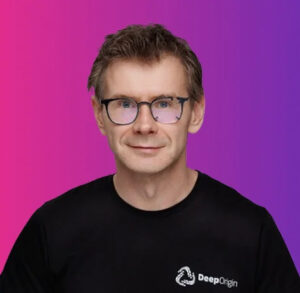
Michael Antonov, co-founder of Oculus and Deep Origin [Deep Origin]
On the visualization side, for displayed molecules, there’s a company that has done a great job of allowing you to look at the molecules, and this could be useful for research. That said, it just gives you more spatial perception. It doesn’t actually solve the problem for you.
On the training side, there are potentially huge benefits, even though you would then have to require investing a lot in software to make it actually perform well. Now, one good example is, I have invested in this company called Osso VR, which does training for knee replacement surgery, and they actually practiced it, and they did a study where their surgeons trained with their knee replacement and got 230% more proficiency.
Given the time and the accuracy of a procedure and the speed of how they learn. But to me, that felt actually very incredible that it’s actually being used. I think they also do nursing trade trainings and such. Those are probably the top areas that will probably be more brain-oriented cognitive things you could do. It would just take time to explore it.
IPM: What will AI’s impact be on medicine and healthcare?
Antonov: I think that there is still a lot of uncertainty. The system is overloaded. There’s a whole spectrum, and the challenge is that there are hundreds of different companies and projects with a whole different range of funding.
For pharma, it would be a big job to sift through what is actually good and what will help me take my target forward. That’s a challenge because there’s a lot more noise and there are some really good companies, but there are also many me-too, not-so-great ones. There are also certain fundamental areas that haven’t been solved yet, like toxicity and other issues, although there has been progress in some areas. There are like dozens of predictors, but they’re not necessarily super great, though they’re better than nothing. It’s hard to tell where it’s going. The biggest thing is to see what you actually prove in the lab.
The other thing is that there is a range of medicinal chemists and other knowledgeable people who haven’t been exposed to the breakthroughs or effects we might see on our side. AI may surprise us in certain biological parts of the name for certain problems. Now, more holistically at Deep Origin, our plan is to support the discovery process for small molecule drugs and have predictable outcomes.
IPM: How will AI drive the future of precision medicine?
Antonov: The super exciting way it could look in 20 years in that type of timeframe is that we are starting to get personalized medicine. You’re really combining the patient and the system model so that whenever you have a disease, if you have maybe a novel genomic mutation or if you have a new virus, you can literally put the data into the system.
Here is basically experimental data about whatever you collect from the virus. I don’t know if you get the structure of its protease from crystallography. I will even tell you here are the steps you need to take and which lab to run them in. But once you provide it, the system will be able to decompose the pathways and targets it’s affecting and then identify the specific concentrations you might need for these patients.
Essentially, you can provide a target in just a few months. You have good candidates, and these candidates have a much higher probability of not being toxic and having good admin properties. Let’s say we are moving from 90% failure rate to maybe 60%. That would be a huge job. That’s what the toxicity models enable, though they are hard because they need both experimental and data collection. But actually, even things like physics can help with counter screening, asking, what are all these things we should not bind to? Go and check them computationally. This whole stack basically gives you data on how to run your trial. That’s ten years. But then you level it up with populations and the individual.
This is a 2030 year outlook because then you’re pulling in the genomics data, maybe various things, and this is where the industry really becomes much more powerful and individualized. To do that, you really need these more detailed models.
IPM: Do you have a prediction about a current AI trend that will be around for a while?
Antonov: One of the hot topics right now is the idea of AI scientists. In our case, we have an AI discovery engine. We actually did this earlier, which is this area grant from the U.K. for picking up the disease, which can be fully drugged by AI.
We ran our AI scientist system to pick a target for endometriosis. It uses our tools to come up with a molecule. It’s currently in progress, and it did a very detailed breakdown and analysis of hundreds of targets based on very specific criteria, and I picked a particular one with all the reasons.
It’s interesting to make those kinds of tools and this whole pipeline available to almost everyday people because then, much like some genomics tools, an available AI system, which can support the full path of drug development, can in fact let a patient or an interest group just come in and take lots of steps in the direction of saying, “Here’s either maybe an RNA or a gene therapy or a drug that can serve.”
That would be a huge step toward democratizing it. It doesn’t mean that AI will do all the steps for us, but it doesn’t mean that it can do a lot of the known steps, which have been done many times and can help us along the way. Of course, the real scientist will still be very critical to all the parts.
For general accessibility, this automation that is happening and these kinds of simulation tools and large language models in general are incredible. They’ve got a little bit of a long-winded thing, but I wanted to reflect on what you said.
IPM: What are the pros and cons of building Deep Origin in the U.S. or China?
Antonov: Some of the more recent wisdom that I’ve heard is that if you want to survive in the U.S. or more expensive countries, you need to be taking bigger risks, and you need to be more innovative in how you approach the type of modalities and things. So that’s one line of thinking.
Another way is to be distributed. In our case, a big part of our AI/ML team is in Armenia. My co-founder is Armenian. We have 40 people there. I have just come from spending a week and a half with the team there for model building and science. There is an AI, and there are definitely people in all of the areas. Automated labs could also probably be in any country.
In terms of the actual trials, it depends on the situation. There are certain things that it’s probably wiser to do in China for this time being, but also maybe India will be up and coming, and if there are certain scenarios where there are more rare diseases, it’s probably okay to also not stay in the States.
There’s no perfect answer. We have a challenging environment. At the end of the day, you have to have something really valuable and novel to keep going forward. They have really great scientific research there too. We have to be careful and just really go at it hard.
IPM: Where does China stand out from the United States in terms of pharmaceutical research and development?
Antonov: If I were to pick one area, it’s the cost of clinical trials and the way we select just all the aspects of this. And to be honest, I’m not an expert in this. And clearly there’s a lot of progress in China right now. Everybody talks about how it’s much more cost-effective and quicker to do things there. There are a lot of “right to try” opportunities that are helping.
That said, I believe that we can have a lot better kinds of social programs around this to make it like easier for people to participate and maybe take more highly educated guesses and risks. There’s software infrastructure to simplify and reduce the cost. That would be amazing. In some of those areas, AI also can help, and the models actually can help.
IPM: If you could work on anything, what would it be?
Antonov: I would say focusing on aging as a disease. If you look at the funding, things could shake up the type of research that the NIH and the National Institute on Aging (NIA) do, which is really fundamental to our biology because it drives the majority of diseases and has 3% of the budget, whereas oncology and Alzheimer’s have huge budgets. There’s probably more impact in aging than probably some other well-funded areas if we look at the fundamental parts. That would be a big area where you can have a multiplier effect just from the research side.
To really build an ecosystem of better computational and AI models, maybe creating some way to actually incentivize people to contribute to them, because that’s the challenge right now. You can publish a research paper, or you can build your model to make your proprietary hidden drug. But we need scientists to share those in an integrated way. How do we do that?
Maybe it’ll take some big AI companies to jump into it and do something there. But it’s not going to be solved with just a model. It really needs to be a true experiment-grounded framework where researchers can contribute their part and have it be a part of a whole.
This is today’s edition of The Download, our weekday newsletter that provides a daily dose of what’s going on in the world of technology.
Claude Science is Anthropic’s newest flagship product
At an event for pharmaceutical executives, biotech founders, and researchers yesterday, Anthropic announced Claude Science, a major new product intended to support scientific research like Claude Code supports software engineering.
Like Claude Code, Claude Science can autonomously carry out meaningful work from concise, high-level instructions, with tools for computational biology and drug development. The launch signals that Anthropic is doubling down on AI for science, and the company will also use the product in its own research into drugs for rare, neglected diseases.
Why California’s carbon manure math doesn’t add up
Something stinks in California’s climate policies.
Years ago, the state set up a system that pays cattle farmers to turn the methane emitted from cattle manure into natural gas. It’s become wildly popular because the subsidies are extremely lucrative. But research suggests the program exposes the shortcomings of carbon offsetting and trading schemes.
Instead of forcing industries to directly cut their pollution or pay for it as a cost of doing business, legislators have opted for incentives that swap climate responsibilities between parties and regions. The system could ultimately lock in more warming.
This story is from The Spark, our weekly climate tech newsletter. Sign up to receive it in your inbox every Wednesday.
Watch now: longevity’s next frontier—“reprogramming” your body
Billions of dollars are pouring into efforts to reverse aging as scientists investigate ways to return cells to a younger state. But how close are these experimental treatments? And are they likely to work?
MIT Technology Review Narrated: the search for dark matter has been blown wide open
For decades, physicists have hunted for weakly interacting massive particles (WIMPs), a leading candidate for dark matter. But their search has run into a new problem: neutrinos.
These tiny particles from the sun and other stars can create a “neutrino fog” that drowns out any signal of dark matter. Hitting the neutrino fog does not, however, mean an end to the search. Researchers just have to shift the focus of their hunt.
They’re now casting a much wider net. New proposals include quantum sensors, liquid-helium detectors, and even searches in Jupiter’s atmosphere.
—Dan Garisto
This is our latest story to be turned into an MIT Technology Review Narrated podcast, which we publish each week on Spotify and Apple Podcasts. Just navigate to MIT Technology Review Narrated on either platform, and follow us to get all our new content as it’s released.
The must-reads
I’ve combed the internet to find you today’s most fun/important/scary/fascinating stories about technology.
1 The US has lifted restrictions on Anthropic’s Mythos and Fable models Anthropic said it would begin restoring access today. (NYT $) + The US had imposed controls over security concerns. (Bloomberg $) + It lifted the restrictions after lengthy talks with Anthropic. (BBC) + But the crackdown has already opened doors for Chinese AI rivals. (CNBC)
2 The most detailed survey of the universe ever is now underway It’s using the largest digital camera on Earth. (New Scientist $) + The project is based at the Vera C. Rubin Observatory in Chile. (NYT $) + It aims to transform our view of the cosmos. (MIT Technology Review)
3 Tech talent is fleeing the US due to H1-B visa chaos They’re eyeing relocation to Canada, the UK, or the Gulf. (Rest of World) + While China is poaching AI talent from the US. (CNBC) + Visa rules are also affecting young scientists. (MIT Technology Review)
4 Trump raked in more than $1 billion from crypto businesses in 2025 He reported $635 million in royalties from a Trump meme coin. (BBC) + The rest largely came from his World Liberty Financial venture. (The Hill)
5 The UN warns that the rapid spread of AI may worsen global inequality It’s proposed a shared framework for responsible AI development. (Guardian)
6 Companies are making LLMs talk like a caveman to curb AI spending A senior OpenAI employee contributed to the “caveman” project. (404 Media)
7 Babies are born with the neural foundations for math Brain recordings have identified the mechanisms. (New Scientist $)
8 An independent studio has bought the OpenAI movie Amazon dropped Neon has purchased “Artificial,” which focuses on Sam Altman. (NYT $) + Amazon had dumped it after investing in OpenAI. (Gizmodo) + The depiction of Altman is reportedly unsympathetic. (Variety)
9 AI has re-created Gene Wilder’s voice for a new “Willy Wonka” series Wilder’s wife said his estate is “delighted” with the new show. (NBC News) + Netflix partnered with AI company ElevenLabs on the project. (The Verge)
10 NASA aims to send a spare Mars rover—and soccer ball—to the moon The nuclear-powered “Promise” may help establish a lunar base. (NYT $)
AI is dreaming up drugs that no one has ever seen. Now we’ve got to see if they work.
On average, it takes more than 10 years and billions of dollars to develop a new drug. A growing number of startups are betting that AI can make the process faster and cheaper.
By predicting how potential drugs might behave in the body and discarding dead-end compounds before they leave the computer, machine-learning models can cut down on the need for painstaking lab work.
Yet it is still early days for AI drug discovery. A lot of AI companies are making claims they can’t back up—and the technology is not a panacea. But the technology is beginning to move from promise to practice.
High-altitude hypobaric hypoxia poses a significant threat to brain function, yet effective neuroprotective strategies remain limited. Emerging evidence highlights the microbiota-gut-brain axis (MGBA) as a key mediator in high-altitude-induced cognitive impairment, positioning it as a potential therapeutic target. This review synthesizes current knowledge on how high-altitude exposure dynamically reshapes gut microbial ecology, characterized by reduced diversity, phylum-level instability, and functional metabolic shifts. Furthermore, we delineate how such altitude-induced dysbiosis has been associated with neural dysfunction through interconnected pathogenic mechanisms that are proposed to link gut ecology to brain outcomes: intestinal barrier disruption with metabolic dysregulation, LPS/TLR4-mediated neuroinflammation, vagal and enteric nervous system alterations, oxidative stress imbalance, and neuroendocrine dysregulation. Most current evidence is correlational, and further research is needed to establish causality. A critical unresolved question is whether short-term, transient gut dysbiosis at high altitude can instigate long-lasting neurological deficits independent of ongoing microbial perturbation. We further evaluate microbiota-targeted neuroprotective strategies, including probiotics, prebiotics, and fecal microbiota transplantation, highlighting their distinct mechanisms and summarizing the current evidence supporting MGBA-targeted interventions for high-altitude brain health. Preclinical studies suggest these approaches hold promise by restoring barrier integrity, attenuating inflammatory signaling, and rebalancing microbial metabolite profiles, while human intervention evidence remains scarce. Finally, we discuss critical challenges and future directions for translating these mechanistic insights into personalized interventions, emphasizing deeper mechanistic exploration and the synergistic interactions among microbial taxa. These insights may inform more effective therapeutic strategies for the growing populations residing in or traveling to high-altitude regions.
Alzheimer’s disease (AD) is a progressive neurodegenerative disorder, and magnetic resonance imaging (MRI) has become an important tool for its auxiliary diagnosis because it can reveal key structural abnormalities, including hippocampal and parahippocampal atrophy, ventricular enlargement, temporal cortical degeneration, and gray matter loss. However, reliable stage-aware classification remains challenging because current methods are still limited in handling weak anatomical boundaries, low-contrast lesions, subtle inter-stage differences, and the semantic gap between neuroimaging features and clinical descriptions. To address these issues, we propose AFCG-Net, a diagnosis-guided and frequency-aware cross-modal network for joint MRI-text diagnosis. The framework consists of three stages: anatomy-guided visual encoding, cross-modal semantic alignment, and gated fusion with anatomical priors. Specifically, ASFG enhances visual representations through multi-scale modeling and low frequency-guided refinement, CASF strengthens the consistency between clinical semantics and imaging features, and AGDF performs anatomy-guided deep fusion to improve both discriminability and interpretability. Experiments on a combined cohort of 4,197 original MRI-text samples, including 2,106 self-collected samples and 2,091 ADNI samples, show that AFCG-Net achieves Precision, Recall, and F-score values of 96.3%, 96.5%, and 95.8%, respectively. The proposed method achieves the best results in the Mild dementia and Moderate dementia categories, while also showing stronger performance in the more challenging Non-dementia and Very Mild dementia categories. These results suggest that AFCG-Net provides an effective and interpretable multimodal solution for AD-assisted diagnosis.
Diabetic retinopathy (DR) is a leading cause of blindness characterized by early neurovascular damage driven by hyperglycemia-induced mechanisms, including inflammation. The system composed of the urokinase-type plasminogen activator (uPA) and its receptor (uPAR) has previously emerged as a potential regulator of the pro-inflammatory events in DR, possibly through the interaction of uPAR with its lateral partners, such as formyl peptide receptors (FPRs). This study explored whether the inhibition of uPAR/FPR1 crosstalk may reduce early neurovascular alterations in DR by targeting inflammation. To this aim, the new FPR1 antagonist N-19004 was tested in a rat model of streptozotocin-induced diabetes. N-19004 was administered subcutaneously for 7 days at 1 month from diabetes onset. Immunofluorescence, RT-qPCR, Western blot and Evans blue perfusion were performed to evaluate the effects of N-19004 on inflammation, reactive gliosis, blood-retinal barrier (BRB) integrity and apoptosis. In addition, electroretinogram (ERG) was used to assess N-19004 efficacy on retinal function. N-19004 inhibited the activation of inflammation-related transcription factors, including nuclear factor kappa-light-chain-enhancer of activated B cells and signal transducer and activator of transcription 3, leading to reduced interleukin-1β and tumor necrosis factor-α expression. The attenuation of inflammatory processes resulted in reduced glial activation, as indicated by lower glial fibrillary acidic protein expression and Müller cell gliosis. The anti-inflammatory activity of N-19004 was accompanied by decreased BRB breakdown, as demonstrated by N-19004-mediated reduction of vascular endothelial growth factor, increased levels of tight junction components and diminished vessel leakage. The amelioration of BRB integrity was associated with reduced activation of caspase 3 and partial preservation of scotopic ERG a- and b-wave amplitudes, thereby improving retinal viability and function in N-19004-treated STZ rats. These results support the possible involvement of uPAR/FPR1 interactions in the regulation of DR-related inflammation and suggest a novel therapeutic target for the management of the early phases of disease.
Bruxism is a multifactorial motor behavior of predominantly central origin, characterized by repetitive masticatory muscle activity and associated with dysregulation of dopaminergic, serotonergic, GABAergic, and glutamatergic pathways involved in motor control, emotional regulation, and stress responsivity. The endocannabinoid system (ECS) has emerged as a key homeostatic neuromodulator capable of integrating these neurotransmitter systems, thereby influencing pain processing, sleep–wake dynamics, and motor output. This article develops a neurobiological hypothesis based on a narrative integrative synthesis of clinical, experimental, and translational evidence regarding ECS involvement in the pathophysiology of bruxism. Findings from randomized clinical trials suggest that topical cannabidiol (CBD) may modulate motor neuron excitability and reduce pain-related outcomes, while case-based and experimental evidence supports the interaction between cannabinoid signaling and neural circuits implicated in motor control and behavioral regulation. Building on this evidence, we propose a hypothesis-driven translational model in which ECS-mediated neuromodulation may influence central mechanisms underlying bruxism, including motor pattern generation, stress responsivity, and nociceptive processing. Rather than providing prescriptive therapeutic recommendations, this model is intended as a hypothesis-generating construct that integrates current knowledge on ECS signaling within the broader neurobiology of motor control. Although heterogeneity in study design and outcome measures limits definitive conclusions, the available evidence supports the ECS as a plausible modulatory system in bruxism, with potential implications for future mechanistic and clinical research in centrally mediated motor disorders.