Sponsors: Nanyang Technological University; Agency for Science, Technology and Research (A*STAR); KK Women’s and Children’s Hospital; Institute for Human Development and Potential (IHDP), Singapore
WASHINGTON — Federal health officials said Monday they remain focused on lettuce from Taylor Farms as the source of a multistate outbreak of a diarrhea-causing parasite, despite inaccurate test results that the government briefly publicized over the weekend.
Food and Drug Administration officials on Monday said a laboratory test incorrectly identified a positive result for cyclospora on a sample of lettuce from Taylor Farms. The FDA posted the finding to its website on Saturday but then said Sunday that the result had been a false positive.
Background: Empathic communication in the clinical setting has been associated with improved clinical outcomes, decreased anxiety, and increased patient satisfaction, treatment adherence, and trust. Despite the recent growth in patient portal use, the expression of empathic communication through patient portal secure messages is not well understood. Objective: This study aimed to construct a coding schema to define and assess empathic opportunities initiated by patients and primary care clinicians’ responses to these opportunities within a patient portal messaging environment. Methods: Data for this study included adult patient secure messages and responding messages from clinicians working in family practice clinics within a regional health care system serving central and northeast Pennsylvania between January 2018 and December 2023. We conducted a manual review of messages using the Empathic Communication Coding System as a guiding framework, which defines empathic opportunities created by patients and corresponding empathic responses by clinicians. We double-coded 500 patient messages for 3 empathic opportunity types: statements of emotion, progress, and challenge. Coding definitions were iteratively updated to describe specific textual cues unique to the patient portal context. This procedure was repeated to code for empathy in clinician responses to empathic opportunities. An additional 100 patient messages were double-coded for interrater reliability testing, and 500 patient messages were single-coded using the finalized coding schema. Results: Among 1100 patient messages coded, 576 (52.4%) included an empathic opportunity. Of these messages, 100 (17.3%) included a statement of emotion, 85 (14.7%) included a statement of progress, and 539 (93.6%) included a statement of challenge. Statements of challenge were primarily characterized by patients explicitly describing physical or mental health issues, a barrier in care, or difficulties in their personal lives. Among the 576 patient messages with empathic opportunities, 446 (77.4%) received at least 1 response from a clinician. Clinicians sent 483 response messages, of which 64 (13.2%) expressed empathy. Conclusions: While patients created empathic opportunities in over half of patient portal secure messages, primary care clinicians infrequently responded with empathy. The findings of this study provide initial evidence of gaps in empathic communication within patient portal secure messages and lay the groundwork for using artificial intelligence models to systematically measure and improve this communication across the patient portal messaging system.
<img src="https://jmir-production.s3.us-east-2.amazonaws.com/thumbs/b25d0804a4d183367c4b91a44f24e0f8" />
Alzheimer’s disease (AD) and many other forms of neurodegeneration share a common culprit. In these diseases, tau proteins that normally stabilize neuronal microtubule filaments within nervous system networks instead form noxious knots and gradually disrupt the circuits they would otherwise preserve.
Scientists at Sanford Burnham Prebys have now shown that a different protein known as SORLA offers protection against the effects of these lethal loops. The results of the researcher’s’ study in mice suggests that future research may yield new treatments capable of boosting this protein’s ability to defend the brain.
Timothy Huang, PhD, assistant professor in the Center for Neurologic Diseases at Sanford Burnham Prebys, is senior and corresponding author of the team’s published paper in Science Advances, titled “SORLA up-regulation suppresses pathological effects in aged tauopathy mouse brain,” in which they concluded “These findings reveal a protective role for SORLA in multiple aspects of tauopathy pathogenesis and highlight its potential as a therapeutic target.”
Normally, tau proteins are found throughout the brain and nervous system, helping to maintain the shape and structure of our neuronal wiring. But in certain diseases, including Alzheimer’s disease, tau proteins clump together inside nerve cells, forming what are known as tau tangles. These toxic tangles are linked to cognitive impairment and nerve cell death in diseases known as tauopathies. “In AD, amyloid-β (Aβ) plaques and neurofibrillary tangles (NFTs) comprising hyperphosphorylated tau accumulate in brain,” the authors explained.
The new study focused on the safeguarding capabilities of protein known as SORLA. “A role for the trafficking receptor SORLA (Sortilin-related receptor containing LDLR class A repeats) in reducing Aβ levels has been well established,” the investigators continued. “… however, relatively little is known with respect to whether and how SORLA can potentially affect tau pathology in vivo.”
Timothy Huang added, “In the last 15 or 20 years, considerable data has come out from our lab and other groups showing that SORLA can suppress one of the hallmarks of Alzheimer’s disease—amyloid-beta generation and accumulation. Very little was known, however, about whether SORLA affected the tau tangles reflected on the other side of the coin in Alzheimer’s disease.”
SORLA is expressed in both neurons and glia in mouse and human brain, the authors noted. For their newly reported study the team began by crossbreeding mice that produce extra human SORLA protein, with PS19 (P301S) mice that develop tau tangles, brain atrophy and cognitive deficits. This new mouse model enabled experiments to determine SORLA’s effects on tau protein buildup and its resulting harms.
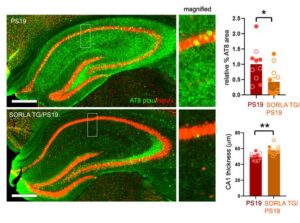
Their studies showed that an overabundance of SORLA protein protected against a number of biological processes linked to the formation of tau tangles and progression of neurodegeneration. These include reducing the addition of too many phosphate groups to tau—known as hyperphosphorylation—and the ability of misshapen tau to serve as “seeds” that attract more tau and form clumps. This protection also extended to preservation of the synapses at the junction between neurons and the brain’s ability to adjust these connection points—which is called synaptic plasticity. “Using complementary approaches, we show that SORLA overexpression attenuates ventricular enlargement, tau phosphorylation and seeding, synaptic loss, impaired synaptic plasticity, and glial hyperactivation in the PS19 mouse brains,” the team wrote in summary.
An overabundance of SORLA protein protects against a number of biological processes linked to the formation of tau tangles and progression of neurodegeneration. These include reducing the addition of too many phosphate groups to tau, known as hyperphosphorylation. In these biopsy images, less phosphorylated tau—stained to appear green—has accumulated in the bottom sample overexpressing SORLA. [Tim Huang, Huijie Huang, Sanford Burnham Prebys]
“When you upregulate SORLA, you can suppress the negative effects found in tauopathies,” said first author Huijie Huang, PhD, a staff scientist in the Huang lab at Sanford Burnham Prebys. “We found there was less brain atrophy and less tau accumulation, which was very exciting to see.”
Because some people have mutations that disable the gene carrying the code for SORLA, Sorl1, the scientists wanted to compare the outcome of having extra SORLA to having none of it at all. Tests of mice genetically modified to lack Sorl1 told a very different story. “The opposite turned out to be true when we deleted the ability to produce SORLA proteins,” said Timothy Huang. “A lack of SORLA exacerbated the harmful effects observed in tauopathies.”
To address how extra SORLA or a lack of SORLA were either ameliorating or aggravating diseases featuring tau tangles, the research team used a combination of sequencing techniques capturing the levels of all proteins and gene expression in each cell, as well as mapping the spatial relationship of RNA and proteins within brain tissue. The scientists found that upregulated SORLA prevented problematic protein production changes in the synapses between neurons while also suppressing other drivers of tauopathy disease progression. They also observed that extra SORLA tamped down on disease-related gene expression patterns in brain cells known as glial cells that support and protect neurons in many ways. “One particularly notable finding that we can build on is the upregulation of a member of the plexin-B family of receptors in the absence of SORLA,” said Huijie Huang.
“There are unique drugs that can target this class of receptors that we may be able to apply to tau-related dementia disorders,” suggested Tim Huang. “One potential future direction is to repurpose these drugs to target overactivation of glial cells and perhaps reverse some of the phenotypes in tauopathies.”
The scientists also want to better understand what happens in each individual cell type when they upregulate or downregulate SORLA. “While it is not possible to specifically determine how cell-specific modulation of SORLA can affect tau using the global transgenic overexpression/deletion models used here, we are interested in further characterizing specific effects of SORLA on tau in neurons, and the extent of SORLA modulation on glia in influencing overall tau pathology,” they stated. The team plans to graft human neurons or glial cells into the mouse brain to study the effects of different SORLA mutations.
“Mouse cells and human cells are different,” said Tim Huang. “Because we’re looking at human disease, it’s more informative if we can observe the modulation and dysfunction of SORLA in the context of a human cell inside of a diseased brain environment.”
This continued research will reveal more knowledge about the ability of SORLA to safeguard against the toxic effects of tau tangles, and how to develop new treatments or repurpose existing therapies to benefit patients suffering from Alzheimer’s disease and other tau-related dementia disorders.
This story originally appeared in The Algorithm, our weekly newsletter on AI. To get stories like this in your inbox first, sign up here.
Over the weekend, several current and former advisors to President Donald Trump on AI publicly lobbed insults at the country’s leading AI companies. David Sacks, the president’s AI and crypto “czar” until March, branded Anthropic’s models as “lobotomized” and “woke.” Emil Michael, a top Pentagon official, called OpenAI’s new head of strategic futures a “supreme village idiot.”
It began because no one can agree on what to do about Kimi, a free, open source model that Chinese AI company Moonshot launched last week. It appears to rival the intelligence of models from OpenAI and Anthropic, which are very much not free.
Kimi and other Chinese models like it pose a real problem for Trump. And they’re dividing the top AI strategists in his orbit into factions. Every time a new smart, free model from China like Kimi gets released, US companies see less reason to fork out money to access models from Anthropic or OpenAI. Given that enthusiasm for these and other AI companies is driving an outsized share of economic growth, China’s AI models create both economic and political problems for the president. They are “a threat for an administration that really doesn’t want more economic bad news,” Anton Leicht, a fellow at the Carnegie Endowment, wrote on X. They’ve already rattled US stocks.
What is Trump to do? First, consider that this is all happening just a week after New York imposed the country’s first state ban on new data centers. There is growing distrust of AI companies, and I imagine a not-insignificant share of Americans would have little sympathy for OpenAI or Anthropic as they fend off cheaper competitors, and would say it’s not the government’s job to protect their interests.
On this point, they’d see a sliver of agreement (and really just a sliver) with David Sacks, who on July 19 criticized top AI companies that “want the government to eliminate their open source competition.” He has also argued that Chinese AI models have become popular because they come with fewer restrictions on how people can use them (putting aside the built-in state censorship).
Sacks, however, is out of a job. He no longer has a formal role advising Trump, and his position that more open AI is better has been largely replaced in the administration by one that sees a larger role for government intervention. The thinking behind this view is that because AI models have gotten strong enough to pose threats to national security, the government must control how they’re used.
This position has fueled the new White House review process that aims to vet AI models’ security before they’re released. Dean Ball, a former Trump AI advisor who now works for OpenAI, criticized it over the weekend as a “de facto licensing regime for frontier AI.” Ball predicted Trump may solve his Chinese open source problem with a bit of soft power, perhaps by making US companies afraid to use models like Kimi. That drew a response from Michael, who, with Secretary of Defense Pete Hegseth, has been the agency’s main liaison with AI companies. Michael called Ball the AI industry’s “supreme village idiot,” bristling at the suggestion that the government would quietly strong-arm companies rather than, as Michael put it, go through “the democratic process not some Deep State scheme.”
Left out of the conversation has been how a model like Kimi got so good in the first place.For much of the Biden administration and even the beginning of Trump’s second administration, keeping China from getting top chips was a priority. Those export controls have loosened—Trump made the controversial decision to allow Nvidia to sell more chips to China, in exchange for the US government taking a cut—and the government has alleged that some chip smuggling has taken place. But China nonetheless has limited computing power, and it’s not clear what chips the company behind Kimi used to train the model.
It’s possible that the process involved some distillation, a practice in which AI models are trained on the outputs of existing AI models. OpenAI and Anthropic have long complained that Chinese AI companies do this, and they have requested government help to put a stop to it. In April, they got it, when the Trump administration announced a series of efforts to curb the practice.
But Kimi is out there and free, and it is nearly as good as the Anthropic model the US government deemed so powerful that it was briefly shut down because it threatened national security. The weekend’s sparring suggests many in Trump’s orbit see that as a wake-up call. But nobody can agree on what for.
This is the online version of STAT’s weekly email newsletter Health Care Inc. Sign up here.
Hello, everyone! I’ve seen upwards of 50,000 public comments on proposed health care regulations, but the 200,000 comments (!) on the SEC’s proposal to eliminate quarterly financial reports is jaw-dropping. Yes, a lot of them seem like automated templates from interest groups, but still. Some poor soul has to sift through them. I’d like to see you try to send 200,000 comments here (please don’t): bob.herman@statnews.com.
Site-Neutral Milk Hotel
The most consequential policy in Medicare’s recent outpatient rule is the cuts to drugs that hospitals get under the 340B discount program. But the Centers for Medicare and Medicaid Services subtly doubled down on another major policy that hospitals loathe.